Writing And City Life- Source Based Type Questions | Famous Books for UPSC Exam (Summary & Tests) PDF Download

1. Read the following extract carefully and answer the following question by choosing the correct option:
The connection between city life, trade and writing is brought out in a long Sumerian Epic poem about Enmerkar, one of the earliest rulers of Uruk. In Mesopotamian tradition, Uruk was the city par excellence, known simply as The City.
Enmerkar is associated with the organisation of the first trade of Sumer: in the early days, the Epic says, ‘trade was not known’. Enmerkar wanted lapis lazuli and precious metals for the beautification of a city Temple and sent his messenger out to get them from the chief of a very distant land called Aratta. ‘The Messenger heeded the word of the king. By night he went just by the stars. By day, he would go by Heaven’s Sun divine. He had to go up into the mountain ranges, and had to come down out of the mountain range. The people of Susa (a city) below the mountains saluted him like tiny mice. Five mountain ranges, six mountain ranges, seven mountain ranges he crossed...’
Q1: “Uruk was the city par excellence”, which of the following statements justifies it?
(a) Uruk was a prosperous city
(b) Uruk had many temples
(c) Enmerkar wanted lapis lazuli and precious metals for the beautification of a city Temple
(d) Both (a) and (b)
Option (c) is correct
Mesopotamians had to fight wars from time to time against pastoralists and nomadic communities of the Western desert and thus, the cities destroyed in war; yet they recalled them in their epics namely Gilmesh and Enmerkar. These are in long poems. The former epic says that the ruler of Uruk Enmerkar wanted lapis lazuli and precious metals for the beautification of a city temple and had sent his messenger to Aratta, a distant country but he could not convince the ruler of Aratta, he frequently went there and came back to the king. At last, the message was communicated through a letter inscribed on a clay tablet.
Q2: “The people of Susa below the mountains saluted him like tiny mice.” What did the poet mean?
(a) The people of Susa were like mice
(b) The people of Susa were very short in height
(c) Once the messenger had climbed to a great height, everything appeared small
(d) All of these
Option (c) is correct
Once the messenger had climbed to a great height, everything appeared small.
2. Read the following extract carefully and answer the following question by choosing the correct option:
City life began in Mesopotamia, the land between the Euphrates and the Tigris rivers that is now part of the Republic of Iraq. Mesopotamian Civilization is known for its prosperity, city life, its voluminous and rich literature and its mathematics and astronomy. Mesopotamia's writing system and literature spread to the Eastern Mediterranean, Northern Syria and Turkey after 2000 BCE, so that the kingdoms of that entire region were writing to one another and the Pharaoh of Egypt, in the language and script of Mesopotamia. At the beginning of recorded history, the land, mainly the urbanized South, was called Sumer and Akkad. After 2000 BCE when Babylon became an important city, the term Babylonia was used for the southern region. From about 1100 BCE when the Assyrians established their Kingdom in the north, the region became known as Assyria. The first known language of the land was Sumerian. It was gradually replaced by Akkadian around 2400 BCE when Akkadian speakers arrived. This language flourished till about Alexander time 336 - 323 BCE with some regional changes occurring. From 1400 BCE Aramaic also trickled in.
Q3: What does Mesopotamia mean?
(a) The land between two mountains.
(b) The land between two valleys.
(c) The land between two rivers.
(d) The land on plateau.
Option (c) is correct
Mesopotamia is a historical region of Western Asia situated within the Tigris–Euphrates river system, in the northern part of the Fertile Crescent. It occupies the area of present-day Iraq, and parts of Iran, Turkey, Syria and Kuwait.
Q4: The term Babylonia was used for?
(a) Unurbanized Southern Region.
(b) Urbanized Southern Region.
(c) Urbanized Northern Region.
(d) Southern region
Option (d) is correct
Southern region.
Q5: According to the extract Mesopotamian Civilization is known for?
(a) City Life
(b) Rich Literature
(c) Prosperity
(d) All of these
Option (d) is correct
CITY life began in Mesopotamia*, the land between the Euphrates and the Tigris rivers that is now part of the Republic of Iraq. Mesopotamian civilisation is known for its prosperity, city life, its voluminous and rich literature and its mathematics and astronomy.
3. Read the following extract carefully and answer the following question by choosing the correct option:
Today Mesopotamian excavators have much higher standards of accuracy and care in recording than in the old days, so that few dig huge areas the way Ur was excavated. Moreover, few archaeologists have the funds to employ large teams of excavators. Thus, the mode of obtaining data has changed.
Take the small town of Abu Salabikh, about 10 hectares in area in 2500 BCE with a population of less than 10000. The outlines of walls were at first traced by scrapping surfaces. This involves scraping off the top few millimetres of the mound with the sharp and wide end of a shovel or other tool. While the soil underneath was still slightly moist, the archaeologist could make out different colours, textures and lines of bricks, walls pits or other features. A few houses that were discovered were excavated. The archaeologist also sieved through tons of earth to recover plant and animal remains, and in the process identified many species of plants and animals and found large quantities of charred fish bones that had been swept out onto the streets. Plant seeds and fibre remained after dung cake had been burned as fuel and thus kitchens were identified. Living rooms were those with fewer traces. Because they found the teeth of very young pigs on the streets, archaeologists concluded that pigs must have roamed freely here as in any other Mesopotamian town. In fact, one house burial contained some pig bones - the dead person must have been given some pork for his nourishment in the Afterlife. The archaeologist also made microscopic studies of room floors to decide which rooms in a house were roofed (with popular logs, Palm leaves, straw etc.) and which were open to the sky.
Q6: Why did Mesopotamian excavators have much higher standards of accuracy?
(a) The procedure involves scraping off the top few millimetres of the mound with the sharp and wide tool.
(b) A few archaeologists employed large teams of excavators to carry out excavation work.
(c) The mode of obtaining data was different.
(d) All of these.
Option (d) is correct
The procedure involves the scraping off the top few millimeters of the mound with the sharp and wide and of a shovel or other tools. The digging work was carefully carried out with high standards for accuracy. A few archaeologists employed large team of excavators to carry out excavation work. The mode of data collecting was totally different.
Q7: How the kitchens were identified by the archaeologist during the excavation of Abu Salabikh?
(a) By the plant and animal remains.
(b) By new varieties and species of plants and animals.
(c) Large quantities of charred fish bones that had been swept out onto the streets.
(d) Plant seeds and fibre remained after dung cake had been burned as fuel.
Option (d) is correct
Plant seeds and fibre remained after dung cake had been burned as fuel.
4. Read the following extract carefully and answer the following question by choosing the correct option:
However rich the food resources of Mesopotamia, its mineral resources were few. Most parts of the South lacked stones for tools, seals and jewels; the wood of the Iraqi Date Palm and poplar was not good enough for carts, cartwheels boats; and there was no metal for tools, vessels or ornaments. So, we can summarise that the ancient MeMesopotamiansould have traded their abundant textiles and agricultural produce for wood, copper, tin, silver, gold, shells and various stones from Turkey and Iran, or across the Gulf. These latter regions had mineral resources, but much less scope for agriculture. Regular exchange - possible only when there was a social organisation - to equip foreign expeditions and direct the exchange was initiated by the people of Southern Mesopotamia.
Study the extract and answer the following question:
Q8: Assertion (A): Mesopotamian mineral resources were few
Reasons (R): Mesopotamians could have traded their abundant textile and agricultural produce for wood, copper, tin, silver, gold and shells from Turkey and Iran.
(a) Both (A) and (R) are correct and (R) is a correct explanation of (A)
(b) Both (A) and (R) are correct and (R) is not a correct explanation of (A)
(c) (A) is correct and (R) is not a correct explanation of (A)
(d) (A) is not correct and (R) is not a correct explanation of (A)
Option (a) is correct
However rich the food resources of Mesopotamia, its mineral resources were few. Most parts of the south lacked stones for tools, seals and jewels; the wood of the Iraqi date-palm and poplar was not good enough for carts, cart wheels or boats; and there was no metal for tools, vessels or ornaments. So we can surmise that the ancient Mesopotamians could have traded their abundant textiles and agricultural produce for wood, copper, tin, silver, gold, shell and various stones from Turkey and Iran, or across the Gulf. These latter regions had mineral resources, but much less scope for agriculture. Regular exchanges – possible only when there was a social organisation – to equip foreign expeditions and direct the exchanges were initiated by the people of southern Mesopotamia
Q9: Which of the following is true in context with Mesopotamia?
(a) Mesopotamia did not have metals for tools, vessels or ornaments
(b) The wood of the Iraqi Date Palm and poplar was not good enough for cartscartwheelsls or boats
(c) Both (a) and (b)
(d) None of these
Option (a) is correct
Most parts of the south lacked stones for tools, seals and jewels; the wood of the Iraqi date-palm and poplar was not good enough for carts, cart wheels or boats; and there was no metal for tools, vessels or ornaments.
Q10: Name the things that were lacking in Mesopotamian cities.
(a) Tools
(b) Seals
(c) Jewels
d) All of these.
Option (d) is correct
However rich the food resources of Mesopotamia, its mineral resources were few. Most parts of the south lacked stones for tools, seals and jewels; the wood of the Iraqi date-palm and poplar was not good enough for carts, cart wheels or boats; and there was no metal for tools, vessels or ornaments.
5. Study this picture of Clay Tablet used by Mesopotamians carefully and answer the following questions by choosing the correct option:
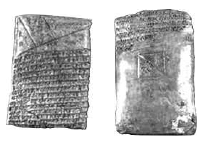
Q11: Mesopotamians wrote on tablets of clays.
(a) The above statement is True.
(b) The statement is partially True.
(c) The above statement is False.
(d) None of these
Option (a) is correct
Mesopotamians wrote on tablets of clay. Hear this out loud In Mesopotamia, writing began as simple counting marks, sometimes alongside a non-arbitrary sign, in the form of a simple image, pressed into clay tokens or less commonly cut into wood, stone or pots. The clay tablet was thus being used by scribes to record events happening during their time.
Q12: Mesopotamia is widely known due to;
(a) Records of Literature and Poetry
(b) Availability of sources including clay tablets in abundance.
(c) Availability of records in English.
(d) All of the above.
Option (b) is correct
Availability of sources including clay tablets in abundance.
Q13: The Clay tablet depicts a picture of:
(a) A Poetry written by Mesopotamians.
(b) A mathematical exercise with triangles and lines.
(c) A science experiment.
(d) A secret document with codes.
Option (b) is correct
A mathematical exercise with triangles and lines.
6. Read the following extract carefully and answer the following question by choosing the correct option:
Mesopotamians valued city life in which people of many communities and cultures lived side by side. After cities were destroyed in the war, they recorded them in poetry.
The most ignorant reminder to us of the pride Mesopotamians took in their City came at the end of Gilgamesh Epic, which was written on twelve tablets. Gilgamesh is said to have ruled the city of Uruk sometime after Enmerkar. A great hero who subdued people far and wide, he got a shock when his heroic friend died. He then set out to find the secret of immortality, crossing the water that surrounds the world. After a heroic attempt,t Gilgamesh failed and returned to Uruk. There he consoled himself by walking along the city wall, back and forth. He admired the foundation made of fired bricks that he had put into place. It is on the city wall of Uruk that the long tail of heroism and endeavour fizzles out. Gilgamesh does not say that even though he would die his sons would outlive him, as a tribal hero would have done. He consolidated the city that his people had built.
Q14: How did Mesopotamians recall their cities?
(a) They recall them in their painting.
(b) They recall them in their songs.
(c) They recall them in their poetry.
(d) They recall them in their stories.
Option (c) is correct
They recall them in their poetry.
Q15: Consider the following statement:
(i) While moving narratives can be transmitted orally.
(ii) Science requires written text that a generation of scholars can read and build upon.
(a) Both (a) and (b) are correct.
(b) Only (b) is correct.
(c) Only (a) is correct.
(d) Both (a) and (b) are wrong.
Option (a) is correct
Both (a) and (b) are correct.
|
744 videos|1444 docs|633 tests
|
FAQs on Writing And City Life- Source Based Type Questions - Famous Books for UPSC Exam (Summary & Tests)
| 1. What are the advantages of city life? |  |
| 2. What are the disadvantages of city life? | |
| 3. How does living in a city impact one's social life? | |
| 4. Is it better to raise children in the city or countryside? | |
| 5. How can one cope with the challenges of city life? | |





Free
,Writing And City Life- Source Based Type Questions | Famous Books for UPSC Exam (Summary & Tests)
,Semester Notes
,Previous Year Questions with Solutions
,video lectures
,study material
,Writing And City Life- Source Based Type Questions | Famous Books for UPSC Exam (Summary & Tests)
,ppt
,Objective type Questions
,Extra Questions
,Sample Paper
,shortcuts and tricks
,past year papers
,Important questions
,Viva Questions
,mock tests for examination
,Summary
,Exam
,practice quizzes
,Writing And City Life- Source Based Type Questions | Famous Books for UPSC Exam (Summary & Tests)
,MCQs
,



Writing And City Life- Source Based Type Questions Free PDF Download
Importance of Writing And City Life- Source Based Type Questions
Writing And City Life- Source Based Type Questions Notes
Writing And City Life- Source Based Type Questions UPSC
Study Writing And City Life- Source Based Type Questions on the App
|
© EduRev
|
Education Revolution
|


|




within 7 days!