The Preposition


Prepositions play an essential role in showing relationships between words in a sentence, especially in expressing time, place, and direction. Among these, for, by, from, and on are some of the most frequently used prepositions in English. Each has specific uses and meanings that help convey accurate information.
Use of Prepositions "For"
For is used to express the duration or definite length of time something continues. It answers the question "How long?".
Common time expressions with for include: for four days, for three months, for two years, for a long time, for several days, for a short time, for a little while. Examples:
- I have lived in this house for two years.
- He stayed away from office for a week.
- For how long had he been absent from duty?
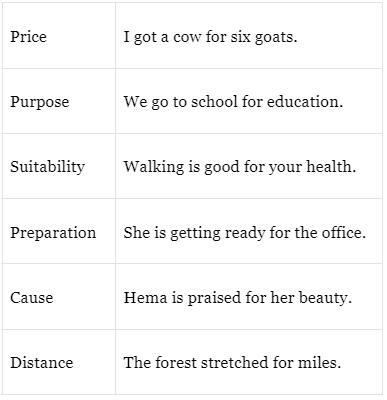
Note: For is used with periods of time (minutes, hours, days, months, years, etc.) and with non-specific durations such as a long time or a while.
Contrast with "since": Use since to indicate the starting point of an action that continues up to the present (for example, since 2018, since Monday). Use for to state how long the action has lasted (for example, for three years).
Use of Prepositions "By"
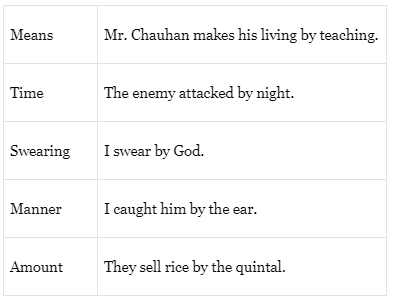
By has several common uses in English. These are the most important ones for students to remember:
- Deadline or latest time: to show that something must be finished before a particular time or no later than that time. Example: Please submit the form by Friday.
- Agent in the passive voice: to indicate who performed the action. Example: The novel was written by her.
- Means or method: to show how something is done. Example: We travelled by train.
- Close proximity or next to: to indicate position. Example: She stood by the window.
- Time close to a given point: to mean "not later than" or "around" in some contexts. Example: He will arrive by noon.
Note: By is not used to express duration; use for or since for that purpose.
Use of Prepositions "From"
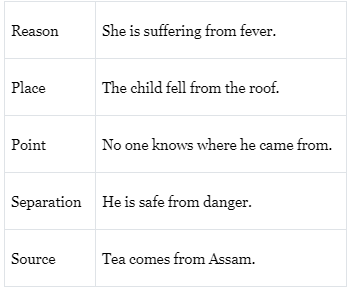
From is used to indicate origin, starting point in space or time, or a range between two points.
- Origin (place): She came from Delhi.
- Starting point in time: The course runs from January to March.
- Range or separation: Temperatures range from 10°C to 20°C.
- Source or cause: He suffered from a fever.
Note: When indicating the period during which something happens, from is often paired with to or until (from Monday to Friday, from 9 am until 5 pm).
Use of Prepositions "On"
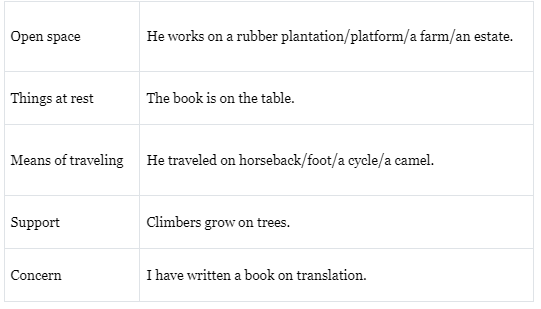
On is commonly used for days and dates, and for parts of days when we refer to a named day or a date with a specific event. It is used to indicate something that happens during the course of a day or on a particular surface.
- Specific day or date: on Monday, on 15 July, on my birthday.
- Parts of certain days: on Sunday morning, on Sunday evening, on Christmas evening.
- Day or date with descriptive phrase: on the morning of the 15th, on the night of June 22, 2020.
- Surface or position: The book is on the table.
Note: Use in for longer periods, such as months or years (in June, in 2020), and on for particular days or dates.
Common Errors and Tips
To avoid common mistakes, remember these simple checks:
- Ask "how long?" - if the answer is a duration, use for.
- Ask "when did it start?" - if the answer names a starting point (a date or time), use since or from.
- Ask "by what time?" - if it is a deadline, use by.
- Ask "where from?" or "origin?" - use from.
- Ask "which day or date?" - use on.
Practice Sentences
Fill in the blanks with for, by, from, or on:
- I have been studying here ___ three years.
- The assignment is due ___ Monday.
- She returned ___ the market at noon.
- The meeting is scheduled ___ the evening of 10th March.
Answers:
- for
- by
- from
- on
Summary
Use for to express duration, by for deadlines, agents and means, from for origin and starting points, and on for days, dates and surfaces. Remember the contrasts (for vs since, on vs in) to choose the correct preposition in context.
FAQs on The Preposition
| 1. What is the importance of prepositions in the English language? |  |
| 2. Can you provide some common examples of prepositions used in everyday language? | |
| 3. How can prepositions change the meaning of a sentence? | |
| 4. Are there any fixed rules for using prepositions in English? | |
| 5. How can I improve my understanding and usage of prepositions? | |