Notes: Aims & Objectives of science | Science & Pedagogy Paper 2 for CTET & TET Exams - CTET & State TET PDF Download

Introduction
While starting to work on any mission it is essential to think before working towards the motives and purposes of understanding that mission. Consequently, the work on this machine is always planned in view of the various advantages anticipated to be drawn through it. The same holds good for the study of a particular subject. Without knowledge of aim, the educator is like a sailor who does not know his destination and the young learner is like rudderless vessel drifting ashore.
According to John Dewey, an aim is a foreseen and which give direction to certain activities or motivates human behaviour.
The aims of teaching Science
- to provide the broader objectives of science that is process skill knowledge curiosity etc.
- to encourage and enable students to develop inquiring minds and curiosity about science and nature.
- to acquire knowledge, conceptual understanding, and skills to solve problems and make informed decisions in scientific contexts.
- to develop skills of scientific inquiry to design and carry out scientific investigations and evaluate scientific evidence to draw conclusions
- to communicate scientific ideas, arguments, and practical experiences accurately in a variety of ways
- to think analytically, critically and creatively to solve problems, judge arguments and make decisions in scientific and other contexts
- to appreciate the benefits and limitations of science and its application in technological developments
- to understand the nature of science and the interdependence of science, technology, and society including the benefits, limitations, and implications imposed by social, economic, political, environmental, cultural and ethical factors
- to demonstrate attitudes and develop values of honesty and respect for themselves, others, and their shared environment.
The advantages that can be drawn for purposes that can be served by the study of that subject generally become the aim of its study. In order to proceed for the realization of aim or broader purpose, these are usually divided into some definite functional and workable units named as objectives. These objectives may be termed as short-term goals that may be achieved within the specific limited resources and time by a subject teacher. They can be easily evaluated to the expected behavioural changes or learning outcomes. In this way, objectives are the ways and means of achieving the aim in a more practical and definitely. The aim of teaching science may thus be broken into some specified objectives for providing definite learning experiences to bring desirable behavioural changes. Objectives of science teaching may provide certain well defined short-term purposes are tasks before a science teacher at the time of teaching a particular topic for providing a particular type of learning experience.
An objective is an intent communicated by a statement describing a proposed change in the learner a statement of what the learner is to like when he has successfully completed a learning experience. It is a description of a pattern of behaviour or performance we want the learner or student to be able to demonstrate.
As per UNESCO Planning Commission (1964), the teaching of science objectives should be worked on the problems of science education in India and suggested ways to improve it.
According to Kothari Commission (1964- 66), the science education is in bad shape and it becomes worse if we fail to reckon with the exclusion of knowledge to meet his immediate feet the recommended upgrading School curricula by research in curriculum development the division of the textbook and teaching-learning material.
Difference between Objectives and Aims
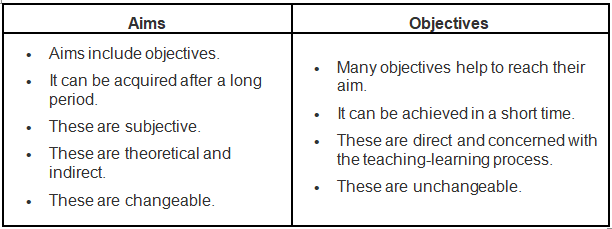
Objectives of general Science teaching at a Primary Stage
- To provide practical knowledge of the subject matter content.
- to provide the latest knowledge to develop scientific knowledge scientific appreciation and scientific temper among the students.
- to encourage them to learn about nature to develop the love for nature and to try to conserve the natural resources and prevent pollution.
- to develop the scientific attitude and to use it for the development works to have open-mindedness two objective decision making critical thinking a desire for accurate knowledge who developed the skill of experimentation.
Objectives of teaching at a Secondary Stage
- To work according to the students' science method and developed scientific views.
- To impart the knowledge to the students about the world, the importance of Science and its effects on society and its environment and give them the knowledge of the role of the environment so that learners can utilize the correct methods of the uses of the environment.
- To use scientific method i.e. problem, hypothesis, experiment, a conclusion in decision making.
- To develop the competency to apply his knowledge to the solution of the problems around him he or she has an understanding of the technological processes so that he or she can use it in his or her surrounding.
- He or she should develop desirable scientific attitudes and values like cooperation, team, spirit, fellow feeling, leadership, courage, truthfulness, honesty, and sincerity.
Instructional Objectives
- Teachers accept the general objectives in the form of desired goals but his or her goals are not clear and not helpful in teaching for removing these demerits classify the human behaviour in 1948 which are related to student’s behavioural change.
- A teacher has to make some definite and specific objectives of a particular lesson, unit or subunit of the subject like science before the teaching-learning process for attending within a specified classroom period and resources and in hand through these so specific classroom teaching-learning objectives known as instructional objectives.
- A teacher tries to bring desired changes in the behaviour of students so the term instructional objectives are defined as a group of statements formulated by the teacher for describing what the students are expected to do all will be able to do once the process of classroom instruction is over.
- In fact, instructional outcomes are the teaching-learning product in the form of behavioural changes in the students that a teacher expects as a result of his or her instruction related with a particular lesson, unit or subunit of the subject.
- instructional objectives are the descriptions of the students terminal behaviour expected out of the ongoing classroom instruction.
Relationship of instructional objectives with general Aims and Objectives
- In comparison to the general aim and objectives of teaching biological science instructional objectives are quite narrow and specific.
- Both are definite, precise, functional and tangible.
- Both are predetermined.
- They must be predictable
- They are therefore termed as teaching-learning objectives for behavioural objectives the main purpose of these objectives is to provide statements of skills, concepts or behaviour students are expected to demonstrate after going through particular instruction.
- They are more specific and defined than the general circles but less specific and much wider than the classroom instructional objectives.
- Their attainment is quite possible within the educational structure and means.
|
35 videos|145 docs|32 tests
|




Notes: Aims & Objectives of science | Science & Pedagogy Paper 2 for CTET & TET Exams - CTET & State TET
,study material
,Semester Notes
,Notes: Aims & Objectives of science | Science & Pedagogy Paper 2 for CTET & TET Exams - CTET & State TET
,Summary
,MCQs
,Sample Paper
,video lectures
,practice quizzes
,Exam
,Previous Year Questions with Solutions
,past year papers
,Important questions
,ppt
,Viva Questions
,shortcuts and tricks
,mock tests for examination
,Notes: Aims & Objectives of science | Science & Pedagogy Paper 2 for CTET & TET Exams - CTET & State TET
,Free
,Objective type Questions
,Extra Questions
;




Notes: Aims & Objectives of science Free PDF Download
Importance of Notes: Aims & Objectives of science
Notes: Aims & Objectives of science
Notes: Aims & Objectives of science CTET & State TET Questions
Study Notes: Aims & Objectives of science on the App
|
© EduRev
|
Education Revolution
|


|




