Revision Notes: Teaching Aids | Science & Pedagogy Paper 2 for CTET & TET Exams - CTET & State TET PDF Download
| Table of contents |

|
| Introduction |
|
| A Need for Teaching Aids |
|
| Types of Teaching Aids |
|
| Selection of Teaching Aids |
|

Introduction
Teaching is most effective when it engages multiple senses, making learning both meaningful and enjoyable. Teaching aids play a crucial role in this process by transforming abstract ideas into concrete experiences, helping students grasp concepts with clarity.
According to Kothari Commission, “The supply of teaching aids to every school is essential for the improvement of the quality of teaching.
According to Froebel, "Our lesson ought to start from the concrete and end in the abstract.”
According to Comenius , "Our teaching may be purposeful only when we use more pictures in our books. He was of the view that knowledge is gained through different senses. In audio-visual aids, eye and ear work together."
The National Policy on Education has laid great stress on the use of teaching aids, especially improvised aids, to make teaching-learning more effective and realistic.
A Need for Teaching Aids
- Proper use of teaching aids helps to retain concepts permanently.
- Students can learn better when they are motivated properly through different teaching aids.
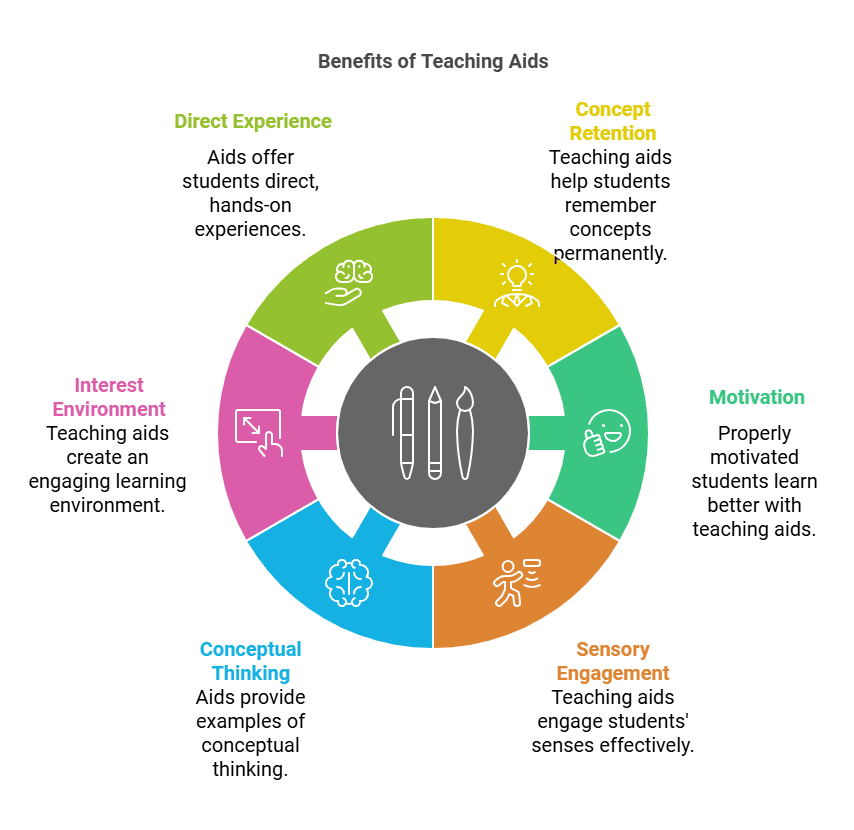
- Teaching aids develop the proper image when the students see, hear, taste and smell properly.
- Teaching aids provide a complete example of conceptual thinking.
- The teaching aids create an environment of interest for the students.
- Teaching aids provide direct experience to the students.
Types of Teaching Aids
Teaching aids are essential tools in the teaching-learning process, helping to make abstract concepts more concrete and facilitating better understanding among students. These aids can be classified into various types based on the senses they engage.
- Visual Aids: The aids which use a sense of vision are called Visual Aids. For example actual objects, models, pictures, charts, maps, flashcards, flannel boards, bulletin boards, chalkboards, overhead projectors, slides etc.

- Audio Aids: The aids that involve the sense of hearing are called Audio aids. For example- radio, tape recorder, gramophone etc.
- Audio-Visual Aids: The aids which involve the sense of vision as well as hearing are called Audio-Visual aids. For example television, film projector, film strips, etc.
1. Visual Aids
These aids involve the use of the sense of hearing. These aids are also called audiology aids such as charts, models, slides, maps etc.(a) Black-Board
(b) Charts, Graphs, Diagrams, Models
Charts, graphs, diagrams, and models play a very important role in science teaching. With the help of the charts, the teacher can explain the various functions, topics, and information on science with ease. They help in creating a suitable subject atmosphere in the classroom and clarifying various difficult things.
(c) Film Strip
A film strip contains a series of still pictures of about 24 to 48 frames arranged in a sequence. Knowledge of various functions, discoveries and other information related to science can be imparted with the help of film strips. It may be used for large groups or individualized instruction, for introducing a unit or for teaching a lesson.
(d) Epidiascope
Epidiascope is a combination of episcope and diascope. With the epidiascope in the epi-position, flat opaque objects can be projected. In epidiascope, one 1000 watts lamp or one 500 watts lamp or two 500 lamps are used. There is a powerful blower cooling the lamp and directing a blast of air on the opaque object to be projected.
2. Audio Aids
By the use of this type of aid, the student gains knowledge through hearing. The use of audio aid students listen to the discoveries and scientific inventions and life histories of scientists and gain knowledge.
(a) Radio
Different types of educational programs are broadcasted through All India Radio. Talks of subject experts on some specific topics are also presented on the radio. Thus, these devices can effectively be used as teaching aid.
(b) Tape-Recorders
Sound recording and playback equipment play an important role in a well-rounded teaching program. Many audio experiences that contribute to student growth and development are the result of proper utilization of equipment that serves a variety of purposes at all ages and levels of learning the specific use of the recording and playback equipment should be determined by the individual instructor.
(c) Wire Recorder
In this recorder, a sound may be recorded on a wire approximately five-thousandths of an inch in diameter. The most commonly used spools are the hour, % hour and one-hour sizes. One of the outstanding advantages of wire recording is that it will not only play back the recording as frequently as desired but it may also be used over and over again for other programmes simply by ‘erasing’ the previous program. The wire spools are compact and may easily be stored for future use.
3. Audio-Visual Aids
Multi-Sensory Learning – Audio-visual aids engage both sight and hearing, allowing students to see, listen, and retain key learning points effectively.
Precision and Clarity – These aids should present information in a clear, real, and understandable manner; otherwise, their effectiveness is diminished.
Significance in Science Teaching – Science teachers benefit greatly from these aids as they help simplify complex formulas, theories, and relationships, enhancing students' understanding.
Improvement in Teaching Methods – The use of audio-visual tools allows teachers to refine their instructional techniques, making lessons more engaging and effective.
Retention of Information – The principle behind their effectiveness is:
What I hear, I may forget.
What I see, I am more likely to remember.Facilitating Communication – These tools serve as mediums for effective idea exchange in teaching and training environments.
Crow & Crow’s View – Audio-visual aids provide learners with indirect experiences, helping them understand events, objects, relationships, and cause-effect connections.
Need and Importance of Audio-Visual Aids
- The use of audio-visual aids enables the teachers to follow the maxims of teaching as, concrete to abstract, know to unknown and learning by doing.
- It develops a scientific attitude in the students.
- It creates interest in the students.
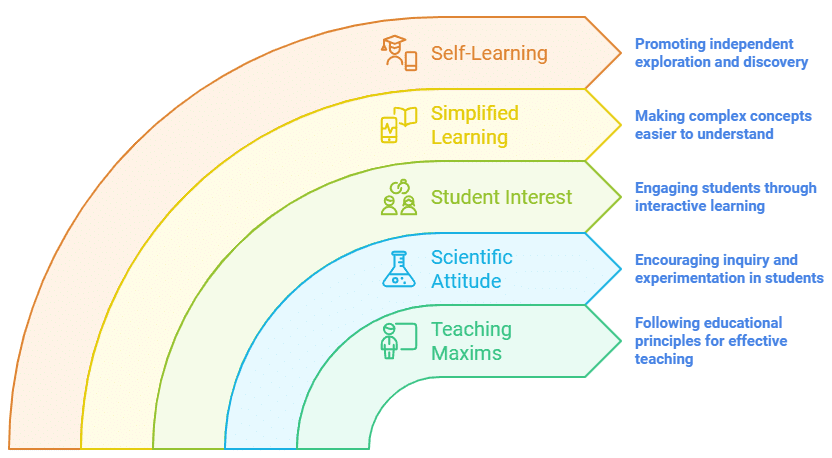
- It makes the teaching-learning process simple and interesting.
- Audio-visual aids promote self-learning and constructiveness in the students.
- Many visual aids offer opportunities for students to handle and manipulate things.
- They develop curiosity towards an exploration of various subjects
Thus, teaching aids influence the minds of the learners through their senses.
Selection of Teaching Aids
Teaching aids serve as essential tools for educators, assisting in achieving the desired teaching-learning objectives. A teacher must select and utilize appropriate teaching aids that best suit a given instructional situation. When choosing teaching aids, especially in science education, the following principles should be considered:
- Relevance – The selected aid must directly relate to the topic being taught.
- Suitability – It should effectively enhance understanding by making learning comprehensive, engaging, and impactful.
- Educational Value – The aid should provide significant educational benefits beyond just entertainment, stimulating students' interest and motivation.
- Effective Substitute for First-Hand Experience – It should closely replicate real-life experiences with accuracy and authenticity.
- Learner-Centered – The aid should align with students' age, grade level, interests, instincts, and overall learning needs.
- Simplicity – It should be easy to construct, use, and understand, ensuring clear communication of concepts.
- Environment-Centered – The aid must be relevant to the students' physical, social, and cultural surroundings.
- Practicality – It should be chosen based on available resources, affordability, and feasibility for classroom use. Factors such as weather conditions, institutional facilities, and ease of handling should also be considered.
- Objective-Oriented – The aid must contribute effectively to achieving the intended learning goals of the lesson.
By adhering to these principles, teachers can ensure the selection of teaching aids that enhance the learning experience and make lessons more effective and engaging.
|
35 videos|145 docs|32 tests
|
FAQs on Revision Notes: Teaching Aids - Science & Pedagogy Paper 2 for CTET & TET Exams - CTET & State TET
| 1. What are teaching aids and why are they important for CTET and State TET exams? |  |
| 2. How can I effectively use teaching aids in my classroom? | |
| 3. What types of teaching aids are most commonly used in CTET and State TET? | |
| 4. How do teaching aids contribute to student learning outcomes? | |
| 5. What strategies can I use to evaluate the effectiveness of teaching aids in my lessons? | |



Previous Year Questions with Solutions
,Sample Paper
,practice quizzes
,Important questions
,Summary
,ppt
,study material
,mock tests for examination
,video lectures
,Extra Questions
,Revision Notes: Teaching Aids | Science & Pedagogy Paper 2 for CTET & TET Exams - CTET & State TET
,past year papers
,MCQs
,Revision Notes: Teaching Aids | Science & Pedagogy Paper 2 for CTET & TET Exams - CTET & State TET
,shortcuts and tricks
,Revision Notes: Teaching Aids | Science & Pedagogy Paper 2 for CTET & TET Exams - CTET & State TET
,Objective type Questions
,Free
,Exam
,Viva Questions
,Semester Notes
;




Revision Notes: Teaching Aids Free PDF Download
Importance of Revision Notes: Teaching Aids
Revision Notes: Teaching Aids
Revision Notes: Teaching Aids CTET & State TET Questions
Study Revision Notes: Teaching Aids on the App
|
© EduRev
|
Education Revolution
|


|




