CAT Previous Year Questions: Arrangements

From 2023 to 2025, CAT LRDI featured multiple arrangement and scheduling-based sets, typically 2-3 sets per year. These included circular seating arrangements, tournament structures, training schedules with constraints, and grid-based logical puzzles. Most sets were moderate to difficult, requiring structured case analysis, sequencing of moves, and careful deduction across multiple conditions.
2025
Q1 to Q4:
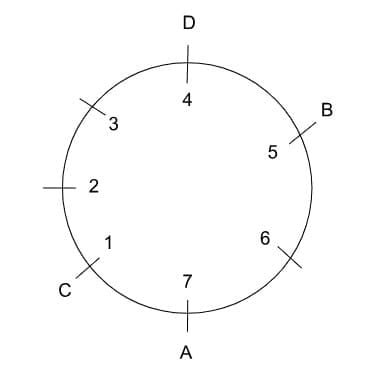
A round table has seven chairs around it. The chairs are numbered 1 through 7 in a clockwise direction. Four friends, Aslam, Bashir, Chhavi, and Davies, sit on four of the chairs. In the starting position, Aslam and Chhavi are sitting next to each other, while for Bashir as well as Davies, there are empty chairs on either side of the chairs that are sitting on.
The friends take turns moving either clockwise or counterclockwise from their chair. The friend who has to move in a turn occupies the first empty chair in whichever direction (s)he chooses to move. Aslam moves first (Turn 1), followed by Bashir, Chhavi, and Davies (Turns 2, 3, and 4, respectively). Then Aslam moves again followed by Bashir, and Chhavi (Turns 5, 6, and 7, respectively).
The following information is known
- The four friends occupy adjacent chairs only at the end of Turn 2 and Turn 6.
- Davies occupies Chair 2 after Turn 1 and Chair 4 after Turn 5, and Chhavi occupies Chair 7 after Turn 2.
Q1: What is the number of the chair initially occupied by Bashir?
Ans: 4
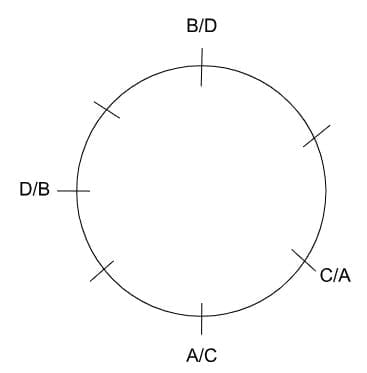
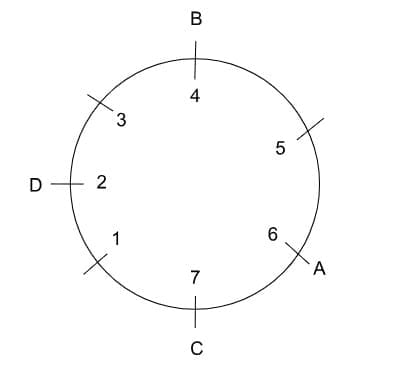
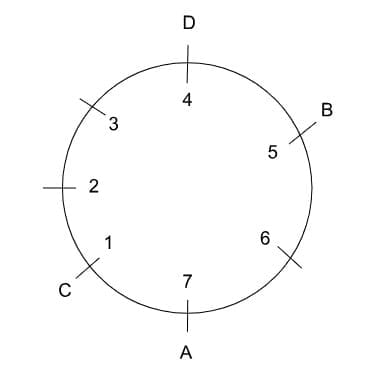
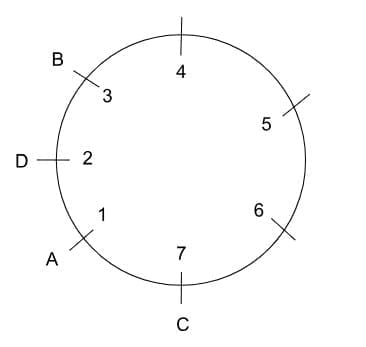
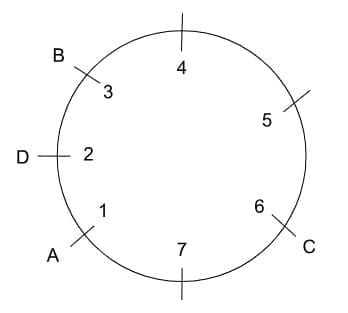
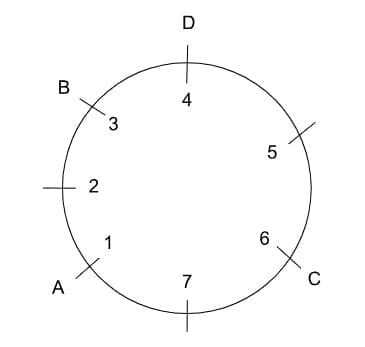
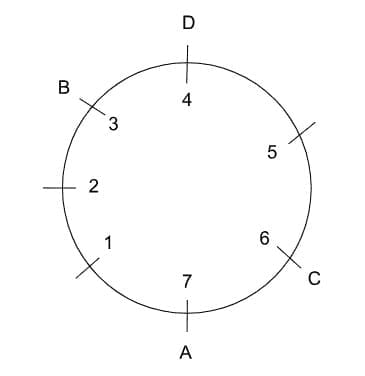
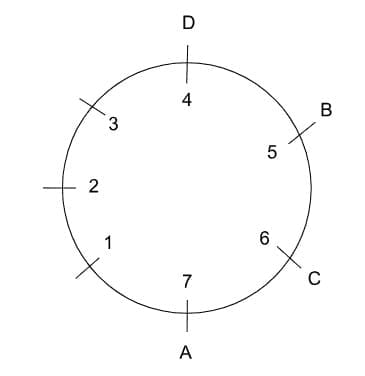
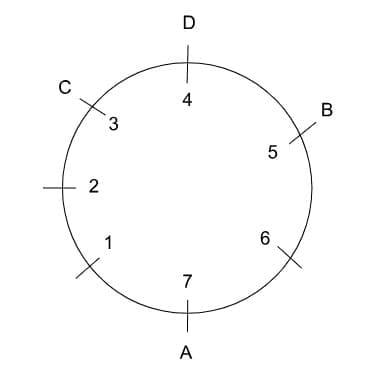
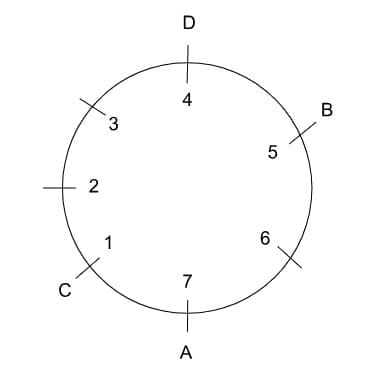
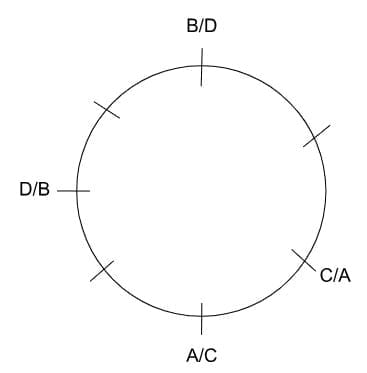
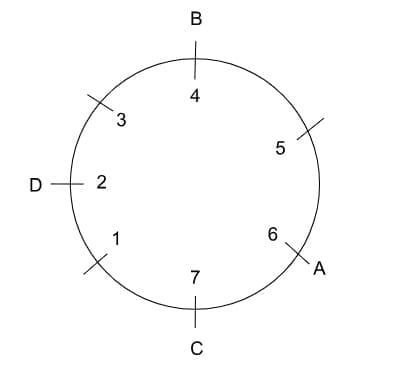
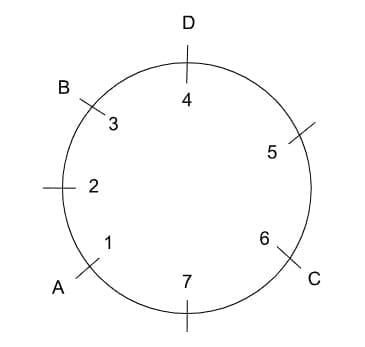
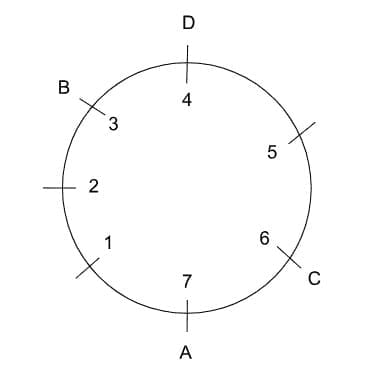
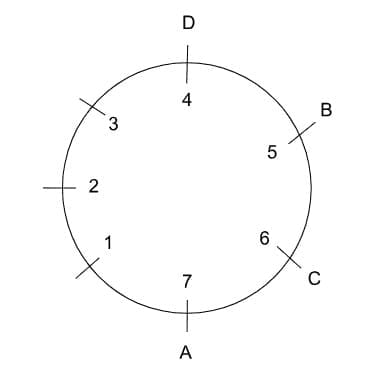
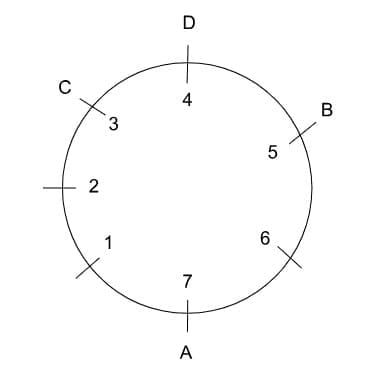
Sol: Based on the information about the initial positions of Aslam and Chhavi sitting next to each other, while Bashir and Davies have empty chairs on either side of their seats, the possible combinations are,This has 4 possible combinations.
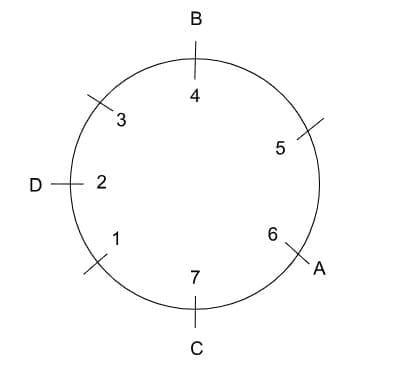
We are also given that Davies occupies Chair 2 after Turn 1 and Chhavi occupies Chair 7 after Turn 2. We know that the positions of Davies and Chhavi won't be changing after turn 2, as we know that in those turns, only the positions of Aslam and Bashir are being changed in the first 2 turns. Therefore, we can determine that Davies' initial position is chair 2, and Chhavi's initial position is chair 7.
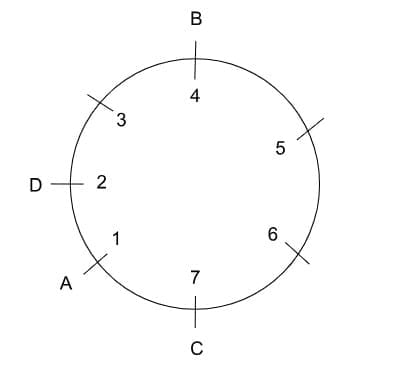
Out of the 4 possible combinations, Davies on chair 2 and Chhavi on chair 7 are only possible in one case, which is,
So, Bashir's initial position is chair 4.
Hence, the correct answer is 4.
Q2: Who sits on the chair numbered 4 at the end of Turn 3?
(a) Bashir
(b) Chhavi
(c) Davies
(d) No one
Ans: d
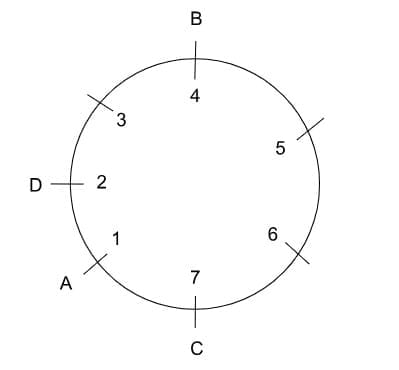
Sol: Based on the information about the initial positions of Aslam and Chhavi sitting next to each other, while Bashir and Davies have empty chairs on either side of their seats, the possible combinations are,
This has 4 possible combinations.
We are also given that Davies occupies Chair 2 after Turn 1 and Chhavi occupies Chair 7 after Turn 2. We know that the positions of Davies and Chhavi won't be changing after turn 2, as we know that in those turns, only the positions of Aslam and Bashir are being changed in the first 2 turns. Therefore, we can determine that Davies' initial position is chair 2, and Chhavi's initial position is chair 7.
Out of the 4 possible combinations, Davies on chair 2 and Chhavi on chair 7 are only possible in one case, which is,
We now have the initial position, and we are told that all the members are adjacent only after turn 2 and turn 6.
We know that A changed his position in turn 1.
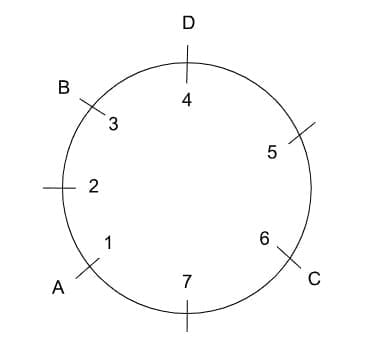
Turn 1: Aslam moves
If A changed his position anticlockwise, he would go to chair 5, and if he changed his position clockwise, he would go to chair 1.
If A ends in chair 5 after turn 1, then it is not possible for all of them to be adjacent to each other after B changes his position in turn 2.
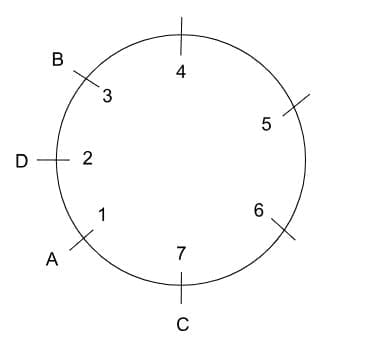
So, A has to end in chair 1 after turn 1, so that B will have a chance in turn 2 for all of them to be adjacent.
Turn 2: Bashir moves
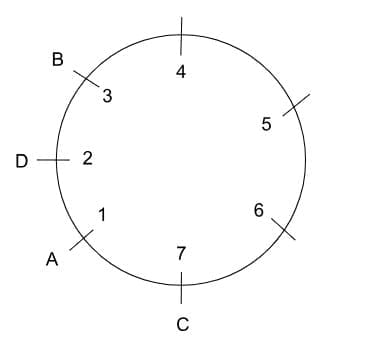
For all of them to be adjacent after turn 2, B must change his position anticlockwise, and after turn 2, he would end up on chair 3.
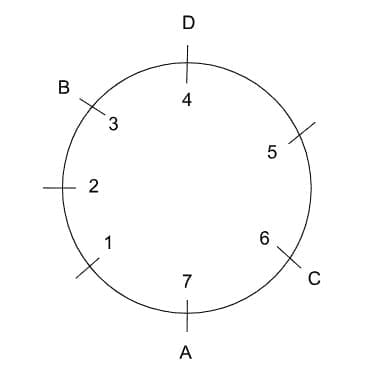
Turn 3: Chhavi moves
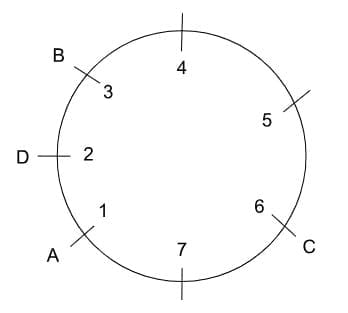
We are given that Davies occupies chair 4 after turn 5, and for this to happen, chair 4 must be empty and cannot be occupied by anyone who does not move before turn 5. So, in turn 3, C must go anticlockwise and occupy chair 6, as if he goes clockwise, he would occupy chair 4, which must be empty for Davies.
Turn 4: Davies moves
Davies will not move in turn 5, and for him to occupy chair 4 after turn 5, he must occupy it on turn 4. So, D has to go clockwise in turn 4 and must occupy chair 4.
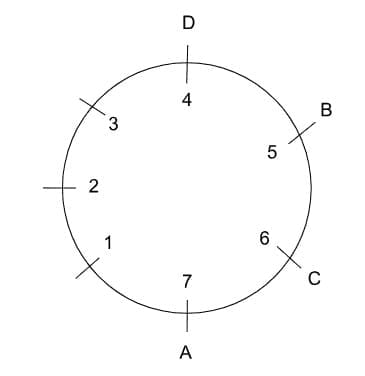
Turn 5: Aslam moves
We know that all of them are again adjacent after turn 6. If A goes clockwise in turn 5, then he will occupy the chair 2, and in that case, it is not possible for them to be adjacent after turn 6 in either of the cases of B going clockwise or anticlockwise.
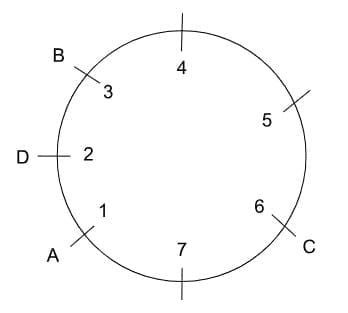
So, A must go anticlockwise and occupy chair 7 for them to be adjacent after turn 6.
Turn 6: Bashir moves
Now, for them to be adjacent after turn 6, B must go clockwise and must occupy chair 5.
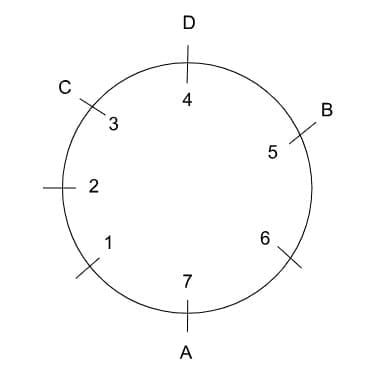
Turn 7: Chavvi moves
We do not have any information to determine whether C went clockwise or anticlockwise. So, both cases are possible after turn 7.
After turn 3, chair 4 is occupied by no one.
Hence, the correct answer is option D.
Q4: Which of the chairs are occupied at the end of Turn 6?
(a) Chairs numbered 4, 5, 6, and 7
(b) Chairs numbered 1, 2, 3, and 4
(c) Chairs numbered 2, 3, 4, and 5
(d) Chairs numbered 1, 2, 6, and 7
Ans: a
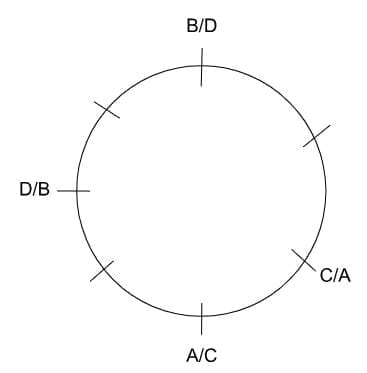
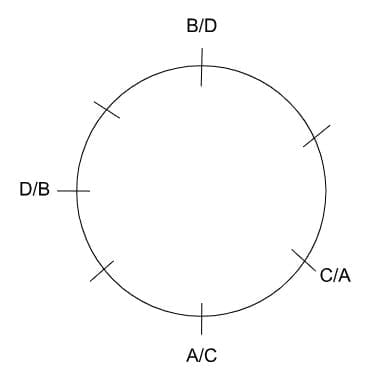
Sol: Based on the information about the initial positions of Aslam and Chhavi sitting next to each other, while Bashir and Davies have empty chairs on either side of their seats, the possible combinations are,
This has 4 possible combinations.
We are also given that Davies occupies Chair 2 after Turn 1 and Chhavi occupies Chair 7 after Turn 2. We know that the positions of Davies and Chhavi won't be changing after turn 2, as we know that in those turns, only the positions of Aslam and Bashir are being changed in the first 2 turns. Therefore, we can determine that Davies' initial position is chair 2, and Chhavi's initial position is chair 7.
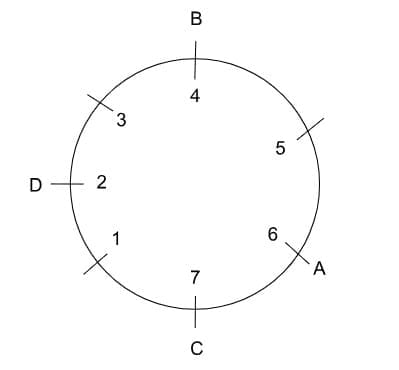
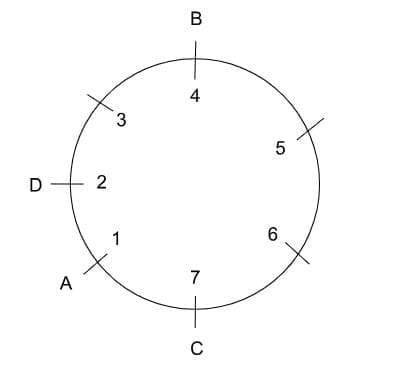
Out of the 4 possible combinations, Davies on chair 2 and Chhavi on chair 7 are only possible in one case, which is,
We now have the initial position, and we are told that all the members are adjacent only after turn 2 and turn 6.
We know that A changed his position in turn 1.
Turn 1: Aslam moves
If A changed his position anticlockwise, he would go to chair 5, and if he changed his position clockwise, he would go to chair 1.
If A ends in chair 5 after turn 1, then it is not possible for all of them to be adjacent to each other after B changes his position in turn 2.
So, A has to end in chair 1 after turn 1, so that B will have a chance in turn 2 for all of them to be adjacent.
Turn 2: Bashir moves
For all of them to be adjacent after turn 2, B must change his position anticlockwise, and after turn 2, he would end up on chair 3.
Turn 3: Chhavi moves
We are given that Davies occupies chair 4 after turn 5, and for this to happen, chair 4 must be empty and cannot be occupied by anyone who does not move before turn 5. So, in turn 3, C must go anticlockwise and occupy chair 6, as if he goes clockwise, he would occupy chair 4, which must be empty for Davies.
Turn 4: Davies moves
Davies will not move in turn 5, and for him to occupy chair 4 after turn 5, he must occupy it on turn 4. So, D has to go clockwise in turn 4 and must occupy chair 4.
Turn 5: Aslam moves
We know that all of them are again adjacent after turn 6. If A goes clockwise in turn 5, then he will occupy the chair 2, and in that case, it is not possible for them to be adjacent after turn 6 in either of the cases of B going clockwise or anticlockwise.
So, A must go anticlockwise and occupy chair 7 for them to be adjacent after turn 6.
Turn 6: Bashir moves
Now, for them to be adjacent after turn 6, B must go clockwise and must occupy chair 5.
Turn 7: Chavvi moves
We do not have any information to determine whether C went clockwise or anticlockwise. So, both cases are possible after turn 7.
The chairs occupied after turn 6 are 4, 5, 6 and 7.
Hence, the correct answer is option A.
Q4: Which of the following BEST describes the friends sitting on chairs adjacent to the one occupied by Bashir at the end of Turn 7?
(a) Chhavi only
(b) Davies only
(c) Chhavi and Davies
(d) Aslam and Chhavi
Ans: b
Sol: Based on the information about the initial positions of Aslam and Chhavi sitting next to each other, while Bashir and Davies have empty chairs on either side of their seats, the possible combinations are,
This has 4 possible combinations.
We are also given that Davies occupies Chair 2 after Turn 1 and Chhavi occupies Chair 7 after Turn 2. We know that the positions of Davies and Chhavi won't be changing after turn 2, as we know that in those turns, only the positions of Aslam and Bashir are being changed in the first 2 turns. Therefore, we can determine that Davies' initial position is chair 2, and Chhavi's initial position is chair 7.
Out of the 4 possible combinations, Davies on chair 2 and Chhavi on chair 7 are only possible in one case, which is,
We now have the initial position, and we are told that all the members are adjacent only after turn 2 and turn 6.
We know that A changed his position in turn 1.
Turn 1: Aslam moves
If A changed his position anticlockwise, he would go to chair 5, and if he changed his position clockwise, he would go to chair 1.
If A ends in chair 5 after turn 1, then it is not possible for all of them to be adjacent to each other after B changes his position in turn 2.
So, A has to end in chair 1 after turn 1, so that B will have a chance in turn 2 for all of them to be adjacent.
Turn 2: Bashir moves
For all of them to be adjacent after turn 2, B must change his position anticlockwise, and after turn 2, he would end up on chair 3.
Turn 3: Chhavi moves
We are given that Davies occupies chair 4 after turn 5, and for this to happen, chair 4 must be empty and cannot be occupied by anyone who does not move before turn 5. So, in turn 3, C must go anticlockwise and occupy chair 6, as if he goes clockwise, he would occupy chair 4, which must be empty for Davies.
Turn 4: Davies moves
Davies will not move in turn 5, and for him to occupy chair 4 after turn 5, he must occupy it on turn 4. So, D has to go clockwise in turn 4 and must occupy chair 4.
Turn 5: Aslam moves
We know that all of them are again adjacent after turn 6. If A goes clockwise in turn 5, then he will occupy the chair 2, and in that case, it is not possible for them to be adjacent after turn 6 in either of the cases of B going clockwise or anticlockwise.
So, A must go anticlockwise and occupy chair 7 for them to be adjacent after turn 6.
Turn 6: Bashir moves
Now, for them to be adjacent after turn 6, B must go clockwise and must occupy chair 5.
Turn 7: Chavvi moves
We do not have any information to determine whether C went clockwise or anticlockwise. So, both cases are possible after turn 7.
In either of the cases after turn 7, the seat adjacent to Bashir is occupied only by Davies, and the other one is empty.
Hence, the correct answer is option B.
Q5 to Q9:
Ananya Raga, Bhaskar Tala, Charu Veena, and Devendra Sur are four musicians. Each of them started and completed their training as students under each of three Gurus - Pandit Meghnath, Ustad Samiran, and Acharya Raghunath between 2013 and 2024, including both the years. Each Guru trains any student for consecutive years only, for a span of 2, 3, or 4 years, with each Guru having a different span. During some of these years, a student may not have trained under these Gurus; however, they never trained under multiple Gurus in the same year. In none of these years, any of these Gurus trained more than two of these students at the same time. When two students train under the same Guru at the same time, they are referred to as Gurubhai, irrespective of their gender.
The following additional facts are known.
- Acharya Raghunath did not train any of these students during 2015-2018, as well as during 2021-24.
- Ananya and Devendra were never Gurubhai; neither were Bhaskar and Charu. All other pairs of musicians were Gurubhai for exactly 2 years.
- In 2013, Ananya and Bhaskar started their trainings under Pandit Meghnath and under Ustad Samiran, respectively.
- Ustad Samiran never trained more than one of these students in the same year.
Q5: In which of the following years were Ananya and Bhaskar Gurubhai?
(a) 2020
(b) 2018
(c) 2021
(d) 2014
Ans: a
Sol: Representing Ananya Raga, Bhaskar Tala, Charu Veena, and Devendra Sur as A, B, C and D, respectively, for easy usage. Also using PM, US, and AR for Pandit Meghnath, Ustad Samiran, and Acharya Raghunath, respectively, for easy reference.
We are given that AR did not train during the periods of 2015-2018 and 2021-2024.
Other information provided is that PM, US, and AR had a span of 2, 3, and 4 consecutive years for each student, in some order. We also know that all the gurus trained each of the students for exactly one span.
In clue 4, we are given that A started the training in 2013 under PM, and B started training in 2013 under US.
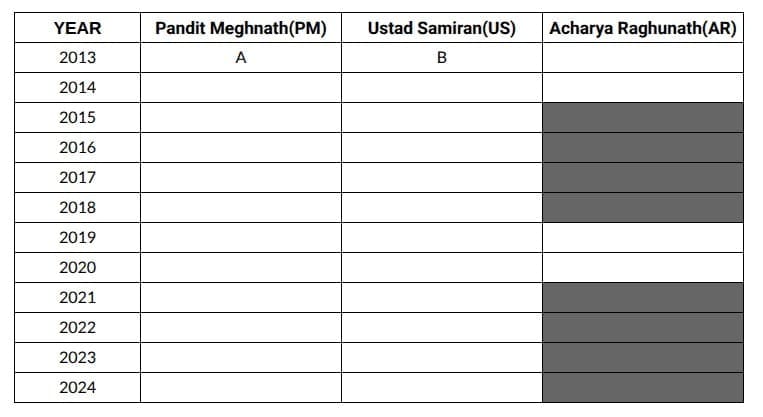
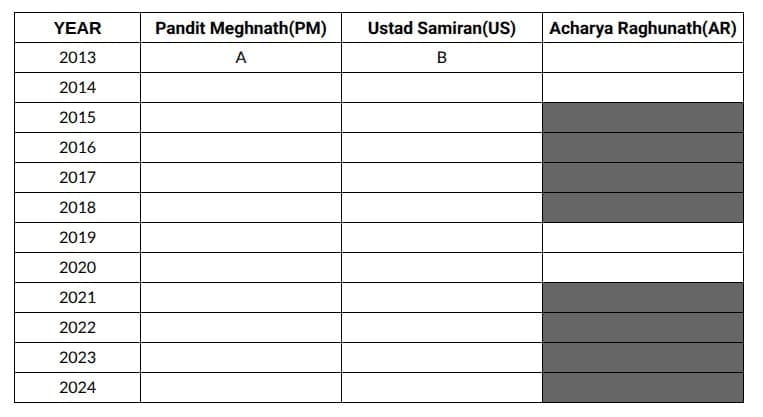
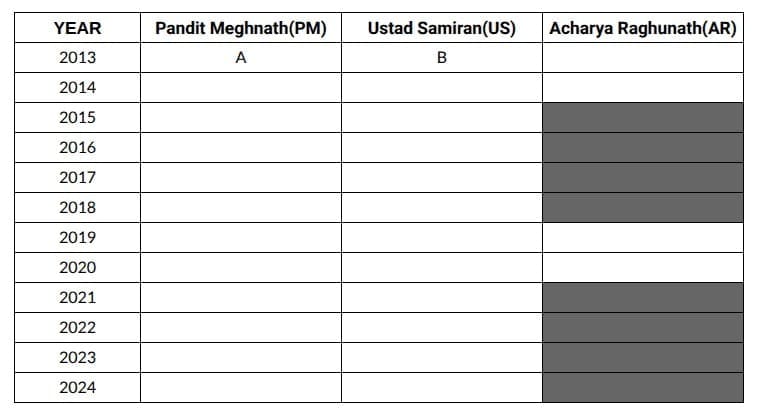
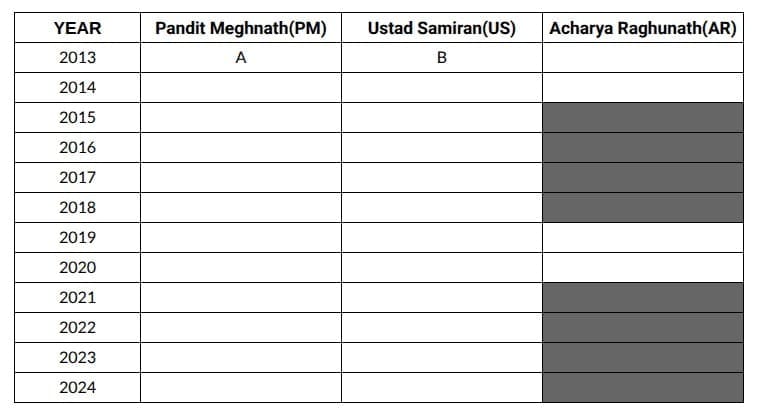
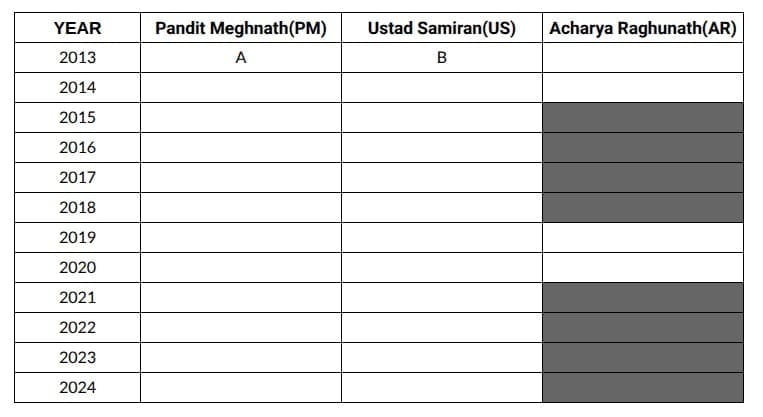
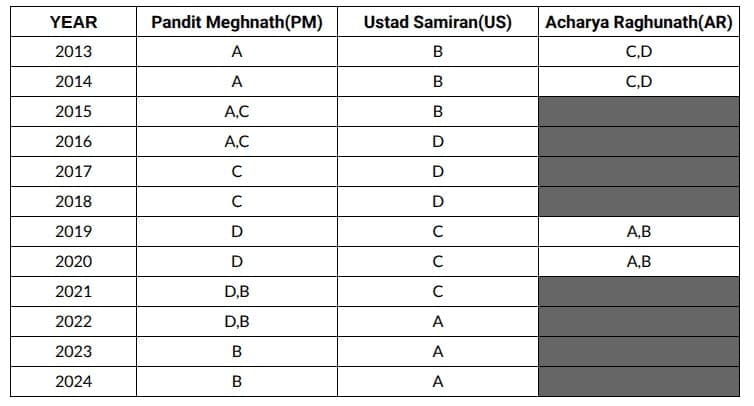
Putting all the known information in the table, we get,
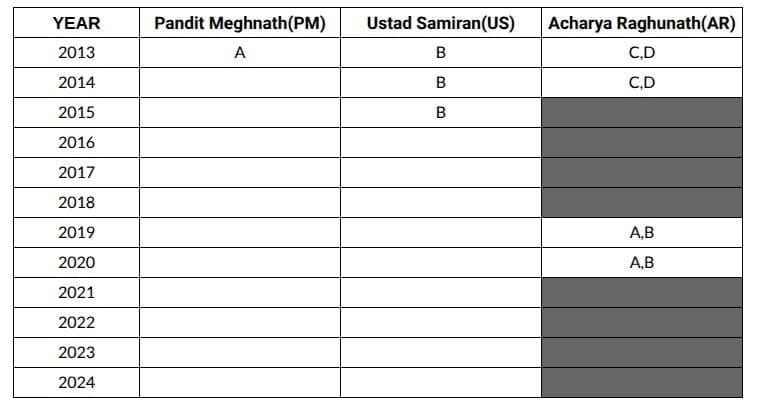
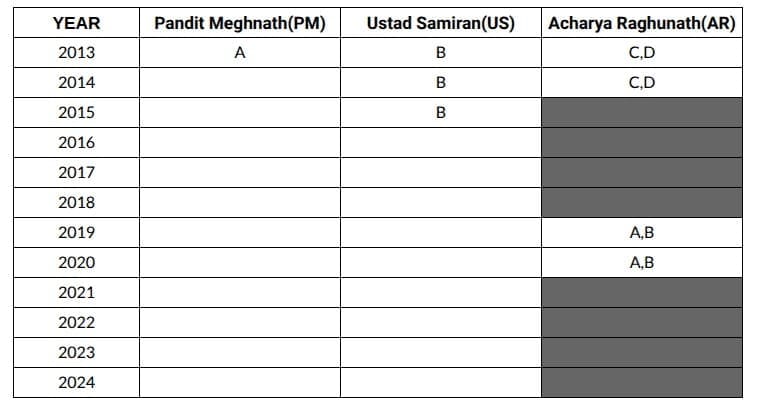
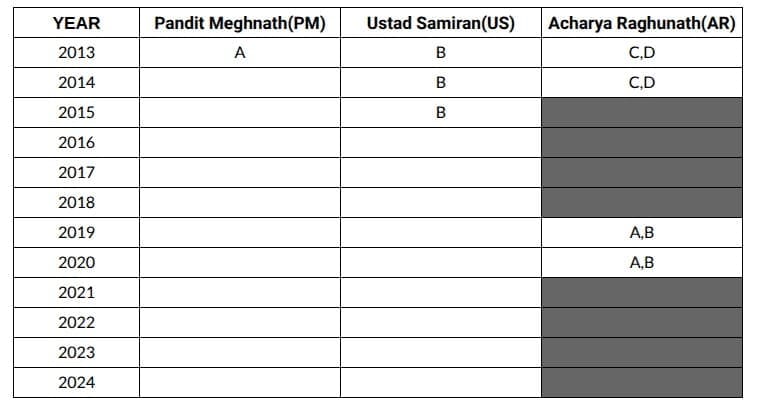
Now, if we look at the table, we can see that AR is training for only 4 years, with two years each, separated by a few years. Therefore, the span of AR must be 2 years because we know that he is not teaching continuously for 3 or 4 years.
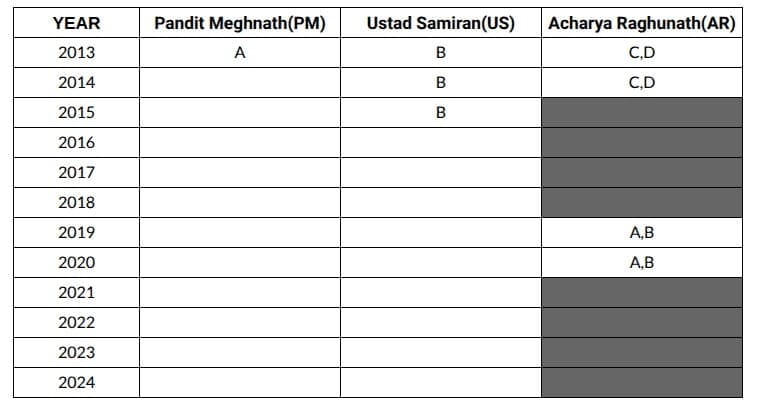
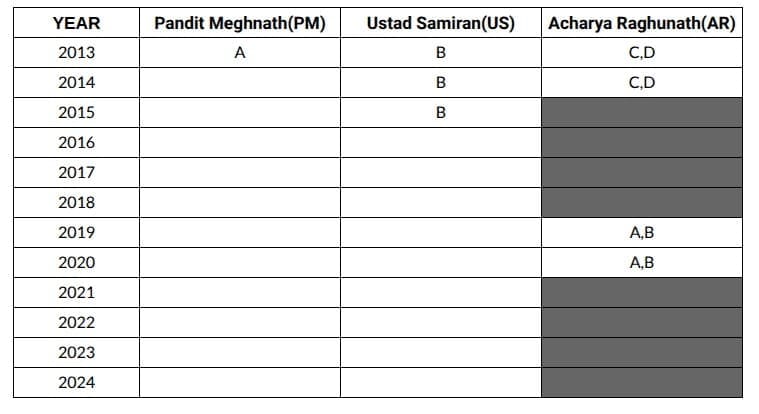
Since we know that each guru taught all the students, and AR only has 4 years to teach all the students, he must definitely teach 2 students at a time each year, as we are told that no guru taught more than 2 students in a single year. We also know that A and B were taught by PM and US in 2013, respectively. Therefore, we can conclude that C and D were taught by AR during both 2013 and 2014, as AR's span is 2 years.
We can also conclude that A and B were taught by AR during both 2019 and 2020, as AR's span is 2 years, and they were the only students left for AR's class.
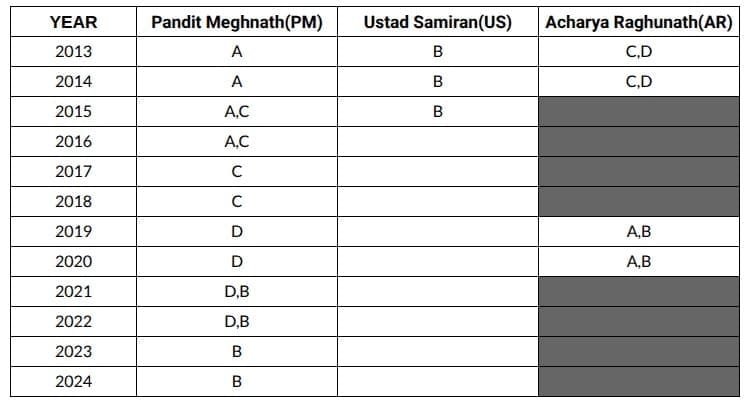
We are also given in clue 1 that US did not train more than 1 student in any year, and there are a total of 12 years from 2013 to 2024. If the span of US is 4 years, then he would need a total of 16 years to teach every student, as he is not teaching more than 1 student in any year, but he only taught for 12 years, so the only possibility is for US to have a span of 3 years and PM to have a span of 4 years. We can also conclude that US taught B from 2013 to 2015, as he has a span of 3 years.
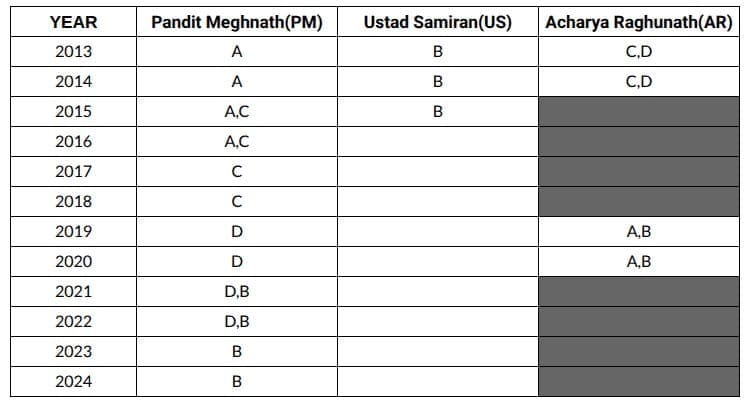
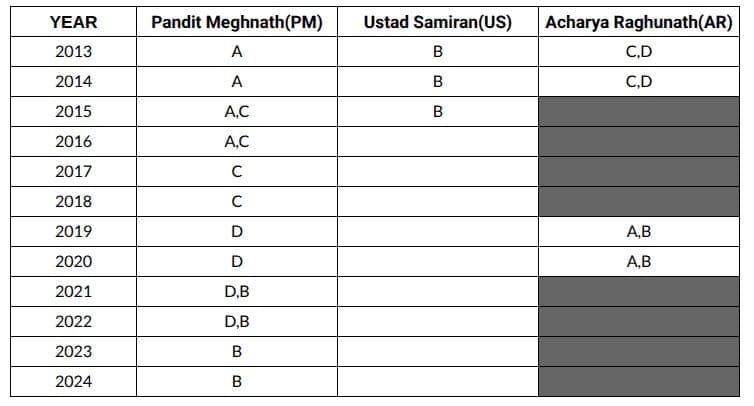
We are also given that A, D and B, C were never Gurubhai, and all the other pairs were Gurubhai for exactly 2 years. Therefore, there must be two years each of {A, B}, {A, C}, {B, D}, and {C, D} with classes together. We have already completed the 2 years of {A, B} and {C, D}, so the ones left are two years of {A, C} and {B, D}. We know that the US did not take classes of 2 students together, and we have already filled the schedule of AR, so the only one left is PM, and he must have the other two left.
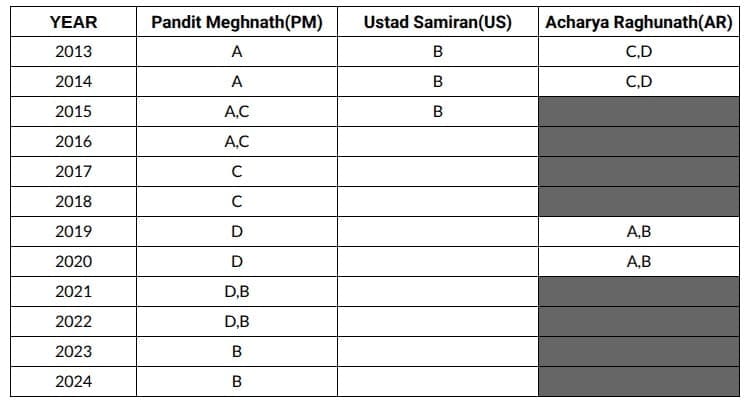
Since the span of PM is 4, he taught A from 2013 to 2016 and during this span, there must be 2 years of {A, C}, as we know that A will not be taught again after 2016. To have an exact span of 2 years together, C must start in 2015, as it is the only possibility, and he will teach C until 2018, as he has a span of 4 years.
There must be 2 years of {B, D} in the remaining time period of PM. In 2019, A and B were already enrolled with AR, and C had already completed his time with PM. So, the only person possible to have class in 2019 with PM is D, and D will have classes with PM until 2022. Now for 2 years of {B, D}, D must have his classes start from 2021, as it is the only possibility.
There cannot be any gap in the case of US, and in 2016, the only possibility is D as A, C were having classes with PM, and B already had his classes with US. D had classes from 2016 to 2018. In 2019, A, B and D were already having classes, so the only possibility is for C to have classes with US from 2019 to 2021, and finally A will have his classes from 2022 to 2024 with US, as he is the only person left to have classes with US.
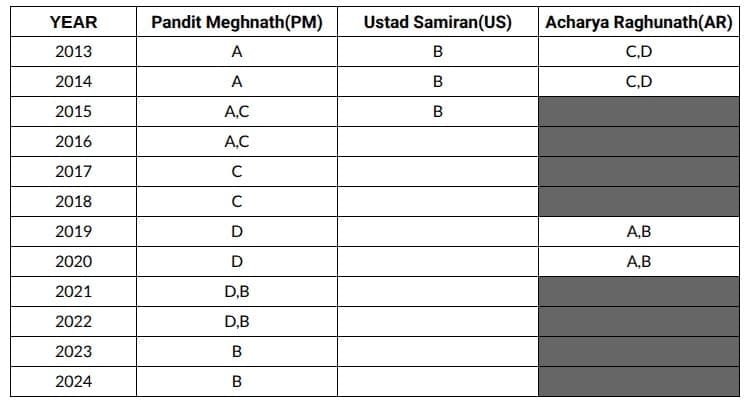
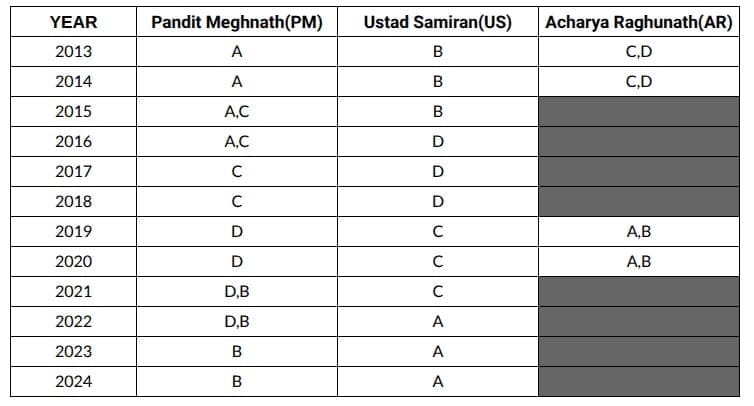
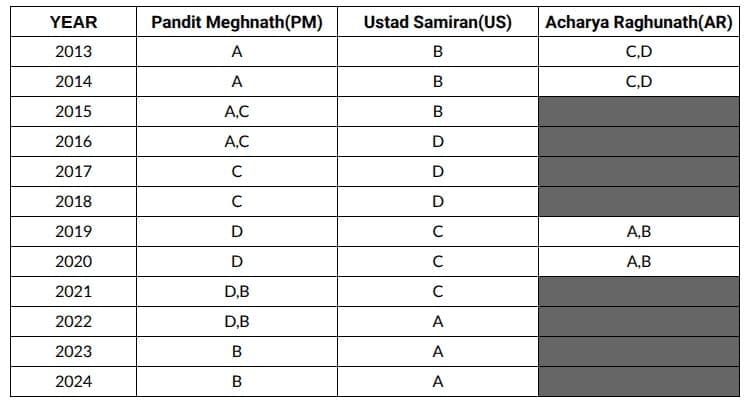
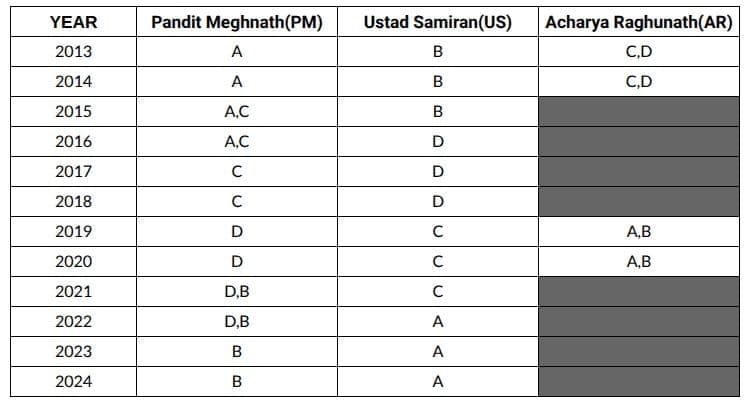
The final table looks like,
Ananya and Bhaskar were Gurubhai from 2019 to 2020. Since 2020 is the only option present during this period, it has to be the answer.
Hence, the correct answer is option A.
Q6: In which year did Charu begin her training under Pandit Meghnath?
(a) 2017
(b) 2015
(c) 2021
(d) 2016
Ans: b
Sol: Representing Ananya Raga, Bhaskar Tala, Charu Veena, and Devendra Sur as A, B, C and D, respectively, for easy usage. Also using PM, US, and AR for Pandit Meghnath, Ustad Samiran, and Acharya Raghunath, respectively, for easy reference.
We are given that AR did not train during the periods of 2015-2018 and 2021-2024.
Other information provided is that PM, US, and AR had a span of 2, 3, and 4 consecutive years for each student, in some order. We also know that all the gurus trained each of the students for exactly one span.
In clue 4, we are given that A started the training in 2013 under PM, and B started training in 2013 under US.
Putting all the known information in the table, we get,
Now, if we look at the table, we can see that AR is training for only 4 years, with two years each, separated by a few years. Therefore, the span of AR must be 2 years because we know that he is not teaching continuously for 3 or 4 years.
Since we know that each guru taught all the students, and AR only has 4 years to teach all the students, he must definitely teach 2 students at a time each year, as we are told that no guru taught more than 2 students in a single year. We also know that A and B were taught by PM and US in 2013, respectively. Therefore, we can conclude that C and D were taught by AR during both 2013 and 2014, as AR's span is 2 years.
We can also conclude that A and B were taught by AR during both 2019 and 2020, as AR's span is 2 years, and they were the only students left for AR's class.
We are also given in clue 1 that US did not train more than 1 student in any year, and there are a total of 12 years from 2013 to 2024. If the span of US is 4 years, then he would need a total of 16 years to teach every student, as he is not teaching more than 1 student in any year, but he only taught for 12 years, so the only possibility is for US to have a span of 3 years and PM to have a span of 4 years. We can also conclude that US taught B from 2013 to 2015, as he has a span of 3 years.
We are also given that A, D and B, C were never Gurubhai, and all the other pairs were Gurubhai for exactly 2 years. Therefore, there must be two years each of {A, B}, {A, C}, {B, D}, and {C, D} with classes together. We have already completed the 2 years of {A, B} and {C, D}, so the ones left are two years of {A, C} and {B, D}. We know that the US did not take classes of 2 students together, and we have already filled the schedule of AR, so the only one left is PM, and he must have the other two left.
Since the span of PM is 4, he taught A from 2013 to 2016 and during this span, there must be 2 years of {A, C}, as we know that A will not be taught again after 2016. To have an exact span of 2 years together, C must start in 2015, as it is the only possibility, and he will teach C until 2018, as he has a span of 4 years.
There must be 2 years of {B, D} in the remaining time period of PM. In 2019, A and B were already enrolled with AR, and C had already completed his time with PM. So, the only person possible to have class in 2019 with PM is D, and D will have classes with PM until 2022. Now for 2 years of {B, D}, D must have his classes start from 2021, as it is the only possibility.
There cannot be any gap in the case of US, and in 2016, the only possibility is D as A, C were having classes with PM, and B already had his classes with US. D had classes from 2016 to 2018. In 2019, A, B and D were already having classes, so the only possibility is for C to have classes with US from 2019 to 2021, and finally A will have his classes from 2022 to 2024 with US, as he is the only person left to have classes with US.
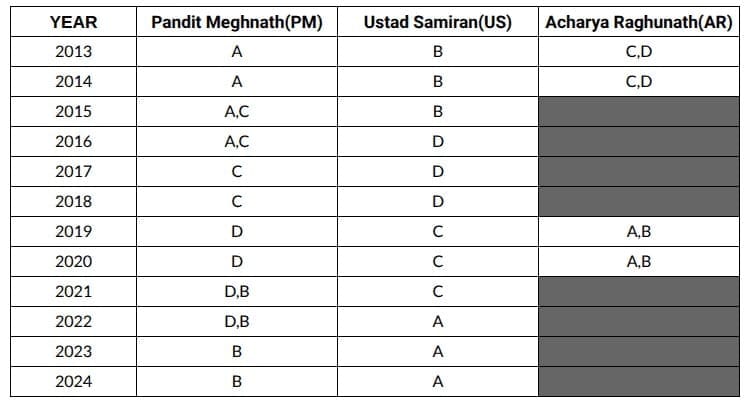
The final table looks like,
Charu began her training under Pandit Meghnath in 2015.
Hence, the correct answer is option B.
Q7: In which of the following years were Bhaskar and Devendra Gurubhai?
(a) 2022
(b) 2015
(c) 2020
(d) 2018
Ans: a
Sol: Representing Ananya Raga, Bhaskar Tala, Charu Veena, and Devendra Sur as A, B, C and D, respectively, for easy usage. Also using PM, US, and AR for Pandit Meghnath, Ustad Samiran, and Acharya Raghunath, respectively, for easy reference.
We are given that AR did not train during the periods of 2015-2018 and 2021-2024.
Other information provided is that PM, US, and AR had a span of 2, 3, and 4 consecutive years for each student, in some order. We also know that all the gurus trained each of the students for exactly one span.
In clue 4, we are given that A started the training in 2013 under PM, and B started training in 2013 under US.
Putting all the known information in the table, we get,
Now, if we look at the table, we can see that AR is training for only 4 years, with two years each, separated by a few years. Therefore, the span of AR must be 2 years because we know that he is not teaching continuously for 3 or 4 years.
Since we know that each guru taught all the students, and AR only has 4 years to teach all the students, he must definitely teach 2 students at a time each year, as we are told that no guru taught more than 2 students in a single year. We also know that A and B were taught by PM and US in 2013, respectively. Therefore, we can conclude that C and D were taught by AR during both 2013 and 2014, as AR's span is 2 years.
We can also conclude that A and B were taught by AR during both 2019 and 2020, as AR's span is 2 years, and they were the only students left for AR's class.
We are also given in clue 1 that US did not train more than 1 student in any year, and there are a total of 12 years from 2013 to 2024. If the span of US is 4 years, then he would need a total of 16 years to teach every student, as he is not teaching more than 1 student in any year, but he only taught for 12 years, so the only possibility is for US to have a span of 3 years and PM to have a span of 4 years. We can also conclude that US taught B from 2013 to 2015, as he has a span of 3 years.
We are also given that A, D and B, C were never Gurubhai, and all the other pairs were Gurubhai for exactly 2 years. Therefore, there must be two years each of {A, B}, {A, C}, {B, D}, and {C, D} with classes together. We have already completed the 2 years of {A, B} and {C, D}, so the ones left are two years of {A, C} and {B, D}. We know that the US did not take classes of 2 students together, and we have already filled the schedule of AR, so the only one left is PM, and he must have the other two left.
Since the span of PM is 4, he taught A from 2013 to 2016 and during this span, there must be 2 years of {A, C}, as we know that A will not be taught again after 2016. To have an exact span of 2 years together, C must start in 2015, as it is the only possibility, and he will teach C until 2018, as he has a span of 4 years.
There must be 2 years of {B, D} in the remaining time period of PM. In 2019, A and B were already enrolled with AR, and C had already completed his time with PM. So, the only person possible to have class in 2019 with PM is D, and D will have classes with PM until 2022. Now for 2 years of {B, D}, D must have his classes start from 2021, as it is the only possibility.
There cannot be any gap in the case of US, and in 2016, the only possibility is D as A, C were having classes with PM, and B already had his classes with US. D had classes from 2016 to 2018. In 2019, A, B and D were already having classes, so the only possibility is for C to have classes with US from 2019 to 2021, and finally A will have his classes from 2022 to 2024 with US, as he is the only person left to have classes with US.
The final table looks like,
Bhaskar and Devendra were Gurubhai from 2021 to 2022. Since 2022 is the only option present during this period, it has to be the answer.
Hence, the correct answer is option A.
Q8: Which of the following statements is TRUE?
(a) Charu was training under Ustad Samiran in 2018.
(b) Ananya was training under Ustad Samiran in 2015.
(c) Ananya was training under Ustad Samiran in 2018.
(d) 5. 3.Ananya was training under Ustad Samiran in 2018.
Ans: d
Sol: Representing Ananya Raga, Bhaskar Tala, Charu Veena, and Devendra Sur as A, B, C and D, respectively, for easy usage. Also using PM, US, and AR for Pandit Meghnath, Ustad Samiran, and Acharya Raghunath, respectively, for easy reference.
We are given that AR did not train during the periods of 2015-2018 and 2021-2024.
Other information provided is that PM, US, and AR had a span of 2, 3, and 4 consecutive years for each student, in some order. We also know that all the gurus trained each of the students for exactly one span.
In clue 4, we are given that A started the training in 2013 under PM, and B started training in 2013 under US.
Putting all the known information in the table, we get,
Now, if we look at the table, we can see that AR is training for only 4 years, with two years each, separated by a few years. Therefore, the span of AR must be 2 years because we know that he is not teaching continuously for 3 or 4 years.
Since we know that each guru taught all the students, and AR only has 4 years to teach all the students, he must definitely teach 2 students at a time each year, as we are told that no guru taught more than 2 students in a single year. We also know that A and B were taught by PM and US in 2013, respectively. Therefore, we can conclude that C and D were taught by AR during both 2013 and 2014, as AR's span is 2 years.
We can also conclude that A and B were taught by AR during both 2019 and 2020, as AR's span is 2 years, and they were the only students left for AR's class.
We are also given in clue 1 that US did not train more than 1 student in any year, and there are a total of 12 years from 2013 to 2024. If the span of US is 4 years, then he would need a total of 16 years to teach every student, as he is not teaching more than 1 student in any year, but he only taught for 12 years, so the only possibility is for US to have a span of 3 years and PM to have a span of 4 years. We can also conclude that US taught B from 2013 to 2015, as he has a span of 3 years.
We are also given that A, D and B, C were never Gurubhai, and all the other pairs were Gurubhai for exactly 2 years. Therefore, there must be two years each of {A, B}, {A, C}, {B, D}, and {C, D} with classes together. We have already completed the 2 years of {A, B} and {C, D}, so the ones left are two years of {A, C} and {B, D}. We know that the US did not take classes of 2 students together, and we have already filled the schedule of AR, so the only one left is PM, and he must have the other two left.
Since the span of PM is 4, he taught A from 2013 to 2016 and during this span, there must be 2 years of {A, C}, as we know that A will not be taught again after 2016. To have an exact span of 2 years together, C must start in 2015, as it is the only possibility, and he will teach C until 2018, as he has a span of 4 years.
There must be 2 years of {B, D} in the remaining time period of PM. In 2019, A and B were already enrolled with AR, and C had already completed his time with PM. So, the only person possible to have class in 2019 with PM is D, and D will have classes with PM until 2022. Now for 2 years of {B, D}, D must have his classes start from 2021, as it is the only possibility.
There cannot be any gap in the case of US, and in 2016, the only possibility is D as A, C were having classes with PM, and B already had his classes with US. D had classes from 2016 to 2018. In 2019, A, B and D were already having classes, so the only possibility is for C to have classes with US from 2019 to 2021, and finally A will have his classes from 2022 to 2024 with US, as he is the only person left to have classes with US.
The final table looks like,
Statement 1) Charu was training under Ustad Samiran in 2018. This is false as she was training under Pandit Meghnath in 2018.
Statement 2) Ananya was training under Ustad Samiran in 2015. This is false as she was training under Pandit Meghnath in 2015.
Statement 3) Ananya was training under Ustad Samiran in 2018. This is false as she was not training in 2018.
Statement 4) Charu was training under Ustad Samiran in 2019. This is true.
Hence, the correct answer is option D.
Q9: In how many of the years between 2013-24, were only two of these four musicians training under these three Gurus?
Ans: 4
Sol: Representing Ananya Raga, Bhaskar Tala, Charu Veena, and Devendra Sur as A, B, C and D, respectively, for easy usage. Also using PM, US, and AR for Pandit Meghnath, Ustad Samiran, and Acharya Raghunath, respectively, for easy reference.
We are given that AR did not train during the periods of 2015-2018 and 2021-2024.
Other information provided is that PM, US, and AR had a span of 2, 3, and 4 consecutive years for each student, in some order. We also know that all the gurus trained each of the students for exactly one span.
In clue 4, we are given that A started the training in 2013 under PM, and B started training in 2013 under US.
Putting all the known information in the table, we get,
Now, if we look at the table, we can see that AR is training for only 4 years, with two years each, separated by a few years. Therefore, the span of AR must be 2 years because we know that he is not teaching continuously for 3 or 4 years.
Since we know that each guru taught all the students, and AR only has 4 years to teach all the students, he must definitely teach 2 students at a time each year, as we are told that no guru taught more than 2 students in a single year. We also know that A and B were taught by PM and US in 2013, respectively. Therefore, we can conclude that C and D were taught by AR during both 2013 and 2014, as AR's span is 2 years.
We can also conclude that A and B were taught by AR during both 2019 and 2020, as AR's span is 2 years, and they were the only students left for AR's class.
We are also given in clue 1 that US did not train more than 1 student in any year, and there are a total of 12 years from 2013 to 2024. If the span of US is 4 years, then he would need a total of 16 years to teach every student, as he is not teaching more than 1 student in any year, but he only taught for 12 years, so the only possibility is for US to have a span of 3 years and PM to have a span of 4 years. We can also conclude that US taught B from 2013 to 2015, as he has a span of 3 years.
We are also given that A, D and B, C were never Gurubhai, and all the other pairs were Gurubhai for exactly 2 years. Therefore, there must be two years each of {A, B}, {A, C}, {B, D}, and {C, D} with classes together. We have already completed the 2 years of {A, B} and {C, D}, so the ones left are two years of {A, C} and {B, D}. We know that the US did not take classes of 2 students together, and we have already filled the schedule of AR, so the only one left is PM, and he must have the other two left.
Since the span of PM is 4, he taught A from 2013 to 2016 and during this span, there must be 2 years of {A, C}, as we know that A will not be taught again after 2016. To have an exact span of 2 years together, C must start in 2015, as it is the only possibility, and he will teach C until 2018, as he has a span of 4 years.
There must be 2 years of {B, D} in the remaining time period of PM. In 2019, A and B were already enrolled with AR, and C had already completed his time with PM. So, the only person possible to have class in 2019 with PM is D, and D will have classes with PM until 2022. Now for 2 years of {B, D}, D must have his classes start from 2021, as it is the only possibility.
There cannot be any gap in the case of US, and in 2016, the only possibility is D as A, C were having classes with PM, and B already had his classes with US. D had classes from 2016 to 2018. In 2019, A, B and D were already having classes, so the only possibility is for C to have classes with US from 2019 to 2021, and finally A will have his classes from 2022 to 2024 with US, as he is the only person left to have classes with US.
The final table looks like,
Between 2013 and 2024, the years 2017, 2018, 2023, and 2024 were the only years when only two of these four musicians were training under these three Gurus.
Hence, the correct answer is 4.
Q10 to 13:
Seven children, Aarav, Bina, Chirag, Diya, Eshan, Farhan, and Gaurav, are sitting in a circle facing inside (not necessarily in the same order) and playing a game of 'Passing the Buck'.
The game is played over 10 rounds. In each round, the child holding the Buck must pass it directly to a child sitting in one of the following positions:
- Immediately to the left;
- Immediate to the right;
- Second to the left; or
- Second to the right.
The game starts with Bina passing the Buck and ends with Chirag receiving the Buck. The table below provides some information about the pass types and the child receiving the Buck. Some information is missing and labelled as '?'.
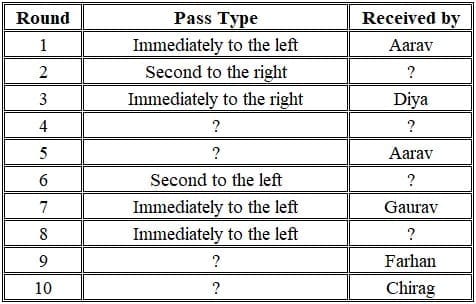
Q10: Who is sitting immediately to the right of Bina?
(a) Aarav
(b) Eshan
(c) Farhan
(d) Chirag
Ans: b
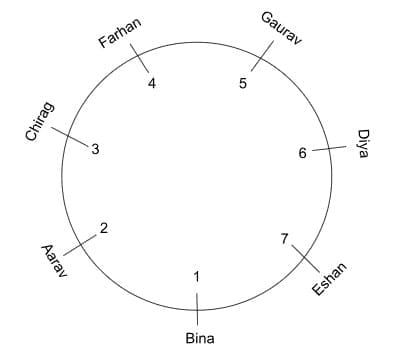
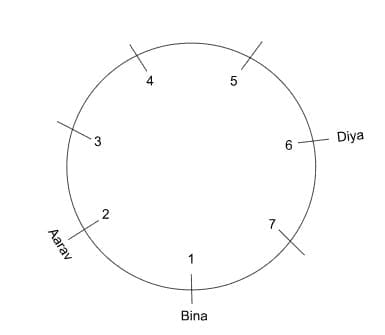
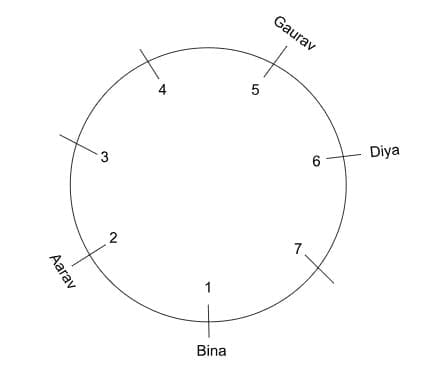
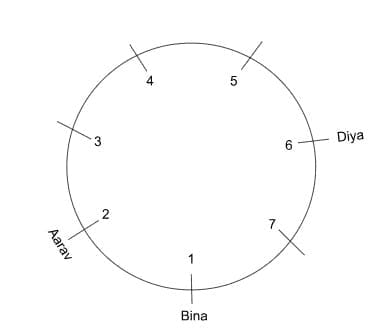
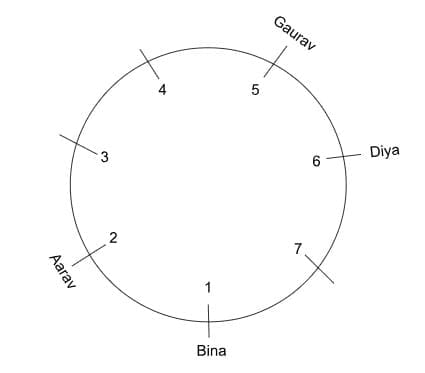
Sol: Let us place Bina at position 1 and arrange the numbers in a clockwise direction for better understanding, and then position the rest of the people on the table.
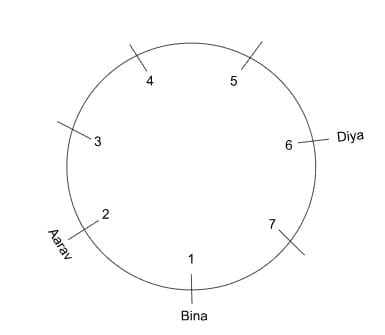
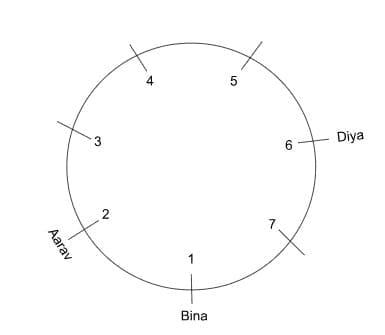
Round 1: The holder of the buck is Bina. The buck is passed immediately to the left, which means it is given to position 2 from 1, and it is received by Aarav. So, Aarav's position is 2.
Round 2: The holder of the buck is Aarav. The buck is passed second to the right, which means it is given to the position 7 from 2, and the person receiving it is unknown.
Round 3: The holder of the buck is unknown, but it is at position 7. The buck is passed immediately to the right, which means it is given to the position 6 from 7, and the person receiving it is Diya. Therefore, Diya's position is 6.
Round 4 and 5:
The buck is at position 6 at the start of round 4 with Diya, and the pass types of rounds 4 and 5 are not provided to us. The only information known to us is that after round 5, the buck is with Aarav, who is at position 2.
The possible ways for Aarav to receive the buck after rounds 4 and 5 are:
1) Passing the buck second to the right in round 4 and second to the right in round 5.
2) Passing the buck second to the left in round 4 and to the left in round 5.
3) Passing the buck to the left in round 4 and second to the left in round 5.These are the only possible ways for the buck to reach Aarav after round 6.
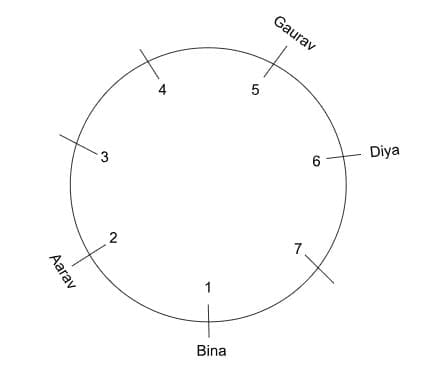
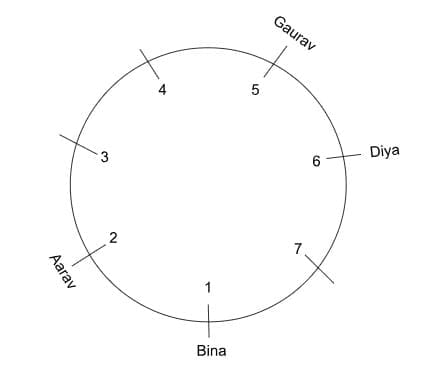
Round 6: The holder of the buck is Aarav. The buck is passed second to the left, which means it is given to the position 4 from 2, and the person receiving it is unknown.Round 7: The holder of the buck is unknown, but it is at position 4. The buck is passed immediately to the left, which means it is given to position 5 from 4, and the person receiving it is Gaurav. Therefore, Gaurav's position is 5.
Round 8: The holder of the buck is Gaurav. The buck is passed immediately to the left, which means it is given to position 6 from 5, and the person receiving it is unknown. But we know that the person in position 6 is Diya. So, the buck is currently at position 6 with Diya.
Round 9 and 10:
The pass types of rounds 9 and 10 are unknown to us, but we are told that the buck is passed to Farhan in round 9 and to Chirag in round 10. The positions of Farhan and Chirag are currently not assigned, and they are out of 3, 4, and 7. From position 6, the only positions that Buck can reach out of the three are 4 or 7.
If the buck is passed to position 7 in round 9, then it has to reach either 3 or 4 in round 10 to get to Chirag, but it is not possible to pass the buck from 7 to 3 or 4 in a single round. So, we can eliminate the case of Buck going to 7 in round 9.
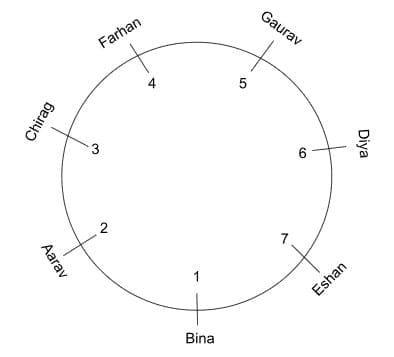
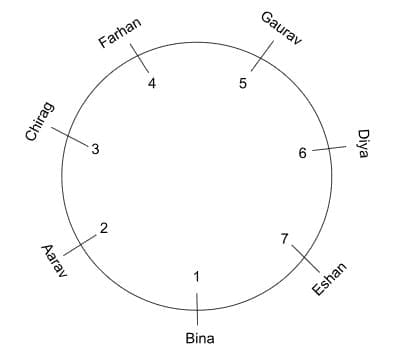
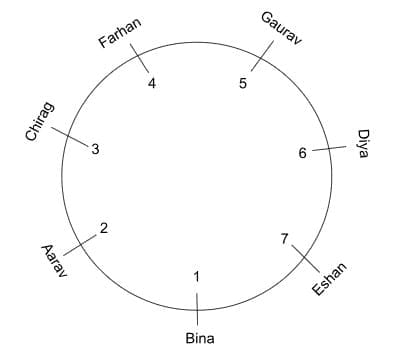
The only case left is for the buck to go to position 4 in round 9 and to position 3 in round 10, as from 4, the buck can only be passed to 3 out of 3 and 7 in one round. Hence, we can conclude that Farhan is placed at position 4 and Chirag is placed at position 3. This leaves out only position 7 and the only person left to be assigned is Eshan making the person at position 7 to be Eshan.
This is the final arrangement.
The person immediately to the right of Bina is Eshan.
Hence, the correct answer is option B.
Q11: Who is sitting third to the left of Eshan?
(a) Gaurav
(b) Divya
(c) Chirag
(d) Aarav
Ans: c
Sol: Let us place Bina at position 1 and arrange the numbers in a clockwise direction for better understanding, and then position the rest of the people on the table.
Round 1: The holder of the buck is Bina. The buck is passed immediately to the left, which means it is given to position 2 from 1, and it is received by Aarav. So, Aarav's position is 2.
Round 2: The holder of the buck is Aarav. The buck is passed second to the right, which means it is given to the position 7 from 2, and the person receiving it is unknown.
Round 3: The holder of the buck is unknown, but it is at position 7. The buck is passed immediately to the right, which means it is given to the position 6 from 7, and the person receiving it is Diya. Therefore, Diya's position is 6.
Round 4 and 5:
The buck is at position 6 at the start of round 4 with Diya, and the pass types of rounds 4 and 5 are not provided to us. The only information known to us is that after round 5, the buck is with Aarav, who is at position 2.
The possible ways for Aarav to receive the buck after rounds 4 and 5 are:
1) Passing the buck second to the right in round 4 and second to the right in round 5.
2) Passing the buck second to the left in round 4 and to the left in round 5.
3) Passing the buck to the left in round 4 and second to the left in round 5.These are the only possible ways for the buck to reach Aarav after round 6.
Round 6: The holder of the buck is Aarav. The buck is passed second to the left, which means it is given to the position 4 from 2, and the person receiving it is unknown.Round 7: The holder of the buck is unknown, but it is at position 4. The buck is passed immediately to the left, which means it is given to position 5 from 4, and the person receiving it is Gaurav. Therefore, Gaurav's position is 5.
Round 8: The holder of the buck is Gaurav. The buck is passed immediately to the left, which means it is given to position 6 from 5, and the person receiving it is unknown. But we know that the person in position 6 is Diya. So, the buck is currently at position 6 with Diya.
Round 9 and 10:
The pass types of rounds 9 and 10 are unknown to us, but we are told that the buck is passed to Farhan in round 9 and to Chirag in round 10. The positions of Farhan and Chirag are currently not assigned, and they are out of 3, 4, and 7. From position 6, the only positions that Buck can reach out of the three are 4 or 7.
If the buck is passed to position 7 in round 9, then it has to reach either 3 or 4 in round 10 to get to Chirag, but it is not possible to pass the buck from 7 to 3 or 4 in a single round. So, we can eliminate the case of Buck going to 7 in round 9.
The only case left is for the buck to go to position 4 in round 9 and to position 3 in round 10, as from 4, the buck can only be passed to 3 out of 3 and 7 in one round. Hence, we can conclude that Farhan is placed at position 4 and Chirag is placed at position 3. This leaves out only position 7, and the only person left to be assigned is Eshan, making the person at position 7 Eshan.
This is the final arrangement.
The person third to the left of Eshan is Chirag.
Hence, the correct answer is option C.
Q12: For which of the following pass types can the total number of occurrences be uniquely determined?
(a) Immediately to the left
(b) Second to the right
(c) Immediately to the right
(d) Second to the left
Ans: c
Sol: Let us place Bina at position 1 and arrange the numbers in a clockwise direction for better understanding, and then position the rest of the people on the table.Round 1: The holder of the buck is Bina. The buck is passed immediately to the left, which means it is given to position 2 from 1, and it is received by Aarav. So, Aarav's position is 2.
Round 2: The holder of the buck is Aarav. The buck is passed second to the right, which means it is given to the position 7 from 2, and the person receiving it is unknown.
Round 3: The holder of the buck is unknown, but it is at position 7. The buck is passed immediately to the right, which means it is given to the position 6 from 7, and the person receiving it is Diya. Therefore, Diya's position is 6.
Round 4 and 5:
The buck is at position 6 at the start of round 4 with Diya, and the pass types of rounds 4 and 5 are not provided to us. The only information known to us is that after round 5, the buck is with Aarav, who is at position 2.The possible ways for Aarav to receive the buck after rounds 4 and 5 are:
1) Passing the buck second to the right in round 4 and second to the right in round 5.
2) Passing the buck second to the left in round 4 and to the left in round 5.
3) Passing the buck to the left in round 4 and second to the left in round 5.These are the only possible ways for the buck to reach Aarav after round 6.
Round 6: The holder of the buck is Aarav. The buck is passed second to the left, which means it is given to the position 4 from 2, and the person receiving it is unknown.Round 7: The holder of the buck is unknown, but it is at position 4. The buck is passed immediately to the left, which means it is given to position 5 from 4, and the person receiving it is Gaurav. Therefore, Gaurav's position is 5.
Round 8: The holder of the buck is Gaurav. The buck is passed immediately to the left, which means it is given to position 6 from 5, and the person receiving it is unknown. But we know that the person in position 6 is Diya. So, the buck is currently at position 6 with Diya.
Round 9 and 10:
The pass types of rounds 9 and 10 are unknown to us, but we are told that the buck is passed to Farhan in round 9 and to Chirag in round 10. The positions of Farhan and Chirag are currently not assigned, and they are out of 3, 4, and 7. From position 6, the only positions that Buck can reach out of the three are 4 or 7.
If the buck is passed to position 7 in round 9, then it has to reach either 3 or 4 in round 10 to get to Chirag, but it is not possible to pass the buck from 7 to 3 or 4 in a single round. So, we can eliminate the case of Buck going to 7 in round 9.
The only case left is for the buck to go to position 4 in round 9 and to position 3 in round 10, as from 4, the buck can only be passed to 3 out of 3 and 7 in one round. Hence, we can conclude that Farhan is placed at position 4 and Chirag is placed at position 3. This leaves out only position 7, and the only person left to be assigned is Eshan, making the person at position 7 Eshan.
In rounds 4 and 5, the possibilities were
1) Passing the buck second to the right in round 4 and second to the right in round 5.
2) Passing the buck second to the left in round 4 and to the left in round 5.
3) Passing the buck to the left in round 4 and second to the left in round 5.Here, Buck could have been passed second to the right, second to the left or immediately to the left in rounds 4 and 5, which is unknown to us. The only pass type that we are certain to have happened is immediately to the right.
Hence, the correct answer is option C.
Q13: For which of the following children is it possible to determine how many times they received the Buck?
(a) Farhan
(b) Eshan
(c) Bina
(d) Gaurav
Ans: d
Sol: Let us place Bina at position 1 and arrange the numbers in a clockwise direction for better understanding, and then position the rest of the people on the table.
Round 1: The holder of the buck is Bina. The buck is passed immediately to the left, which means it is given to position 2 from 1, and it is received by Aarav. So, Aarav's position is 2.
Round 2: The holder of the buck is Aarav. The buck is passed second to the right, which means it is given to the position 7 from 2, and the person receiving it is unknown.
Round 3: The holder of the buck is unknown, but it is at position 7. The buck is passed immediately to the right, which means it is given to the position 6 from 7, and the person receiving it is Diya. Therefore, Diya's position is 6.
Round 4 and 5: The buck is at position 6 at the start of round 4 with Diya, and the pass types of rounds 4 and 5 are not provided to us. The only information known to us is that after round 5, the buck is with Aarav, who is at position 2.
The possible ways for Aarav to receive the buck after rounds 4 and 5 are:
1) Passing the buck second to the right in round 4 and second to the right in round 5.
2) Passing the buck second to the left in round 4 and to the left in round 5.
3) Passing the buck to the left in round 4 and second to the left in round 5.These are the only possible ways for the buck to reach Aarav after round 6.
Round 6: The holder of the buck is Aarav. The buck is passed second to the left, which means it is given to the position 4 from 2, and the person receiving it is unknown.Round 7: The holder of the buck is unknown, but it is at position 4. The buck is passed immediately to the left, which means it is given to position 5 from 4, and the person receiving it is Gaurav. Therefore, Gaurav's position is 5.
Round 8: The holder of the buck is Gaurav. The buck is passed immediately to the left, which means it is given to position 6 from 5, and the person receiving it is unknown. But we know that the person in position 6 is Diya. So, the buck is currently at position 6 with Diya.
Round 9 and 10:
The pass types of rounds 9 and 10 are unknown to us, but we are told that the buck is passed to Farhan in round 9 and to Chirag in round 10. The positions of Farhan and Chirag are currently not assigned, and they are out of 3, 4, and 7. From position 6, the only positions that Buck can reach out of the three are 4 or 7.
If the buck is passed to position 7 in round 9, then it has to reach either 3 or 4 in round 10 to get to Chirag, but it is not possible to pass the buck from 7 to 3 or 4 in a single round. So, we can eliminate the case of Buck going to 7 in round 9.
The only case left is for the buck to go to position 4 in round 9 and to position 3 in round 10, as from 4, the buck can only be passed to 3 out of 3 and 7 in one round. Hence, we can conclude that Farhan is placed at position 4 and Chirag is placed at position 3. This leaves out only position 7, and the only person left to be assigned is Eshan, making the person at position 7 Eshan.
In rounds 4 and 5, the possibilities were
1) Passing the buck second to the right in round 4 and second to the right in round 5. Here, the buck would have gone to Farhan in round 4.
2) Passing the buck second to the left in round 4 and to the left in round 5. Here, the buck would have gone to Bina in round 4.
3) Passing the buck to the left in round 4 and second to the left in round 5. Here, the buck would have gone to Eshan in round 4.In round 4, the buck might have gone to either Farhan, Bina or Eshan, which is not known to us. Therefore, the count of the number of times the buck was received by them cannot be determined uniquely, whereas it can be uniquely determined in the case of Gaurav, which is 1 in round 7.
Hence, the correct answer is option D.
2023
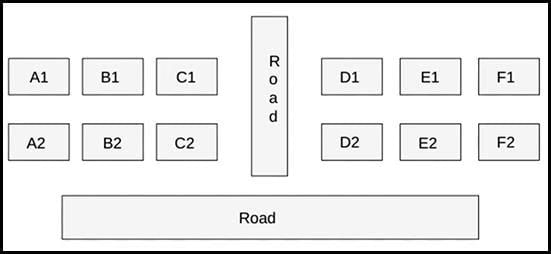
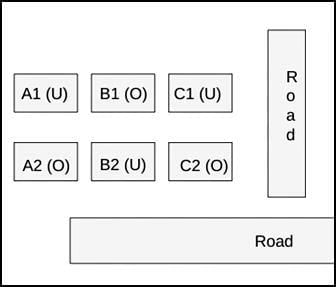
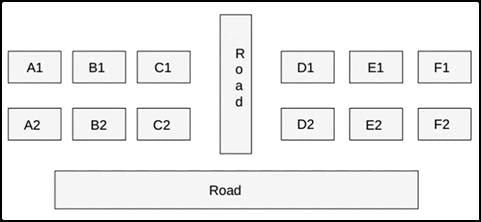
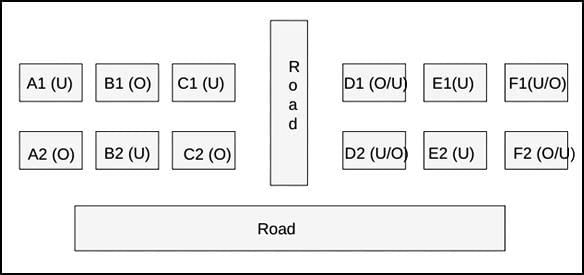
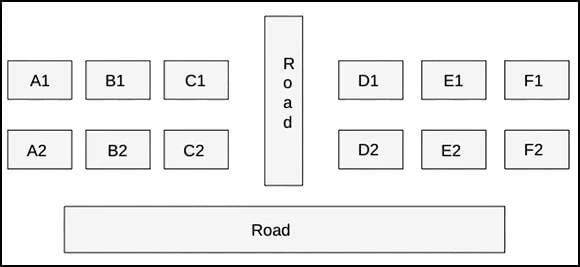
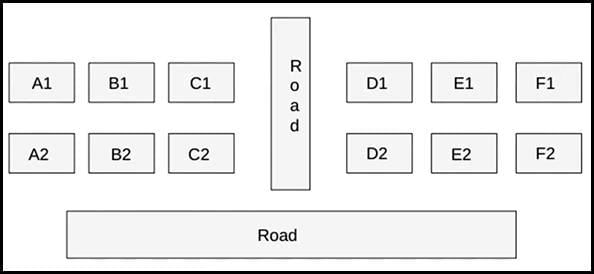
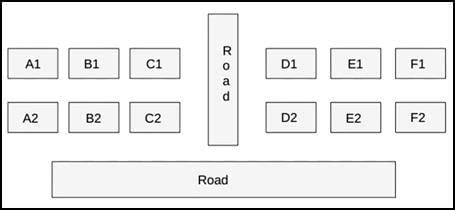
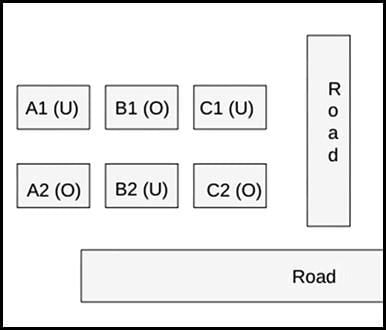
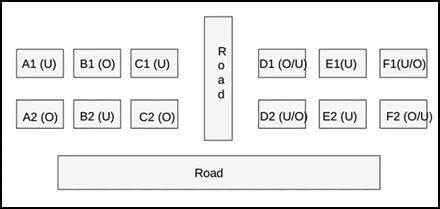
The schematic diagram below shows 12 rectangular houses in a housing complex. House numbers are mentioned in the rectangles representing the houses. The houses are located in six columns - Column-A through Column-F, and two rows - Row-1 and Row-2. The houses are divided into two blocks - Block XX and Block YY. The diagram also shows two roads, one passing in front of the houses in Row-2 and another between the two blocks.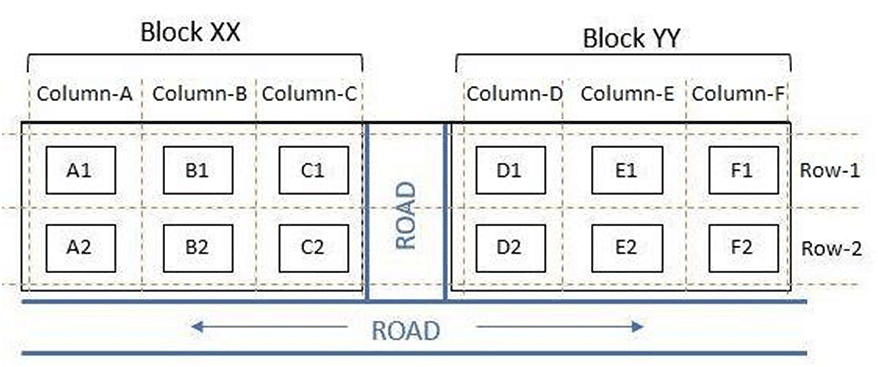
Some of the houses are occupied. The remaining ones are vacant and are the only ones available for sale.
The road adjacency value of a house is the number of its sides adjacent to a road. For example, the road adjacency values of C2, F2, and B1 are 2, 1, and 0, respectively. The neighbour count of a house is the number of sides of that house adjacent to occupied houses in the same block. For example, E1 and C1 can have the maximum possible neighbour counts of 3 and 2, respectively.
The base price of a vacant house is Rs. 10 lakhs if the house does not have a parking space, and Rs. 12 lakhs if it does. The quoted price (in lakhs of Rs.) of a vacant house is calculated as (base price) + 5 × (road adjacency value) + 3 × (neighbour count).
The following information is also known.
1. The maximum quoted price of a house in Block XX is Rs. 24 lakhs. The minimum quoted price of a house in block YY is Rs. 15 lakhs, and one such house is in Column-E.
2. Row-1 has two occupied houses, one in each block.
3. Both houses in Column-E are vacant. Each of Column-D and Column-F has at least one occupied house.
4. There is only one house with parking space in Block YY. [2023]
Q1: How many houses are vacant in Block XX?
Ans: 3
Sol:
It is given that some of the houses are occupied. The remaining ones are vacant and are the only ones available for sale.
The base price of a vacant house is Rs. 10 lakhs if the house does not have a parking space, and Rs. 12 lakhs if it does. The quoted price (in lakhs of Rs.) of a vacant house is calculated as (base price) + 5 × (road adjacency value) + 3 × (neighbor count).
It is also known that the maximum quoted price of a house in Block XX is Rs. 24 lakhs
Hence, there can be two cases for the maximum quoted price of a house in block XX.
Case 1: House with parking space:
=> 12+5a+3b = 24 => 5a+3b = 12 ( a = road adjacency value, b= neighbor count)
The only value for which the equation satisfies is (a = 0, and b=4). But the value of b can't be 4 because the maximum neighbor count can be at most 3.
Hence, case 1 is invalid.
Case 2: House without parking space:
=> 10+5a+3b = 24 => 5a+3b = 14
=> (a, b) = (1, 3)
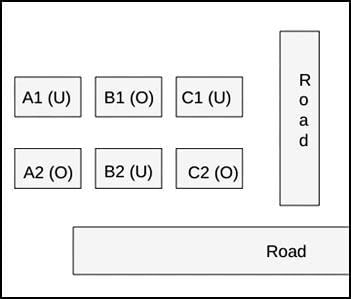
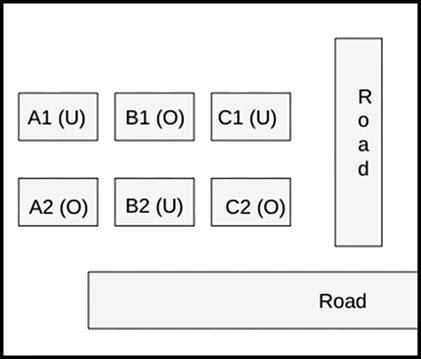
Hence, the house must have 3 neighbors and 1 road connected to it. Hence, the only possible case is B2. Therefore, the neighbor houses of B2, which are (B1, A2, and C2) are also occupied.
It is known that Row 1 has two occupied houses, one in each block. Since B1 is already occupied, it implies A1, and C1 are vacant.
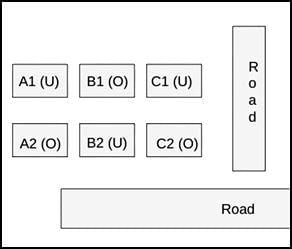
Hence, the configuration of block XX is given below: (Where U = Unoccupied/ Vacant, and U = Occupied)
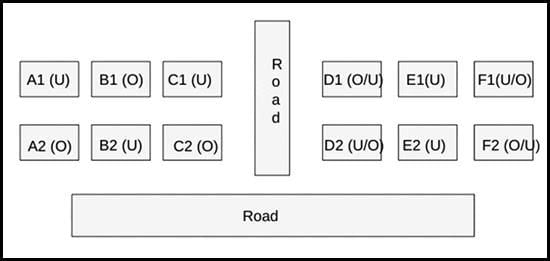
Now for block YY, we know that both houses in Column E are vacant. Each of Column-D and Column-F has at least one occupied house. There is only one house with parking space in Block YY.
It is also known that the minimum quoted price of a house in block YY is Rs. 15 lakhs, and one such house is in Column E.
Case 1: The minimum quoted house is E2:
We know that the road adjacency of E2 is 1, hence we can calculate whether the house has parking space or not, and the neighbor count (b)
If the house has parking space, then: 12+5*1+3*b = 15 => 3b = -2 (which is not possible)
Hence, the house has no parking space => 10+5*1+3b = 15 => b = 0
b = 0 implies all the neighbor house of E2 is vacant, which are (E1, D2, and F2).
It is known that each of Column-D and Column-F has at least one occupied house, which implies D1, and F1 must be occupied.
But D1 and F1 can't be occupied together since the total number of occupied houses in Row 1 is 2 (one in each block).
Hence, This case is invalid.
Case 2: The minimum quoted house is E1:
We know that the road adjacency of E1 is 0, hence we can calculate whether the house has parking space or not, and the neighbor count (b).
i) If the house has no working space, then: 10+5*0+3b = 15 => b = 5/3 (this is not possible since b has to be an integer value)
Hence, the house has parking space => 12+5*0+3b = 15 => b = 1 => One neighbor house is occupied among D1 and F1.
We already know that E2 is vacant. Among the houses D2, and F2, at least one must be occupied since each of Column-D and Column-F has at least one occupied house.
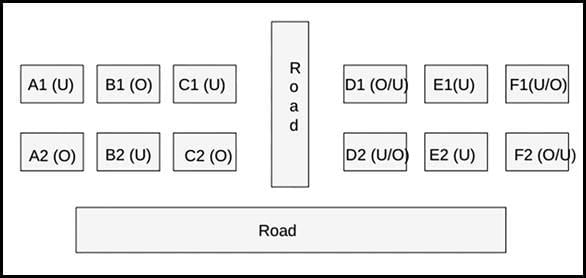
Therefore, the final diagram is given below:
From the diagram, we can see that 3 houses are vacant in block XX.
Q2: Which of the following houses is definitely occupied?
(a) A1
(b) D2
(c) B1
(d) F2
Ans: c
Sol:
It is given that some of the houses are occupied. The remaining ones are vacant and are the only ones available for sale.
The base price of a vacant house is Rs. 10 lakhs if the house does not have a parking space, and Rs. 12 lakhs if it does. The quoted price (in lakhs of Rs.) of a vacant house is calculated as (base price) + 5 × (road adjacency value) + 3 × (neighbor count).
It is also known that the maximum quoted price of a house in Block XX is Rs. 24 lakhs
Hence, there can be two cases for the maximum quoted price of a house in block XX.
Case 1: House with parking space:
=> 12+5a+3b = 24 => 5a+3b = 12 ( a = road adjacency value, b= neighbor count)
The only value for which the equation satisfies is (a = 0, and b=4). But the value of b can't be 4 because the maximum neighbor count can be at most 3.
Hence, case 1 is invalid.
Case 2: House without parking space:
=> 10+5a+3b = 24 => 5a+3b = 14
=> (a, b) = (1, 3)
Hence, the house must have 3 neighbors and 1 road connected to it. Hence, the only possible case is B2. Therefore, the neighbor houses of B2, which are (B1, A2, and C2) are also occupied.
It is known that Row 1 has two occupied houses, one in each block. Since B1 is already occupied, it implies A1, and C1 are vacant.
Hence, the configuration of block XX is given below: (Where U = Unoccupied/ Vacant, and U = Occupied)
Now for block YY, we know that both houses in Column E are vacant. Each of Column-D and Column-F has at least one occupied house. There is only one house with parking space in Block YY.
It is also known that the minimum quoted price of a house in block YY is Rs. 15 lakhs, and one such house is in Column E.
Case 1: The minimum quoted house is E2:
We know that the road adjacency of E2 is 1, hence we can calculate whether the house has parking space or not, and the neighbor count (b)
If the house has parking space, then: 12+5*1+3*b = 15 => 3b = -2 (which is not possible)
Hence, the house has no parking space => 10+5*1+3b = 15 => b = 0
b = 0 implies all the neighbor house of E2 is vacant, which are (E1, D2, and F2).
It is known that each of Column-D and Column-F has at least one occupied house, which implies D1, and F1 must be occupied.
But D1 and F1 can't be occupied together since the total number of occupied houses in Row 1 is 2 (one in each block).
Hence, This case is invalid.
Case 2: The minimum quoted house is E1:
We know that the road adjacency of E1 is 0, hence we can calculate whether the house has parking space or not, and the neighbor count (b).
i) If the house has no working space, then: 10+5*0+3b = 15 => b = 5/3 (this is not possible since b has to be an integer value)
Hence, the house has parking space => 12+5*0+3b = 15 => b = 1 => One neighbor house is occupied among D1 and F1.
We already know that E2 is vacant. Among the houses D2, and F2, at least one must be occupied since each of Column-D and Column-F has at least one occupied house.
Therefore, the final diagram is given below:
From the diagram, we can see that B1 is definitely occupied. The rest opinions are not definitely correct.
The correct option is C
Q3: Which of the following options best describes the number of vacant houses in Row-2?
(a) Either 3 or 4
(b) Exactly 2
(c) Exactly 3
(d) Either 2 or 3
Ans: d
Sol:
It is given that some of the houses are occupied. The remaining ones are vacant and are the only ones available for sale.
The base price of a vacant house is Rs. 10 lakhs if the house does not have a parking space, and Rs. 12 lakhs if it does. The quoted price (in lakhs of Rs.) of a vacant house is calculated as (base price) + 5 × (road adjacency value) + 3 × (neighbor count).
It is also known that the maximum quoted price of a house in Block XX is Rs. 24 lakhs
Hence, there can be two cases for the maximum quoted price of a house in block XX.
Case 1: House with parking space:
=> 12+5a+3b = 24 => 5a+3b = 12 ( a = road adjacency value, b= neighbor count)
The only value for which the equation satisfies is (a = 0, and b=4). But the value of b can't be 4 because the maximum neighbor count can be at most 3.
Hence, case 1 is invalid.
Case 2: House without parking space:
=> 10+5a+3b = 24 => 5a+3b = 14
=> (a, b) = (1, 3)
Hence, the house must have 3 neighbors and 1 road connected to it. Hence, the only possible case is B2. Therefore, the neighbor houses of B2, which are (B1, A2, and C2) are occupied.
It is known that Row 1 has two occupied houses, one in each block. Since B1 is already occupied, it implies A1, and C1 are vacant.
Hence, the configuration of block XX is given below: (Where U = Unoccupied/ Vacant, and U = Occupied)
Now for block YY, we know that both houses in Column E are vacant. Each of Column-D and Column-F has at least one occupied house. There is only one house with parking space in Block YY.
It is also known that the minimum quoted price of a house in block YY is Rs. 15 lakhs, and one such house is in Column E.
Case 1: The minimum quoted house is E2:
We know that the road adjacency of E2 is 1, hence we can calculate whether the house has parking space or not, and the neighbor count (b)
If the house has parking space, then: 12+5*1+3*b = 15 => 3b = -2 (which is not possible)
Hence, the house has no parking space => 10+5*1+3b = 15 => b = 0
b = 0 implies all the neighbor house of E2 is vacant, which are (E1, D2, and F2).
It is known that each of Column-D and Column-F has at least one occupied house, which implies D1, and F1 must be occupied.
But D1 and F1 can't be occupied together since the total number of occupied houses in Row 1 is 2 (one in each block).
Hence, This case is invalid.
Case 2: The minimum quoted house is E1:
We know that the road adjacency of E1 is 0, hence we can calculate whether the house has parking space or not, and the neighbor count (b).
i) If the house has no working space, then: 10+5*0+3b = 15 => b = 5/3 (this is not possible since b has to be an integer value)
Hence, the house has parking space => 12+5*0+3b = 15 => b = 1 => One neighbor house is occupied among D1 and F1.
Let's take the case that house D1 is occupied and F1 is empty. In that case, the value of house F1 would be 10(there is no parking space)+ (5*0) + (3*the number of neighbours)
Here, even if we take the number of neighbours to be 1, which is maximum for F1 in this case, the value of F1 would be a maximum of 13. This is lower than the lowest value house in block YY. Therefore, F1 cannot be empty.
Let us see the other scenario of D1 being unoccupied.
Here, the value of D1 can be 15 or 18 depending on if D2 is unoccupied or occupied respectively.We do not know the status of houses D2 and F2.
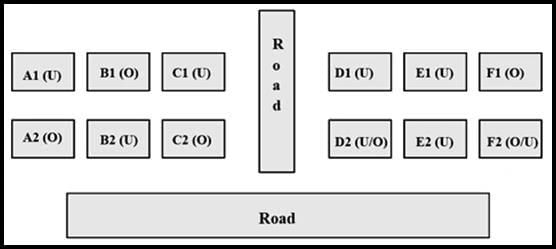
Therefore, the final diagram is given below:
From the diagram, we can say that the number of vacant houses in Row 2 in Block XX is 1, and the number of vacant houses in Row 2 in Block YY is either 1 or 2.
Hence, the total number of vacant houses is either 2 or 3
The correct option is D
Q4: What is the maximum possible quoted price (in lakhs of Rs.) for a vacant house in Column-E?
Ans: 21
Sol:
It is given that some of the houses are occupied. The remaining ones are vacant and are the only ones available for sale.
The base price of a vacant house is Rs. 10 lakhs if the house does not have a parking space, and Rs. 12 lakhs if it does. The quoted price (in lakhs of Rs.) of a vacant house is calculated as (base price) + 5 × (road adjacency value) + 3 × (neighbor count).
It is also known that the maximum quoted price of a house in Block XX is Rs. 24 lakhs
Hence, there can be two cases for the maximum quoted price of a house in block XX.
Case 1: House with parking space:
=> 12+5a+3b = 24 => 5a+3b = 12 ( a = road adjacency value, b= neighbor count)
The only value for which the equation satisfies is (a = 0, and b=4). But the value of b can't be 4 because the maximum neighbor count can be at most 3.
Hence, case 1 is invalid.
Case 2: House without parking space:
=> 10+5a+3b = 24 => 5a+3b = 14
=> (a, b) = (1, 3)
Hence, the house must have 3 neighbors and 1 road connected to it. Hence, the only possible case is B2. Therefore, the neighbor houses of B2, which are (B1, A2, and C2) are also occupied.
It is known that Row 1 has two occupied houses, one in each block. Since B1 is already occupied, it implies A1, and C1 are vacant.
Hence, the configuration of block XX is given below: (Where U = Unoccupied/ Vacant, and U = Occupied)
Now for block YY, we know that both houses in Column E are vacant. Each of Column-D and Column-F has at least one occupied house. There is only one house with parking space in Block YY.
It is also known that the minimum quoted price of a house in block YY is Rs. 15 lakhs, and one such house is in Column E.
Case 1: The minimum quoted house is E2:
We know that the road adjacency of E2 is 1, hence we can calculate whether the house has parking space or not, and the neighbor count (b)
If the house has parking space, then: 12+5*1+3*b = 15 => 3b = -2 (which is not possible)
Hence, the house has no parking space => 10+5*1+3b = 15 => b = 0
b = 0 implies all the neighbor house of E2 is vacant, which are (E1, D2, and F2).
It is known that each of Column-D and Column-F has at least one occupied house, which implies D1, and F1 must be occupied.
But D1 and F1 can't be occupied together since the total number of occupied houses in Row 1 is 2 (one in each block).
Hence, This case is invalid.
Case 2: The minimum quoted house is E1:
We know that the road adjacency of E1 is 0, hence we can calculate whether the house has parking space or not, and the neighbor count (b).
i) If the house has no working space, then: 10+5*0+3b = 15 => b = 5/3 (this is not possible since b has to be an integer value)
Hence, the house has parking space => 12+5*0+3b = 15 => b = 1 => One neighbor house is occupied among D1 and F1.
We already know that E2 is vacant. Among the houses D2, and F2, at least one must be occupied since each of Column-D and Column-F has at least one occupied house.
Therefore, the final diagram is given below:
From the diagram, the vacant house with the maximum possible quoted price in column E is E2 when both D2 and F2 are occupied.
The maximum possible quoted price of E2 is 10+5*1+3*2 = 21 Lacs. ( E2 has no parking space because E1 has the parking space and it is given that there is only one house with parking space in Block YY.)
Q5: Which house in Block YY has parking space?
(a) E1
(b) F2
(c) E2
(d) F1
Ans: a
Sol:
It is given that some of the houses are occupied. The remaining ones are vacant and are the only ones available for sale.
The base price of a vacant house is Rs. 10 lakhs if the house does not have a parking space, and Rs. 12 lakhs if it does. The quoted price (in lakhs of Rs.) of a vacant house is calculated as (base price) + 5 × (road adjacency value) + 3 × (neighbor count).
It is also known that the maximum quoted price of a house in Block XX is Rs. 24 lakhs
Hence, there can be two cases for the maximum quoted price of a house in block XX.
Case 1: House with parking space:
=> 12+5a+3b = 24 => 5a+3b = 12 ( a = road adjacency value, b= neighbor count)
The only value for which the equation satisfies is (a = 0, and b=4). But the value of b can't be 4 because the maximum neighbor count can be at most 3.
Hence, case 1 is invalid.
Case 2: House without parking space:
=> 10+5a+3b = 24 => 5a+3b = 14
=> (a, b) = (1, 3)
Hence, the house must have 3 neighbors and 1 road connected to it. Hence, the only possible case is B2. Therefore, the neighbor houses of B2, which are (B1, A2, and C2) are also occupied.
It is known that Row 1 has two occupied houses, one in each block. Since B1 is already occupied, it implies A1, and C1 are vacant.
Hence, the configuration of block XX is given below: (Where U = Unoccupied/ Vacant, and U = Occupied)
Now for block YY, we know that both houses in Column E are vacant. Each of Column-D and Column-F has at least one occupied house. There is only one house with parking space in Block YY.
It is also known that the minimum quoted price of a house in block YY is Rs. 15 lakhs, and one such house is in Column E.
Case 1: The minimum quoted house is E2:
We know that the road adjacency of E2 is 1, hence we can calculate whether the house has parking space or not, and the neighbor count (b)
If the house has parking space, then: 12+5*1+3*b = 15 => 3b = -2 (which is not possible)
Hence, the house has no parking space => 10+5*1+3b = 15 => b = 0
b = 0 implies all the neighbor house of E2 is vacant, which are (E1, D2, and F2).
It is known that each of Column-D and Column-F has at least one occupied house, which implies D1, and F1 must be occupied.
But D1 and F1 can't be occupied together since the total number of occupied houses in Row 1 is 2 (one in each block).
Hence, This case is invalid.
Case 2: The minimum quoted house is E1:
We know that the road adjacency of E1 is 0, hence we can calculate whether the house has parking space or not, and the neighbor count (b).
i) If the house has no working space, then: 10+5*0+3b = 15 => b = 5/3 (this is not possible since b has to be an integer value)
Hence, the house has parking space => 12+5*0+3b = 15 => b = 1 => One neighbor house is occupied among D1 and F1.
We already know that E2 is vacant. Among the houses D2, and F2, at least one must be occupied since each of Column-D and Column-F has at least one occupied house.
Therefore, the final diagram is given below:
From the diagram, we can see that E1 has the parking space (case 2).
The correct option is A
Passage
The game of Chango is a game where two people play against each other; one of them wins and the other loses, i.e., there are no drawn Chango games. 12 players participated in a Chango championship. They were divided into four groups: Group A consisted of Aruna, Azul, and Arif; Group B consisted of Brinda, Brij, and Biju; Group C consisted of Chitra, Chetan, and Chhavi; and Group D consisted of Dipen, Donna, and Deb.
Players within each group had a distinct rank going into the championship. The players have NOT been listed necessarily according to their ranks. In the group stage of the game, the second and third ranked players play against each other, and the winner of that game plays against the first ranked player of the group. The winner of this second game is considered as the winner of the group and enters a semi-final.
The winners from Groups A and B play against each other in one semi-final, while the winners from Groups C and D play against each other in the other semi-final. The winners of the two semi-finals play against each other in the final to decide the winner of the championship.
It is known that:
1. Chitra did not win the championship.
2. Aruna did not play against Arif. Brij did not play against Brinda.
3. Aruna, Biju, Chitra, and Dipen played three games each, Azul and Chetan played two games each, and the remaining players played one game each.
Q1: Who among the following was DEFINITELY NOT ranked first in his/her group?
(a) Dipen
(b) Aruna
(c) Brij
(d) Chitra
Ans: a
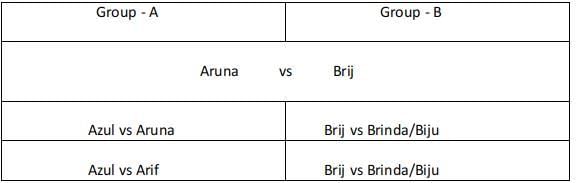
Sol: Group A :
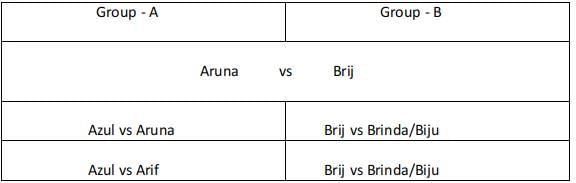
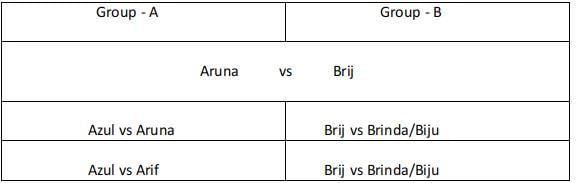
Since Aruna played 3 games if she belongs to rank 2 or rank 3 in her group she must have reached the semifinals and lost in the semifinals. But for this case, she must play against rank 1 and rank 3 in her group. But she did not play against Arif from her group.
Hence Aruna was ranked 1 in her group, Among Azul and Arif one of them was ranked 2 and the other was ranked 3. Azul defeated Arif in the first round and in the second round lost to Aruna. Aruna played her first round with Azul and won the round and played against the winner from group B and defeated them and moved to the finals.
Group B :
Brij did not play against Brinda. Biju played three games, Brij and Brinda played one game each.
Since Brij and Brinda played only one game each one of them was ranked 1 and the other was ranked 2 and 3. Brij did not play against Brinda. We are aware that Aruna reached finals and hence the person from Group B did not reach the finals. Biju played three games and hence must have played with Brij/Brinda in the first round and won the round. Plays with Brij/ Brinda and wins the second round. Plays with Aruna and loses the third round.
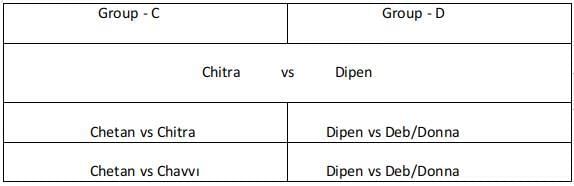
Group - C :
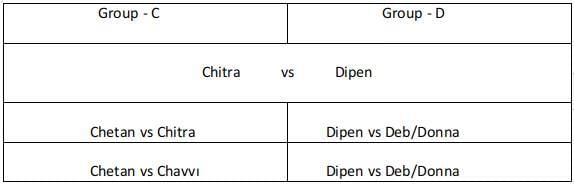
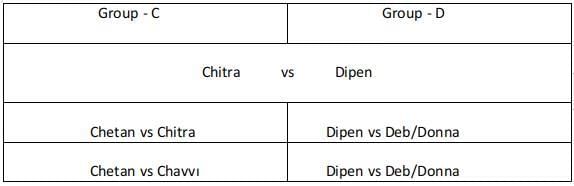
Chitra played 2 matches and Chetan played 2 matches. For Chitra to play 2 matches if she is rank 2 or rank 3 in her group. She must at least reach the semifinals. But in this case, Chetan will be defeated in his first round. So Chitra must be ranked 1 in her group and Chetan must be ranked 2 or rank 3 in his group. He defeats Chhavi in his first round and loses to Chitra in his second round. Chitra plays Chetan in her first round, wins over the winner of group D in her second round, and loses in the final against Aruna as per condition 1.
Group -D :
The person from Group D did not reach the finals because Chitra reached the finals. In order for Dipen to play 3 matches before his finals. Dipen must be ranked 2 or rank 3 in his group and plays Deb and Donna in the first two rounds in any order and wins over both of them. Dipen loses to Chitra in his third round.
Aruna plays Chitra in the finals and wins the final round.
Dipen was ranked 2 or 3 in his group
Q2: Who won the championship?
(a) Chitra
(b) Aruna
(c) Brij
(d) Cannot be determined
Ans: b
Sol: Group A :
Since Aruna played 3 games if she belongs to rank 2 or rank 3 in her group she must have reached the semifinals and lost in the semifinals. But for this case, she must play against rank 1 and rank 3 in her group. But she did not play against Arif from her group.
Hence Aruna was ranked 1 in her group, Among Azul and Arif one of them was ranked 2 and the other was ranked 3. Azul defeated Arif in the first round and in the second round lost to Aruna. Aruna played her first round with Azul and won the round and played against the winner from group B and defeated them and moved to the finals.
Group B :
Brij did not play against Brinda. Biju played three games, Brij and Brinda played one game each.
Since Brij and Brinda played only one game each one of them was ranked 1 and the other was ranked 2 and 3. Brij did not play against Brinda. We are aware that Aruna reached finals and hence the person from Group B did not reach the finals. Biju played three games and hence must have played with Brij/Brinda in the first round and won the round. Plays with Brij/ Brinda and wins the second round. Plays with Aruna and loses the third round.
Group - C :
Chitra played 2 matches and Chetan played 2 matches. For Chitra to play 2 matches if she is rank 2 or rank 3 in her group. She must at least reach the semifinals. But in this case, Chetan will be defeated in his first round. So Chitra must be ranked 1 in her group and Chetan must be ranked 2 or rank 3 in his group. He defeats Chhavi in his first round and loses to Chitra in his second round. Chitra plays Chetan in her first round, wins over the winner of group D in her second round, and loses in the final against Aruna as per condition 1.
Group -D :
The person from Group D did not reach the finals because Chitra reached the finals. In order for Dipen to play 3 matches before his finals. Dipen must be ranked 2 or rank 3 in his group and plays Deb and Donna in the first two rounds in any order and wins over both of them. Dipen loses to Chitra in his third round.Aruna plays Chitra in the finals and wins the final round.
Aruna is the winner.
Q3: Which of the following pairs must have played against each other in the championship?
(a) Deb, Donna
(b) Azul, Biju
(c) Donna, Chetan
(d) Chitra, Dipen
Ans: d
Sol: Group A :
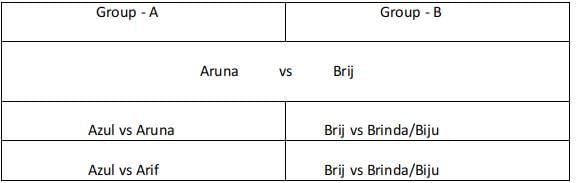
Since Aruna played 3 games if she belongs to rank 2 or rank 3 in her group she must have reached the semifinals and lost in the semifinals. But for this case, she must play against rank 1 and rank 3 in her group. But she did not play against Arif from her group.
Hence Aruna was ranked 1 in her group, Among Azul and Arif one of them was ranked 2 and the other was ranked 3. Azul defeated Arif in the first round and in the second round lost to Aruna. Aruna played her first round with Azul and won the round and played against the winner from group B and defeated them and moved to the finals.
Group B :
Brij did not play against Brinda. Biju played three games, Brij and Brinda played one game each.
Since Brij and Brinda played only one game each one of them was ranked 1 and the other was ranked 2 and 3. Brij did not play against Brinda. We are aware that Aruna reached finals and hence the person from Group B did not reach the finals. Biju played three games and hence must have played with Brij/Brinda in the first round and won the round. Plays with Brij/ Brinda and wins the second round. Plays with Aruna and loses the third round.
Group - C :
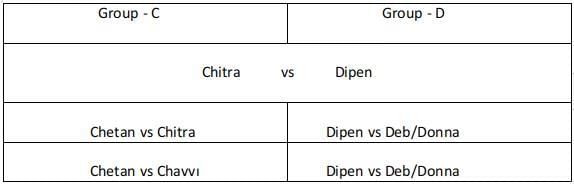
Chitra played 2 matches and Chetan played 2 matches. For Chitra to play 2 matches if she is rank 2 or rank 3 in her group. She must at least reach the semifinals. But in this case, Chetan will be defeated in his first round. So Chitra must be ranked 1 in her group and Chetan must be ranked 2 or rank 3 in his group. He defeats Chhavi in his first round and loses to Chitra in his second round. Chitra plays Chetan in her first round, wins over the winner of group D in her second round, and loses in the final against Aruna as per condition 1.
Group -D :
The person from Group D did not reach the finals because Chitra reached the finals. In order for Dipen to play 3 matches before his finals. Dipen must be ranked 2 or rank 3 in his group and plays Deb and Donna in the first two rounds in any order and wins over both of them. Dipen loses to Chitra in his third round.Aruna plays Chitra in the finals and wins the final round.
Chitra and Dipen played in the semifinals
Q4: Who among the following did NOT play against Chitra in the championship?
(a) Aruna
(b) Chetan
(c) Dipen
(d) Biju
Ans: d
Sol: Group A :
Since Aruna played 3 games if she belongs to rank 2 or rank 3 in her group she must have reached the semifinals and lost in the semifinals. But for this case, she must play against rank 1 and rank 3 in her group. But she did not play against Arif from her group.
Hence Aruna was ranked 1 in her group, Among Azul and Arif one of them was ranked 2 and the other was ranked 3. Azul defeated Arif in the first round and in the second round lost to Aruna. Aruna played her first round with Azul and won the round and played against the winner from group B and defeated them and moved to the finals.
Group B :
Brij did not play against Brinda. Biju played three games, Brij and Brinda played one game each.
Since Brij and Brinda played only one game each one of them was ranked 1 and the other was ranked 2 and 3. Brij did not play against Brinda. We are aware that Aruna reached finals and hence the person from Group B did not reach the finals. Biju played three games and hence must have played with Brij/Brinda in the first round and won the round. Plays with Brij/ Brinda and wins the second round. Plays with Aruna and loses the third round.
Group - C :
Chitra played 2 matches and Chetan played 2 matches. For Chitra to play 2 matches if she is rank 2 or rank 3 in her group. She must at least reach the semifinals. But in this case, Chetan will be defeated in his first round. So Chitra must be ranked 1 in her group and Chetan must be ranked 2 or rank 3 in his group. He defeats Chhavi in his first round and loses to Chitra in his second round. Chitra plays Chetan in her first round, wins over the winner of group D in her second round, and loses in the final against Aruna as per condition 1.
Group -D :
The person from Group D did not reach the finals because Chitra reached the finals. In order for Dipen to play 3 matches before his finals. Dipen must be ranked 2 or rank 3 in his group and plays Deb and Donna in the first two rounds in any order and wins over both of them. Dipen loses to Chitra in his third round.Aruna plays Chitra in the finals and wins the final round.
Brij was the player from group B who played Chitra. Aruna played in finals, Chetan in round 2, and Dipen in semi finals
FAQs on CAT Previous Year Questions: Arrangements
| 1. How do I solve circular arrangement problems in CAT without making mistakes? |  |
| 2. What's the difference between permutations and combinations when solving arrangement problems? | |
| 3. Why do some arrangement problems ask about clockwise vs anticlockwise directions? | |
| 4. How do I handle conditional constraints in linear and circular arrangement questions? | |
| 5. What common mistakes should I avoid in arrangement-type CAT questions? | |