Anthropology: Meaning, Scope & Development

Meaning
Anthropology is the study of humans, focusing on their biology and culture to understand how they originated and evolved over time. It examines the development of various beliefs, social customs, and the differences that set humans apart from other species.
The word "anthropology" comes from the Greek words "anthropos," meaning human, and "logus," meaning discourse or science. Essentially, it is the science or study of humans. The term was first used by Aristotle to describe the study of human beings.
Anthropology explores a wide range of topics, including:
- Biology and Evolutionary History: Understanding the biological makeup and evolutionary journey of Homo sapiens.
- Social Structures: Examining how societies are organized and function.
- Cultural Practices: Investigating the beliefs, customs, and practices that define different groups of people.
- Distinctions from Other Species: Identifying the unique features that differentiate humans from other animals, such as advanced communication, tool use, and social cooperation.
Due to its broad scope, anthropology has developed into various specialized fields, each focusing on different aspects of human life and society.
Definitions of Anthropology
- The concise oxford dictionary: study of mankind especially of its societies and customs; study of structure and evolution of man as an animal"
- Kroeber: "Anthropology is the science of groups of men and their behaviour and production".
- Herskovits: "Anthropology may be defined as the measurement of human beings."
- Jocobs and Stern: "Anthropology is the scientific study of the physical, social and cultural development and behavior of human beings since their appearance on this earth."
Scope
Anthropology has been divided into two main branches: Physical anthropology and cultural anthropology. These two main branches have been again, sub-divided into several other branches.
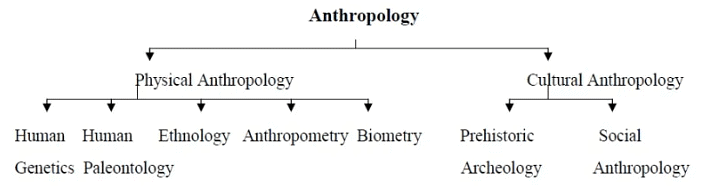
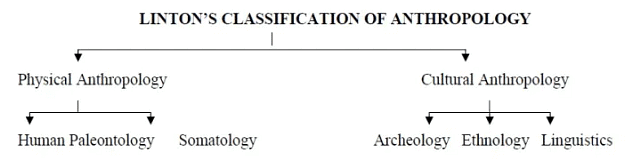
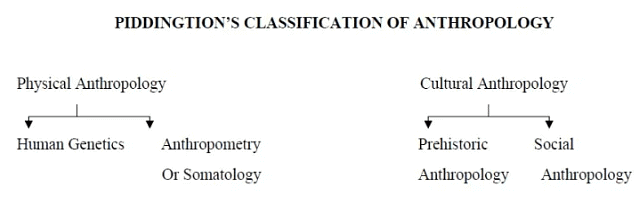
Physical anthropology is the branch that concentrates on the biology and evolution of humanity.
The branches that study the social and cultural constructions of human groups are variously recognized as belonging to cultural anthropology (or ethnology), social anthropology, linguistic anthropology, and psychological anthropology.
Archaeology , as the method of investigation of prehistoric cultures, has been an integral part of anthropology since it became a self-conscious discipline in the latter half of the 19th century.
1. Physical Anthropology
Physical anthology studies human body, genetic and the status of man among living beings.
- J.E. Manchip White: "Physical anthropology is the study of bodily appearance of man."
- Hoebel: "Physical anthropology is therefore the study of the physical characteristics of the human race as such".
- M.H. Herskovits: "Physical anthropology is, in essence, human biology."
- Piddington: "Physical anthropology is concerned with the bodily characteristics of man."
2. Cultural anthropology
Cultural anthropology studies human cultures. In order to carry on his personal and social life man invents some sort of system, develops and establishes it. This total system is culture. It is social heritage. It is however, not transmitted through heredity. It is learned through imitation, experience and understanding.
Cultural anthropology studies human customs, mores, traditions, social life, religion, art, science, literature and economic and political organization.
E.A. Hoebel: "The phase of anthropology that devotes its attention to the customs of mankind, is called cultural anthropology".
S.C. Dube: "Social anthropology is that part of cultural anthropology which devotes its primary attention to the study of social structure and religion rather than material aspects of culture." It is clear that social anthropology studies the different aspects of social structure such as social institutions, social relations and social events, etc.
Penniman: "That part of cultural anthropology which treats of social phenomena is called social anthropology".
M.N. Srinivas: "it is a comparative study of human societies. Ideally, it includes all societies, primitive, civilized and historic."
Charles Winick: "social anthropology is the study of social behaviour, especially from the point of view of the systematic comparative study of social forms and institutions."
Origin and Development of Anthropology
Appearance of anthropology as a discipline
Humanity's Fascination with Itself and Its Surroundings
- From ancient times, people have been deeply curious about themselves and their environment.
- This curiosity has driven the quest for understanding human nature and society.
- The study of humanity is not new; it has roots in ancient Greece.
Ancient Greek Civilization and Early Thinkers
- Systematic thinking about humanity often traces back to classical Greek civilization.
- Historians like Herodotus, along with thinkers such as Socrates,Aristotle,Hippocrates, and Plato, were among the first to show a keen interest in human affairs from a broad perspective.
- These early thinkers approached the study of humanity from a humanistic angle, considering people within the context of the universe.
The Birth of Anthropology as a Discipline
- Anthropology began to emerge as a separate field of study in the nineteenth century.
- In the past,Sydney Slotkin noted the early history of anthropological sub-disciplines dating back to the seventeenth and eighteenth centuries.
- However,professional interest in anthropology truly developed in the nineteenth century.
Formation of Ethnological Societies
- In 1839,Hodgkin and others established an Ethnological Society in Berlin.
- Similar societies were formed in London in 1841 and in New York in 1842.
Influence of Charles Darwin
- Darwin's "Origin of Species" in 1859 significantly impacted various scientific fields.
- His theory of evolution from unicellular to complex multicellular organisms opened new avenues for zoology,anatomy,physiology,philology,palaeontology,archaeology,geology, and socio-cultural studies.
Influence of Darwin and the Birth of Anthropology
- A group of intellectuals, including Spencer, Morgan, and Tylor, influenced by Darwin, concluded that evolution applied not only to the physical aspects of mankind but also to cultural life.
- The year 1859 is considered the birth year of anthropology. R.R. Marret (1912) referred to anthropology as the "child of Darwin."
Foundation of Anthropological Societies
- In the same year,1859, Paul Broca founded the Anthropological Society in Paris.
- Broca, an anatomist and human biologist, promoted the idea of general biology by integrating various specialized studies to understand humans.
- Following Broca's lead, anthropology made significant progress in America.
Debate and Establishment of Terminology
- From 1840 to 1870, there was a debate between the terms ethnology and anthropology.
- During this period, terms like anthropology, ethnology, ethnography, archaeology, prehistory, philology, and linguistics became firmly established.
- Eventually, anthropology acquired a synthesis character and gained recognition in both Europe and America.
Contributions of Key Figures
- Lewis Henry Morgan was a prominent figure who combined fieldwork in a native culture with comparative analysis and theory.
- He founded social-cultural anthropology through the comparative analysis of family and kinship structures.
- In Germany, a psychological and later a geographical tradition of cultural anthropology was established.
- Theodore Waitz developed physical anthropology, encompassing all world peoples.
- Adolf Bastain surveyed world cultures to infer about the basic psychological configuration of humans.
- Friedrich Ratzel combined geography and anthropology, creating anthropogeography.
Establishment of Anthropology as a Discipline
- Sir Edward Burnett Tylor(1832-1917) played a crucial role in establishing anthropology as an academically recognized discipline in Europe.
- In his influential book "Primitive Culture"(1871), Tylor defined culture as a complex whole, including knowledge, belief, art, morals, law, custom, and other capabilities and habits acquired by individuals as members of society.
- Tylor is often regarded as the father of modern anthropology.
Relationship Between Sociology and Anthropology
- Sociology and anthropology emerged as twin disciplines, particularly after the Industrial Revolution and colonial expansion.
Shifts in Anthropology After World War I
- After World War I, the perspective of anthropology shifted significantly.
- 19th-century anthropologists were often unfamiliar with the peoples they studied.
- Bronislaw Malinowski emphasized the importance of field study over speculation about primitive people.
Focus on Psychological Issues and National Character Studies
- During World War II, American anthropologists became focused on psychological issues and the characteristics of entire nations to understand the fundamental features of developed civilizations such as Japan,China, and Russia.
- National character studies gained popularity during this period.
Influence of Claude Levi-Strauss and Genetics
- After the war, the French scholar Claude Levi-Strauss contributed to anthropology by emphasizing the formal aspects of culture.
- By the end of World War II, the physical aspect of anthropology took a new direction, shifting from mere measurements to the study of growth and development, influenced by advances in genetics.
- Progress in the study of human genetics provided a basis for integrating physical and social anthropology.
Interest in Prehistory and Primitive Ethnography
- Anthropologists' interest in prehistory was closely related to primitive ethnography.
Evolutionary, Diffusionist, and Structural-Functional Theories
- The British Evolutionary and Diffusionist theories faced setbacks.
- The structural-functional theory emerged as a significant school of thought.
- This period marked the formative phase of the institutionalization of anthropology.
- British social anthropology gained global recognition.
Colonial Anthropology and Neo-Imperialism
- The concept of colonial anthropology or neo-imperialism in anthropology is a relatively recent development.
FAQs on Anthropology: Meaning, Scope & Development
| 1. What is anthropology and how is it different from other social sciences? |  |
| 2. What are the main branches of anthropology and what does each one study? | |
| 3. How does anthropology help us understand human society and culture better? | |
| 4. What is the scope of anthropology for UPSC preparation and how broad is this subject? | |
| 5. How did anthropology develop as an academic discipline and what shaped its evolution? | |





