Electrical Engineering (EE) Exam > Electrical Engineering (EE) Notes > Control Systems > Lag Lead Compensator
Lag Lead Compensator | Control Systems - Electrical Engineering (EE) PDF Download

Introduction
- A lag lead compensator is a type of electrical network that generates phase lag as well as phase lead in the output signal at different frequencies when a steady-state sinusoidal input is provided to it. It is also known as lag lead network.
- In case of a lag lead compensator, the phase lead and phase lag occur at different frequency regions. Generally, at low-frequency phase lag characteristics is noticed in the output of the circuit. While at high frequency, we have phase lead characteristics.
- Thus, we can say a phase lag lead network is a cascade combination of phase lag and phase lead network.
What is lag compensator?
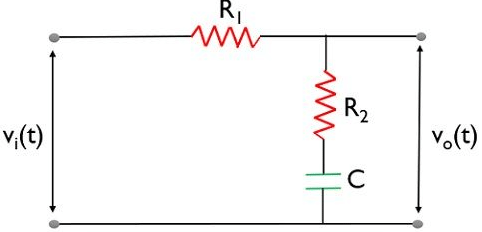
- A lag compensator is an electrical network that is designed to compensate a control system by adding a phase lag in the generated output signal when an input signal is applied to it.
What is lead compensator?
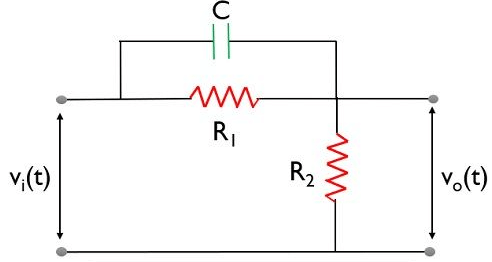
- Unlike a phase lag network, a phase lead compensator introduces a phase lead in the sinusoidal output of the system, whenever a steady-state input is provided to it.
Need for Lag Lead Compensator
- Generally, compensation in a control system is majorly done for two main reasons. Like for an absolutely unstable system, compensation is done in order to stabilize the system.
- While sometimes the system is stable still, we don’t achieve the desired performance where the desired performance depends on various system parameters.
- More simply, we can say, to have the accurate transient and steady-state response, a combination of lag and lead compensator is used.
- However, each of the compensating networks introduces some drawbacks along with improving the characteristics.
- A lag compensator improves the steady-state performance of the system but at the same time, such a network causes a reduction in the overall bandwidth.
- A lead compensator offers increased bandwidth, thus provides a fast response of the system, but this increases the susceptibility of the system towards noise.
Lag Lead Compensator
The figure below represents the circuit of a lag lead compensator: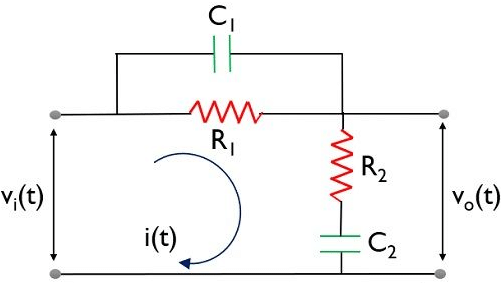
- It is clear from the circuit shown above that if C1 is eliminated from the above circuit, then that particular circuit will be a lag network. While if C2 is not present, then we get a lead network.
- This indicates that the above given network is a cascade combination of the lag as well as lead network.
- So, consider the circuit shown above.
- The loop current i(t) will be given as:

- The output equation is given as:

- We know that the transfer function of the system is the Laplace transform of the response of the system to the Laplace transform of the input. So, taking the Laplace transform of the above equations, we will get,
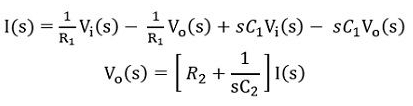
- Now substitute the value of I(s) in the above equation, we will have

- On simplifying,
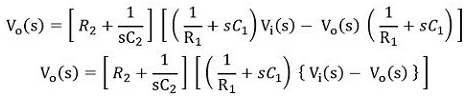
- Further,

- So,

- Therefore,
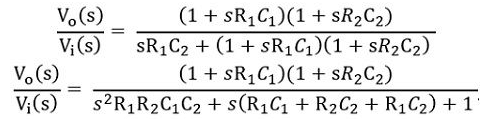
- On simplifying we will get,
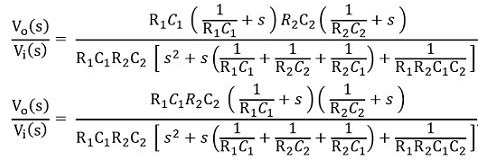
- On cancelling like terms from numerator and denominator, we will get
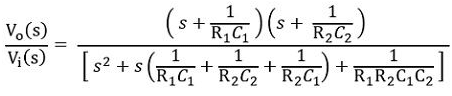
- In generalized form
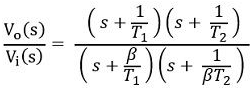
- So, on comparing,
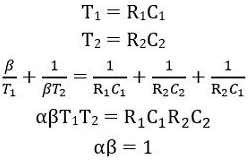
- Therefore,
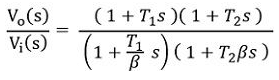
- Here the value of β > 1
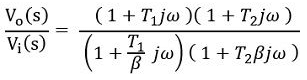
- Here poles are s = – β/T1, – 1/βT2 and zeros are at s = – 1/T1, – 1/T2
- The figure below shows the pole-zero plot of the lag lead compensator:
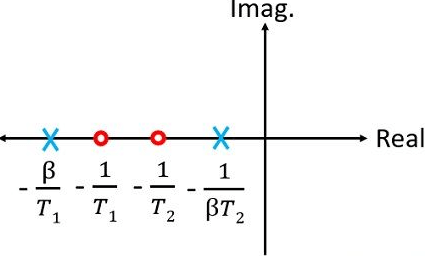
- Thus, in case of the lag lead compensator, a lead angle is added by the phase lead portion whereas attenuation near the crossover frequency is provided by the phase lag portion.
- Now, substituting s = jω in the above equation, the transfer function will be
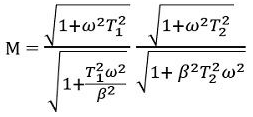
- So, the magnitude will be:
- Hence, the phase angle will be

Effects of Lag Lead Compensator
- The lead characteristics of the cascaded compensator provide improvement in the overall bandwidth.
- Also, due to the use of the lag network, the steady-state performance of the system gets improved.
So, we can say, a lag lead network provides a quick response with good accuracy. The low-frequency gain of the system is increased with this network, thereby improving the steady-state response. Hence, we use a combination of lag and lead network as a compensator to provide required compensation to the control system.
The document Lag Lead Compensator | Control Systems - Electrical Engineering (EE) is a part of the Electrical Engineering (EE) Course Control Systems.
All you need of Electrical Engineering (EE) at this link: Electrical Engineering (EE)
|
53 videos|107 docs|40 tests
|
About this Document

4.66/5
Rating

Oct 01, 2025
Last updated
Document Description: Lag Lead Compensator for Electrical Engineering (EE) 2025 is part of Control Systems preparation.
The notes and questions for Lag Lead Compensator have been prepared according to the Electrical Engineering (EE) exam syllabus. Information about Lag Lead Compensator covers topics
like Introduction and Lag Lead Compensator Example, for Electrical Engineering (EE) 2025 Exam. Find important definitions, questions, notes, meanings, examples, exercises and tests below for Lag Lead Compensator.
Introduction of Lag Lead Compensator in English is available as part of our Control Systems
for Electrical Engineering (EE) & Lag Lead Compensator in Hindi for Control Systems course.
Download more important topics related with notes, lectures and mock test series for Electrical Engineering (EE)
Exam by signing up for free. Electrical Engineering (EE): Lag Lead Compensator | Control Systems - Electrical Engineering (EE)
Description
Full syllabus notes, lecture & questions for Lag Lead Compensator | Control Systems - Electrical Engineering (EE) - Electrical Engineering (EE) | Plus excerises question with solution to help you revise complete syllabus for Control Systems | Best notes, free PDF download
Information about Lag Lead Compensator
In this doc you can find the meaning of Lag Lead Compensator defined & explained in the simplest way possible. Besides explaining types of
Lag Lead Compensator theory, EduRev gives you an ample number of questions to practice Lag Lead Compensator tests, examples and also practice Electrical Engineering (EE)
tests


Related Searches
Semester Notes
,video lectures
,Extra Questions
,Lag Lead Compensator | Control Systems - Electrical Engineering (EE)
,Sample Paper
,Viva Questions
,Previous Year Questions with Solutions
,Free
,study material
,Summary
,Exam
,ppt
,Objective type Questions
,Important questions
,Lag Lead Compensator | Control Systems - Electrical Engineering (EE)
,Lag Lead Compensator | Control Systems - Electrical Engineering (EE)
,practice quizzes
,MCQs
,shortcuts and tricks
,past year papers
,mock tests for examination
;




Additional Information about Lag Lead Compensator for Electrical Engineering (EE) Preparation
Lag Lead Compensator Free PDF Download
The Lag Lead Compensator is an invaluable resource that delves deep into the core of the Electrical Engineering (EE) exam.
These study notes are curated by experts and cover all the essential topics and concepts, making your preparation more efficient and effective.
With the help of these notes, you can grasp complex subjects quickly, revise important points easily,
and reinforce your understanding of key concepts. The study notes are presented in a concise and easy-to-understand manner,
allowing you to optimize your learning process. Whether you're looking for best-recommended books, sample papers, study material,
or toppers' notes, this PDF has got you covered. Download the Lag Lead Compensator now and kickstart your journey towards success in the Electrical Engineering (EE) exam.
Importance of Lag Lead Compensator
The importance of Lag Lead Compensator cannot be overstated, especially for Electrical Engineering (EE) aspirants.
This document holds the key to success in the Electrical Engineering (EE) exam.
It offers a detailed understanding of the concept, providing invaluable insights into the topic.
By knowing the concepts well in advance, students can plan their preparation effectively.
Utilize this indispensable guide for a well-rounded preparation and achieve your desired results.
Lag Lead Compensator Notes
Lag Lead Compensator Notes offer in-depth insights into the specific topic to help you master it with ease.
This comprehensive document covers all aspects related to Lag Lead Compensator.
It includes detailed information about the exam syllabus, recommended books, and study materials for a well-rounded preparation.
Practice papers and question papers enable you to assess your progress effectively.
Additionally, the paper analysis provides valuable tips for tackling the exam strategically.
Access to Toppers' notes gives you an edge in understanding complex concepts.
Whether you're a beginner or aiming for advanced proficiency, Lag Lead Compensator Notes on EduRev are your ultimate resource for success.
Lag Lead Compensator Electrical Engineering (EE) Questions
The "Lag Lead Compensator Electrical Engineering (EE) Questions" guide is a valuable resource for all aspiring students preparing for the
Electrical Engineering (EE) exam. It focuses on providing a wide range of practice questions to help students gauge
their understanding of the exam topics. These questions cover the entire syllabus, ensuring comprehensive preparation.
The guide includes previous years' question papers for students to familiarize themselves with the exam's format and difficulty level.
Additionally, it offers subject-specific question banks, allowing students to focus on weak areas and improve their performance.
Study Lag Lead Compensator on the App
Students of Electrical Engineering (EE) can study Lag Lead Compensator alongwith tests & analysis from the EduRev app,
which will help them while preparing for their exam. Apart from the Lag Lead Compensator,
students can also utilize the EduRev App for other study materials such as previous year question papers, syllabus, important questions, etc.
The EduRev App will make your learning easier as you can access it from anywhere you want.
The content of Lag Lead Compensator is prepared as per the latest Electrical Engineering (EE) syllabus.
|
© EduRev
|
Education Revolution
|


|




Signup to see your scores
go up within 7 days!
Access 1000+ FREE Docs, Videos and Tests
Takes less than 10 seconds to signup