CTET & State TET Exam > CTET & State TET Notes > Mathematics & Pedagogy Paper 2 for CTET & TET Exams > Important Formulas: Understanding Elementary Shapes
Important Formulas: Understanding Elementary Shapes


Measurement of Line Segment
- A line segment is defined as a segment of a line that is fixed in place. This enables the measurement of a line segment.
- The length of a line segment is the distance between its endpoints.
- When comparing the lengths of line segments, a graduated ruler and a divider are used. These methods give accurate length distance.
- Also, we can compare the two line segments by observation or with the help of trace paper. But, both the methods have very little accuracy and we can't trace the lengths every time.
Angles - 'Right' and 'Straight'
An example of an angle is when the hand of a clock shifts from one location to another.A right angle is used to turn from north to east.A full turn is made by turning in the same direction by two straight angles (or four right angles).The angle for one revolution is called a complete angle.One revolution's angle is a full angle.A protractor is used to calculate the size of an angle in degrees.A 1/4 revolution is aright angle, whereas a 1/2 revolution is a straight angle.
- From above,
Clock 1 represents 1/2 of revolution or 2 right angles.
Clock 2 represents 1/4 of revolution or 1 right angle, and
Clock 3 represents 3/4 of revolution or 3 right angles. - A right angle is 1/4 a revolution and a straight angle is 1/2 a revolution.
- Protractor is an instrument used to measure the size of an angle in degrees.
- The measure of a right angle is 90o and hence that of a straight angle is 180o.
- An angle is said to be acute if its measure is less than that of a right angle and is said to be obtuse if its measure is more than that of a right angle but is less than a straight angle.
- Sea-saw, rooftop, opening book, etc. are examples of an acute angle.
- House, desk for book reading, etc. are examples of an obtuse angle.
- A reflex angle is larger than a straight angle.
- Two intersecting lines are perpendicular if the angle between them is 90o.
- The perpendicular bisector of a line segment is perpendicular to the line segment that divides it into two equal parts.
Triangles
Triangles can be classified as follows based on their angles
Angles - 'Acute', 'Obtuse' and 'Reflex':
- An acute angle is an angle smaller than a right angle.
- An obtuse angle is one that is greater than a right angle but smaller than a straight one.
- A reflex angle is more than twice as large as a straight angle.

Triangles can be classified as follows based on the lengths of their sides:
Polygon
Polygons are named based on their sides: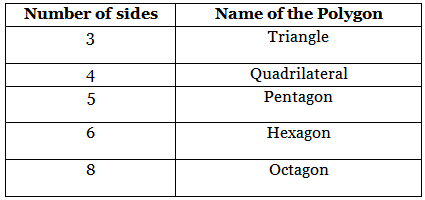
Quadrilaterals
Quadrilaterals are further classified with reference to their properties: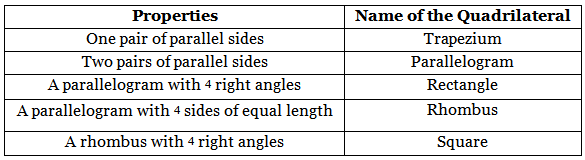
Faces, Edges, and Vertice
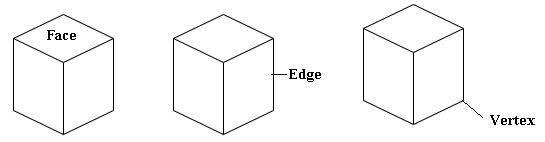
We see around us many three-dimensional shapes. Cubes, cuboids, spheres, Cylinders, cones, prisms, and pyramids are some of them.- Each side of the cube is a flat surface called a flat face (or simply a face).
- Two faces meet at a line segment called an edge.
- Three edges meet at a point called a vertex.
Prism
The triangular prism has a triangular base, whereas the rectangular prism has a rectangular base.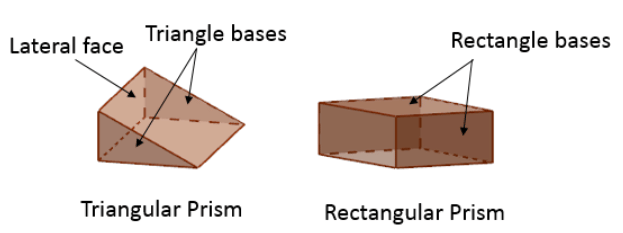
The document Important Formulas: Understanding Elementary Shapes is a part of the CTET & State TET Course Mathematics & Pedagogy Paper 2 for CTET & TET Exams.
All you need of CTET & State TET at this link: CTET & State TET
FAQs on Important Formulas: Understanding Elementary Shapes
| 1. What are the basic formulas for calculating the area and perimeter of a rectangle? |  |
Ans. The area of a rectangle can be calculated using the formula \( A = l \times w \), where \( l \) is the length and \( w \) is the width. The perimeter can be found with the formula \( P = 2(l + w) \).
| 2. How do you find the area and circumference of a circle? | |
Ans. The area of a circle is calculated using the formula \( A = \pi r^2 \), where \( r \) is the radius of the circle. The circumference can be found using the formula \( C = 2\pi r \).
| 3. What is the formula for the area of a triangle? | |
Ans. The area of a triangle can be calculated using the formula \( A = \frac{1}{2} b h \), where \( b \) is the base of the triangle and \( h \) is the height.
| 4. How do you calculate the volume of a cube? | |
Ans. The volume of a cube is calculated using the formula \( V = s^3 \), where \( s \) is the length of a side of the cube.
| 5. What formulas are used to find the surface area of a cylinder? | |
Ans. The surface area of a cylinder can be calculated using the formula \( SA = 2\pi r(h + r) \), where \( r \) is the radius of the base and \( h \) is the height of the cylinder.
About this Document

1.1K Views

4.79/5
Rating

Apr 18, 2026
Last updated
Related Exams
Document Description: Important Formulas: Understanding Elementary Shapes for CTET & State TET 2026 is part of Mathematics & Pedagogy Paper 2 for CTET & TET Exams preparation.
The notes and questions for Important Formulas: Understanding Elementary Shapes have been prepared according to the CTET & State TET exam syllabus. Information about Important Formulas: Understanding Elementary Shapes covers topics
like and Important Formulas: Understanding Elementary Shapes Example, for CTET & State TET 2026 Exam. Find important definitions, questions, notes, meanings, examples, exercises and tests below for Important Formulas: Understanding Elementary Shapes.
Introduction of Important Formulas: Understanding Elementary Shapes in English is available as part of our Mathematics & Pedagogy Paper 2 for CTET & TET Exams
for CTET & State TET & Important Formulas: Understanding Elementary Shapes in Hindi for Mathematics & Pedagogy Paper 2 for CTET & TET Exams course.
Download more important topics related with notes, lectures and mock test series for CTET & State TET
Exam by signing up for free. CTET & State TET: Important Formulas: Understanding Elementary Shapes
Description
Important Formulas: Understanding Elementary Shapes of Mathematics & Pedagogy Paper 2 on EduRev - covers all the formulas compiled in a single place. Download free PDF for last-minute revision.
Information about Important Formulas: Understanding Elementary Shapes
In this doc you can find the meaning of Important Formulas: Understanding Elementary Shapes defined & explained in the simplest way possible. Besides explaining types of
Important Formulas: Understanding Elementary Shapes theory, EduRev gives you an ample number of questions to practice Important Formulas: Understanding Elementary Shapes tests, examples and also practice CTET & State TET
tests



Related Searches
Important Formulas: Understanding Elementary Shapes, Previous Year Questions with Solutions, mock tests for examination, Extra Questions, Important Formulas: Understanding Elementary Shapes, study material, Objective type Questions, shortcuts and tricks, Semester Notes, Free, Important questions, practice quizzes, Sample Paper, Viva Questions, past year papers, video lectures, Exam, MCQs, Important Formulas: Understanding Elementary Shapes, Summary, pdf , ppt;