How to Master Animal Kingdom for NEET? | Topic-wise MCQ Tests for NEET PDF Download

In Biology, the Animal Kingdom is an essential chapter. Animal Kingdom is one of the five kingdoms according to the scheme of classification by Whittaker, that comprises multicellular eukaryotic animals.
As a top-scoring topic, Animal Kingdom carries around 7 to 8% weightage in NEET and candidates can expect direct questions from it.
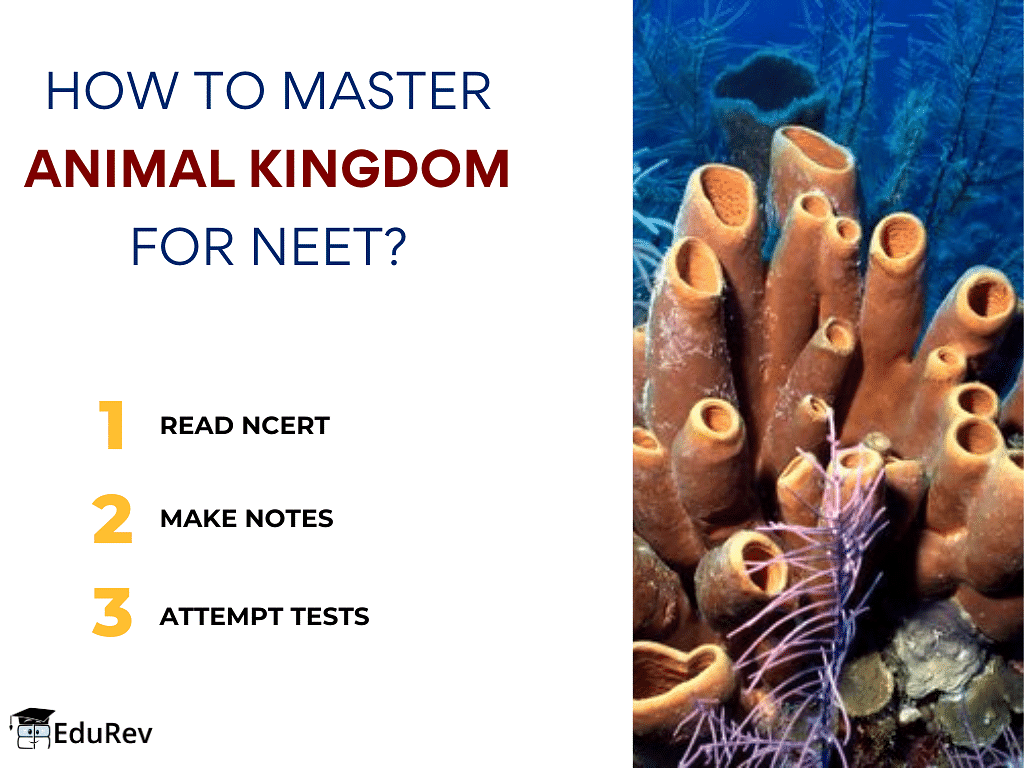
Here are some tips that you can follow to master the Animal Kingdom chapter for NEET Biology:
- Prepare from NCERTs: Read the chapter first and understand it. Preparing from NCERT would be best as many questions are directly asked from NCERTs from this chapter. This chapter mainly contains examples and clear-cut facts which do not need that much critical thinking.
- Make Notes: Make notes from NCERT, make them pointwise, include flowcharts and diagrams as well. Use sketch pens or color pens to make them attractive as in the last few months these notes are going to help you a lot in your preparation. Just read those notes once before going to bed daily.
- Common Names and Scientific Names: To master this chapter, you need to learn the common names with the respective scientific names. You can write all the names on a chart or a stick pad and can paste it on the wall in your room. Make sure to go through them again and again.
- Memorize the Animal Classification: Memorize the classification of animals based on their different phyla. Learn the characteristics of each phylum, including their habitat, morphology, and body systems.
- Revision Frequency: This chapter needs a lot of repeated revision. Revise the chapter once every week, and continue this frequency till 1–1.5 months before the exam. In the last month, revise it every 3–4 days.
- Practice Questions in a Strategic Manner: The important part you have to do for every chapter is to practice as much as MCQs as you can. To ace NEET, you need to practice a lot in a very limited time.
What to Read in the Chapter of Animal Kingdom?
- Introduction: Start with the introduction to the Animal Kingdom, its features, and diversity. Understand the importance of studying the Animal Kingdom, and its significance in the field of Biology.
- Basis of Classification: Learn the basis of classification of animals into different phyla. Understanding the classification system is important for recognizing the characteristics of animals belonging to different phyla.
- Phylum Porifera: Study the characteristics, structure, and reproduction of Porifera, also known as sponges. Porifera is important to study as they are one of the simplest animals in the Animal Kingdom.
- Phylum Cnidaria: Learn the characteristics, structure, and reproduction of Cnidaria, including jellyfish, corals, and sea anemones. Cnidaria is important to study as they possess a unique type of cells called Cnidocytes.
- Phylum Platyhelminthes: Study the characteristics, structure, and reproduction of Platyhelminthes, including tapeworms and flatworms. Platyhelminthes is important to study as they are the simplest organisms to exhibit bilateral symmetry.
- Phylum Nematoda: Learn the characteristics, structure, and reproduction of Nematoda, including roundworms. Nematoda is important to study as they are one of the most abundant organisms on earth.
- Phylum Annelida: Study the characteristics, structure, and reproduction of Annelida, including earthworms, leeches, and marine worms. Annelida is important to study as they exhibit a segmented body.
- Phylum Arthropoda: Learn the characteristics, structure, and reproduction of Arthropoda, including insects, spiders, and crustaceans. Arthropoda is important to study as they are the most diverse group of animals in the Animal Kingdom.
- Phylum Mollusca: Study the characteristics, structure, and reproduction of Mollusca, including snails, clams, and squids. Mollusca is important to study as they possess a unique structure called a mantle.
- Phylum Echinodermata: Learn the characteristics, structure, and reproduction of Echinodermata, including starfish, sea urchins, and sea cucumbers. Echinodermata is important to study as they possess a unique water vascular system.
- Chordata: Study the characteristics, structure, and reproduction of Chordata, including fishes, amphibians, reptiles, birds, and mammals. Chordata is important to study as they are the most complex organisms in the Animal Kingdom and possess a notochord, dorsal hollow nerve cord, pharyngeal slits, and post-anal tail.
To better understand the topic, it is recommended that you refer to the notes specific to particular topics. These notes can help you clear any doubts and gain a deeper understanding of the subject matter:
- Chapter Notes: Animal Kingdom
- Symmetry, Diploblastic & Triploblastic Organisation
- Coelom, Segmentation & Notochord
- Phylum Porifera & Phylum Coelenterata
- Phylum - Aschelminthes (Nematoda)
- Phyla - Platyhelminthes & Annelida
- Phyla - Echinodermata & Hemichordata
- Phylum - Ctenophora
- Phyla - Arthropoda & Mollusca
- Class - Aves
- Class - Amphibia, Reptilia & Mammalia
- Super Class - Pisces (Chondrichthyes & Osteichthyes)
- Sub-phylum - Vertebrata
Here’s how you can practice questions of the chapter “Animal Kingdom” in a strategic manner for NEET.
Topic Wise Tests
After covering the topics thoroughly. You should practice topic-wise questions from the chapter, which will help you to retain the concepts for a longer period of time.
Here are the topic-wise tests of Animal Kingdom Chapter which you can attempt for a stronger understanding:
OneTime: Test: Ascaris - 1
OneTime: Test: Ascaris - 2
OneTime: Test: Ascaris - 3
OneTime: Test: Hydra - 1
OneTime: Test: Hydra - 2
OneTime: Test: Amoeba - 1
OneTime: Test: Amoeba - 2
OneTime: Test: Entamoeba
OneTime: Test: Phylum Protochordata & Class Amphibia
OneTime: Test: Basis of Classification
OneTime: Test: Classification of Non-Chordates
OneTime: Test: Classification of Chordates
Chapter Wise Tests and PYQs
After strengthening your topics make sure you practice the questions of entire chapter well enough. Solving chapter-wise previous year questions is the most important part during NEET preparation. Many questions in NEET Exam are repeated from previous years questions only. PYQs make you aware of the important topics and their weightage and give you immense confidence.
Here are the chapter-wise tests and chapter-wise NEET PYQs that you can attempt for this chapter:
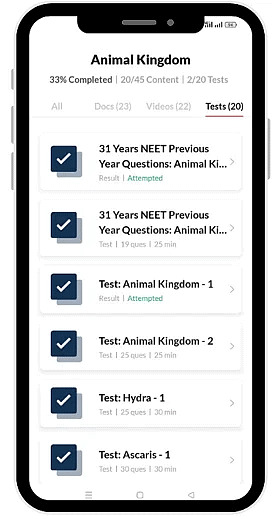 Chapter-wise tests, topic-wise tests & PYQs of the chapter Animal KingdomOneTime: Test: Animal Kingdom - 1
OneTime: Test: Animal Kingdom - 2
OneTime: Test: Animal Kingdom - 3
OneTime: 31 Years NEET Previous Year Questions: Animal Kingdom - 1
OneTime: 31 Years NEET Previous Year Questions: Animal Kingdom - 2
OneTime: 31 Years NEET Previous Year Questions: Animal Kingdom - 3
OneTime: Assertion & Reason Test: Animal Kingdom
|
9 docs|806 tests
|
FAQs on How to Master Animal Kingdom for NEET? - Topic-wise MCQ Tests for NEET
| 1. What is the importance of studying Animal Kingdom for NEET? |  |
| 2. How can I effectively study Animal Kingdom for NEET? | |
| 3. What are some important topics to cover in Animal Kingdom for NEET? | |
| 4. What are some common mistakes to avoid while studying Animal Kingdom for NEET? | |
| 5. How can I remember the classification and characteristics of different animal groups for NEET? | |





Important questions
,Sample Paper
,past year papers
,Objective type Questions
,Viva Questions
,Semester Notes
,practice quizzes
,How to Master Animal Kingdom for NEET? | Topic-wise MCQ Tests for NEET
,Previous Year Questions with Solutions
,How to Master Animal Kingdom for NEET? | Topic-wise MCQ Tests for NEET
,Exam
,Summary
,shortcuts and tricks
,How to Master Animal Kingdom for NEET? | Topic-wise MCQ Tests for NEET
,Extra Questions
,mock tests for examination
,MCQs
,video lectures
,study material
,ppt
,Free
;



How to Master Animal Kingdom for NEET? Free PDF Download
Importance of How to Master Animal Kingdom for NEET?
How to Master Animal Kingdom for NEET? Notes
How to Master Animal Kingdom for NEET? NEET Questions
Study How to Master Animal Kingdom for NEET? on the App
|
© EduRev
|
Education Revolution
|


|




within 7 days!