Engineering Mathematics Exam  >  Engineering Mathematics Notes  >  Engineering Mathematics  >  Matrix Diagonalization - Engineering - Engineering

Matrix Diagonalization - Engineering - Engineering

Introduction

Let A and B be square matrices of order n. The matrix B is said to be similar to A if there exists an invertible matrix P such that

B = P-1 A P

This relation is called a matrix similarity transformation. Similar matrices represent the same linear transformation with respect to different choices of basis.

Diagonalisation of a matrix is the process of converting a square matrix A into a diagonal matrix D by a similarity transformation. That is, if there exists an invertible matrix P such that

D = P-1 A P

then A is said to be diagonalizable, and the matrix P is often called a modal matrix.

Modal matrix: It is an n × n matrix whose columns are eigenvectors of A. The modal matrix is used to diagonalise A when a full set of linearly independent eigenvectors exists.

Basic idea

If the columns of P are eigenvectors of A, and the corresponding eigenvalues are placed on the diagonal of D in the same order, then the similarity relation A = P D P-1 (equivalently D = P-1 A P) holds. Diagonal matrices are simpler to work with; many matrix computations (powers, exponentials, solving systems) become easier when matrices are diagonal.

Procedure (computational steps for diagonalisation)

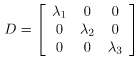
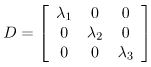
  1. Set up the diagonal matrix D with unknown diagonal entries that will turn out to be eigenvalues:
    Procedure (computational steps for diagonalisation)
  2. Find the eigenvalues by solving the characteristic equation det(A - λI) = 0. Here I is the n × n identity matrix and λ denotes an eigenvalue.
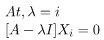
  3. For each eigenvalue λi, compute the corresponding eigenvectors by solving (A - λiI) Xi = 0.
    Procedure (computational steps for diagonalisation)
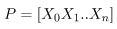
  4. Form the modal matrix P by placing the eigenvectors as columns in P in the same order as the eigenvalues will appear on the diagonal of D:
    Procedure (computational steps for diagonalisation)
  5. Check that P is invertible (i.e., det(P) ≠ 0). If invertible, compute P-1 and obtain the diagonal matrix by D = P-1 A P.

Key theoretical facts

  • Characterisation: A matrix A of order n is diagonalizable over a field if and only if there exists a basis of the vector space consisting entirely of eigenvectors of A. Equivalently, A is diagonalizable iff it has n linearly independent eigenvectors.
  • Distinct eigenvalues: If an n × n matrix has n distinct eigenvalues (all algebraic multiplicities are 1), then it is diagonalizable. This is a convenient sufficient condition.
  • Algebraic and geometric multiplicity: For each eigenvalue, algebraic multiplicity is its multiplicity as a root of the characteristic polynomial. Geometric multiplicity is the dimension of the eigenspace (number of independent eigenvectors for that eigenvalue). A necessary and sufficient condition for diagonalizability is that for each eigenvalue the geometric multiplicity equals its algebraic multiplicity, and the sum of geometric multiplicities is n.
  • Non-diagonalisable (defective) matrices: If for some eigenvalue the geometric multiplicity is strictly less than its algebraic multiplicity, then the matrix is not diagonalizable (it is said to be defective). Such matrices can be brought to Jordan canonical form instead of a diagonal form.
  • Similarity preserves characteristic polynomial: Similar matrices have the same characteristic polynomial and hence the same eigenvalues (with the same algebraic multiplicities).
  • Real symmetric matrices: A real symmetric matrix is always diagonalizable by an orthogonal matrix. That is, for a real symmetric matrix A there exists an orthogonal matrix Q (QTQ = I) such that A = Q D QT, where D is real and diagonal. Eigenvectors corresponding to distinct eigenvalues are orthogonal.

Why diagonalisation is useful (applications in engineering)

  • Computing matrix powers: Ak = P Dk P-1, so powers reduce to powering diagonal entries.
  • Solving linear systems of ODEs: Systems x' = A x become simple when transformed to diagonal coordinates; each scalar equation decouples.
  • Modal analysis (structural and mechanical engineering): Natural frequencies and mode shapes correspond to eigenvalues and eigenvectors; diagonalisation decouples equations of motion.
  • Control and stability (electrical and control engineering): Diagonalisation simplifies analysis of system response, stability and controllability in state-space form.
  • Principal component analysis (computer science, data engineering): Diagonalisation of covariance matrices (via orthogonal diagonalisation) identifies principal directions.

Proof sketch: diagonalisation ⇔ n independent eigenvectors

If A = P D P-1 with D diagonal, then columns of P are eigenvectors of A and D contains the corresponding eigenvalues on its diagonal.

Conversely, if A has n linearly independent eigenvectors v1,...,vn, form P = [v1 ... vn] and let D be the diagonal matrix with diagonal entries λ1,...,λn where A vi = λi vi. Then AP = P D and hence P-1 A P = D.

Example Problem

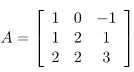
Problem Statement: Assume a 3×3 square matrix A having the following values:

Example Problem

Find the diagonal matrix D of A using the diagonalization of the matrix. [ D = P-1AP ]

Step 1: Initializing D as:

Example Problem

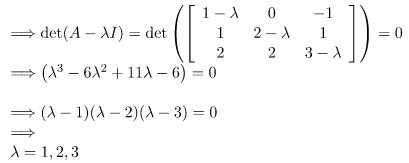
Step 2: Find the eigen values. (or possible values of λ)

Example Problem
Example Problem

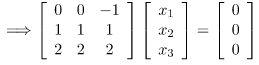
Step 3: Find the eigen vectors X1, X2, X3 corresponding to the eigen values λ = 1,2,3.

Example Problem
Example Problem
Example Problem

On solving, we get the following equation

x3 = 0 (x1)x1 + x2 = 0

Example Problem
Example Problem

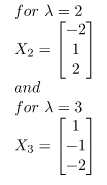
Similarly, for λ = 2

Example Problem

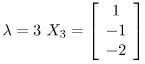
and for

Example Problem

similarly

Example Problem

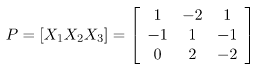
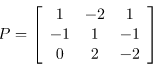
Step 5: Creation of modal matrix P. (here, X1, X2, X3 are column vectors)

Example Problem

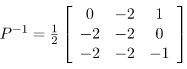
Step 6: Finding P-1 and then putting values in diagonalization of a matrix equation. [D = P-1AP]

We do Step 6 to find out which eigenvalue will replace λ1, λ2, and λ3 in the initial diagonal matrix created in Step 1.

Example Problem
Example Problem
Example Problem

Since det(P) ≠ 0 ⇒ Matrix P is invertible

we know that

Example Problem

On solving, we get

Example Problem

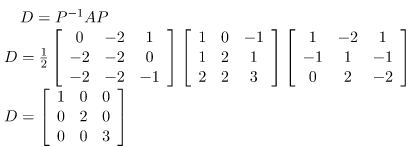
Putting in the Diagonalization of Matrix equation, we get
Example Problem

Sol. Detailed worked explanation (step-by-step)

Compute the characteristic polynomial:

Form the matrix A - λI and compute det(A - λI) = 0 to obtain the eigenvalues.

For each eigenvalue λi, solve the homogeneous linear system (A - λiI) X = 0 to obtain the eigenspace and basis eigenvectors corresponding to λi.

Collect one independent eigenvector from each eigenspace until you have three independent vectors (for a 3×3 matrix). Place these eigenvectors as columns of P in the same order as their eigenvalues will be placed on the diagonal of D.

Verify that det(P) ≠ 0 to ensure P is invertible.

Compute P-1 (for a 3×3 matrix use the adjoint/determinant method or Gaussian elimination) and form D = P-1 A P.

The diagonal entries of D are the eigenvalues placed in the order corresponding to the columns of P. The final D is thus a diagonal matrix with those eigenvalues on its diagonal.

Remarks on the provided worked example

  • The sequence of images above (Remarks on the provided worked example ... Remarks on the provided worked example) in the example shows the characteristic polynomial calculation, eigenvector computations, the modal matrix P, the inverse P-1, and the resulting diagonal matrix D. These illustrate the standard computational route described in the procedure.
  • Keep the ordering of eigenvectors consistent: the i-th column of P must correspond to the eigenvalue that is placed in the i-th diagonal position of D.
  • When eigenvalues repeat, ensure you have enough independent eigenvectors for each repeated eigenvalue. If not enough are present, the matrix is not diagonalizable.

Practical tips and common pitfalls

  • Always check linear independence of eigenvectors before computing P-1.
  • When working over the real numbers, a real matrix with non-real complex eigenvalues cannot be diagonalised over R into a real diagonal matrix - complex diagonalisation is possible over C.
  • For symmetric (or Hermitian) matrices use orthogonal (or unitary) diagonalisation to obtain numerically stable computations and orthonormal eigenvectors.
  • Use diagonalisation to compute functions of matrices (e.g., exp(A)) by applying the function to diagonal entries.

Summary - Diagonalisation reduces a matrix to a diagonal form by a similarity transformation using a modal matrix whose columns are eigenvectors. A matrix is diagonalizable iff it has a full set of linearly independent eigenvectors; real symmetric matrices are always diagonalizable by orthogonal matrices. Diagonalisation is a central tool in many engineering computations including modal analysis, solution of linear differential systems, and efficient computation of matrix powers.

The document Matrix Diagonalization - Engineering - Engineering is a part of the Engineering Mathematics Course Engineering Mathematics.
All you need of Engineering Mathematics at this link: Engineering Mathematics
71 videos|135 docs|94 tests

FAQs on Matrix Diagonalization - Engineering - Engineering

1. What is matrix diagonalization?
Ans.Matrix diagonalization refers to the process of finding a diagonal matrix that is similar to a given matrix. It involves finding a matrix P such that P^(-1)AP is a diagonal matrix, where A is the given matrix.
2. How is matrix diagonalization useful?
Ans.Matrix diagonalization is useful in various areas of mathematics and science, particularly in linear algebra. It simplifies calculations involving matrix powers, matrix exponentials, and matrix equations. It also helps in understanding the properties and behavior of the given matrix.
3. Can every matrix be diagonalized?
Ans.No, not every matrix can be diagonalized. A matrix can only be diagonalized if it satisfies certain conditions. One of the conditions is that the matrix should have n linearly independent eigenvectors, where n is the size of the matrix. If the matrix does not meet these conditions, it cannot be diagonalized.
4. How do you diagonalize a matrix?
Ans.To diagonalize a matrix, follow these steps: 1. Find the eigenvalues of the matrix by solving the characteristic equation. 2. For each eigenvalue, find its corresponding eigenvectors. 3. If the matrix has n linearly independent eigenvectors, form a matrix P by placing the eigenvectors as columns. 4. Calculate P^(-1) and form the diagonal matrix D by placing the eigenvalues along the main diagonal. 5. Finally, the diagonalized matrix is given by P^(-1)AP = D.
5. Can a matrix have multiple diagonalizations?
Ans.Yes, a matrix can have multiple diagonalizations. If a matrix has repeated eigenvalues, it can have different sets of linearly independent eigenvectors associated with each eigenvalue. Therefore, different choices of eigenvectors can lead to different diagonalizations of the same matrix.
Related Searches
past year papers, mock tests for examination, Summary, Extra Questions, study material, Objective type Questions, video lectures, Exam, Matrix Diagonalization - Engineering - Engineering , MCQs, Sample Paper, Semester Notes, shortcuts and tricks, Free, pdf , Viva Questions, Previous Year Questions with Solutions, Matrix Diagonalization - Engineering - Engineering , ppt, Important questions, practice quizzes, Matrix Diagonalization - Engineering - Engineering ;