UPSC Exam > UPSC Notes > Famous Books for UPSC Exam (Summary & Tests) > Nervous System
Nervous System | Famous Books for UPSC Exam (Summary & Tests) PDF Download

Introduction
- Unit is Neuron.
- Largest cell of our body is Neuron .
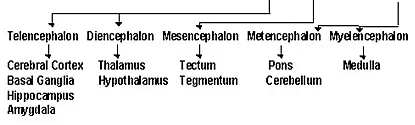
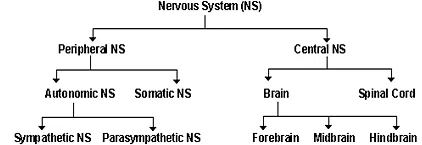
Nervous System is of following types:
- Central Nervous System : Brain + Spinal Chord
- Peripheral Nervous System : Nerves
- Autonomic Nervous System : Sympathetic + Parasympathetic Nervous System.
A. Central Nervous System :
Consists of Brain and Spinal Cord
Brain :
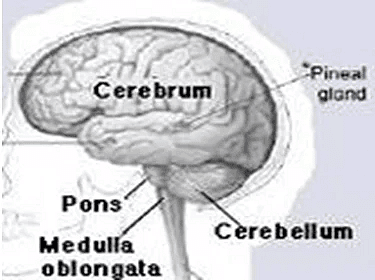
- Brain has the following parts :
(a) Cerebrum
(b) Cerebellum
(c) Medulla Oblongata :
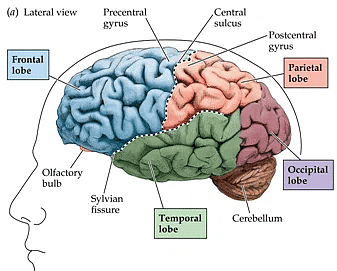
(a) Cerebrum
2 distinct Parts : Outer Grey Matter or Cerebral Cortex and Inner White Matter.
- Grey Matter Controls Activities such as Speech, Taste, Smell, Hearing (Conscious Activities).
- It is the seat of Intelligence, Reasoning, Learning, will pleasure, Pain, Fear, etc. Beneath the Grey Matter is White Matter.
- If cerebrum is removed, the person will become a simple reflex animal.
(b) Cerebellum
- Concerned with equilibrium of the body and brings about co - ordination and control of muscular activities of the body.
(c) Medulla Oblongata :
- Lowest Part of the brain and is connected to the Spinal Cord.
- Controls the involuntary actions (Respiration, Heart Beat, Flow of Blood in Blood Vessels, Secretion of Glands, etc).
Nerves :
- It is of 2 Types :
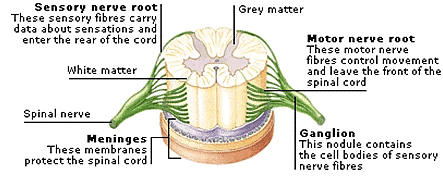
- Efferent : The fibres which carry impulses from the CNS. Many of them pass through the muscles making them to contract, and are therefore called Motor Nerve Fibres.
- Afferent : Those which carry impulses to the CNS. The information which they transmit from the skin and deeper tissues often evokes subjective sensation within the nervous system and are therefore called Sensory Nerve Fibres.
B. Peripheral Nervous System :
- Composed of Cranial Nerves and Spinal Nerves.
- Cranial arise from Brain While Spinal from Spinal Cord.
- Cranial are 12 pairs while spinal are 31 pairs.
The following are the Cranial Nerves in man.
They can broadly be divided into Sensory, Motor and mixed Nerves.
- Olfactory : Sensory
- Optic : Sensory
- Occulomotor : Motor
- Trochlear : Motor
- Trigeminal : Mixed
- Abducens : Motor (smallest)
- Facial : Mixed
- Auditory : Sensory
- Glosso pharyngeal : Mixed
- Vagus : Mixed (largest)
- Spinal Accessory : Motor
- Hypoglossal : Motor
C. Autonomous Nervous System :
- Not under voluntary control.
- Controlled by Central Nervous System.
- Controls, Digestion, Excretion, Secretion of Sweat and Digestive Juices, etc.
- Divided into two:
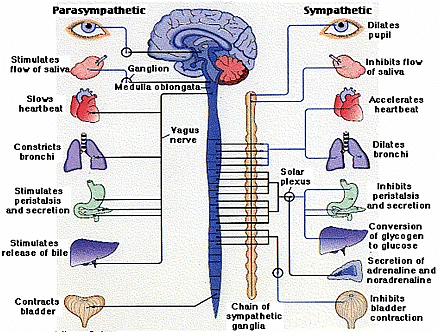
- 1. Sympathetic Nervous System
- 2. Parasympathetic Nervous System :
1. Sympathetic Nervous System :
- Increases the defence of body against adverse conditions.
- It is active in stress condition, pain, fear and anger.
- Speeds up heartbeat etc.
- Expenditure of energy takes place.
2. Parasympathetic Nervous System :
- Provides relaxation, comfort and pleasure at the time of rest.
- Lowers heartbeat, thus lowering the BP.
- Restoration and conservation of energy takes place.
The document Nervous System | Famous Books for UPSC Exam (Summary & Tests) is a part of the UPSC Course Famous Books for UPSC Exam (Summary & Tests).
All you need of UPSC at this link: UPSC
|
744 videos|1444 docs|633 tests
|
About this Document

4.96/5
Rating

Oct 11, 2025
Last updated
Related Exams
Document Description: Nervous System for UPSC 2025 is part of Famous Books for UPSC Exam (Summary & Tests) preparation.
The notes and questions for Nervous System have been prepared according to the UPSC exam syllabus. Information about Nervous System covers topics
like Introduction and Nervous System Example, for UPSC 2025 Exam. Find important definitions, questions, notes, meanings, examples, exercises and tests below for Nervous System.
Introduction of Nervous System in English is available as part of our Famous Books for UPSC Exam (Summary & Tests)
for UPSC & Nervous System in Hindi for Famous Books for UPSC Exam (Summary & Tests) course.
Download more important topics related with notes, lectures and mock test series for UPSC
Exam by signing up for free. UPSC: Nervous System | Famous Books for UPSC Exam (Summary & Tests)
Description
Full syllabus notes, lecture & questions for Nervous System | Famous Books for UPSC Exam (Summary & Tests) - UPSC | Plus excerises question with solution to help you revise complete syllabus for Famous Books for UPSC Exam (Summary & Tests) | Best notes, free PDF download
Information about Nervous System
In this doc you can find the meaning of Nervous System defined & explained in the simplest way possible. Besides explaining types of
Nervous System theory, EduRev gives you an ample number of questions to practice Nervous System tests, examples and also practice UPSC
tests


Related Searches
Previous Year Questions with Solutions
,practice quizzes
,Nervous System | Famous Books for UPSC Exam (Summary & Tests)
,Extra Questions
,MCQs
,ppt
,shortcuts and tricks
,Viva Questions
,Summary
,video lectures
,past year papers
,study material
,mock tests for examination
,Nervous System | Famous Books for UPSC Exam (Summary & Tests)
,Semester Notes
,Important questions
,Exam
,Nervous System | Famous Books for UPSC Exam (Summary & Tests)
,Free
,Sample Paper
,Objective type Questions
;



Additional Information about Nervous System for UPSC Preparation
Nervous System Free PDF Download
The Nervous System is an invaluable resource that delves deep into the core of the UPSC exam.
These study notes are curated by experts and cover all the essential topics and concepts, making your preparation more efficient and effective.
With the help of these notes, you can grasp complex subjects quickly, revise important points easily,
and reinforce your understanding of key concepts. The study notes are presented in a concise and easy-to-understand manner,
allowing you to optimize your learning process. Whether you're looking for best-recommended books, sample papers, study material,
or toppers' notes, this PDF has got you covered. Download the Nervous System now and kickstart your journey towards success in the UPSC exam.
Importance of Nervous System
The importance of Nervous System cannot be overstated, especially for UPSC aspirants.
This document holds the key to success in the UPSC exam.
It offers a detailed understanding of the concept, providing invaluable insights into the topic.
By knowing the concepts well in advance, students can plan their preparation effectively.
Utilize this indispensable guide for a well-rounded preparation and achieve your desired results.
Nervous System Notes
Nervous System Notes offer in-depth insights into the specific topic to help you master it with ease.
This comprehensive document covers all aspects related to Nervous System.
It includes detailed information about the exam syllabus, recommended books, and study materials for a well-rounded preparation.
Practice papers and question papers enable you to assess your progress effectively.
Additionally, the paper analysis provides valuable tips for tackling the exam strategically.
Access to Toppers' notes gives you an edge in understanding complex concepts.
Whether you're a beginner or aiming for advanced proficiency, Nervous System Notes on EduRev are your ultimate resource for success.
Nervous System UPSC Questions
The "Nervous System UPSC Questions" guide is a valuable resource for all aspiring students preparing for the
UPSC exam. It focuses on providing a wide range of practice questions to help students gauge
their understanding of the exam topics. These questions cover the entire syllabus, ensuring comprehensive preparation.
The guide includes previous years' question papers for students to familiarize themselves with the exam's format and difficulty level.
Additionally, it offers subject-specific question banks, allowing students to focus on weak areas and improve their performance.
Study Nervous System on the App
Students of UPSC can study Nervous System alongwith tests & analysis from the EduRev app,
which will help them while preparing for their exam. Apart from the Nervous System,
students can also utilize the EduRev App for other study materials such as previous year question papers, syllabus, important questions, etc.
The EduRev App will make your learning easier as you can access it from anywhere you want.
The content of Nervous System is prepared as per the latest UPSC syllabus.
|
© EduRev
|
Education Revolution
|


|




Signup on EduRev and stay on top of your study goals
10M+ students crushing their study goals daily