CBSE Class 10 > Class 10 Notes > Science > Important Equations and Definitions: Electricity
Important Equations and Definitions: Electricity


Electric Current
- Definition: The flow of electric charge is known as Electric Current. It is carried by moving electrons through a conductor.
- Direction: By convention, electric current flows in the opposite direction to the movement of electrons.
- Electric Circuit: A continuous and closed path of electric current.
Expression of Electric Current
- Symbol: Electric current is denoted by the letter 'I'.
- Formula: If a net electric charge (Q) flows through a conductor in time t, then

S.I. Units
- Electric Charge: Coulomb (C). 1 C=6×10¹⁸ electrons.
- Electric Current: Ampere (A). 1 A=1 C/s.
Small Quantities
- Milliampere (mA): 1 mA=10-3 A
- Microampere (μA): 1 μA=10-6 A
Instruments
- Ammeter: Measures electric current in a circuit.
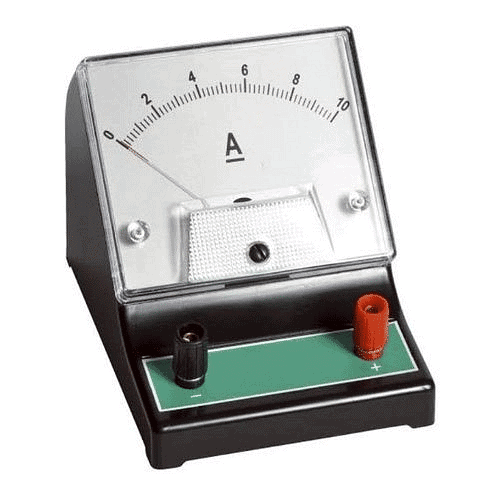 Ammeter
Electric Charge and Potential
- Charge: Fundamental property of matter. Two types: Positive and Negative.
- Properties of Electric Charge:
- Unlike charges attract, like charges repel.
- Force between charges varies with the product of charges and inversely with the square of the distance.
Electric Potential and Potential Difference
- Electric Potential: Amount of electric potential energy at a point.
- Potential Difference (Voltage): Difference in electric potential energy between two points.
V=W/Q - S.I. Unit: Volt (V).
Instruments
- Voltmeter: Measures potential difference.
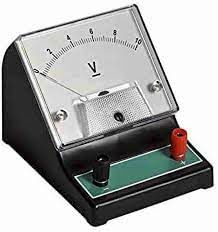 Voltmeter
- Galvanometer: Detects current in a circuit.
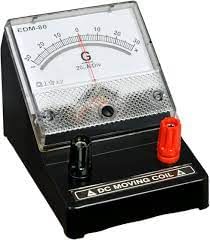 Galvanometer
Ohm's Law
- Statement: Potential difference is directly proportional to electric current at constant temperature.

- Resistance: Property resisting electric current. Unit: Ohm (ΩΩ).
Factors Affecting Resistance
- Nature: Good conductors vs. insulators.
- Length:R ∝ l
- Area of Cross Section: R ∝ 1/A
- Specific Resistance (Resistivity):
 . Unit: Ω⋅m
Combination of Resistors
Series Combination
- Total Resistance (Rs):Rs=R1+R2+R3.
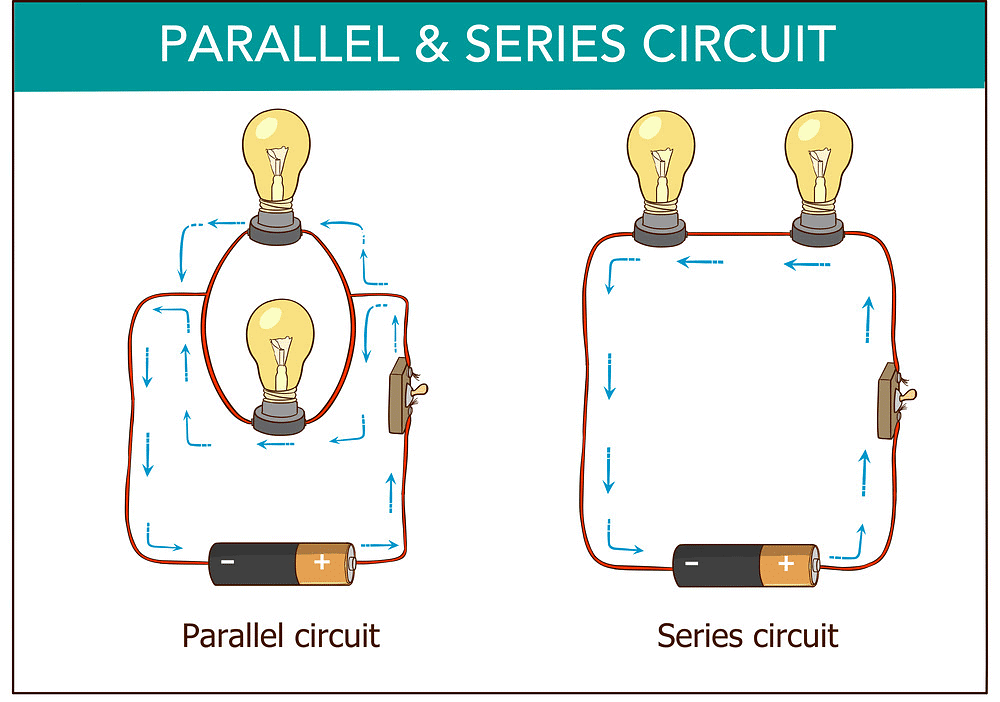
Parallel Combination
- Inverse of Total Resistance

Heating Effect of Electric Current
- Joule's Law: H=I2Rt
- Applications: Electric bulb, electric iron, electric heater.
Electric Power
- Definition: Work done per unit time. P=VI.
- S.I. Unit: Watt (W). 1 W=1 V×1 A.
- Kilowatt: 1 kW=1000 W.
Electric Energy
- Definition: Amount of work done to maintain continuous electric current.
- Unit: Joule (J).
Electric Power Consumption
- Unit: Kilowatt-hour (kWh). 1 kWh=3.6×10⁶ J.
Conductors and Insulators
- Conductor: Allows flow of electrons. Low opposition to current.
- Insulator: Doesn't allow flow of electrons. High opposition to current.
Current Rating
- Definition: Maximum current without damaging the appliance.
The document Important Equations and Definitions: Electricity is a part of the Class 10 Course Science Class 10.
All you need of Class 10 at this link: Class 10
FAQs on Important Equations and Definitions: Electricity
| 1. What is electric current and how is it measured? |  |
Ans.Electric current is the flow of electric charge in a conductor. It is measured in amperes (A) using an ammeter. One ampere corresponds to one coulomb of charge passing through a point in a circuit per second.
| 2. What is the difference between electric charge and electric potential? | |
Ans.Electric charge is a fundamental property of matter that causes it to experience a force in an electric field, measured in coulombs (C). Electric potential, measured in volts (V), is the amount of electric potential energy per unit charge at a point in a circuit, indicating how much work would be done to move a charge from a reference point.
| 3. How does Ohm’s Law relate voltage, current, and resistance? | |
Ans.Ohm's Law states that the current (I) flowing through a conductor between two points is directly proportional to the voltage (V) across the two points and inversely proportional to the resistance (R) of the conductor. It is expressed mathematically as V = I × R.
| 4. What are the different ways to combine resistors in a circuit? | |
Ans.Resistors can be combined in two main ways: in series and in parallel. In a series combination, the total resistance increases and is the sum of individual resistances (R_total = R1 + R2 + ...). In parallel, the total resistance decreases, calculated using the formula 1/R_total = 1/R1 + 1/R2 + ... .
| 5. What is the heating effect of electric current and its applications? | |
Ans.The heating effect of electric current, also known as Joule's heating, occurs when electric current passes through a conductor, producing heat due to resistance. This effect is utilized in various applications, such as electric heaters, toasters, and incandescent light bulbs, where heat generation is desired.
About this Document

9.6K Views

4.89/5
Rating

Apr 22, 2026
Last updated
Document Description: Important Equations and Definitions: Electricity for Class 10 2026 is part of Science Class 10 preparation.
The notes and questions for Important Equations and Definitions: Electricity have been prepared according to the Class 10 exam syllabus. Information about Important Equations and Definitions: Electricity covers topics
like and Important Equations and Definitions: Electricity Example, for Class 10 2026 Exam. Find important definitions, questions, notes, meanings, examples, exercises and tests below for Important Equations and Definitions: Electricity.
Introduction of Important Equations and Definitions: Electricity in English is available as part of our Science Class 10
for Class 10 & Important Equations and Definitions: Electricity in Hindi for Science Class 10 course.
Download more important topics related with notes, lectures and mock test series for Class 10
Exam by signing up for free. Class 10: Important Equations and Definitions: Electricity
Description
Important Equations & Definitions: Electricity of Science Class 10 covers all the important topics, helping you prepare for the Class 10 exam on EduRev. Start for free!
Information about Important Equations and Definitions: Electricity
In this doc you can find the meaning of Important Equations and Definitions: Electricity defined & explained in the simplest way possible. Besides explaining types of
Important Equations and Definitions: Electricity theory, EduRev gives you an ample number of questions to practice Important Equations and Definitions: Electricity tests, examples and also practice Class 10
tests



Related Searches
Important Equations and Definitions: Electricity, Free, Extra Questions, practice quizzes, past year papers, ppt, pdf , Important Equations and Definitions: Electricity, MCQs, Summary, Objective type Questions, video lectures, Previous Year Questions with Solutions, Exam, study material, Sample Paper, Semester Notes, Important Equations and Definitions: Electricity, shortcuts and tricks, Important questions, Viva Questions, mock tests for examination;