Worksheet Solutions: Solar System | Science for Class 3 PDF Download

Q1: Multiple Choice Questions
(i): The family of the sun is called
(a) solar system
(b) organ system
(c) galaxy
(d) celestial system
Ans: solar system
The correct answer is "a) solar system." The options are not used to describe the grouping of the sun and its celestial bodies.
(ii): The vast space containing stars, planets, meteors etc. is called-
(a) universe
(b) galaxies
(c) solar system
(d) cosmos
Ans: universe
The correct answer is (a) universe. The term "universe" encompasses the entirety of space, including stars, planets, meteors, and other celestial entities. It differs from "galaxies," which are specific collections of stars, and "solar system," which refers to our Sun and its associated celestial bodies. "Cosmos" is not the commonly used term for the vast space containing celestial objects.
(iii): The name of our galaxy is
(a) Milky Way
(b) Jupiter
(c) Mercury
(d) Andromeda
Ans: Milky Way Galaxy
The correct answer is (a) Milky Way Galaxy. Our galaxy is named the Milky Way. "Jupiter" and "Mercury" are individual planets, while "Andromeda" is a different galaxy. Identifying the name of our galaxy is crucial for understanding the context of celestial structures in our cosmic vicinity.
(iv): The Sun is a-
(a) Star
(b) Galaxy
(c) Planet
(d)Celestial body
Ans: Star
The correct answer is (a) Star. The Sun is a massive, luminous ball of hot plasma primarily composed of hydrogen and helium, undergoing nuclear fusion. It falls under the category of stars, emitting light and heat due to the ongoing fusion reactions in its core. Options (b) Galaxy and (c) Planet are incorrect, as the Sun is not a galaxy but a member of the Milky Way galaxy, and it is the central body of our solar system, not a planet. Option (d) "Celestial body" is a general term encompassing various astronomical entities, making it less specific than "star."
(v): A ___________ is a heavenly body without heat and light of its own
(a) planets
(b) sun
(c) stars
(d) moon
Ans: planets
The correct answer is (a) planets. Planets are celestial bodies that do not generate their own heat and light but instead reflect the light from the stars they orbit. Option (b) "sun" and option (c) "stars" are incorrect, as the sun is a star that emits its own heat and light, and stars are self-luminous celestial bodies. Option (d) "moon" is included as an additional choice, but it is also incorrect, as the moon reflects sunlight and does not possess its own source of heat and light.
Q2: Answer the following questions
(i) What makes our earth blue and green in colour?
Ans: The surface of the earth is mostly covered by water which appears blue and only partly by land which appears brown or green.
(ii) What is atmosphere?
Ans: The earth is surrounded by a layer of air. This is called its atmosphere.
(iii) What is a solar system?
Ans: The family of the sun is called the solar system. It is made up of the sun, eight planets and their moons.
(iv) What is a sun?
Ans: It is a huge fiery ball made up of hot burning gases which keeps burning all the time.
(v) What is a moon?
Ans: It is dry and barren. It has no air or water. It has no light of its own. It shines because it reflects the sun’s light.
(vi) What is constellation?
Ans: We find that these stars form imaginary groups. These groups of stars are called constellations.
(vii) write the names of planets in solar system in order
Ans: Mercury, Venus, Earth, Mars, Jupiter, Saturn, Uranus, Neptune
Q3: True and false
(i) Earth is only planet with water and life
Ans: True
(ii) The earth has only water and is blue in colour
Ans: False
(iii) The solar system is made up of the sun 10 planets and their moons
Ans: False
(iv) The family of sun is called solar system true
Ans: True
(v) The sun is star for plant earth true
Ans: True
(vi) There is only one type of constellation false
Ans: False
(vii) Sunlight helps plants to produce food true
Ans: True
(viii) Planets do not move around the sun false
Ans: False
(ix) Moon has light of its own.
Ans: False
(x) The full Moon is also called Purnima.
Ans: True
Q4: Define the terms
(i) Heavenly body
Ans: The sun, the moon, the stars and the planets
(ii) Solar System
Ans: Comprises the Sun, the eight planets and the other heavenly bodies
(iii) Stars
Ans: Large heavenly bodies which give off their own heat and light
(iv) Constellation
Ans: A group of stars arranged in a particular pattern
(v) Planets
Ans: Heavenly bodies which revolve around the sun
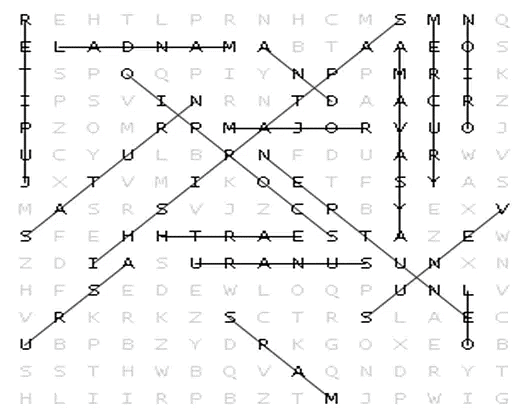
Q5: Solve the puzzle
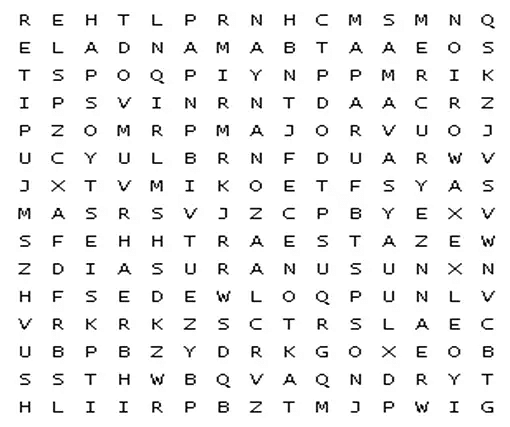
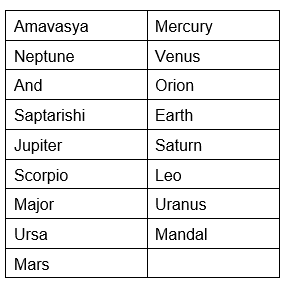
Ans:
|
20 videos|121 docs|32 tests
|
FAQs on Worksheet Solutions: Solar System - Science for Class 3
| 1. What are the main components of the solar system ? |  |
| 2. How do planets in the solar system differ from one another ? | |
| 3. What role does the Sun play in the solar system ? | |
| 4. How do scientists study the solar system ? | |
| 5. What is the significance of studying the solar system ? | |




Objective type Questions
,practice quizzes
,Viva Questions
,Semester Notes
,video lectures
,past year papers
,Exam
,MCQs
,shortcuts and tricks
,Worksheet Solutions: Solar System | Science for Class 3
,mock tests for examination
,Extra Questions
,Important questions
,Free
,Sample Paper
,Worksheet Solutions: Solar System | Science for Class 3
,Previous Year Questions with Solutions
,Summary
,ppt
,study material
,Worksheet Solutions: Solar System | Science for Class 3
;



Worksheet Solutions: Solar System Free PDF Download
Importance of Worksheet Solutions: Solar System
Worksheet Solutions: Solar System Notes
Worksheet Solutions: Solar System Class 3 Questions
Study Worksheet Solutions: Solar System on the App
|
© EduRev
|
Education Revolution
|


|




within 7 days!