CBSE Class 2  >  Class 2 Notes  >  English (Mridang)  >  NCERT Solutions: Picture Reading

NCERT Solutions: Picture Reading

Let us Read

Q1: What do you see?
Ans:
We see children.

Q2: How many children are there in the picture?
Ans:
There are about 17 children in the picture.

Q3: What are the children doing?
Ans:
The children are playing

Q4: How are children having fun?
Ans: 
The children are having fun by playing different games.

Q5: What games do you play?
Ans:
We play cricket and football.


Let' us Speak

A. Answer the following questions.

Q1: What games do you like to play with your friends?
Ans:
I like to play cricket and football with my friends.

Q2: Have you played 'bat and ball'?
Ans: Yes, I have.

Q3: Babli made a ball using a few rags, paper, wool and string. Have you tried to play a game using the things around you? What did you play? Name the things that you use to play. Talk about it in the class.
Ans: Yes, I have, I played tippu using the ball made by paper, rags and string.

Q4: Read pages 10 - 11 of the story again and number the following sentences in their correct order.

(i) Babli hit the ball.
Ans: (3)

(ii) Jeet threw the ball.
Ans: (2)

(iii) The ball went into Mohit's garden.
Ans: (4)

(iv) Jeet got ready to throw the ball.
Ans: (1)

(v) They lost the ball.
Ans: (5)


Let's Write

A. Read the story 'OUT! OUT!' again and fill in the blanks.

Q1: Write the names of the children in the story.
Ans: Jeet, Babli, Mohit

Q2: Write the items that the children used to make a ball.
Ans: Rags, paper wool

B. Write the opposites of the following words. One has been done for you.
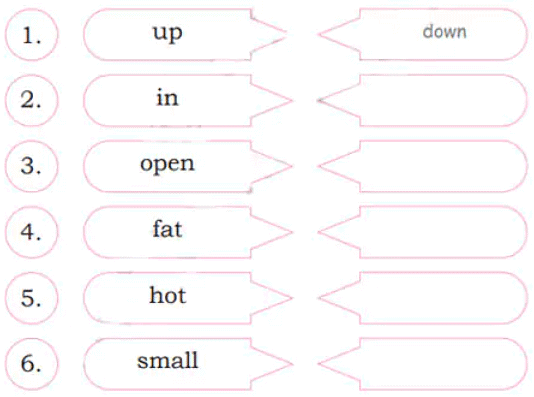
B. Write the opposites of the following words. One has been done for you.Ans:
1. Up - down
2. in - out
3. open - close
4. fat - slim
5. hot - cold
6. small - big

C. Join the sentences using 'and'. Write it in the given space. One has been done for you.

Q1: Suresh went to school.
Gopal went to school.
Ans:
Suresh and Gopal went to school.

Q2: I like to eat mangoes.
I like to eat grapes.
Ans: I like to eat mangoes and grapes.

Q3: The cat sat on the mat.
The dog sat on the mat
Ans: The cat and dog sat on the mat.

Q4: This ball has yellow dots on it.
This ball also has green dots on it.
Ans: The ball has yellow and green dots on it.

Q5: There are tables in my classroom.
There are chairs in my classroom.
Ans: There are tables and chairs in my classroom.

The document NCERT Solutions: Picture Reading is a part of the Class 2 Course English for Class 2 (Mridang).
All you need of Class 2 at this link: Class 2

FAQs on NCERT Solutions: Picture Reading

1. How do I understand what a picture is showing in Class 2 English picture reading?
Ans. Picture reading involves observing details in an image and describing what you see using simple words and sentences. Students identify objects, people, animals, colours, and actions within the picture, then create short narratives or answers based on those observations. This skill helps develop vocabulary and sentence-formation abilities at the Class 2 level.
2. What are the main steps to answer picture reading questions correctly?
Ans. First, look carefully at the entire picture to identify all elements like characters, settings, and activities. Next, observe colours, expressions, and actions to understand the context. Finally, answer questions using complete sentences with describing words. Practice with visual worksheets and flashcards to strengthen observation skills and improve response quality in picture-based comprehension tasks.
3. How can I describe pictures using describing words in Class 2 English?
Ans. Describing words (adjectives) add detail to picture descriptions-use terms like "big," "small," "happy," "red," or "busy." Instead of saying "a dog," say "a brown dog." Instead of "a girl," say "a girl is playing." NCERT picture reading exercises encourage students to combine nouns with adjectives, making sentences more interesting and detailed while building vocabulary foundations.
4. What kind of questions usually come in picture reading for Class 2?
Ans. Common picture reading questions ask: "What do you see?" "How many objects are there?" "What colour is the...?" and "What is happening?" Students must identify objects, count items, recognize colours, and describe actions shown in images. These question types develop observational skills and encourage sentence construction using vocabulary appropriate for Class 2 English learners.
5. How does picture reading help improve English speaking and writing skills in Class 2?
Ans. Picture reading strengthens vocabulary retention and sentence-building confidence by connecting visual concepts to English words. Students practise describing scenes, using new words in context, and constructing simple sentences independently. Regular picture comprehension practice develops communication skills and prepares learners for structured writing tasks, making it essential for early-stage language development in CBSE Class 2 curriculum.
Explore Courses for Class 2 exam
Get EduRev Notes directly in your Google search
Related Searches
past year papers, video lectures, NCERT Solutions: Picture Reading, Extra Questions, Semester Notes, Summary, Free, NCERT Solutions: Picture Reading, practice quizzes, Sample Paper, Previous Year Questions with Solutions, mock tests for examination, MCQs, Viva Questions, shortcuts and tricks, Exam, NCERT Solutions: Picture Reading, pdf , study material, Important questions, Objective type Questions, ppt;