CBSE Class 3  >  Class 3 Notes  >  English (Santoor)  >  Worksheet Solutions: Talking Toys

Worksheet Solutions: Talking Toys

Fill in the Blanks

Q1: The toy shop opened at ______ a.m.

Ans: 9
The story mentions that the toy shop opened at 9 a.m.
Fill in the Blanks

Q2: The girl chose the game ______ from the toy shop.

Ans: Snakes and Ladders
The story mentions the girl chose Snakes and Ladders.

Q3: The little boy wanted the ______ toy train.

Ans: Vande Bharat
The boy pointed at the Vande Bharat toy train and wanted to buy it.

Fill in the Blanks

Q4: One girl bought marbles and the other girl bought a ______.

Ans: Aeroplane
The other girl decided to buy the toy aeroplane.

Q5: The boy with the red cap took the ______ from the shop.

Ans: Spinning top
The boy with the red cap chose the spinning top. 
Fill in the Blanks

True or False

Q1: The toy shop opened in the evening.

Ans: False
The toy shop opened at 9 a.m.

Q2: The first two girls who came into the shop bought a toy.

Ans: False
The first two girls only looked through the windows and did not buy anything.

Q3: The toy phone thought the girls might play with it.

Ans: True
The toy phone hoped the girls would like to play with it.
True or False

Q4: The boy in the blue shirt bought a dancing doll.

Ans: True
The boy in the blue shirt bought cute dancing dolls.

Q5: All the toys in the shop were sad because no one bought them.

Ans: False
Many toys were bought by children, making them happy. 

One Word Answer Type Questions

Q1: What time did the toy shop open?

Ans: 9 a.m.

Q2: What did the little boy want to buy from the toy shop?

Ans: Train

Q3: What game did the girl choose?

Ans: Snakes and Ladders

Q4: Who bought the spinning top?

Ans: Boy with red cap

Q5: What did the boy with the blue shirt buy?

Ans: Dancing dolls 
One Word Answer Type Questions

Short Question and Answers

Q1: What toys did the shop have?

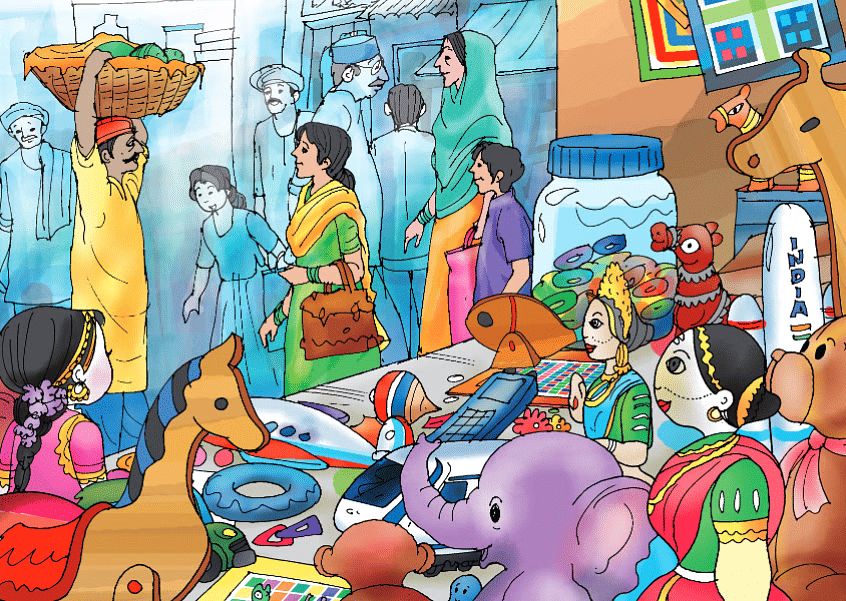
Ans: The shop had wooden toys, soft toys, board games, bats, balls, and many other toys.

Q2: Why were the toys excited when a woman and her son entered the shop?

Ans: The toys were excited because they hoped the boy would choose them.

Q3: What did the little boy buy from the toy shop?

Ans: The little boy bought the Vande Bharat toy train from the shop.

Q4: What toys did the two girls buy?

Ans: One girl bought marbles, and the other bought a toy aeroplane.

Q5: What toys did the children in the group buy from the shop?

Ans: The children bought a toy elephant, a spinning top, and dancing dolls.

The document Worksheet Solutions: Talking Toys is a part of the Class 3 Course English for Class 3 (Santoor).
All you need of Class 3 at this link: Class 3

FAQs on Worksheet Solutions: Talking Toys

1. What are the main characters in the Talking Toys story and what do they do?
Ans. The Talking Toys story features animated toys that come to life and have conversations with each other. These characters represent different types of toys-such as dolls, action figures, and stuffed animals-each with distinct personalities and voices. Their interactions teach Class 3 students about friendship, cooperation, and imaginative play through dialogue-based storytelling.
2. How do I answer comprehension questions about what the toys say to each other?
Ans. When answering comprehension questions on the Talking Toys worksheet, focus on the exact dialogue and actions described in the story. Identify who is speaking, what they're discussing, and why it matters to the plot. Use direct quotes from the text to support your answers, and explain how each toy's words reveal their personality or feelings toward the other characters.
3. What kinds of vocabulary words from the Talking Toys lesson should I focus on for CBSE exams?
Ans. Key vocabulary from Talking Toys includes action verbs (whisper, giggle, bounce), descriptive adjectives (cheerful, lonely, brave), and conversational phrases used by the toys. Master words related to emotions, toy descriptions, and speech patterns. These terms frequently appear in comprehension tests and help students understand dialogue better. Create flashcards or use mind maps to organise vocabulary by character or scene.
4. Why do the toys have conversations, and what lesson are they teaching in this chapter?
Ans. The toys engage in conversations to demonstrate how toys interact imaginatively when children aren't watching. These dialogues teach lessons about sharing, kindness, problem-solving, and teamwork. Through the toys' discussions and disagreements, Class 3 students learn vocabulary related to emotions and social skills, plus how to extract meaning from spoken exchanges presented in written form.
5. What's the difference between direct and reported speech in the Talking Toys worksheet solutions?
Ans. Direct speech shows exactly what a toy says using quotation marks-for example, "I'm scared!" said the doll. Reported speech tells us what the toy said without quotes-the doll said she was scared. The Talking Toys worksheet often requires converting one form to the other. Understanding this distinction helps students answer grammar-based questions and improves their writing skills for Class 3 English assessments.
Explore Courses for Class 3 exam
Get EduRev Notes directly in your Google search
Related Searches
Worksheet Solutions: Talking Toys, Semester Notes, Worksheet Solutions: Talking Toys, video lectures, MCQs, Summary, mock tests for examination, Objective type Questions, study material, Sample Paper, Worksheet Solutions: Talking Toys, pdf , Previous Year Questions with Solutions, Free, shortcuts and tricks, Viva Questions, Exam, ppt, Extra Questions, past year papers, Important questions, practice quizzes;