

Best Study Material for Class 6 Exam
Class 6 Exam > Class 6 Notes > IGCSE Cambridge Science for Year 6 > Chapter Notes: Microorganisms
Microorganisms Chapter Notes | IGCSE Cambridge Science for Year 6 - Class 6 PDF Download
Types of Microorganism
Microorganisms Introduction
- Microorganisms, or microbes, are tiny living organisms that include bacteria, viruses, fungi, and the microbes found in yoghurt. These organisms are usually too small to be seen without a microscope.
- They are termed 'micro' due to their very small size.
- Microorganisms are unicellular, meaning they consist of a single cell. They carry out essential life processes and are a fundamental part of ecosystems.
- Microbes are vital in nutrient cycling, decomposition, and as part of the human microbiome.
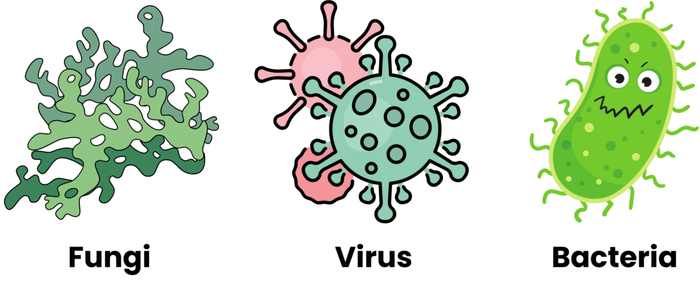 Microorganisms
Fungi

- Fungi are not plants; they do not photosynthesize but instead absorb nutrients from organic materials.
- Fungi can be multicellular (like mushrooms) or unicellular (like yeasts). Moulds, a type of fungi, grow by reproducing through spores, which are capable of traveling through air and growing on new sources.
- Some fungi are beneficial and used in cooking, while others, like certain moulds, can produce toxins and are hazardous.
Bacteria
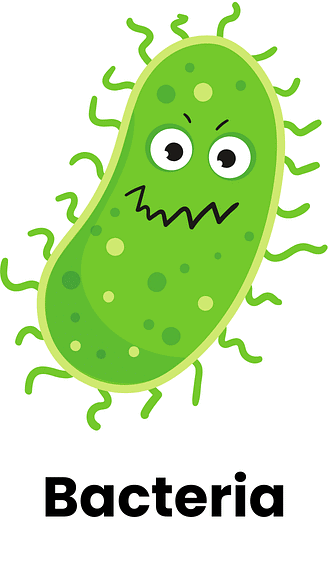
- Bacteria are unicellular organisms that can reproduce quickly. They can be found in every environment on Earth.
- Bacterial structure is simple, yet they are involved in both beneficial processes (like digestion and fermentation) and pathogenic activities.
Viruses
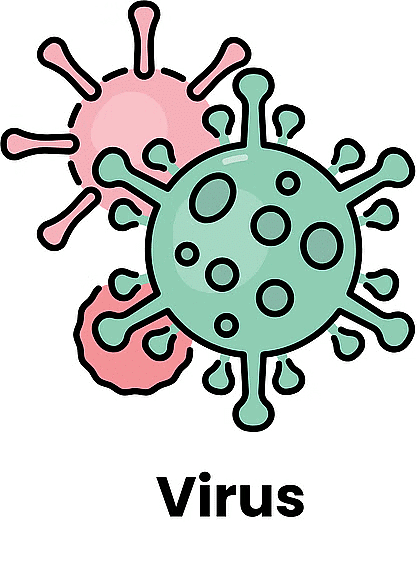
- Viruses are not cells but are tiny particles that infect living cells.
- Viruses must enter into a living cell to replicate (copy) themselves.
- Viruses can infect all types of life forms, from plants and animals to bacteria.
Question for Chapter Notes: Microorganisms
Try yourself:
Which type of microorganism is responsible for decomposing organic materials?View Solution
Microorganisms and Decay
History and Discovery of Microorganisms
- Antonie van Leeuwenhoek first observed microorganisms in 1674.
- Initial scientific belief was that microorganisms spontaneously generated from the materials they were found in, such as bread creating mold.
Louis Pasteur's Experiments
- Louis Pasteur, a French scientist in the 19th century, questioned why clear soup would turn cloudy and start to smell when left open.
- He hypothesized that microorganisms in the air were responsible for spoiling food.
- Pasteur's experiments involved boiling soup in glass containers to kill any existing microorganisms and then allowing air to contact some of the soup while keeping other samples isolated. Only the soup exposed to air spoiled, supporting his hypothesis.
 |
Download the notes
Chapter Notes: Microorganisms
|
Download as PDF |
Download as PDF
Scientific Method
- Involves asking questions, formulating hypotheses, and conducting experiments to test these hypotheses.
- A hypothesis must be testable, meaning experiments can be conducted to prove it right or wrong.
- The results from these experiments provide evidence to support or reject the hypothesis.
Decay
- Decomposers like bacteria and fungi cause decay/breakdown of materials.
- They also play a role in recycling nutrients from dead matter back into the soil.
Food Chain
- A food chain is a diagram showing feeding relationships in a habitat

- It consists of producers (organisms that make their own food, like plants using sunlight) and consumers (animals that eat producers).
- Consumers can be classified as:
- Herbivores: Animals that eat only plants (primary consumers)
- Carnivores: Animals that eat other animals (secondary/tertiary consumers)
- Omnivores: Animals that can eat plants or animals
- Predators: Animals that hunt and eat other animals
- Prey: Animals that are hunted and eaten by other animals
Question for Chapter Notes: Microorganisms
Try yourself:
What did Antonie van Leeuwenhoek observe in 1674?View Solution
 |
Take a Practice Test
Test yourself on topics from Class 6 exam
|
Practice Now |
Practice Now
Food Web
A food web is a diagram that shows how different food chains all interact in a habitat.
For example :
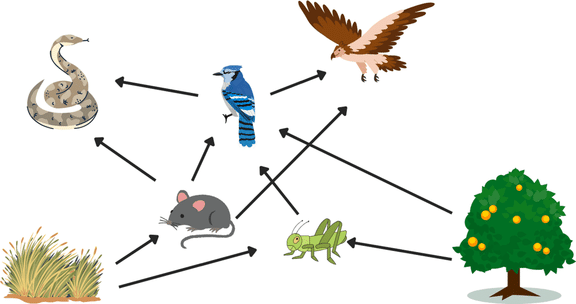 Food Web
Energy Flow in Ecosystems
- Energy flows from producers to various levels of consumers. Not all energy consumed by one level is transferred to the next; some is lost a through respiration, waste, and organism death.
- Decomposers ensure that no energy is wasted by breaking down dead matter and recycling it into the ecosystem.
The document Microorganisms Chapter Notes | IGCSE Cambridge Science for Year 6 - Class 6 is a part of the Class 6 Course IGCSE Cambridge Science for Year 6.
All you need of Class 6 at this link: Class 6
|
31 videos|34 docs|22 tests
|



FAQs on Microorganisms Chapter Notes - IGCSE Cambridge Science for Year 6 - Class 6
| 1. What are the different types of microorganisms? |  |
| 2. How do microorganisms contribute to decay? | |
Ans. Microorganisms contribute to decay by breaking down organic matter, such as dead plants and animals, into simpler substances through the process of decomposition.
| 3. Can microorganisms be beneficial to the environment? | |
Ans. Yes, microorganisms can be beneficial to the environment by promoting nutrient recycling, decomposing waste, and aiding in the production of food and medicine.
| 4. How do microorganisms affect human health? | |
Ans. Some microorganisms can cause diseases in humans, such as bacteria causing infections or viruses causing illnesses like the common cold or flu.
| 5. What role do microorganisms play in the food industry? | |
Ans. Microorganisms play a crucial role in the food industry by being used in processes like fermentation (e.g., making yogurt or cheese) and food preservation (e.g., pickling).
Related Exams
About this Document

4.89/5
Rating

Apr 20, 2025
Last updated
Document Description: Chapter Notes: Microorganisms for Class 6 2025 is part of IGCSE Cambridge Science for Year 6 preparation.
The notes and questions for Chapter Notes: Microorganisms have been prepared according to the Class 6 exam syllabus. Information about Chapter Notes: Microorganisms covers topics
like Types of Microorganism, Microorganisms and Decay and Chapter Notes: Microorganisms Example, for Class 6 2025 Exam. Find important definitions, questions, notes, meanings, examples, exercises and tests below for Chapter Notes: Microorganisms.
Introduction of Chapter Notes: Microorganisms in English is available as part of our IGCSE Cambridge Science for Year 6
for Class 6 & Chapter Notes: Microorganisms in Hindi for IGCSE Cambridge Science for Year 6 course.
Download more important topics related with notes, lectures and mock test series for Class 6
Exam by signing up for free. Class 6: Microorganisms Chapter Notes | IGCSE Cambridge Science for Year 6 - Class 6
Description
Full syllabus notes, lecture & questions for Microorganisms Chapter Notes | IGCSE Cambridge Science for Year 6 - Class 6 - Class 6 | Plus excerises question with solution to help you revise complete syllabus for IGCSE Cambridge Science for Year 6 | Best notes, free PDF download
Information about Chapter Notes: Microorganisms
In this doc you can find the meaning of Chapter Notes: Microorganisms defined & explained in the simplest way possible. Besides explaining types of
Chapter Notes: Microorganisms theory, EduRev gives you an ample number of questions to practice Chapter Notes: Microorganisms tests, examples and also practice Class 6
tests


Related Searches
past year papers
,Semester Notes
,Previous Year Questions with Solutions
,MCQs
,mock tests for examination
,Sample Paper
,Important questions
,video lectures
,Viva Questions
,Extra Questions
,shortcuts and tricks
,practice quizzes
,Objective type Questions
,study material
,Exam
,Summary
,Free
,Microorganisms Chapter Notes | IGCSE Cambridge Science for Year 6 - Class 6
,ppt
,Microorganisms Chapter Notes | IGCSE Cambridge Science for Year 6 - Class 6
,Microorganisms Chapter Notes | IGCSE Cambridge Science for Year 6 - Class 6
;



Additional Information about Chapter Notes: Microorganisms for Class 6 Preparation
Chapter Notes: Microorganisms Free PDF Download
The Chapter Notes: Microorganisms is an invaluable resource that delves deep into the core of the Class 6 exam.
These study notes are curated by experts and cover all the essential topics and concepts, making your preparation more efficient and effective.
With the help of these notes, you can grasp complex subjects quickly, revise important points easily,
and reinforce your understanding of key concepts. The study notes are presented in a concise and easy-to-understand manner,
allowing you to optimize your learning process. Whether you're looking for best-recommended books, sample papers, study material,
or toppers' notes, this PDF has got you covered. Download the Chapter Notes: Microorganisms now and kickstart your journey towards success in the Class 6 exam.
Importance of Chapter Notes: Microorganisms
The importance of Chapter Notes: Microorganisms cannot be overstated, especially for Class 6 aspirants.
This document holds the key to success in the Class 6 exam.
It offers a detailed understanding of the concept, providing invaluable insights into the topic.
By knowing the concepts well in advance, students can plan their preparation effectively.
Utilize this indispensable guide for a well-rounded preparation and achieve your desired results.
Chapter Notes: Microorganisms
Chapter Notes: Microorganisms Notes offer in-depth insights into the specific topic to help you master it with ease.
This comprehensive document covers all aspects related to Chapter Notes: Microorganisms.
It includes detailed information about the exam syllabus, recommended books, and study materials for a well-rounded preparation.
Practice papers and question papers enable you to assess your progress effectively.
Additionally, the paper analysis provides valuable tips for tackling the exam strategically.
Access to Toppers' notes gives you an edge in understanding complex concepts.
Whether you're a beginner or aiming for advanced proficiency, Chapter Notes: Microorganisms Notes on EduRev are your ultimate resource for success.
Chapter Notes: Microorganisms Class 6 Questions
The "Chapter Notes: Microorganisms Class 6 Questions" guide is a valuable resource for all aspiring students preparing for the
Class 6 exam. It focuses on providing a wide range of practice questions to help students gauge
their understanding of the exam topics. These questions cover the entire syllabus, ensuring comprehensive preparation.
The guide includes previous years' question papers for students to familiarize themselves with the exam's format and difficulty level.
Additionally, it offers subject-specific question banks, allowing students to focus on weak areas and improve their performance.
Study Chapter Notes: Microorganisms on the App
Students of Class 6 can study Chapter Notes: Microorganisms alongwith tests & analysis from the EduRev app,
which will help them while preparing for their exam. Apart from the Chapter Notes: Microorganisms,
students can also utilize the EduRev App for other study materials such as previous year question papers, syllabus, important questions, etc.
The EduRev App will make your learning easier as you can access it from anywhere you want.
The content of Chapter Notes: Microorganisms is prepared as per the latest Class 6 syllabus.
|
© EduRev
|
Education Revolution
|


|








Signup on EduRev and stay on top of your study goals
10M+ students crushing their study goals daily