Buddhism and Jainism | Famous Books for UPSC Exam (Summary & Tests) PDF Download


Buddhism is key for UPSC exams, covering Prelims and Mains. This chapter explores Buddha's life, teachings, and Buddhism's impact on culture and history. It's crucial for understanding India's past and its global influence, helping UPSC aspirants in both knowledge and analytical skills for the exam.
Origin of Buddhism
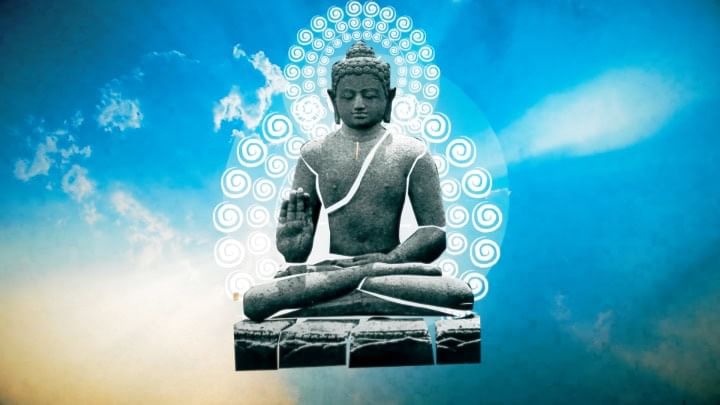
- Buddhism began in India more than 2,600 years ago as a way of life with the potential to change individuals profoundly.
- The foundation of this religion rests on the teachings and life experiences of its founder, Siddhartha Gautam, who was born around 563 BCE into the royal family of the Sakya clan in Kapilvastu, near Lumbini, close to the present-day Indo-Nepal border.
- At the age of 29, Siddhartha Gautam renounced his life of luxury and privilege, choosing instead a path of asceticism, characterized by extreme self-discipline and renunciation.
- After a rigorous period of meditation lasting 49 days, Gautam achieved Bodhi, or enlightenment, under a pipal tree in Bodhgaya, a village in Bihar.
- Following his enlightenment, Buddha delivered his first sermon in Sarnath, near the city of Benares in present-day Uttar Pradesh. This event, known as Dharma-Chakra-Pravartana, marks the turning of the wheel of law and the beginning of his teachings.
- Buddha passed away at the age of 80 in 483 BCE in Kushinagara, located in present-day Uttar Pradesh. This event is referred to as Mahaparinibban, marking the end of his physical existence.
Causes for the Origin of Buddhism
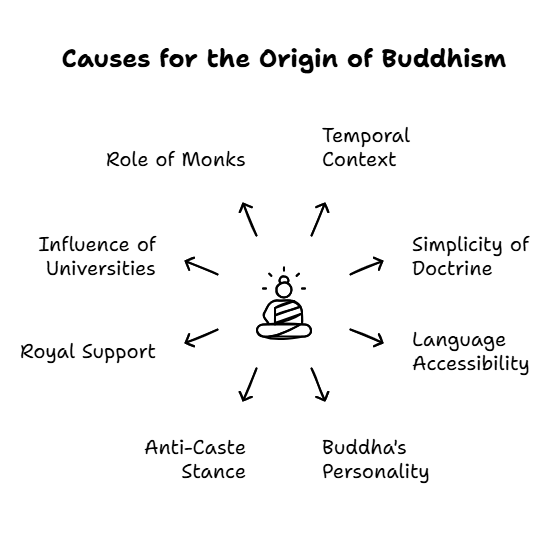
1. Favorable Temporal Context:
- The 6th century B.C. was a conducive period for the emergence and spread of Buddhism.
- There was significant public discontent with the prevalent superstitions, intricate rituals, and blind beliefs of the time.
- Siddhartha Gautam, the Buddha, offered teachings that provided hope and relief to those burdened by Brahmanical practices.
2. Simplicity of Doctrine:
- Buddhism's core teachings, such as the 'Arya Satya,' the 'Eightfold Path,' and the principle of non-violence, were straightforward and easy to grasp.
- In contrast to Jainism, which was perceived as more rigid and complex, Buddhism offered a simpler alternative without the stringent Vedic rituals.
- Those disillusioned with Brahmanical dominance found Buddhism to be a tranquil and refreshing option.
3. Simple Expressions:
- The Buddha communicated his teachings in the Prakrit language, which was widely understood across India.
- This approach contrasted with the Brahmins, who used Sanskrit—a language that was difficult for many people to understand.
- The clarity and accessibility of Buddhist philosophy, communicated in Prakrit, attracted a broad audience of followers.
4. Buddha's Endearing Personality:
- Siddhartha Gautam's reputation for kindness and selflessness contributed significantly to his popularity and the appeal of his teachings.
- He provided moral guidance and solutions to individuals, which facilitated the rapid growth of Buddhism.
- Additionally, Buddhism was perceived as a more economical option compared to the Vedic religion, which involved costly rituals.
5. No Caste Discrimination:
- Buddhism stood against the rigid caste system, promoting the idea of equality among all individuals.
- Ethical and moral discussions were encouraged among followers, regardless of their caste background.
- This anti-caste stance particularly resonated with individuals outside the Brahmanical fold, attracting a diverse following.
6. Royal Support:
- Siddhartha Gautam's background as a Kshatriya (warrior) prince facilitated the acceptance of Buddhism among rulers and the elite.
- Support from influential kings such as Prasenjit, Bimbisara, Ajatasatru, Asoka, Kanishka, and Harshavardhan was instrumental in the growth and establishment of Buddhism.
- Notably, King Asoka played a crucial role in spreading Buddhism beyond India by sending emissaries to promote the faith in various regions.
7. Influence of Universities:
- Ancient universities like Nalanda, Taxila, Puspagiri, and Vikramsila were pivotal in disseminating Buddhist teachings and philosophies.
- These institutions attracted students from various regions, including foreign countries, who embraced Buddhism during their studies.
- Notable figures like Hiuen Tsang, a Chinese pilgrim and student at Nalanda University, significantly contributed to the development and spread of Buddhism through their writings and teachings.
8. Buddhist Monks and Sangha:
- Prominent monks such as Ananda, Sariputta, Maudgalayana, Sudatta, and Upali played crucial roles in spreading Buddhism through their teachings and guidance.
- The ascetic and simple lifestyles of Buddhist monks (bhikshu) and lay followers (Upasakas) inspired many individuals to adopt Buddhism as their way of life.
- The Buddhist community, known as the Sangha, expanded throughout India, drawing in local populations and fostering a sense of community among followers.
9. Buddhist Councils:
- Following the death of the Buddha, four significant Buddhist Councils were convened to preserve and disseminate his teachings and doctrines.
- These councils played a vital role in organizing and spreading Buddhist scriptures, ensuring the continuity and growth of Buddhism in India and beyond.
Life of Gautama Buddha and Evolution of Buddhism
Gautama Buddha, who started Buddhism, was born in 563 BC in Lumbini, Kapilvastu, part of the Sakya Kshatriya clan.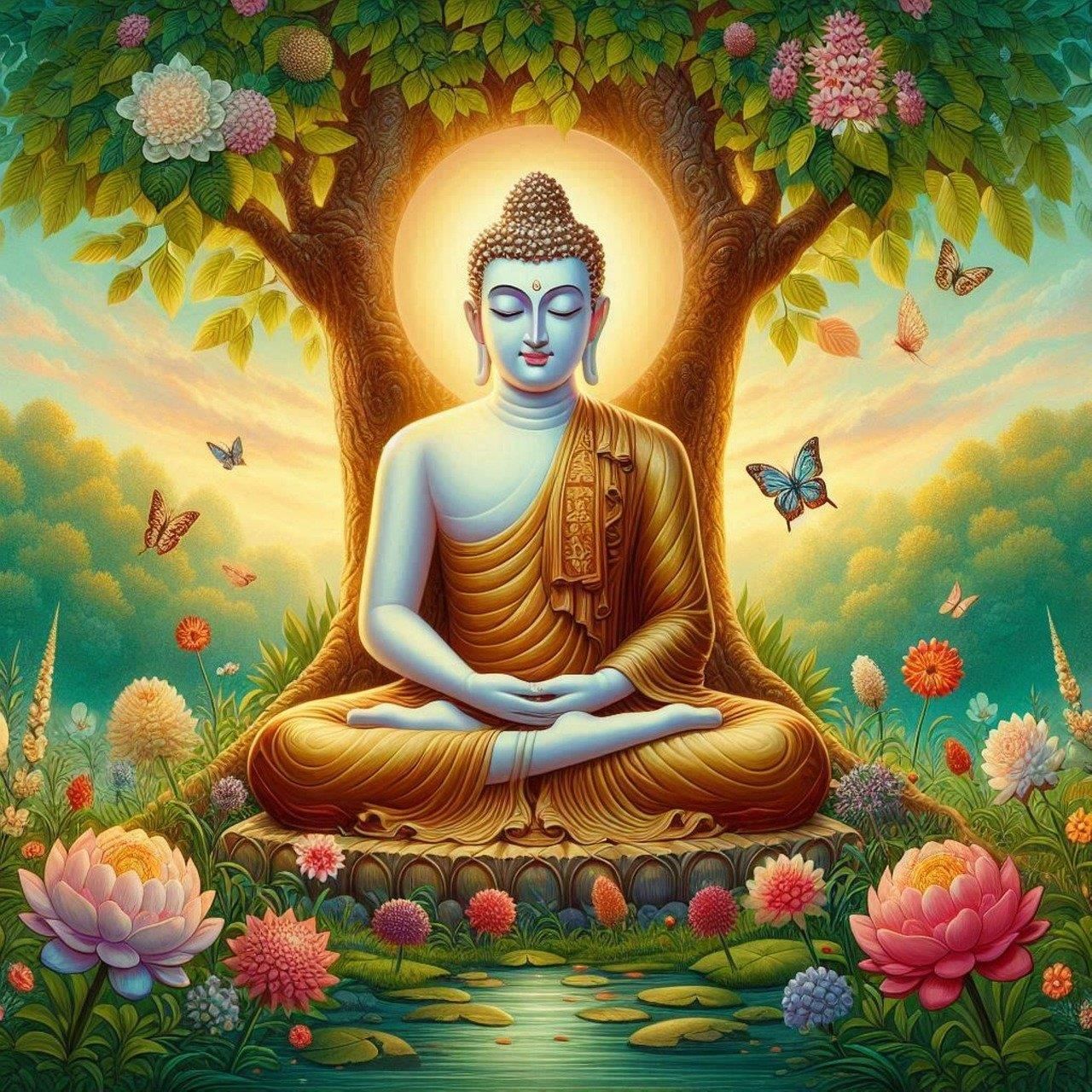
Family Background:
- Father: Suddodhana, the king of Kapilvastu.
- Mother: Mahamaya, a princess from the Koliya dynasty.
- Step Mother: Mahaprajapati Gautami.
- Wife: Yasodhara, also a princess from the Koliya dynasty.
- Son: Rahul.
Renunciation and Ascetic Life:
- At the age of 29, he left his home, an event known as Mahabhinishkramana.
- He wandered as an ascetic, seeking spiritual knowledge.
- His mentors during this period were Alara Kalama and Udraka Ramputra.
Enlightenment:
- At the age of 35, he attained Nirvana (enlightenment) under a peepal tree in Uruvella (Bodh Gaya) after 49 days of meditation by the river Niranjana, now known as Falgu.
Key Events:
- His inaugural sermon at Sarnath, known as Dharmachakra Pravartana (Turning of the Wheel of Law).
- Prominent disciples included Ananda and Upali.
- At Bodh Gaya, he was offered rice milk by Sujata, a farmer's daughter.
- He passed away at the age of 80, with differing accounts of his death in either 486 BC or 480 BC in Kushinagar, an event termed Mahaparinirvana.
Eight Great Places Linked to Buddhism:
- The notable sites are Lumbini, Sarnath, Sravasti, Rajgriha, Bodh Gaya, Kushinagar, Sankisa, and Vaishali, while Patliputra is not included.
Ashoka's Patronage of Buddhism:
- Ashoka was a major promoter of Buddhism.
- He organized the 3rd Buddhist Council.
- He dispatched a mission to Sri Lanka led by his son Mahendra and daughter Sanghamitra.
Final Supporters of Buddhism:
- The Palas of Bengal and Bihar were the last significant backers of Buddhism.
Events Related to Buddha's Life
Doctrines of Buddhism
The core beliefs of Buddhism are centered around the Four Noble Truths and the Eightfold Path.
1)Four Noble Truths
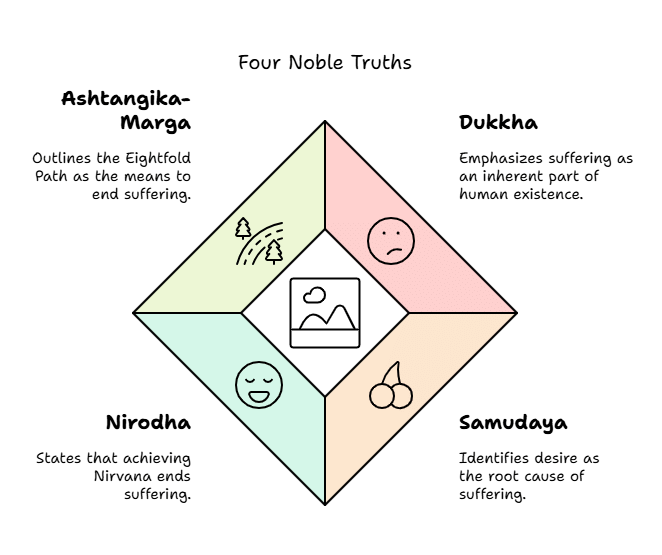
- Dukkha (Suffering):This truth emphasizes that suffering is an inherent part of human existence. It includes both specific pains and the general capacity to endure hardship.
- Samudaya (Cause of Suffering):The root cause of suffering is identified as Trishna, or desire. This highlights that every form of suffering has a purpose and is a part of the human experience.
- Nirodha (End of Suffering):This truth states that achieving Nibbana or Nirvana brings an end to pain and suffering, allowing individuals to break free from the cycle of suffering.
- Ashtangika-Marga(Path to the End of Suffering):This outlines the Eightfold Path as the means to end suffering, providing guidance through essential principles and practices.
In summary, the Four Noble Truths provide a comprehensive framework in Buddhism that addresses the nature of suffering, its causes, the possibility of its cessation through Nirvana, and practical methods to attain freedom from suffering.
2)Eightfold Path
The Eightfold Path in Buddhism emphasizes the process of unlearning to reveal one’s true nature. It consists of eight interconnected actions that guide individuals to move beyond conditioned responses and habitual patterns. The components of the Eightfold Path are: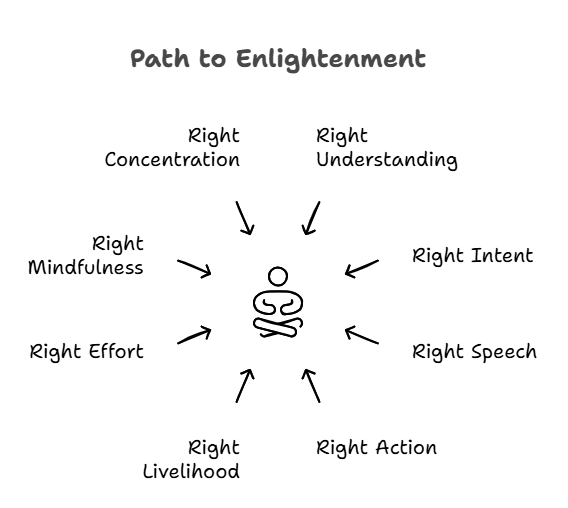
- Right Vision (Samma-Ditthi). This means understanding reality as it truly is and knowing how to bring about change.
- Right Thought or Attitude (Samma-Sankappa). This involves having emotional intelligence and acting with love and compassion.
- Right Speech (Samma-Vacca). This is about communicating in a truthful, clear, uplifting, and non-harmful way.
- Right Action (Samma-Kammanta). Living ethically by avoiding the exploitation of oneself and others. This includes five rules that form the ethical code of conduct for both monastics and laypeople:
- Do not commit violence.
- Do not covet the property of others.
- Do not engage in corrupt practices or sensual behaviour.
- Do not tell lies.
- Do not use intoxicants.
- Avoid eating after mid-day.
- Refrain from entertainment and using ornaments.
- Do not use luxurious beds or handle money.
- Right Livelihood (Samma-Ajiva). This involves earning a living based on ethical actions and principles of non-exploitation, which is considered essential for a good society in Buddhist teachings.
- Right Effort (Samma-Vayama). This means actively directing our energy towards creative and healing actions that promote wholeness and conscious growth.
- Right Mindfulness (Samma-Sati). This is about being aware of oneself and observing one’s behaviour, as the Buddha advised, “If you cherish yourself, watch yourself closely.”
- Right Concentration (Samma-Samadhi). This involves achieving a state of deep engagement and awareness across different levels of consciousness.
Major Buddhist Texts
The early Buddhist literature is divided into canonical and non-canonical texts:

1. Canonical texts:
The earliest compilation of Buddhist teachings which were written on long, narrow leaves is “The Tipitakas” (in Pali) and “Tripitaka” (in Sanskrit).
All the branches of Buddhism have the Tripitakas (also called three baskets/collections) as part of their core scriptures, which comprise three books which are:
- The Sutta (conventional teaching)
- The Vinaya (disciplinary code)
- The Abhidhamma (moral psychology)
1. Sutta Pitaka – consists of the main teaching or Dhamma of Buddha. It is divided into five Nikayas or collections:
(i) Dighgha Nikaya
(ii) Majhim Nikaya
(iii) Sanyukta Nikaya
(iv) Anguttar Nikaya
(v) Kshudraka Nikaya
2. VinayPitaka contains rules for monks and nuns of the monastic order (Sangha). It includes the Patimokkha – a list of transgressions against monastic discipline and atonements for these. The Vinaya text also includes doctrinal expositions, ritual texts, biographical stories and some elements of Jatakas or “birth stories”.
3. Abhidhamma Pitaka–The Abhidamma Pitaka is a philosophical analysis and systematization of the teaching and the scholarly activity of the monks. It consists of the religious and metaphysical discourses of Buddha
2. Non-canonical texts:
Non-canonical or semi-canonical texts are commentaries and observations on canonical texts. Quotes, definitions, historical information, grammar and other writings in Pali, Tibetian, Chinese, and other East Asian languages. Some important ones are:
- Mahavastu(written in Sanskrit-Prakrit mixed) -it is about the sacred biography, i.e hagiography of the Buddha.
- Nidanakatha- the first connected life story of Buddha.
- The Dipavamsa & the Mahavamsa (both in Pali)- both give historical and mythical accounts of the Buddha's life, Buddhist Councils, Asoka and the arrival of Buddhism to Sri Lanka.
- Visuddhimagga (the path to purification written by Buddhaghosa)- deals with the development from the purity of discipline to enlightenment (Nibbana).
- Milindapanho (in Pali) - consists of a dialogue between the Indo-Greek king Milinda/Menander and the monk Nagasena on various philosophical issues. It is the only text in Sanskrit
- Nettipakarana (The book of guidance) - which gives a connected account of the Buddha's teachings.
Buddhist Councils
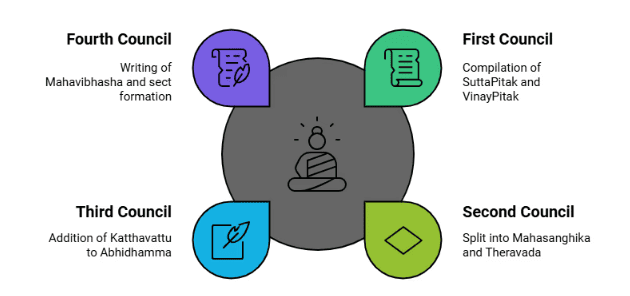
First Council
- The first Buddhist council was held at Rajgriha in 483 B.C. under the patronage of Ajatshatru. It took place just after the death of Lord Buddha. The compilation of SuttaPitakand VinayPitaktook place during this council.
Second Council
- It took place after 100 years of the death of Lord Buddha i.e. 383 in B.C. It took place inVaishali under the patronage of King Kalashoka, it was presided by Sabakami. The split took place in this council on the issue of rules anddiscipline. As a result, two groups, Mahasanghikaand Therivadi (Sthavirvadin) were formed.
Third Council
- It took placein Patliputra under the patronage of Ashoka. It was presided by MogliputtaTisa. It is also known as the Council of Therivadins.“Katthavattu” was added to the Abhidhamma Patika during this council.
- However, none of the Ashokan inscriptions gives us information about the council.
Fourth Council
- It was held in Kundalgrama in Kashmir. The president of the council was Vasumitraand the vice president was Ashvagosha. Mahavibhasha, the doctrine of Sravastivadin was written in Sanskrit on a copper plate and enclosed in stone boxes.
- During this council, the two sects of Buddhism. Hinayana and Mahayana were formed officially.
Different Sects of Buddhism
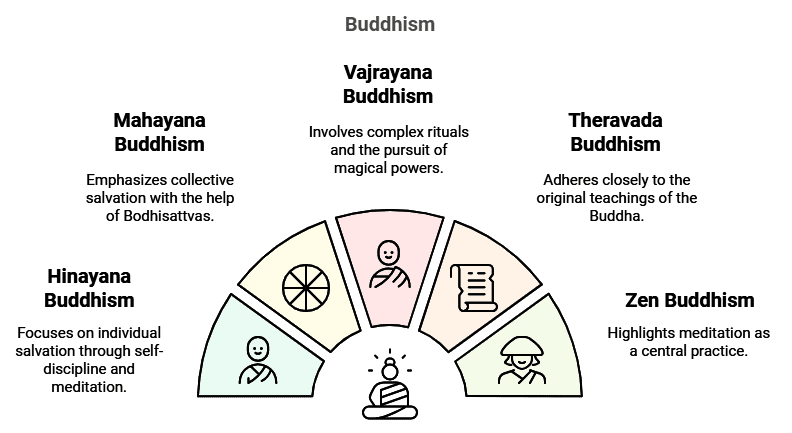
1. Hinayana Buddhism
- Followers of Hinayana Buddhism believe in the historical existence of Buddha.
- They strive for individual salvation through self-discipline and meditation.
- This sect does not support idol worship or the historicity of Buddha.
- In Hinayana, Lord Buddha is regarded as a teacher rather than a deity, and the literature is primarily in Pali.
- It is called the ‘Southern Buddhist Religion. because it was prevalent in southern regions of India and countries like Sri Lanka, Burma (Myanmar), Thailand, and Java.
- There are two sub-sects within Hinayana: Vaibhasika and Sautantrika.
2. Mahayana Buddhism
- Followers of Mahayana Buddhism also believe in the historical existence of Buddha.
- They aim for the salvation of all beings through the grace and assistance of Buddha and Bodhisattvas.
- This sect supports idol worship and considers Buddha as a divine figure.
- The literature of Mahayana Buddhism is written in Sanskrit.
- It is known as Mahayana Buddhism because it was widespread in northern regions of India and countries like China, Korea, and Japan.
- There are two main sub-sects within Mahayana: Madhyamika or Shunyavada, founded by Nagarjuna, and Yogacharya or Vijananavada, founded by Maitreyanath and his disciple Asanga.
3. Vajrayana Buddhism
- Followers of Vajrayana Buddhism believe that salvation can be achieved through acquiring magical powers, known as Vajra.
- This sect originated in Tibet and involves the worship of female deities, with the chief divinities being the Taras.
- Vajrayana Buddhism gained popularity in Eastern India, particularly in regions like Bengal and Bihar.
4. Theravada Buddhism
- Theravada Buddhism is the oldest branch of Buddhism that is still practiced today.
- This branch closely adheres to the original teachings of the Buddha.
- Theravada Buddhism was established in Sri Lanka after spreading from India.
- It is the predominant religion in countries such as Cambodia, Laos, Myanmar, Sri Lanka, and Thailand.
5. Vajrayana Buddhism
- Vajrayana, also known as Tantric Buddhism, translates to "The Vehicle of the Thunderbolt."
- This school of Buddhism originated in India around 900 C.E.
- Vajrayana is characterized by its secretive elements and a complex set of rituals that distinguish it from other Buddhist schools.
6. Zen Buddhism
- Zen Buddhism is a school of Mahayana Buddhism that started in China during the Tang dynasty. Initially known as the Chan school of Chinese Buddhism, it later evolved into various forms.
- Zen Buddhism spread to Japan in the 7th century C.E.
- The most distinctive feature of Zen Buddhism is its emphasis on meditation as a central practice.
Spread of Buddhism
- Buddha's Followers: Buddha had two kinds of followers: monks, known as bhikshus, and lay worshippers called upasikas.
- Formation of the Sangha: The monks were organized into the Sangha to share and preserve Buddha's teachings.
- Democratic Governance: The Sangha was run democratically, allowing it to enforce rules among its members.
- Rapid Growth in North India: Due to the organized efforts of the Sangha, Buddhism spread rapidly in North India during Buddha's lifetime.
- Continued Spread After Buddha: After Buddha's death, his followers continued to meditate and travel, spreading his teachings.
- Early Competition: For about 200 years, Buddhism faced strong competition from Hinduism but continued to grow until the time of Emperor Ashoka.
- Ashoka's Conversion: After the bloody battle of Kalinga, Emperor Ashoka decided to focus on spreading Dhamma instead of territorial expansion.
- Third Buddhist Council: During the third Buddhist council, Ashoka sent out missions to various places, including Gandhara, Kashmir, Greece, Sri Lanka, Burma (Myanmar), Egypt, and Thailand.
- Spread to West Asia and Ceylon: Through his missionary efforts, Ashoka helped spread Buddhism into West Asia and Ceylon (Sri Lanka).
- Transformation into a Major World Religion: What started as a local religious group under Buddha grew into a major world religion due to the efforts of his followers and later, Emperor Ashoka.
Reasons for the Decline of Buddhism
Buddhism, which began in India, started to decline from the early 12th century due to various reasons:
- Corruption in the Buddhist Sangha: Over time, the Buddhist community became corrupt. The Sangha, who were supposed to uphold Buddhist principles, were tempted by luxury and material gifts. This shift led them away from the teachings of the Buddha and marked the beginning of the degradation of Buddhist monks and their teachings.
- Division among Buddhists: Buddhism experienced several divisions over time, leading to the emergence of splinter groups like Hinayana, Mahayana, Vajrayana, Tantrayana, and Sahajayana. These divisions complicated Buddhism and led to a loss of its original simplicity and unity.
- Use of Sanskrit: Initially, Buddhism was spread in Pali, the spoken language of the people. However, at the Fourth Buddhist Council during Kanishka's reign, Pali was replaced by Sanskrit, which was understood only by a few intellectuals. This shift alienated many and contributed to Buddhism's decline.
- Buddha worship: The Mahayana Buddhists introduced the practice of image worship, venerating the image of Buddha. This practice contradicted the original Buddhist principles, which opposed complex rituals and rites similar to those in Brahmanical worship. This contradiction led to the perception that Buddhism was merging with Hinduism.
- Persecution of Buddhists: The resurgence of Brahmanical faith led to the persecution of Buddhists by some Brahmana rulers, such as Pushiyamitra Shunga, the Huna king Mihirakula, and Shaivite Shashank of Gauda. Donations to Buddhist monasteries declined, and some wealthy monasteries were specifically targeted by invaders.
- Muslim invasion: The continuous Muslim invasions severely impacted Buddhism in India. Buddhist monks were forced to seek refuge in places like Nepal and Tibet. Eventually, Buddhism faded away in India, its place of origin, due to these invasions.
Impact of Buddhism on Indian Culture
Buddhism has significantly contributed to the development of Indian culture in various ways:
- One of its key contributions was the concept of ahimsa, which later became a fundamental principle in India.
- The stupas located at Sanchi, Bharhut, and Gaya are outstanding examples of architectural brilliance from this period.
- Buddhism also promoted education by establishing renowned residential universities, such as those at Taxila, Nalanda, and Vikramasila.
- The language of Pali, along with other local languages, evolved through Buddhist teachings and texts.
- Furthermore, Buddhism played a crucial role in disseminating Indian culture to other parts of Asia.
Buddhism as a Tool for Soft Diplomacy
- Buddhism acts as a unique form of soft power in India. Unlike the traditional notion of soft power, India emphasizes shared cultural development rather than merely exporting its culture.
- The teachings of Lord Buddha promote values of peace, inclusiveness, and compassion, which play a significant role in shaping societal values.
- Buddhism ’s principles resonate with the political and economic contexts of many Asian countries, home to about 22% of the world’s population.
- The nationalistic perspectives of Asian nations are deeply intertwined with Buddhism, which can enhance emotional bonds and connections among these countries.
- While Buddhism has its roots in Asia, it has sparked a global spiritual awakening and has impacted various philosophical traditions worldwide.
- India is well-equipped with resources to promote Buddhism, including:
- Pilgrimage sites that attract visitors.
- The esteemed presence of the Dalai Lama, a symbol of peace and spirituality.
- A strong sense of international goodwill and the right intentions to foster these connections.
Future Steps
- The successful revitalization of the Nalanda University project and the promotion of Buddhist studies in established universities will create a common platform for the international community.
- To enhance India's global presence linked to the faith, we need to encourage Buddhist tourism, similar to the 'Incredible India' campaign.
- The government must tackle the vital challenge of effective execution.
- Buddhist diplomacy will be key in helping India counter the rise of China, strengthen ties with Asian countries, and boost its regional and global power ambitions.
Origin of Jainism
- Jainism is an ancient religion that some believe originated around the same time as the Vedic religion.
- Central to Jainism is a lineage of important teachers known as Tirthankaras.
- There were 24 Tirthankaras, with Vardhaman Mahavira being the most recent.
- The first Tirthankara is considered to be Rishabhanath or Rishabhadev.
- The 23rd Tirthankara, Parshvanatha, is believed to have been born in Varanasi and lived around the 8th or 7th century BC.
- All Tirthankaras were born into the Kshatriya caste.
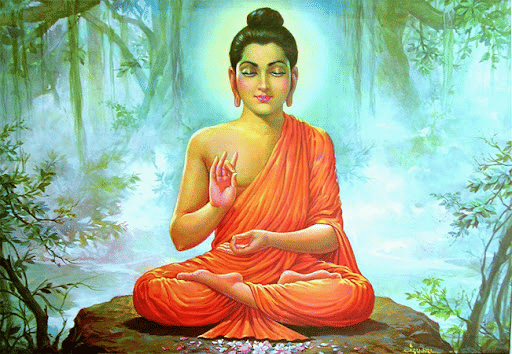
Founder of Jainism – Vardhaman Mahavira (500 B.C.)
- Vardhaman Mahavira is considered the last Tirthankara of Jainism.
- He was born in Kundagrama, near Vaisali.
- His parents were both Kshatriyas. his father, Siddhartha, was the leader of the Jnatrika Clan, and his mother, Trishala, was the sister of Chetaka, a chief of the Lichchhavi clan.
- Mahavira was married to Yasoda, and they had a daughter named Anojja or Priyadarsana.
- He practiced self-mortification, an important aspect of Jain asceticism.
- After 13 years of rigorous meditation, he attained Kevala Jnan, or supreme knowledge, at the age of 42 in Jimbhikagrama, under a sal tree. This event is known as Kaivalya.
- Following his enlightenment, he was called Mahavira, Jina, Jitendriya (one who has mastered his senses), Nigrantha (one who is free from all attachments), and Kevalin.
- Mahavira taught for 30 years before passing away at the age of 72 in Pava, near Rajagriha.
Factors Contributing to the Rise of Jainism
- The Vedic religion had become overly ritualistic.
- Jainism was taught in Pali and Prakrit, which were more accessible to the common people than Sanskrit.
- Jainism was inclusive and open to individuals of all castes.
- The Varna system had grown rigid, creating challenges for those in lower castes.
- Jainism provided an honourable place in society for individuals from lower castes.
- During the Mauryan period, Jainism gained widespread popularity following a severe famine in the Ganga valley.
- This famine prompted Chandragupta Maurya and Bhadrabahu, the last Acharya of the undivided Jain sangha, to migrate to Karnataka.
- From Karnataka, Jainism spread to Southern India.
Teachings of Jainism
- Mahavira rejected the principles of the Vedas.
- He did not believe in the existence of God, thinking instead that the universe is a result of natural processes like cause and effect.
- Mahavira believed in Karma and the transmigration of the soul, which means that when the body dies, the soul continues to exist.
- He advocated for a life of austerity and non-violence.
- While he stressed equality, he did not reject the caste system like Buddhism did. He taught that a person is 'good' or 'bad' based on their actions, not their birth.
- Jainism places a strong emphasis on asceticism, with teachings that include starvation, nudity, and self-mortification.
Core Principles
Jainism teaches that there are two fundamental elements of the world: Jiva, which refers to the conscious beings, and Atma, which refers to the soul. The relationship between these elements is central to Jain beliefs and is expressed through the concepts of:
- Right Faith
- Right Knowledge
- Right Conduct, which involves adhering to five important vows:
- Ahimsa, meaning non-violence
- Satya, which stands for truth
- Asteya, meaning no stealing
- Parigraha, which means no acquiring property
- Brahmacharya, signifying abstinence
Split in Jainism
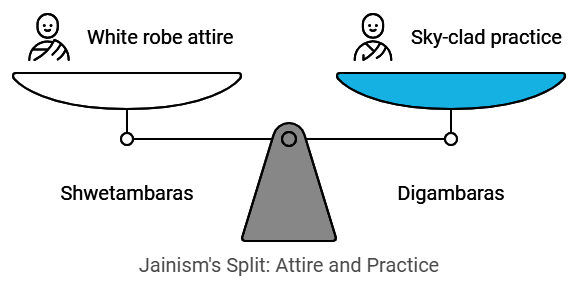
- When Bhadrabahu went to South India, Sthulabahu remained in the North with his followers.
- Sthulabahu altered the rules and permitted the wearing of white clothes.
- This change caused a division in Jainism into two groups:
- Shwetambaras. Jain monks from the North who wore white robes.
- Digambaras. Jain monks from the South who practiced being sky-clad or naked.
Jainism – Jain Councils
- First Council. Took place in Pataliputra during the 3rd century BC, led by Sthulabahu.
- Second Council. Convened at Vallabhi in Gujarat in 512 CE, overseen by Devardhigani. This council was responsible for compiling the texts known as the Angas.
Royal Patrons of Jainism
South India
- Kadamba dynasty
- Ganga dynasty
- Amoghavarsha
- Kumarapala. Chalukya dynasty.
North India
- Bimbisara
- Ajatasatru
- Chandragupta Maurya
- Bindusara
- Harshavardhana
- Ama
- Kharavela
Practice Questions
- Nitin Singhania Test: Buddhism and Jainism - 1
- Nitin Singhania Test: Buddhism and Jainism - 2
- Nitin Singhania Test: Buddhism and Jainism - 3
Jainism has a rich history with various dynasties serving as patrons, particularly in South and North India. Understanding the contributions and significance of these dynasties helps in appreciating the development of Jainism over the centuries.
|
743 videos|1444 docs|633 tests
|
FAQs on Buddhism and Jainism - Famous Books for UPSC Exam (Summary & Tests)
| 1. What were the key events in the life of Gautama Buddha? |  |
| 2. What are the major Buddhist texts and their significance? | |
| 3. What are the core principles of Buddhism? | |
| 4. What are Jain Councils and their purpose? | |
| 5. How do Buddhism and Jainism differ in their beliefs and practices? | |




ppt
,Objective type Questions
,practice quizzes
,Free
,Buddhism and Jainism | Famous Books for UPSC Exam (Summary & Tests)
,Summary
,Exam
,Previous Year Questions with Solutions
,study material
,past year papers
,Important questions
,MCQs
,shortcuts and tricks
,Viva Questions
,Buddhism and Jainism | Famous Books for UPSC Exam (Summary & Tests)
,Semester Notes
,video lectures
,mock tests for examination
,Buddhism and Jainism | Famous Books for UPSC Exam (Summary & Tests)
,Sample Paper
,Extra Questions
;



Buddhism and Jainism Free PDF Download
Importance of Buddhism and Jainism
Buddhism and Jainism Notes
Buddhism and Jainism UPSC Questions
Study Buddhism and Jainism on the App
|
© EduRev
|
Education Revolution
|


|




