CBSE Class 6  >  Class 6 Notes  >  Mathematics  >  Important Formulas: Lines and Angles

Important Formulas: Lines and Angles

1. Point: A point is a precise location with no size-no length, width, or height. It is represented by a small dot. Points are labeled with capital letters, like  A, B, or C.

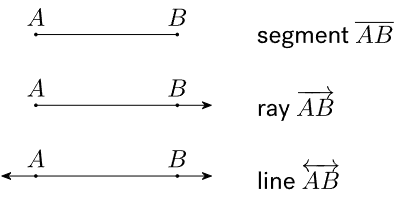
2. Line Segment: A line segment has two distinct endpoints and is the shortest distance between these points.
Important Formulas: Lines and Angles

3. Line: A line extends infinitely in both directions and has no endpoints.

4. Ray: A ray starts at one specific point and extends infinitely in one direction.

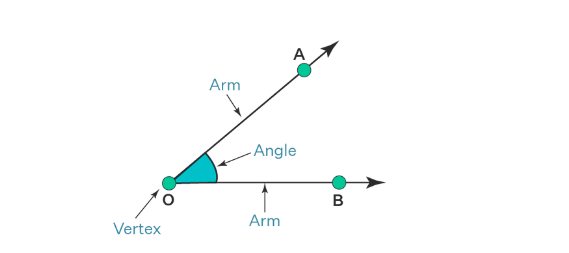
5. Angle: An angle is formed by two rays sharing a common starting point, known as the vertex. The rays are called the arms of the angle. Angles are named using points on each arm and the vertex, like  ∠AOB, with the vertex in the middle.
Important Formulas: Lines and Angles

6. Comparing Angles:

  • Superimposition: Overlaying one angle on top of another to compare their sizes.
  • Alternative Method: Using a transparent circle to compare angles without superimposition.

7. Types of Angles:

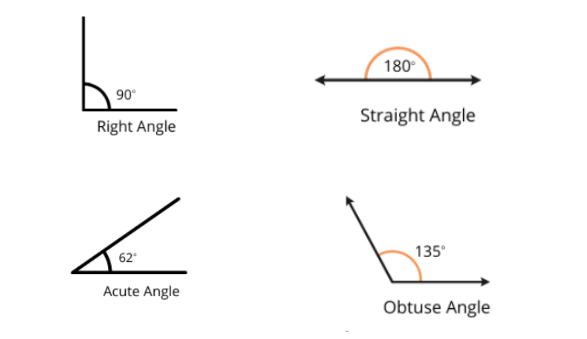
  • Right Angle: Exactly 90°, like the corner of a piece of paper.
  • Straight Angle: Exactly 180°, forming a straight line.
  • Acute Angle: Less than 90°, like a barely open book.
  • Obtuse Angle: More than 90° but less than 180°, like a door opened wider than a right angle.
Important Formulas: Lines and Angles

8. Measuring Angles:

  • Degrees: A full circle has 360°, a straight angle is 180°, and a right angle is 90°.
  • Protractor: Tool for measuring angles, with units marked in degrees.
  • Labeled Protractor: Displays numbers for easy measurement.
  • Unlabeled Protractor: Requires counting marks.

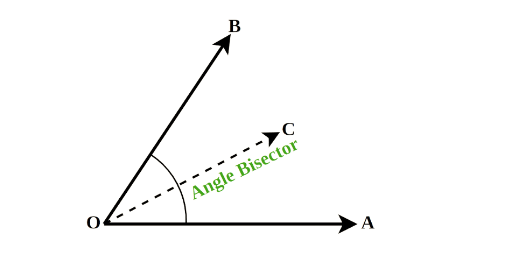
9. Angle Bisector: A line that divides an angle into two equal parts.
Important Formulas: Lines and Angles

10. Common Mistakes with Protractors:

  • Incorrect Placement: Ensure the center is on the vertex.
  • Misalignment: Align one arm of the angle with the 0° line.
  • Wrong Scale: Use the correct scale based on the protractor's alignment.

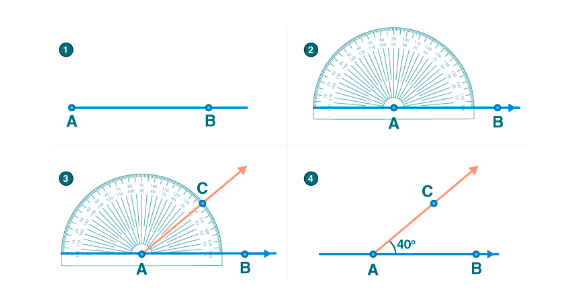
11. Drawing Angles:

Example: To draw a 40° angle, use a protractor to measure and mark the angle, then draw the second arm.
Important Formulas: Lines and Angles

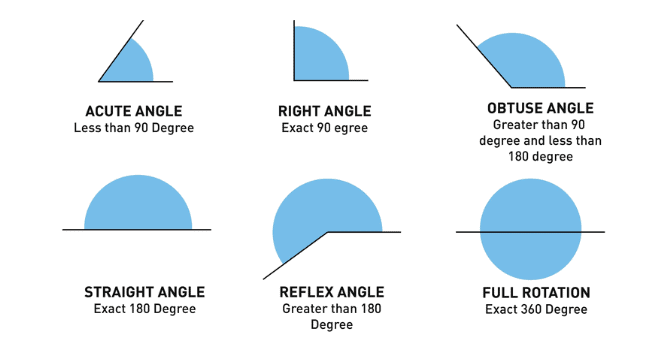
12. Types of Angles and Their Measures:

  • Straight Angle: 180°
  • Right Angle: 90°
  • Acute Angle: More than 0° and less than 90°
  • Obtuse Angle: More than 90° and less than 180°
  • Reflex Angle: More than 180° and less than 360°
Important Formulas: Lines and Angles

MULTIPLE CHOICE QUESTION

Try yourself: An angle of measure 240° is

A

an acute angle

B

a reflex angle

C

a straight angle

D

a complete angle

The document Important Formulas: Lines and Angles is a part of the Class 6 Course Mathematics for Class 6.
All you need of Class 6 at this link: Class 6

FAQs on Important Formulas: Lines and Angles

1. What is the difference between a line, line segment, and a ray in geometry?
Ans. A line extends infinitely in both directions with no endpoints, a line segment has two fixed endpoints, and a ray starts at one point and extends infinitely in one direction. Understanding these distinctions is crucial for CBSE Class 6 geometry, as they form the foundation for studying angles and their properties.
2. How do I identify and measure different types of angles correctly?
Ans. Angles are measured in degrees using a protractor. Acute angles measure less than 90°, right angles equal 90°, obtuse angles range from 90° to 180°, and straight angles measure exactly 180°. Placing the protractor's centre on the vertex and aligning one ray with zero helps obtain accurate angle measurements for exam problems.
3. What are complementary and supplementary angles, and when do I need to use them?
Ans. Complementary angles sum to 90°, while supplementary angles add up to 180°. These concepts appear frequently in CBSE geometry problems involving angle calculations. For example, if one angle is 35°, its complement is 55° and its supplement is 145°-essential formulas for solving missing angle questions.
4. Can you explain vertically opposite angles and why they're always equal?
Ans. Vertically opposite angles form when two straight lines intersect, creating four angles. The angles across from each other are vertically opposite and always measure the same. This property holds true because adjacent angles on a straight line are supplementary, making opposite pairs automatically equal-a key concept in lines and angles problems.
5. What does it mean when two lines are parallel, and how do angles help identify them?
Ans. Parallel lines never meet and maintain constant distance apart. When a transversal (a line crossing two parallel lines) cuts them, corresponding angles are equal, alternate angles match, and co-interior angles sum to 180°. These angle relationships form the foundation for identifying parallel lines in CBSE geometry diagrams and proofs.
Explore Courses for Class 6 exam
Get EduRev Notes directly in your Google search
Related Searches
study material, practice quizzes, ppt, Important Formulas: Lines and Angles, Objective type Questions, video lectures, pdf , Important Formulas: Lines and Angles, Summary, Viva Questions, past year papers, Important questions, Previous Year Questions with Solutions, Semester Notes, Exam, Sample Paper, Important Formulas: Lines and Angles, mock tests for examination, MCQs, shortcuts and tricks, Free, Extra Questions;