|
PARTNER COURSE
CBSE Mental Maths for Class 198,162 students learning this week · Last updated on Jan 05, 2025 |
CBSE Mental Maths Study Material


Mental Maths for Class 1 CBSE Exam Pattern 2025-2026
Mental Maths Exam Pattern for Class 1
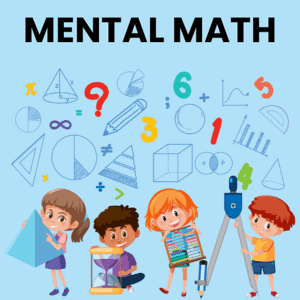
Mental Maths is an essential skill that helps young learners develop their numerical abilities and problem-solving skills. The exam pattern for Class 1 Mental Maths is designed to assess the students' understanding of basic mathematical concepts and their ability to perform mental calculations quickly and accurately. Here is a breakdown of the exam pattern:
1. Multiple-choice Questions:
The Mental Maths exam for Class 1 primarily consists of multiple-choice questions (MCQs). These questions are designed to test the students' ability to choose the correct answer from a given set of options. The MCQs cover various topics such as addition, subtraction, number patterns, counting, and basic shapes.
2. Oral Questions:
In addition to MCQs, the exam may also include oral questions. These questions require the students to solve problems verbally, without using pen and paper. Oral questions assess the students' mental calculation skills, as they need to perform calculations in their mind and provide the answers orally.
3. Time Limit:
The Mental Maths exam for Class 1 is usually conducted within a specific time limit. This time limit encourages students to solve the questions quickly and accurately, improving their mental agility and speed. It also helps assess their ability to manage time effectively while solving mathematical problems.
4. Syllabus Coverage:
The exam pattern covers the syllabus specified for Class 1 Mental Maths. The syllabus generally includes topics such as number recognition, counting numbers up to 100, addition and subtraction within 20, basic shapes, and number patterns. Students are expected to have a good understanding of these concepts to perform well in the exam.
5. Grading System:
The Mental Maths exam for Class 1 is usually graded on a scale or a point-based system. Each question carries a certain number of marks, and the students' performance is evaluated based on their total score. The grading system helps identify the students' strengths and areas needing improvement, allowing teachers to provide targeted guidance for further learning.
In conclusion, the Mental Maths exam pattern for Class 1 focuses on assessing students' understanding of basic mathematical concepts, mental calculation skills, speed, and accuracy. By following this exam pattern, educators can effectively evaluate students' progress in mental maths and provide appropriate support for their overall mathematical development.


Mental Maths Syllabus 2025-2026 PDF Download
- Introduction to mental math techniques
- Addition and subtraction using mental math strategies
- Practice exercises for mental math skills
Class 1 Addition:
- Introduction to addition
- Basic addition facts
- Addition with carrying
- Word problems involving addition
- Addition practice exercises
Class 1 Subtraction:
- Introduction to subtraction
- Basic subtraction facts
- Subtraction with borrowing
- Word problems involving subtraction
- Subtraction practice exercises
Class 1 Multiplication:
- Introduction to multiplication
- Multiplication facts up to 10
- Multiplication using repeated addition
- Word problems involving multiplication
- Multiplication practice exercises
Class 1 Division:
- Introduction to division
- Division facts up to 10
- Division using repeated subtraction
- Word problems involving division
- Division practice exercises
Class 1 Shapes:
- Introduction to basic shapes (circle, square, triangle, rectangle)
- Identifying and naming shapes
- Sorting and classifying shapes
- Drawing and creating shapes
- Shapes practice exercises
Class 1 Geometry:
- Introduction to basic geometric concepts (points, lines, angles)
- Identifying and classifying angles
- Drawing and measuring angles
- Exploring symmetry and patterns
- Geometry practice exercises
Class 1 Bar Graphs:
- Introduction to bar graphs
- Reading and interpreting bar graphs
- Creating and labeling bar graphs
- Analyzing and comparing data using bar graphs
- Bar graphs practice exercises
Class 1 Algebra:
- Introduction to basic algebraic concepts (variables, equations)
- Solving simple algebraic equations
- Using algebraic expressions to solve problems
- Algebra practice exercises
Class 1 Numbers:
- Number recognition and counting up to 100
- Number sequencing
- Number patterns
- Number operations (addition, subtraction, multiplication, division)
- Number practice exercises
Class 1 Maths Tricks:
- Fun and quick math tricks for mental calculations
- Tips and shortcuts for solving math problems
- Engaging activities to improve math skills
- Math tricks practice exercises
Class 1 Fractions Made Easy:
- Introduction to fractions
- Identifying and naming fractions
- Understanding basic fraction concepts (numerator, denominator)
- Comparing and ordering fractions
- Fractions practice exercises
Class 1 Time Travellers:
- Introduction to telling time
- Reading and writing analog and digital clocks
- Understanding hours, minutes, and seconds
- Time conversion (e.g., hours to minutes)
- Time practice exercises
Class 1 Calendar:
- Understanding the concept of a calendar
- Days of the week
- Months of the year
- Reading and interpreting a calendar
- Calendar practice exercises
Class 1 Money Math:
- Introduction to money and its value
- Identifying and counting coins and bills
- Making change
- Money word problems
- Money math practice exercises
Class 1 Profit and Loss:
- Introduction to basic concepts of profit and loss
- Understanding the difference between buying and selling
- Calculating profit and loss
- Real-life examples of profit and loss situations
- Profit and loss practice exercises
This course is helpful for the following exams: Class 1, Class 2, Class 3, Class 4, Class 5, Class 6, Class 10, Grade 1, Grade 2, Grade 3, Grade 4, Grade 5, Grade 6, Grade 7, Grade 8, Grade 9, Grade 10, Year 1, Year 2, Year 3, Year 4, Year 5, Year 6, Year 7, Year 8, Year 9, Year 10, Grade 1, Grade 2, Grade 3, Grade 4, Grade 5, Grade 6, Grade 7, Grade 8, Grade 9, Grade 10, Year 1, Year 2, Year 3, Year 4, Year 5, Year 6, Year 7, Year 8, Year 9, Year 10, Primary 1, Primary 2, Primary 3, Primary 4, Primary 5, Primary 6, JSS 1, JSS 2, JSS 3, SSS 1, Grade 1, Grade 2, Grade 3, Grade 4, Grade 5, Grade 6, Grade 7, Grade 8, Grade 9, Grade 10
How to Prepare Mental Maths for Class 1?
Mental maths is an essential skill that lays the foundation for a strong mathematical understanding. It helps students develop their ability to perform calculations quickly and accurately in their minds, without relying on external aids such as calculators or pen and paper. To excel in mental maths, Class 1 students can follow these key points:
1. Understanding the Basics:
Before diving into complex mental maths techniques, it is crucial for students to have a solid understanding of basic mathematical concepts. This includes having a firm grasp of numbers, counting, addition, and subtraction. Class 1 students should be able to recognize and write numbers from 1 to 100, understand the concept of place value, and perform simple addition and subtraction operations.
2. Practice Counting:
Counting is the foundation of mental maths. Encourage Class 1 students to practice counting forward and backward, starting from different numbers. They can count objects, steps, or even play counting games to make it more interactive and enjoyable. Regular counting practice helps students develop a strong number sense, which is essential for mental calculations.
3. Memorize Number Facts:
To excel in mental maths, students should memorize number facts such as addition and subtraction combinations up to 10. This includes knowing basic addition facts like 1+1=2, 2+2=4, and subtraction facts like 5-1=4, 6-2=4. By memorizing these facts, students can quickly recall them when solving mental maths problems, saving time and effort.
4. Engage in Mental Maths Activities:
Make mental maths practice enjoyable and engaging for Class 1 students. You can use interactive games, puzzles, and flashcards to reinforce their understanding of mathematical concepts. EduRev's mental maths course for Class 1 offers a wide range of activities and exercises specifically designed to enhance mental maths skills in young learners.
5. Practice Speed and Accuracy:
Speed and accuracy are crucial aspects of mental maths. Encourage Class 1 students to practice solving mental maths problems within a time limit. Gradually increase the difficulty level and time constraints as their skills improve. This helps develop their ability to perform calculations swiftly and accurately, improving their overall mental maths proficiency.
6. Regular Revision:
Consistent revision is essential to reinforce mental maths skills. Class 1 students should regularly review previously learned concepts and techniques to ensure they are retained. EduRev's mental maths course for Class 1 provides comprehensive revision materials and assessments to help students reinforce their learning and track their progress.
Preparing for mental maths in Class 1 requires a combination of understanding the basics, regular practice, and engaging learning materials. By following these key points and utilizing EduRev's mental maths course for Class 1, students can develop a strong foundation in mental maths, setting them up for success in their mathematical journey.
Importance of Mental Maths for Class 1
Mental maths is a crucial skill that lays the foundation for mathematical abilities in young learners. The Mental Maths Course offered by EduRev is specifically designed to enhance the numerical skills of Class 1 students. This course focuses on developing mental calculation abilities, improving problem-solving skills, and boosting overall mathematical proficiency.
Why is Mental Maths important for Class 1 students?
1. Building a strong foundation: Mental Maths helps in building a strong foundation in mathematics from an early age. It lays the groundwork for more complex mathematical concepts that students will encounter in higher grades.
2. Improving calculation speed: Mental Maths enables students to perform calculations quickly and accurately in their minds. This skill not only saves time but also enhances their overall computational abilities.
3. Enhancing problem-solving skills: By practicing mental maths, Class 1 students develop critical thinking and problem-solving skills. They learn to analyze problems, identify patterns, and apply appropriate strategies to find solutions.
4. Promoting confidence: As students become proficient in mental maths, their confidence in mathematics grows. They feel more comfortable tackling mathematical problems, which boosts their overall academic confidence.
5. Increasing concentration: Mental Maths requires students to focus and concentrate on numerical tasks. Regular practice of mental calculations enhances their concentration skills and improves their ability to stay focused for longer durations.
Key features of the Mental Maths Course by EduRev
1. Interactive lessons: The course consists of engaging and interactive lessons that make learning mental maths enjoyable for Class 1 students.
2. Comprehensive curriculum: The course covers a wide range of topics, including number sense, addition, subtraction, multiplication, division, and basic problem-solving.
3. Practice exercises: Ample practice exercises are provided to reinforce the concepts learned and enhance students' proficiency in mental calculations.
4. Progress tracking: The course includes progress tracking tools that enable students, parents, and teachers to monitor the improvement in mathematical skills over time.
5. Accessible anytime, anywhere: The course is available online, allowing students to access the lessons and practice materials at their convenience.
In conclusion, the Mental Maths Course offered by EduRev for Class 1 students plays a vital role in developing their mathematical abilities. By focusing on mental calculations, problem-solving, and overall numerical proficiency, this course equips students with essential skills that set them on the path to success in mathematics and beyond.
Mental Maths for Class 1 FAQs
| 1. What is mental maths? |  |
| 2. Why is mental maths important? | |
| 3. How can I improve my mental maths skills? | |
| 4. Can mental maths be helpful in everyday life? | |
| 5. Are there any specific techniques for mental maths? | |
| 6. Can mental maths help improve overall mathematical abilities? | |
| 7. Is mental maths suitable for all age groups? | |
| 8. How can mental maths be beneficial in competitive exams? | |
| 9. Are there any online resources available for learning mental maths? | |
| 10. Can mental maths help improve memory and concentration? | |
| 11. Is mental maths a part of the school curriculum? | |
| 12. Are there any specific techniques for mental multiplication and division? | |
| 13. Can mental maths help in improving problem-solving skills? | |
| 14. Are there any tips for practicing mental maths effectively? | |
| 15. Can mental maths be used for more advanced mathematical concepts? | |
Best Coaching for Mental Maths for Class 1
Tags related with Mental Maths for Class 1
Best Mental Maths for Class 1 NCERT Solutions and Study Materials

|
View your Course Analysis |

|

|
Create your own Test |
|


|
Explore Courses for Class 1 exam
|

|
Course Speciality





CBSE Mental Maths for Class 1 Books
CBSE Mental Maths for Class 1 Notes PDF Download
CBSE Mental Maths for Class 1 Previous Year Papers
Important Questions for CBSE Mental Maths for Class 1
|
© EduRev
|
Education Revolution
|


|