Policy Cycle


Policy Formulation
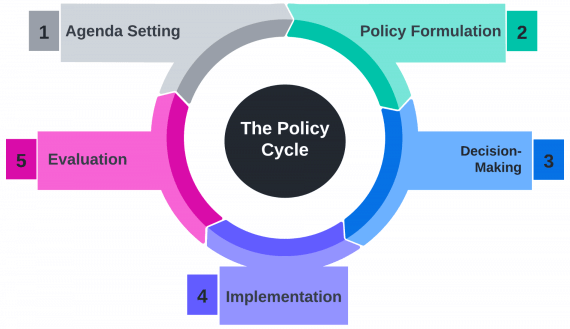
In a democracy, several mechanisms draw government attention to pressing issues. These include:
Legislative Action: Elected representatives in Parliament and state assemblies raise concerns and demand government action on issues where the government has either failed to act adequately or has created new problems.
Pressure Groups: Organized groups, such as business associations (e.g., Federation of Indian Chambers of Commerce and Industry), trade unions, or employee associations, exert influence on government policies.
Social Movements: Grassroots movements, like the Chipko Movement, can highlight specific issues to the government.
Voluntary Organizations and Media: These entities also play a crucial role in drawing attention to various problems and concerns.
Policy Ideology: Governments create policies aligned with their ideological stance. For instance, welfare or socialist ideals enshrined in the Constitution lead to comprehensive policies aimed at social behavior and economic development. Political parties articulate these ideological positions and policy demands, while opposition parties use public and parliamentary forums to advocate for certain policies.
Governments, therefore, must balance internal policy formulation with responding to demands from various groups and institutions. When these groups fail to perform their roles effectively, social conflicts can become more pronounced.
Major Components of Policy Implementation
The key components of policy implementation that need to be decided at this stage are:
Setting Goals and Objectives: This involves defining a clear perspective to establish the broad goals of the policy. For example, in anti-poverty programs, the initial focus is on setting specific goals and objectives.
Developing a Strategy: This component involves determining the strategy for implementing the policy. For instance, to support the poor, strategies might include providing food and shelter at below-market rates or creating employment opportunities to help individuals earn wages sufficient to meet their basic needs.
Implementation Machinery
- Once a strategy is selected, the next step is to determine the implementation machinery, which is the third key component of policy making.
- Some strategies may require the establishment of new administrative structures, while others may not.
- For example, the Integrated Rural Development Programme was created to help the poor generate additional income through loans and subsidies.
- During the policy formulation stage, decisions must be made regarding objectives, goals, strategies, and implementation tools.
- Proper identification of these elements depends on careful policy design.
Constraints in Policy Making
Several constraints can adversely affect the policy-making process:
Financial Constraints: Insufficient financial resources can disrupt the smooth execution of policies. Additionally, increased expenditure due to delays or deviations from schedules exacerbates the problem.
Expertise and Skills: A lack of expertise and skills among policy-making personnel can hinder progress, though this can be addressed through proper training and education.
Clarity and Focus: Unclear goals and a focus on short-term benefits can be significant constraints.
Political and Social Factors: Political interference, lack of public support, and non-involvement of socially aware groups are also challenges.
Design and Oversight Issues: Faulty policy design, absence of policy education, and inadequate monitoring and evaluation further complicate the policy-making process.
State's Role in the Public Policy Process
- Understanding the nature of public policy requires grasping the evolving role of the state.
- Political science has traditionally focused on studying the state and its power structures.
- Public policy and its analysis are directly influenced by these power structures.
- Post-World War II, the discipline faced criticism regarding its relevance and effectiveness.
- Doubts emerged about the practical utility of political science.
- There were concerns about its ability to help the state address various challenges.
- This led to broader questions about the value of studying a subject perceived as having marginal practical impact.
- During this period, there was a shift away from state intervention towards market forces.
- The trend towards liberalism and privatization was exemplified by the American model of development.
- Western societies began to view the state as inflexible and obstructive to economic growth.
- As a result, the role of the state in driving industrialization and modernization diminished.
- The market took on a more prominent role in economic development.
- The state's focus shifted to correcting market distortions rather than actively promoting economic development.
Public Policy Experience in India
Structural Intervention:
- Structural changes are often pursued through public policy interventions.
- Policies aimed at altering land ownership, property rights, and other forms of wealth fall under this category.
- A key example of structural intervention in post-independence India is the land reform policy.
- This policy began taking shape during the freedom movement.
Technological Intervention:
- Another dimension of public policy intervention is technological advancement.
- In developing countries like India, this is exemplified by initiatives such as the Green Revolution and industrial modernization.
- Technological interventions are typically introduced when structural policies fail to achieve desired outcomes.
- For instance, the Green Revolution significantly boosted agricultural production and addressed some of the limitations of earlier policies.
Anti-Poverty Intervention:
- Since independence, all Five Year Plans have emphasized the importance of addressing poverty and inequality.
- However, it was the Fourth Five Year Plan that explicitly targeted poverty eradication.
- This marked the beginning of a series of anti-poverty programs designed to directly combat poverty.
- The shortcomings of structural and technological interventions prompted the government to develop programs specifically aimed at alleviating poverty.
FAQs on Policy Cycle
| 1. What are the main stages of the policy cycle and how do they connect to each other? |  |
| 2. Why is the agenda-setting stage so important in the policy cycle process? | |
| 3. How does policy implementation differ from policy formulation in the policy cycle? | |
| 4. What problems commonly occur during policy implementation that affect the policy cycle's success? | |
| 5. How does policy evaluation inform the next cycle and shape policy feedback mechanisms? | |