UPSC Exam > UPSC Notes > Indian Polity for UPSC CSE > Cheat Sheet: Fundamental Rights
Cheat Sheet: Fundamental Rights | Indian Polity for UPSC CSE PDF Download

Introduction
This document provides a detailed chronology of the Fundamental Rights as outlined in Part III of the Indian Constitution. The purpose of this document is to give a clear understanding of the different Fundamental Rights, their application, and how they have evolved over time. The structure of the document is organized into various sections for each right, followed by a summary of key points. This format allows for easy reading and quick revision, making it suitable for both study and reference.
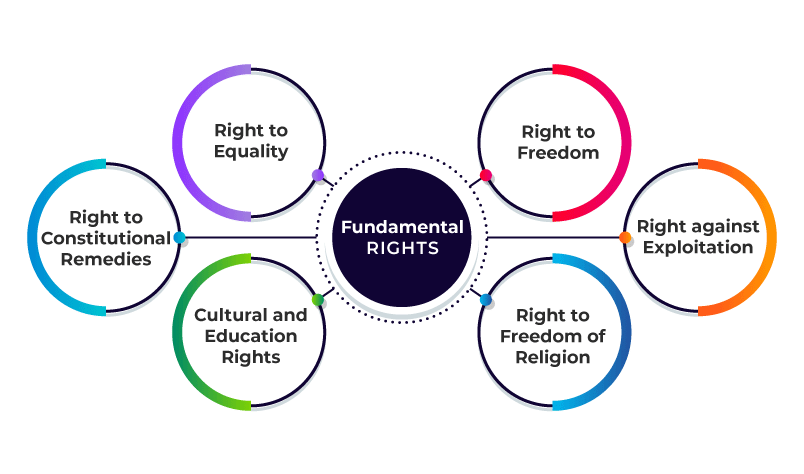
Fundamental Rights Overview
Article 12: Definition of State

Article 13: Laws Inconsistent with Fundamental Rights

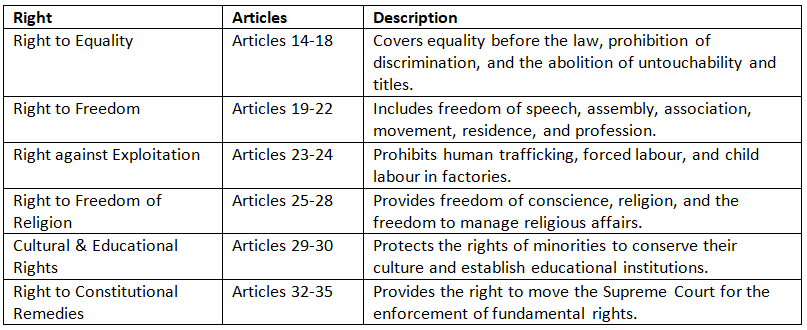
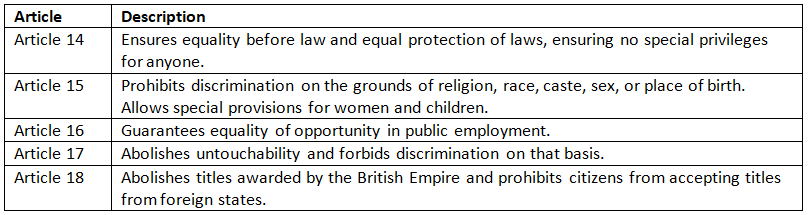
Right to Equality (Articles 14-18)
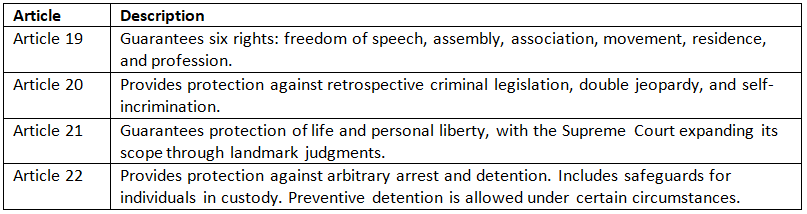
Right to Freedom (Articles 19-22)
Right against Exploitation (Articles 23-24)

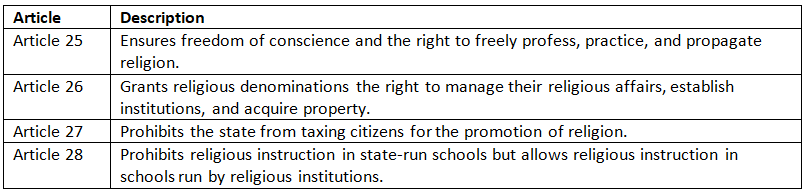
Right to Freedom of Religion (Articles 25-28)
Cultural & Educational Rights (Articles 29-30)

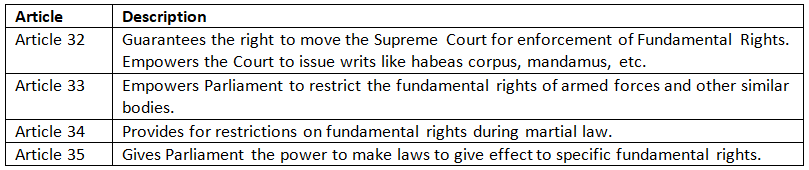
Right to Constitutional Remedies (Articles 32-35)
The document Cheat Sheet: Fundamental Rights | Indian Polity for UPSC CSE is a part of the UPSC Course Indian Polity for UPSC CSE.
All you need of UPSC at this link: UPSC
|
154 videos|998 docs|260 tests
|
FAQs on Cheat Sheet: Fundamental Rights - Indian Polity for UPSC CSE
| 1. What are fundamental rights and why are they important? |  |
Ans.Fundamental rights are a set of legal protections and freedoms that are guaranteed to individuals by the constitution or legal framework of a nation. They are essential because they ensure individuals can live freely and with dignity, protecting them from abuse by the state and ensuring equality before the law. These rights often include the right to equality, freedom of speech and expression, the right to privacy, and protection against discrimination, among others.
| 2. How are fundamental rights different from legal rights? | |
Ans.Fundamental rights are inherent and are typically enshrined in the constitution, meaning they cannot be easily altered or taken away. Legal rights, on the other hand, are granted by legislation and can be modified or revoked by the government. While both types of rights aim to protect individuals, fundamental rights hold a higher status as they are essential for the maintenance of democracy and individual freedom.
| 3. Can fundamental rights be restricted? If so, under what conditions? | |
Ans.Yes, fundamental rights can be restricted, but such restrictions must meet certain criteria. Generally, limitations can be imposed for reasons such as national security, public order, morality, or the rights of others. However, any restriction must be reasonable, proportional, and not arbitrary, ensuring that the essence of the fundamental rights is preserved.
| 4. What role do courts play in protecting fundamental rights? | |
Ans.Courts play a crucial role in safeguarding fundamental rights by interpreting the law and adjudicating disputes related to these rights. Individuals can approach the judiciary if they believe their fundamental rights have been violated. Courts have the authority to review laws and government actions to ensure they comply with constitutional provisions, thus providing a check on governmental power.
| 5. How do fundamental rights evolve over time? | |
Ans.Fundamental rights can evolve through judicial interpretations and societal changes. Courts may expand the scope of these rights based on contemporary values and norms, thereby adapting to new challenges such as technological advancements or social movements. Legislative amendments can also play a role in this evolution, as new rights may be recognized or existing ones revised to reflect the changing needs of society.
About this Document

4.60/5
Rating

Sep 20, 2025
Last updated
Related Exams
Document Description: Cheat Sheet: Fundamental Rights for UPSC 2025 is part of Indian Polity for UPSC CSE preparation.
The notes and questions for Cheat Sheet: Fundamental Rights have been prepared according to the UPSC exam syllabus. Information about Cheat Sheet: Fundamental Rights covers topics
like Introduction and Cheat Sheet: Fundamental Rights Example, for UPSC 2025 Exam. Find important definitions, questions, notes, meanings, examples, exercises and tests below for Cheat Sheet: Fundamental Rights.
Introduction of Cheat Sheet: Fundamental Rights in English is available as part of our Indian Polity for UPSC CSE
for UPSC & Cheat Sheet: Fundamental Rights in Hindi for Indian Polity for UPSC CSE course.
Download more important topics related with notes, lectures and mock test series for UPSC
Exam by signing up for free. UPSC: Cheat Sheet: Fundamental Rights | Indian Polity for UPSC CSE
Description
Full syllabus notes, lecture & questions for Cheat Sheet: Fundamental Rights | Indian Polity for UPSC CSE - UPSC | Plus excerises question with solution to help you revise complete syllabus for Indian Polity for UPSC CSE | Best notes, free PDF download
Information about Cheat Sheet: Fundamental Rights
In this doc you can find the meaning of Cheat Sheet: Fundamental Rights defined & explained in the simplest way possible. Besides explaining types of
Cheat Sheet: Fundamental Rights theory, EduRev gives you an ample number of questions to practice Cheat Sheet: Fundamental Rights tests, examples and also practice UPSC
tests


Related Searches
Exam
,MCQs
,Cheat Sheet: Fundamental Rights | Indian Polity for UPSC CSE
,mock tests for examination
,Summary
,Semester Notes
,Free
,Viva Questions
,Objective type Questions
,Important questions
,Previous Year Questions with Solutions
,study material
,past year papers
,practice quizzes
,shortcuts and tricks
,Cheat Sheet: Fundamental Rights | Indian Polity for UPSC CSE
,Extra Questions
,Sample Paper
,Cheat Sheet: Fundamental Rights | Indian Polity for UPSC CSE
,ppt
,video lectures
;



Additional Information about Cheat Sheet: Fundamental Rights for UPSC Preparation
Cheat Sheet: Fundamental Rights Free PDF Download
The Cheat Sheet: Fundamental Rights is an invaluable resource that delves deep into the core of the UPSC exam.
These study notes are curated by experts and cover all the essential topics and concepts, making your preparation more efficient and effective.
With the help of these notes, you can grasp complex subjects quickly, revise important points easily,
and reinforce your understanding of key concepts. The study notes are presented in a concise and easy-to-understand manner,
allowing you to optimize your learning process. Whether you're looking for best-recommended books, sample papers, study material,
or toppers' notes, this PDF has got you covered. Download the Cheat Sheet: Fundamental Rights now and kickstart your journey towards success in the UPSC exam.
Importance of Cheat Sheet: Fundamental Rights
The importance of Cheat Sheet: Fundamental Rights cannot be overstated, especially for UPSC aspirants.
This document holds the key to success in the UPSC exam.
It offers a detailed understanding of the concept, providing invaluable insights into the topic.
By knowing the concepts well in advance, students can plan their preparation effectively.
Utilize this indispensable guide for a well-rounded preparation and achieve your desired results.
Cheat Sheet: Fundamental Rights Notes
Cheat Sheet: Fundamental Rights Notes offer in-depth insights into the specific topic to help you master it with ease.
This comprehensive document covers all aspects related to Cheat Sheet: Fundamental Rights.
It includes detailed information about the exam syllabus, recommended books, and study materials for a well-rounded preparation.
Practice papers and question papers enable you to assess your progress effectively.
Additionally, the paper analysis provides valuable tips for tackling the exam strategically.
Access to Toppers' notes gives you an edge in understanding complex concepts.
Whether you're a beginner or aiming for advanced proficiency, Cheat Sheet: Fundamental Rights Notes on EduRev are your ultimate resource for success.
Cheat Sheet: Fundamental Rights UPSC Questions
The "Cheat Sheet: Fundamental Rights UPSC Questions" guide is a valuable resource for all aspiring students preparing for the
UPSC exam. It focuses on providing a wide range of practice questions to help students gauge
their understanding of the exam topics. These questions cover the entire syllabus, ensuring comprehensive preparation.
The guide includes previous years' question papers for students to familiarize themselves with the exam's format and difficulty level.
Additionally, it offers subject-specific question banks, allowing students to focus on weak areas and improve their performance.
Study Cheat Sheet: Fundamental Rights on the App
Students of UPSC can study Cheat Sheet: Fundamental Rights alongwith tests & analysis from the EduRev app,
which will help them while preparing for their exam. Apart from the Cheat Sheet: Fundamental Rights,
students can also utilize the EduRev App for other study materials such as previous year question papers, syllabus, important questions, etc.
The EduRev App will make your learning easier as you can access it from anywhere you want.
The content of Cheat Sheet: Fundamental Rights is prepared as per the latest UPSC syllabus.
|
© EduRev
|
Education Revolution
|


|




Signup to see your scores
go up
within 7 days!
within 7 days!
Takes less than 10 seconds to signup