NCERT Solutions: Hide and Seek


Where Are You Hiding?
(Page 24)
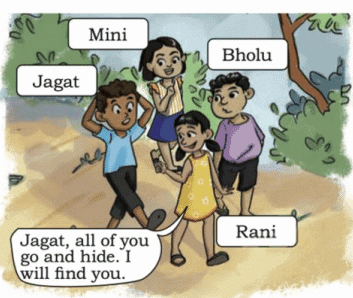
Let Us Do
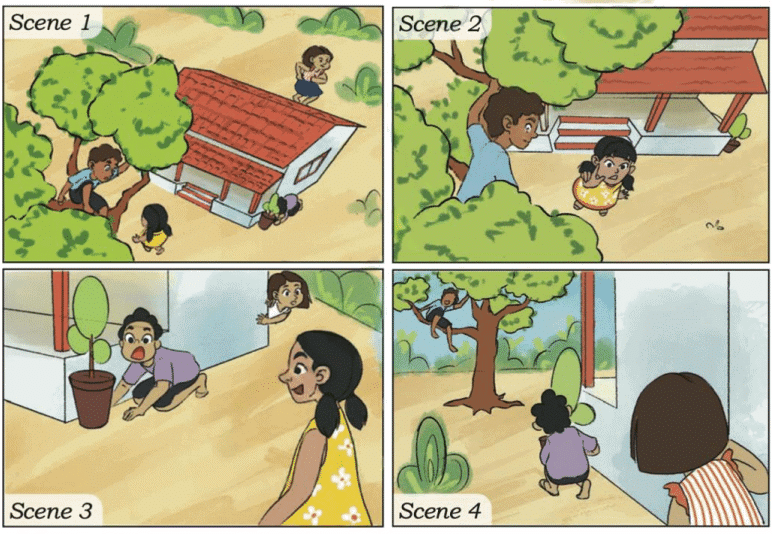
Q1: Look at the picture and answer the following:a. Which game are the children playing?
Ans: The children are playing 'hide and seek' game.
b. Who is looking from the top?
Ans: Jagat is looking from the top.
c. In Scene 1, if Rani faces towards the hut, will she be able to see who all are hiding near the hut? Discuss.
Ans: In scene 1, if Rani faces towards the hut, she will not be able to see who all are hiding near the hut because Bholu is hiding behind the tree and Mini is hiding behind the hut.
Discuss
(Page 25)
In Scene 4, can Mini see all the children playing the game? Discuss.
Ans: No, Mini can only see Bholu and Jagat.
Q2: Mini, Bholu, and Rani draw the same brick. Why are their drawings of the same brick different? Discuss.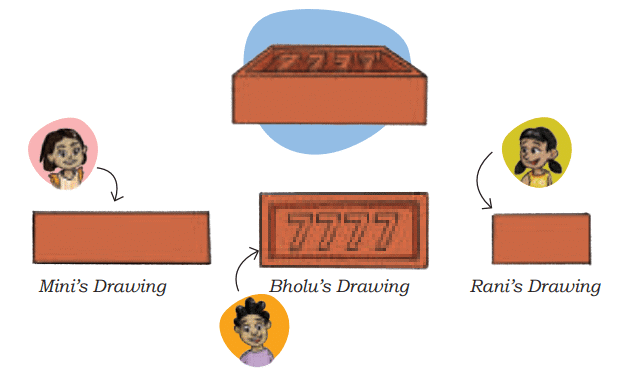 Ans: Their drawings are different because they drew the brick from different views. Mini drew the front view, Bholu drew the top view, and Rani drew the side view. Each view shows a different side of the brick.
Whose drawing shows the following views?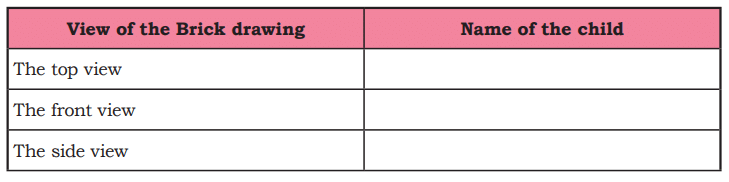
Ans: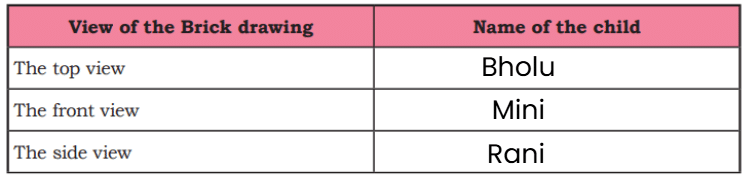
Q3: Look at the pictures and name the objects. Also write which view of the object is given.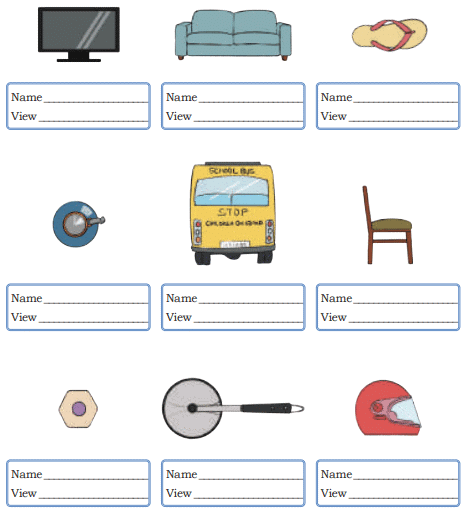
Ans: 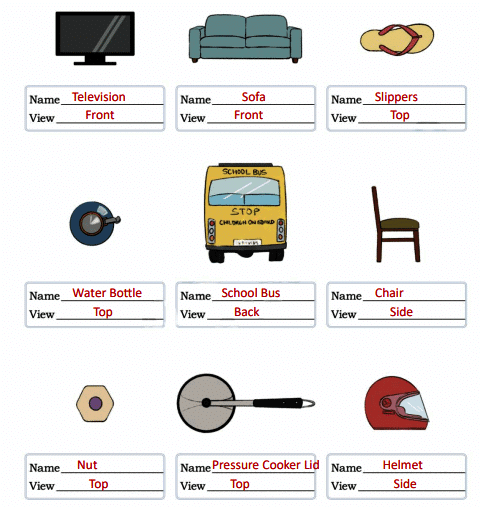
Q4. Jagat and Rani have made different drawings of the same objects. Match the views with the objects.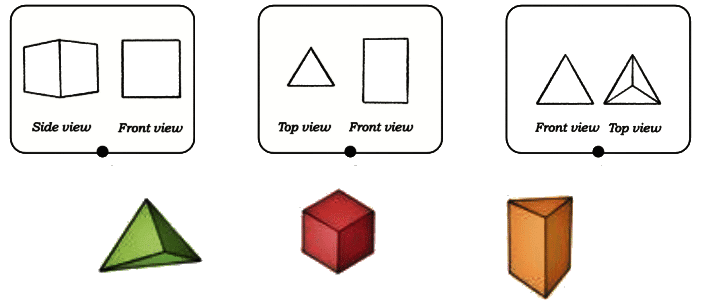 Look around you! Try to make drawings of objects, such as chairs, tables, pencils, erasers, birthday cap, and bottle from different views.
Ans: 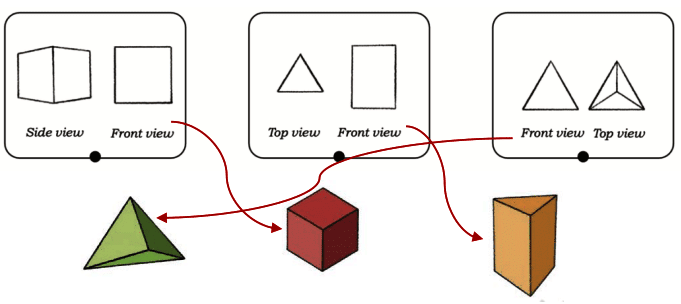
Boxy Buildings
(Page 27)
Jagat and Mini are playing. They are making different buildings using empty matchboxes and making their drawings from different views.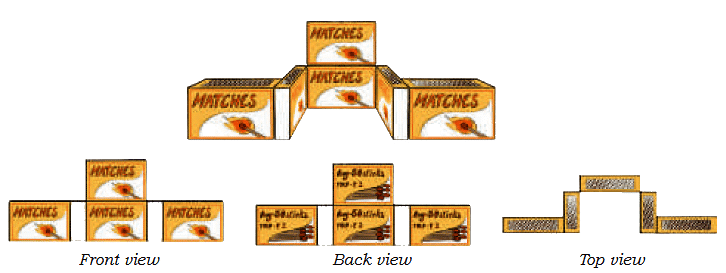
Now, you also collect empty matchboxes or any other empty boxes to create different buildings and draw their top, side, and front views. You can challenge your friends by asking them to match your drawing with the right building.
Ans: Do it Yourself.
Cat Finds Jagat
(Page 28)
The next day, the five friends go to school feeling excited as it is an activity day. Jagat's pet cat follows him to school. The cat sits on the window and tries to find Jagat.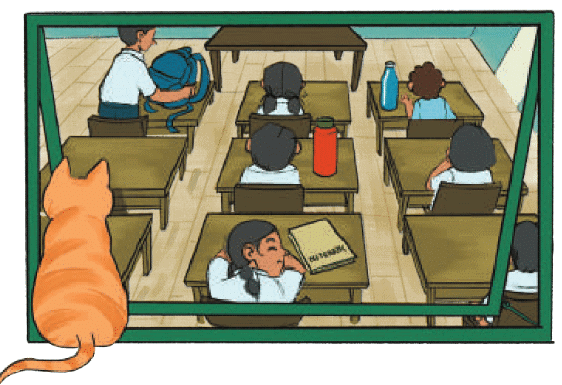
Let Us Do
Jagat's cat sees him sitting on the third desk in the first row .Q1: Mark Jagat's position in the picture.
Ans:
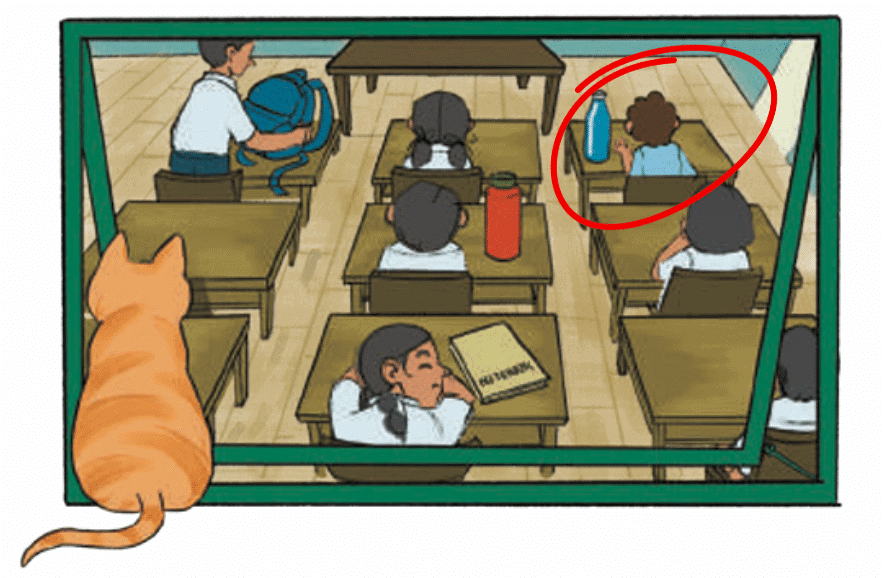
Q2: Describe the position of the blue bag.
Ans: The blue bag is on the first desk in the first row.
Q3: What do you see on the middle desk of the second row?
Ans: A red bottle is on the middle desk of the second row.
Q4: Where is the notebook kept - the first desk in the second row or the middle desk in the third row?
Ans: The notebook is on the middle desk in the third row.
Q5: Draw an apple on the third desk of the second row.
Ans: 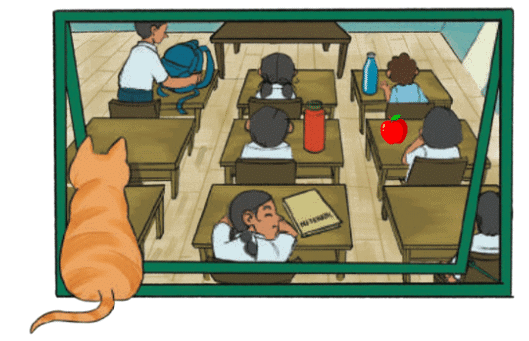
Grid Game
(Page 29)
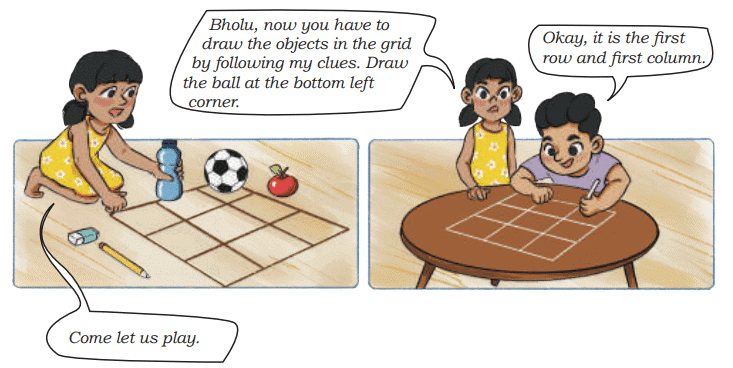
Q: Here are the clues given by Rani to fill the grid:
- An eraser at the top right corner.
- A pencil in the top left corner.
- An apple in the middle of the second row and second column.
- A water bottle in the third row and second column.
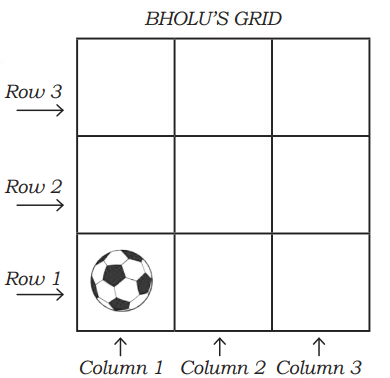
Ans: 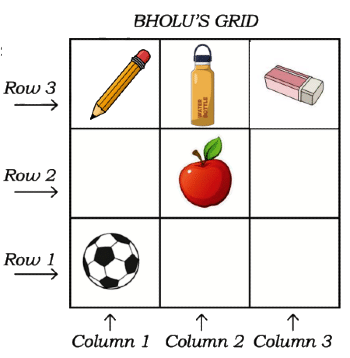
Grid Game - Treasure Hunt
(Page 30)
In this game, one player has to think of an object from the grid and help the other player locate it. Let's see how Jagat and Mini are playing.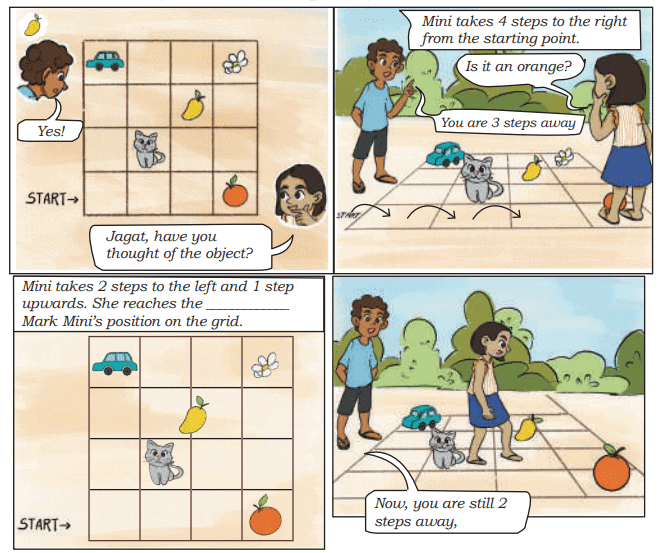
What object did Jagat think of?
Ans:
- Mini takes 2 steps to the left and 1 step upwards. She reaches the Cat.
- Mark Mini's position on the grid.
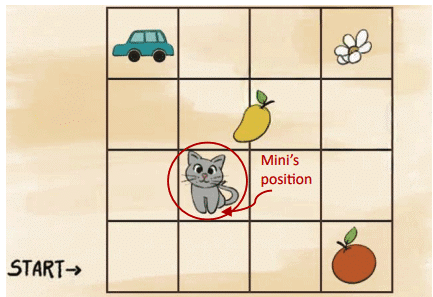
- Jagat thought of object mango.
Play the game with your partner
From the starting point, trace the paths to reach the flower. How many steps are required for each path? Speak out or write down the different paths followed to reach the flower.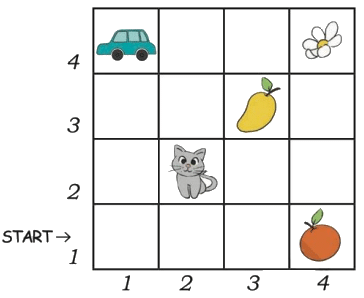 Ans: Steps required for each path (Path 1 and Path 2) = 7 steps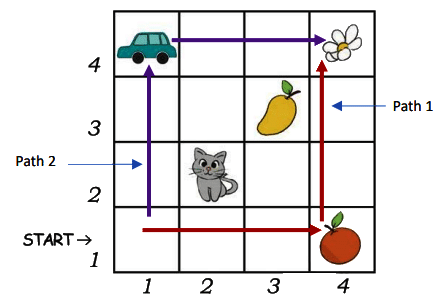
From the starting point, where would you reach in a smaller number of steps: the mango or the orange?
Steps required to reach mango = 5 steps.
Steps required to reach orange = 4 steps
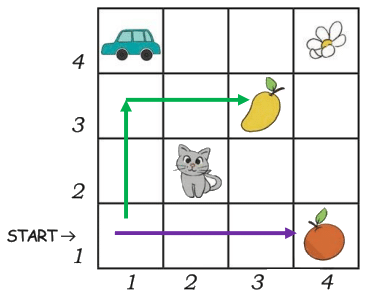 Orange can be reached in smaller number of steps.
Drone Around the School
(Page 31)
Gyan has got a drone to show her friends. A drone can take pictures while flying.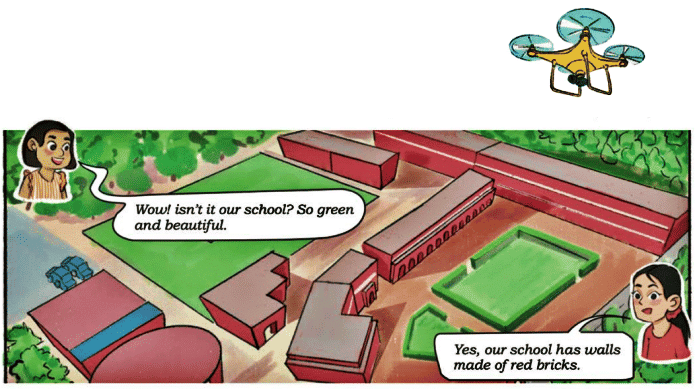
Q: Circle the places or things that you see in the picture and write their names.
Ans: In the drone's picture, circle items or places like trees, buildings, or playgrounds. Their names, e.g., "Tree, Car, School, Playground."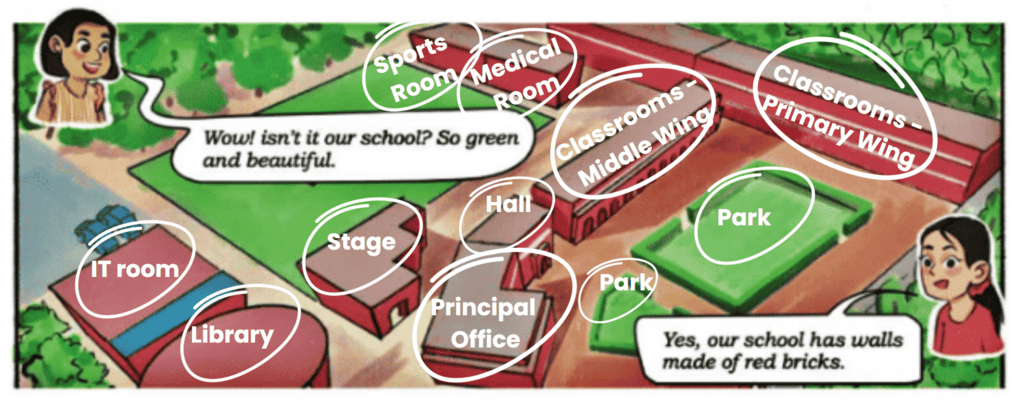
Drone Around the School (Continued)
(Page 32)
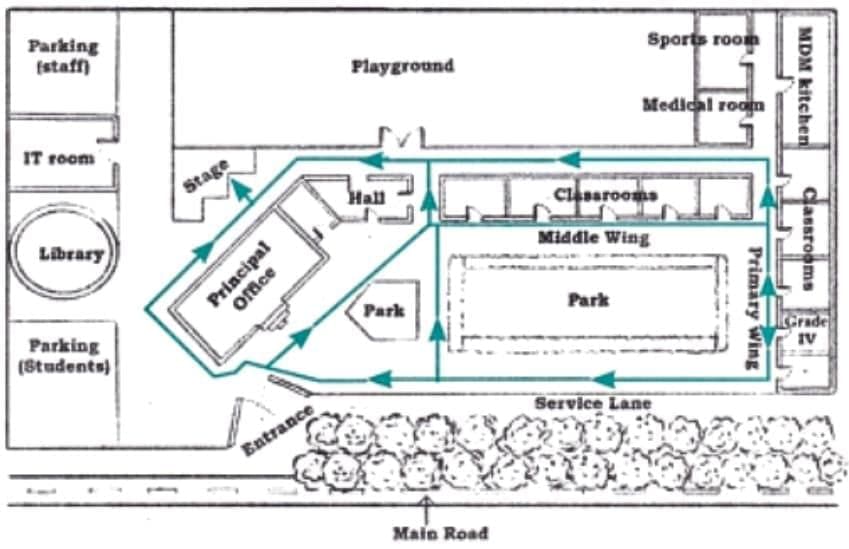
Preet's elder sister has made a sight map of the school. You can easily locate Grade 4 on the map.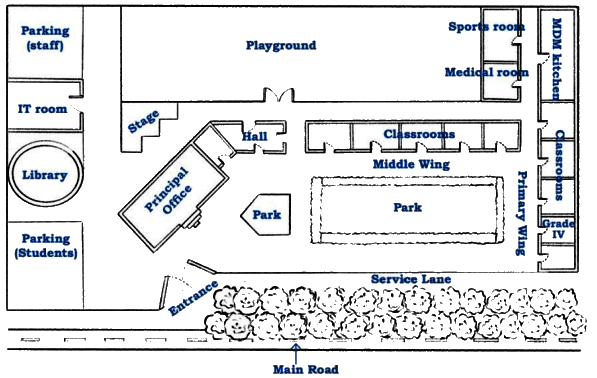 Q1: Trace the path from the Grade 4 classroom to the stage.
Ans:
Q2: How many routes were you able to find? (You may use different colour pencils to trace the different routes)
Ans: Number of routes to go from the Grade 4 classroom to the stage = 5 routes
Q3: Which is the shortest route? How do you know?
Ans: The route which is going to the right of Grade 4 via playground is the shortest.
Q4: The water delivery man has turned left from the entrance. Help him reach MDM Kitchen by telling him the route. Write the directions below.
Ans: 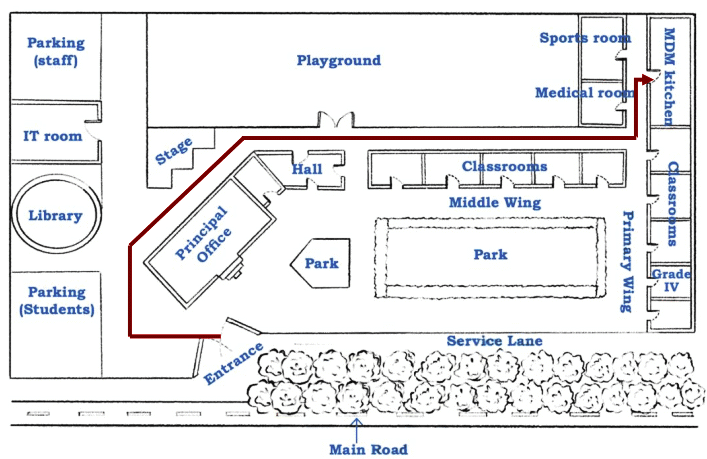 Directions to the MDM Kitchen from the entrance:
(i) Turn left at the entrance and walk straight.
(ii) Go along the path between the Principal's Office and the Stage.
(iii) Keep walking straight until you reach the Medical Room.
(iv) From the Medical Room, turn left. The MDM Kitchen will be right there.
Q5: Rajat is not feeling well. Which way will you choose to take him to the medical room from the library?
Ans: (i) Walk past the stage and enter the corridor next to the hall.
(ii) Continue straight, passing the Middle Wing classrooms.
(iii) The room at the far-left corner of the corridor is the Medical Room.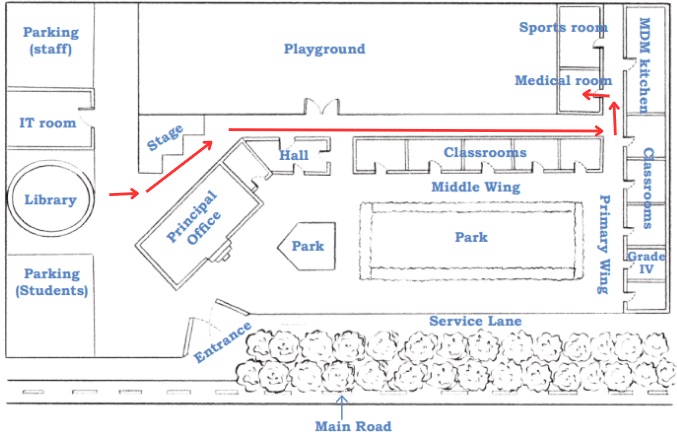
Q6: After the assembly in the playground, Bholu must go to the IT room and Rani has to go to the sports room. Trace their paths. Which way is longer?
Ans: 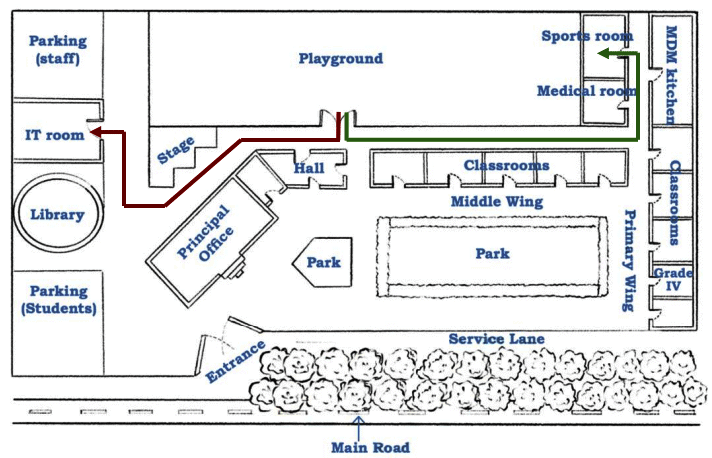 So, Rani's way is longer.
Let Us Do (Project Work)
(Page 33)
Q: Draw a sight map to show the way from your school entrance to your classroom and any other important places. Ans: Do it Yourself.
FAQs on NCERT Solutions: Hide and Seek
| 1. What are the different hiding spots and their tricks in the Hide and Seek chapter? |  |
| 2. How do you count and locate hidden objects using systematic methods? | |
| 3. Why is spatial reasoning important for solving Hide and Seek problems? | |
| 4. What common mistakes do students make when counting hidden objects? | |
| 5. How can I use Hide and Seek concepts to improve my observation skills for exams? | |