UPSC Exam > UPSC Notes > Geography CSE > Cheat Sheet: International Trade
Cheat Sheet: International Trade


Meaning and Importance
- International trade refers to the exchange of goods, services, and capital across international borders.
- It contributes significantly to GDP, employment generation, foreign exchange earnings, and global integration.
- India ranks among the top trading nations globally and is a key player in services trade.
Theories of International Trade
Types of Trade
- Bilateral Trade: Trade between two countries (e.g., India-UAE CEPA).
- Multilateral Trade: Trade under WTO framework involving multiple countries.
- Regional Trade: Conducted under regional agreements like SAFTA, RCEP (India is not a member).
India's Major Trade Partners (2025)
- Top Export Destinations: USA, UAE, Netherlands, China, Bangladesh
- Top Import Sources: China, UAE, USA, Saudi Arabia, Russia
Major Exports of India
- Petroleum products
- Engineering goods
- Gems and jewellery
- Drugs and pharmaceuticals
- IT services
Major Imports of India
- Crude oil
- Gold
- Electronic goods
- Machinery
- Fertilizers
India's Trade Agreements (Key Developments as of 2025)
WTO and India
- India is a founding member of WTO (1995).
- Actively involved in disputes, negotiations on agricultural subsidies, and TRIPS waiver.
- Pushing for fair trade in services and digital commerce.
Issues in India's Trade
- Trade Deficit: Widening with countries like China.
- Logistics & Infrastructure: Need for port modernization and trade facilitation.
- Tariff & Non-Tariff Barriers: Affect India's competitiveness.
- Export Diversification: Heavy dependence on few sectors.
Recent Initiatives
- Foreign Trade Policy : Shift from incentives to remission-based regime.
- PLI Schemes: Boost manufacturing-led exports (electronics, pharma, solar).
- Trade Infrastructure for Export Scheme (TIES): Supports export infrastructure.
- India-Middle East-Europe Economic Corridor (IMEC): Announced during G20; aims to counter China's BRI.
Global Trends Impacting Trade (as of 2025)
- Geopolitical tensions (Russia-Ukraine, Red Sea crisis) affecting shipping and supply chains.
- Rise of protectionism in US and EU.
- Greater focus on green trade and carbon border adjustment mechanisms.
- Shift of global supply chains towards India (China Plus One strategy).
The document Cheat Sheet: International Trade is a part of the UPSC Course Geography for UPSC CSE.
All you need of UPSC at this link: UPSC
FAQs on Cheat Sheet: International Trade
| 1. What is the significance of international trade for a country's economy? |  |
Ans.International trade plays a crucial role in a country's economy by facilitating access to a wider variety of goods and services, promoting economic growth, creating jobs, and encouraging competition. It allows countries to specialize in the production of certain goods, leading to increased efficiency and innovation. Additionally, international trade can enhance diplomatic relationships and foster global cooperation.
| 2. What are the major theories of international trade? | |
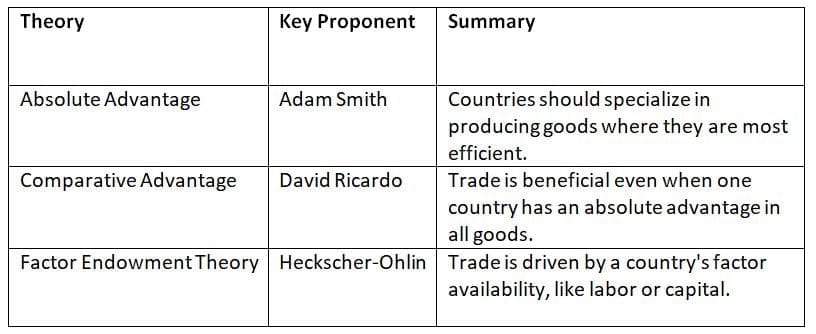
Ans.The major theories of international trade include Absolute Advantage, Comparative Advantage, and Heckscher-Ohlin theory. Absolute Advantage, proposed by Adam Smith, suggests that a country should produce and export goods it can produce more efficiently than others. Comparative Advantage, introduced by David Ricardo, emphasizes that countries should specialize in producing goods where they have a lower opportunity cost. The Heckscher-Ohlin theory focuses on the factors of production, suggesting that countries will export goods that utilize their abundant resources and import goods that require scarce resources.
| 3. Who are India’s major trade partners? | |
Ans.India's major trade partners include countries such as the United States, China, the United Arab Emirates, and Saudi Arabia. These nations engage in significant trade with India, involving both imports and exports across various sectors. The relationships are dynamic and often influenced by changing geopolitical and economic factors.
| 4. What are the key exports and imports of India? | |
Ans.India's major exports include textiles, pharmaceuticals, engineering goods, and IT services. On the other hand, its key imports consist of crude oil, gold, electronics, and machinery. This trade balance reflects India's growing economy and its increasing integration into the global marketplace.
| 5. What are some important trade agreements involving India? | |
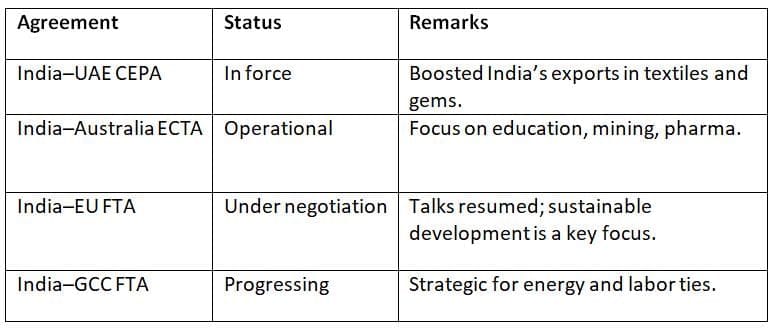
Ans.India has been involved in several key trade agreements, including the Regional Comprehensive Economic Partnership (RCEP) and agreements with countries like Japan and South Korea. These agreements aim to reduce tariffs, enhance trade relations, and facilitate investment. They play a vital role in shaping India's trade policy and economic strategy, fostering both regional and global trade partnerships.
About this Document

4.65/5
Rating

Apr 30, 2026
Last updated
Related Exams
Document Description: Cheat Sheet: International Trade for UPSC 2026 is part of Geography for UPSC CSE preparation.
The notes and questions for Cheat Sheet: International Trade have been prepared according to the UPSC exam syllabus. Information about Cheat Sheet: International Trade covers topics
like and Cheat Sheet: International Trade Example, for UPSC 2026 Exam. Find important definitions, questions, notes, meanings, examples, exercises and tests below for Cheat Sheet: International Trade.
Introduction of Cheat Sheet: International Trade in English is available as part of our Geography for UPSC CSE
for UPSC & Cheat Sheet: International Trade in Hindi for Geography for UPSC CSE course.
Download more important topics related with notes, lectures and mock test series for UPSC
Exam by signing up for free. UPSC: Cheat Sheet: International Trade
Description
Cheat Sheet: International Trade of Geography to help you remember important concepts with short tricks. Start learning for UPSC exam & improve retention with EduRev.
Information about Cheat Sheet: International Trade
In this doc you can find the meaning of Cheat Sheet: International Trade defined & explained in the simplest way possible. Besides explaining types of
Cheat Sheet: International Trade theory, EduRev gives you an ample number of questions to practice Cheat Sheet: International Trade tests, examples and also practice UPSC
tests



Related Searches
MCQs, Semester Notes, Sample Paper, Viva Questions, Objective type Questions, Exam, practice quizzes, study material, Important questions, Cheat Sheet: International Trade, ppt, Extra Questions, Cheat Sheet: International Trade, past year papers, Free, Cheat Sheet: International Trade, Previous Year Questions with Solutions, pdf , shortcuts and tricks, Summary, video lectures, mock tests for examination;