PM to visit Jordan, Ethiopia, Oman


Overview of Prime Minister Narendra Modi's Three-Nation Tour
Prime Minister Narendra Modi is scheduled for a four-day visit from December 15 to 18, covering Jordan, Ethiopia, and Oman. The tour aims to deepen India's diplomatic, economic, and strategic partnerships in West Asia and Africa, regions critical for India's global outreach and South-South cooperation.
- Jordan (Dec 15): Visit at the invitation of King Abdullah II al Hussein, coinciding with 75 years of diplomatic relations. Focus on reviewing bilateral ties and discussing regional issues.
- Ethiopia (Dec 16-17): First-ever visit by Modi to Ethiopia, invited by Prime Minister Dr. Abiy Ahmed Ali. Discussions to cover broad bilateral cooperation including development, agriculture, and investment.
- Oman (Dec 17-18): Second visit by Modi, marking 70 years of diplomatic ties. India and Oman share a comprehensive strategic partnership rooted in historical trade, culture, and people-to-people links.
The program features expert insights from former ambassador Mr. Rabu Deal and Professor Anu Jooshi from JNU to analyze the geopolitical and economic significance of this tour.
Significance of the Tour in India's Broader Foreign Policy
- India's strategic engagement with West Asia and Africa has evolved beyond traditional economic ties to include security, technology, and multilateral cooperation.
- The tour reflects India's "link west" policy, strengthening relations westward with West Asia and Africa as critical regions.
- West Asia's importance for India is highlighted by:
- Energy security needs
- A large and influential Indian diaspora
- The necessity to balance relations across diverse countries including Iran, Saudi Arabia, UAE, Oman, Kuwait, Bahrain, and Israel.
- Africa is a focus of revitalized partnership, with Ethiopia as a key player.
- India balances its global aspirations as a leader of the Global South, promoting South-South cooperation and multilateral representation, demonstrated by India's efforts to democratize international organizations and include African nations in platforms like G20.
Professor Jooshi emphasized:
- The timing of the tour following the Russian President's visit to India.
- India's role in global south solidarity through initiatives like BRICS and supporting African countries.
- The strategic importance of Ethiopia, Jordan, and Oman in regional geopolitics and economic ties.
- Historical and strategic partnerships with Ethiopia (strategic partnership since 2008) and Oman.
- India's efforts to diversify its markets and strengthen south-south cooperation amid global turmoil and geopolitical flux.
Jordan Visit: Key Focus Areas and Strategic Importance
- The visit marks 75 years of diplomatic relations.
- Primary goals include reviewing bilateral ties and enhancing cooperation for mutual growth, security, and stability.
- Jordan is viewed as a stable and moderate voice in the volatile Middle East, making it a crucial partner for India's West Asia engagement.
- Shared concerns over terrorism and extremism lead to active counterterrorism cooperation and defense/security dialogues.
- Jordan consistently supports India's bid for a permanent seat on the UN Security Council and aligns with India on international platforms like WTO.
Economic and trade relations:
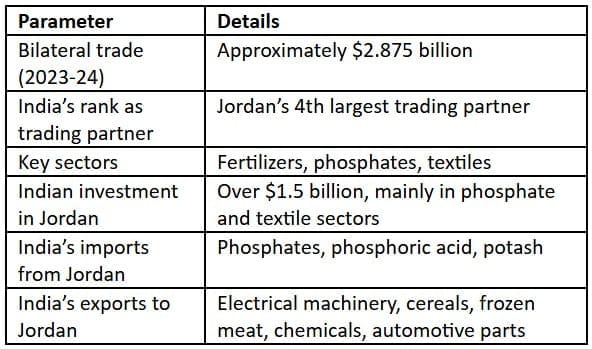
- Around 17,500 Indians live and work in Jordan, mainly in textiles and construction, contributing economically.
- Facilitated people-to-people contacts via visa-on-arrival/e-visas and direct flights boosting tourism and cultural exchange.
- India provides capacity-building assistance to Jordan.
Professor Jooshi highlighted Jordan's important role in regional stability and peacebuilding in West Asia, especially amid ongoing conflicts. India's neutral but peace-committed stance, supporting a two-state solution for Israel-Palestine, aligns with Jordan's diplomatic approach. Jordan supports India's global diplomacy, counterterrorism, and UNSC ambitions.
Ethiopia Visit: Strengthening India-Africa Relations
- Modi's first visit to Ethiopia, invited by Prime Minister Dr. Abiy Ahmed Ali.
- Discussions will cover comprehensive bilateral ties, including:
- Development cooperation
- Agriculture
- Digital public infrastructure
- Capacity building
- Investment opportunities for Indian businesses
- Ethiopia is a key African nation with historic ties to India:
- India was among the first to establish diplomatic missions post-liberation.
- Both countries share common views on global issues in forums like the UN and G77.
- India is one of the top three foreign investors in Ethiopia, alongside China (the largest investor).
- Over 600 Indian companies operate in sectors such as manufacturing, agriculture, floriculture, engineering, and pharmaceuticals.
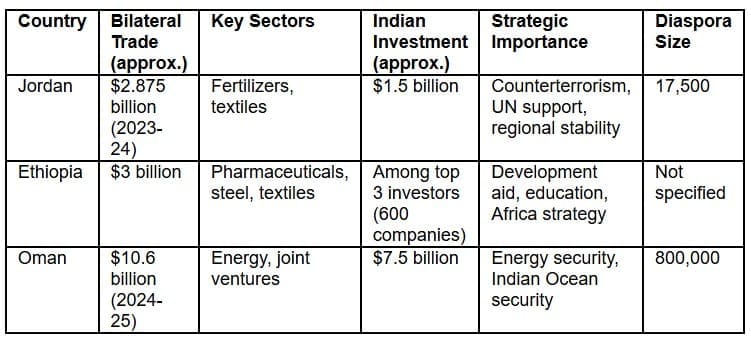
- Bilateral trade approaches $3 billion, with India exporting pharmaceuticals, steel, machinery, textiles, and importing pulses, oilseeds, spices, and leather.
Education and human capital development are significant pillars, with thousands of Indian educators contributing to Ethiopia's educational institutions over decades.
This visit is crucial for advancing India's Africa strategy, balancing competition from China and Western powers by strengthening development partnerships and investment in key sectors.
Oman Visit: Strategic and Economic Partnership
- India-Oman relations are characterized by a long-standing strategic partnership (formalized in 2008), deep-rooted cultural ties, and robust trade.
- India is one of Oman's top trading partners, with bilateral trade reaching approximately $10.6 billion in 2024-25.
- Oman is a critical energy supplier to India, providing crude oil and liquefied natural gas.
- Approximately 600 India-Oman joint ventures exist, with Indian investments totaling an estimated $7.5 billion.
- The two countries are advancing cooperation in the digital economy, including an MoU to link India's UPI payment system with Omani mobile wallets to facilitate digital transactions.
- Strategically, Oman controls the southeastern entrance to the Strait of Hormuz, a vital chokepoint for oil transit, making it key for India's energy security and Indian Ocean security interests.
Professor Jooshi added that:
- Oman is a vital partner in the Gulf Cooperation Council (GCC) and the Arab League, supporting India's West Asia policy.
- The Indian diaspora in Oman is significant, with about 800,000 Indians living there.
- Defense and security cooperation is strong, including joint exercises like Nasim, Albahar, and Naja.
- Indian Navy access to Omani ports is crucial for securing the Indian Ocean region.
- Outcomes expected include enhanced cooperation in defense, security, trade, investment, and people-to-people ties.
- The visit celebrates 70 years of diplomatic relations with Oman and seeks to explore new avenues of collaboration.
Implications for India's Foreign Policy Priorities
- The visit concludes the year 2025 but sets the tone for India's foreign policy agenda in 2026.
- Modi's foreign policy emphasizes personal-level diplomacy with heads of state and government, which strengthens bilateral ties across political, economic, and security dimensions.
- The tour reflects a continuity in India's approach to deepen strategic partnerships with key countries in West Asia and Africa.
- It advances India's national interests by:
- Strengthening energy security
- Expanding markets and investments
- Enhancing regional stability
- Promoting South-South cooperation
- Building on people-to-people connections and diaspora engagement
Key Takeaways
- Modi's three-nation tour reflects India's evolving diplomatic strategy, balancing economic, security, and cultural ties in West Asia and Africa.
- The visits to Jordan, Ethiopia, and Oman are milestones marking decades of diplomatic relations while aiming to open new avenues in trade, investment, development, and security cooperation.
- India's role as a leader of the Global South and its balancing act in complex geopolitical environments are underscored throughout the tour's objectives.
- Strengthening energy security, counterterrorism cooperation, digital economy linkages, and capacity building are core themes in the engagements.
- The tour is expected to yield concrete outcomes in bilateral trade expansion, strategic partnerships, and regional peace efforts, setting a firm foreign policy direction for the coming year.
Bilateral Trade and Investment Highlights
FAQs on PM to visit Jordan, Ethiopia, Oman
| 1. What was the significance of Prime Minister Narendra Modi's three-nation tour? |  |
| 2. What were the key focus areas during the visit to Jordan? | |
| 3. How does the visit to Ethiopia strengthen India-Africa relations? | |
| 4. What are the implications of the Oman visit for India's strategic and economic partnerships? | |
| 5. How do these visits align with India's broader foreign policy priorities? | |




