Adjectives vs Adverbs - English Grammar Basics | Verbal Ability & Reading Comprehension (VARC) - CAT PDF Download

Key Difference:
Adjectives modify nouns or pronouns.
Adverbs modify verbs, adjectives or other adverbs.
Adjectives vs Adverbs Examples
- Adverbs and Adjectives are both modifiers, so it is easy to confuse them with each other. And even more confusingly, some words sometimes act as adjectives, and sometimes act as adverbs.
Hint: Ask yourself which word is being described: adjectives always modify nouns or pronouns, but adverbs never do.
Sarah was a little sleepy. (adverb modifying adjective sleepy)
Sarah took a little nap. (adjective modifying noun nap)
- Use the comparative degree of an adjective or an adverb when speaking of two thingsand the superlative degree when speaking of three or more:
This is the larger of the two rooms.
This white one is the smallest of the three puppies.
Good vs well
Good is an adjective. The adverb is well.
Ex: My father is a good driver -> He drives well.
Your English is good -> You speak English well.
I feel good. (psychologically / morally)
I feel well. (healthy / well being)

Fast / Hard / Late
These words are both adjectives and adverbs:
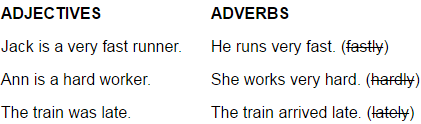
Lately = recently
Have you seen Tom lately?
Hardly = very little, almost not
Sarah was rather unfriendly to me at the party. She hardly spoke to me.(she spoke to me very little, almost not at all)
George and Hilda want to get married but they've only known each other for a few days. I don't think they should get married yet. They hardly know each other. (they know each other very little)
We cannot form adverbs from adjectives ending in ly.
Common adjectives: friendly, lively, ugly, lonely. We add the pattern in a … way/manner or fashion to make them adverb.
Friendly: In a friendly way/manner/fashion He behaves in a friendly way.
Lively : In a lively way / manner / fashion
|
113 videos|461 docs|90 tests
|
FAQs on Adjectives vs Adverbs - English Grammar Basics - Verbal Ability & Reading Comprehension (VARC) - CAT
| 1. What is the difference between adjectives and adverbs? |  |
| 2. Can adjectives be used as adverbs and vice versa? | |
| 3. How can I identify whether a word is an adjective or an adverb? | |
| 4. Can you provide examples of adjectives and adverbs? | |
| 5. What are some common mistakes to avoid when using adjectives and adverbs? | |





Previous Year Questions with Solutions
,MCQs
,Summary
,shortcuts and tricks
,Extra Questions
,Sample Paper
,video lectures
,Adjectives vs Adverbs - English Grammar Basics | Verbal Ability & Reading Comprehension (VARC) - CAT
,study material
,Free
,Viva Questions
,past year papers
,Important questions
,Objective type Questions
,Adjectives vs Adverbs - English Grammar Basics | Verbal Ability & Reading Comprehension (VARC) - CAT
,Semester Notes
,Adjectives vs Adverbs - English Grammar Basics | Verbal Ability & Reading Comprehension (VARC) - CAT
,ppt
,Exam
,mock tests for examination
,practice quizzes
;



Adjectives vs Adverbs - English Grammar Basics Free PDF Download
Importance of Adjectives vs Adverbs - English Grammar Basics
Adjectives vs Adverbs - English Grammar Basics Notes
Adjectives vs Adverbs - English Grammar Basics CAT Questions
Study Adjectives vs Adverbs - English Grammar Basics on the App
|
© EduRev
|
Education Revolution
|


|




within 7 days!