NCERT Solution: Dissolution of Partnership Firm - 2

Q6: How will you deal with the realisation expenses of the firm of Rashim and Bindiya in the following cases:
1. Realisation expenses amount to Rs. 1,00,000,
2. Realisation expenses amounting to Rs. 30,000 are paid by Rashim, a partner.
3. Realisation expenses are to be borne by Rashim and he will be paid Rs. 70,000 as remuneration for completing the dissolution process. The actual expenses incurred by Rashim were Rs. 1,20,000.
Ans:
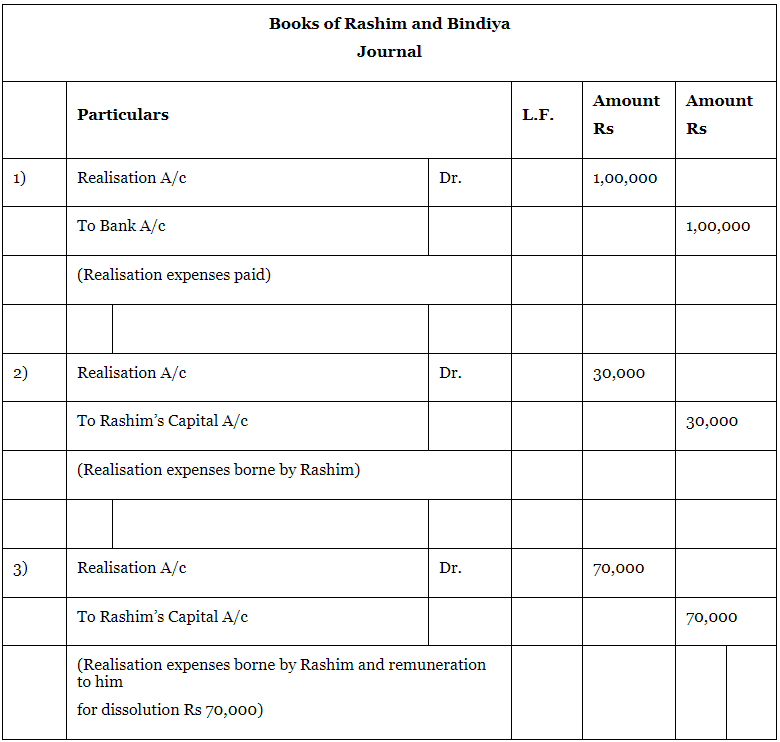
Solution and Journal Entries:
Case 1: Realisation expenses paid by the firm out of cash.
Realisation A/c Dr Rs. 1,00,000
To Cash A/c Rs. 1,00,000
Explanation: All expenses of realisation are charged to Realisation Account and paid from the firm's cash or bank.
Case 2: Realisation expenses of Rs. 30,000 paid personally by Rashim (partner).
Realisation A/c Dr Rs. 30,000
To Rashim's Capital A/c Rs. 30,000
Explanation: When a partner pays dissolution expenses on behalf of the firm, the firm becomes indebted to the partner; therefore the partner's capital (or loan) account is credited.
Case 3: Rashim is to bear the realisation expenses personally but is to receive Rs. 70,000 as remuneration for realisation work. He actually incurred Rs. 1,20,000.
Entry for remuneration (firm's liability):
Realisation A/c Dr Rs. 70,000
To Rashim's Capital A/c Rs. 70,000
Explanation: If Rashim is to bear the expenses, the firm does not record the actual expenses of Rs. 1,20,000. However, the firm must record the remuneration payable to him as a charge to Realisation Account (debit) and as a liability to Rashim (credit).
Practical effect for Rashim: He pays Rs. 1,20,000 personally and receives Rs. 70,000 from the firm; his net outflow is Rs. 50,000. No separate entry for the Rs. 1,20,000 is passed in the firm's books because the expense is borne outside the firm.
Q7: The book value of assets (other than cash and bank) transferred to Realisation Account is Rs. 1,00,000. 50% of the assets are taken over by a partner Atul, at a discount of 20%; 40% of the remaining assets are sold at a profit of 30% on cost; 5% of the balance being obsolete, realised nothing and remaining assets are handed over to a Creditor, in full settlement of his claim.
You are required to record the journal entries for realisation of assets.
Ans:
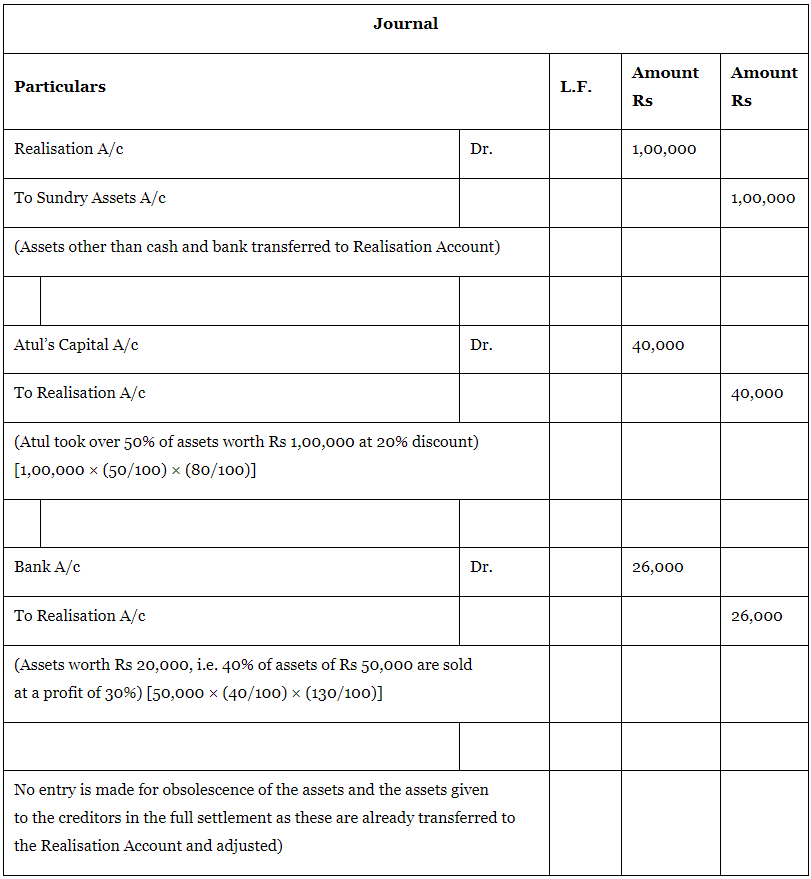
Solution and Journal Entries:
Given: Total book value of assets transferred to Realisation A/c = Rs. 1,00,000.
Stepwise breakup and calculations:
- 50% taken over by Atul = 50,000 (book value). Atul takes at 20% discount ⇒ amount realised = 50,000 × 80% = Rs. 40,000.
- Remaining after this = 50,000.
- 40% of remaining = 20,000 (book value). Sold at profit 30% on cost ⇒ realised = 20,000 × 1.30 = Rs. 26,000.
- Balance after this sale = 50,000 - 20,000 = 30,000.
- 5% of this balance is obsolete and realises nothing ⇒ obsolete = 30,000 × 5% = Rs. 1,500 (no realisation).
- Remaining assets handed to creditor = 30,000 - 1,500 = Rs. 28,500 (book value) realised in full settlement of creditor's claim.
Journal entries (at the time of realisation):
Atul's Capital A/c Dr Rs. 40,000
To Realisation A/c Rs. 40,000
(Assets taken over by Atul at discounted price)
Bank A/c Dr Rs. 26,000
To Realisation A/c Rs. 26,000
(Sale of 40% of remaining assets realised at profit)
Creditor's A/c Dr Rs. 28,500
To Realisation A/c Rs. 28,500
(Assets handed over to creditor in full settlement of his claim - book value credited to Realisation A/c)
Note on obsolete assets: No cash is received for obsolete assets worth Rs. 1,500; the loss is reflected in Realisation A/c because the asset was already debited there at its book value.
Summary of Realisation A/c position:
Realisation A/c Dr (Total book value) Rs. 1,00,000
Realisation A/c Cr (Total realised) Rs. 94,500 (40,000 + 26,000 + 28,500)
Loss on Realisation = Rs. 5,500 (transferred to partners' capital accounts in their profit-sharing ratio).
Q8: Record necessary journal entries to record the following unrecorded assets and liabilities in the books of Paras and Priya:
1. There was an old furniture in the firm which had been written-off completely in the books. This was sold for Rs 3,000,
2. Ashish, an old customer whose Account for Rs 1,000 was written-off as bad in the previous year, paid 60% of the amount,
3. Paras agreed to take over the firm's goodwill (not recorded in the books of the firm), at a valuation of Rs 30,000,
4. There was an old typewriter which had been written-off completely from the books. It was estimated to realize Rs 400. It was taken away by Priya at an estimated price less 25%,
5. There were 100 shares of Rs 10 each in Star Limited acquired at a cost of Rs 2,000 which had been written-off completely from the books. These shares are valued @ Rs 6 each and divided among the partners in their profit sharing ratio.
Ans:
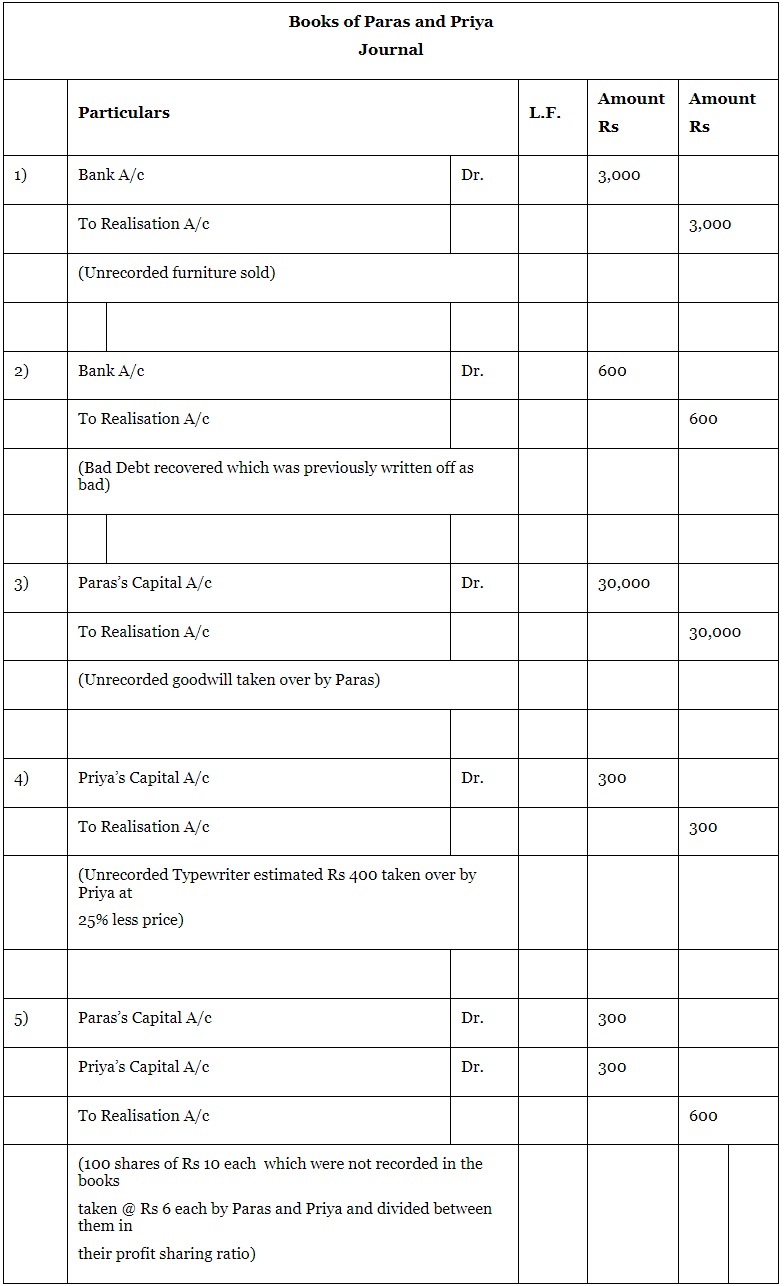
Solution - Journal Entries:
1. Old furniture (previously written off) sold for Rs. 3,000
Bank A/c Dr Rs. 3,000
To Realisation A/c Rs. 3,000
Explanation: The furniture was not shown as an asset now; proceeds on its sale are treated as realisation income.
2. Recovery from previously written-off customer (Ashish) - Rs. 1,000 × 60% = Rs. 600
Bank A/c Dr Rs. 600
To Realisation A/c Rs. 600
Explanation: Recovery of debt previously written off is credited to Realisation A/c as income on dissolution.
3. Paras takes over goodwill at Rs. 30,000 (unrecorded asset)
Paras's Capital A/c Dr Rs. 30,000
To Realisation A/c Rs. 30,000
Explanation: When a partner takes an asset, his capital account is debited for the consideration paid (or agreed) and Realisation A/c is credited.
4. Typewriter (written off earlier), estimated realisable value Rs. 400, taken by Priya at 25% less
Agreed realisation price = Rs. 400 - 25% of 400 = Rs. 300
Priya's Capital A/c Dr Rs. 300
To Realisation A/c Rs. 300
Explanation: Partner taking an asset is treated as payment to the firm; hence the partner's capital is debited.
5. 100 shares (face Rs. 10) valued at Rs. 6 each - total market value Rs. 600 - divided among partners in their profit sharing ratio
Partners' Capital A/cs Dr (in their profit-sharing ratio) - total Rs. 600
To Realisation A/c Rs. 600
Explanation: Since the shares were previously written off, any realisation value now is treated as income of the firm (credited to Realisation A/c) and the partners who take the shares are debited in their profit-sharing ratio.
Q9: All partners wish to dissolve the firm. Yastin, a partner wants that her loan of Rs. 2,00,000 must be paid off before the payment of capitals to the partners. But, Amart, another partner wants that the capitals must be paid before the payment of Yastin's loan. You are required to settle the conflict giving reasons.
Ans: As per Section 48 of the Indian Partnership Act, 1932, on dissolution of the firm, amounts due to third parties and partners' loans must be paid before any repayment of partners' capital. Therefore, Yastin's claim is correct: her loan of Rs. 2,00,000 should be paid before the partners' capital accounts are settled.
Explanation: A partner's loan to the firm is a debt of the firm and ranks ahead of capital which is a residual claim. Repaying loans first protects creditors' and lenders' rights and follows the legal order of settlement on dissolution.
Q10: What journal entries would be recorded for the following transactions on the dissolution of a firm after various assets (other than cash) on the third party liabilities have been transferred to Realisation Account.
1. Arti took over the Stock worth Rs 80,000 at Rs 68,000.
2. There was unrecorded Bike of Rs 40,000 which was taken over By Mr. Karim.
3. The firm paid Rs 40,000 as compensation to employees.
4. Sundry creditors amounting to Rs 36,000 were settled at a discount of 15%.
5. Loss on Realisation Rs 42,000 was to be distributed between Arti and Karim in the ratio of 3:4.
Ans:
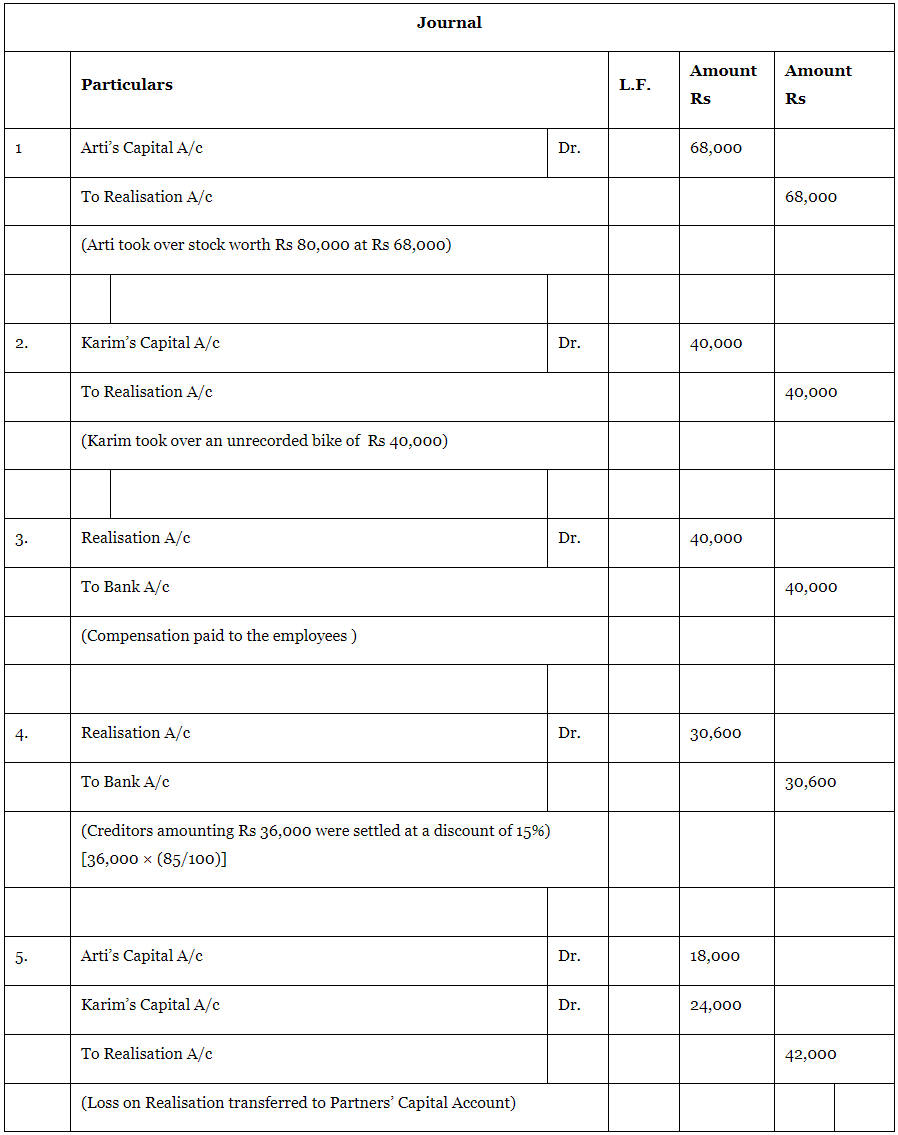
Solution - Journal Entries:
1. Arti takes over stock (book value Rs. 80,000) at Rs. 68,000:
Arti's Capital A/c Dr Rs. 68,000
To Realisation A/c Rs. 68,000
(Stock taken over by Arti at agreed amount; loss of Rs. 12,000 appears in Realisation A/c)
2. Unrecorded bike worth Rs. 40,000 taken over by Mr. Karim:
Karim's Capital A/c Dr Rs. 40,000
To Realisation A/c Rs. 40,000
(Unrecorded asset taken over by partner/third party - credited to Realisation A/c)
3. Compensation paid to employees Rs. 40,000:
Realisation A/c Dr Rs. 40,000
To Bank/Cash A/c Rs. 40,000
(Expenses of realisation paid by the firm)
4. Creditors Rs. 36,000 settled at 15% discount ⇒ payment Rs. 30,600 and discount Rs. 5,400:
Creditors A/c Dr Rs. 36,000
To Bank/Cash A/c Rs. 30,600
To Realisation A/c Rs. 5,400
(Settlement of creditors with discount; the discount is a gain and is credited to Realisation A/c)
5. Loss on Realisation Rs. 42,000 distributed between Arti and Karim in ratio 3:4 (total parts = 7):
Arti's Capital A/c Dr Rs. 18,000 (3/7 × 42,000)
Karim's Capital A/c Dr Rs. 24,000 (4/7 × 42,000)<>br>To Realisation A/c Rs. 42,000
(Loss on realisation transferred to partners in agreed ratio)
Q11: Rose and Lily shared profits in the ratio of 2:3. Their Balance Sheet on March 31, 2017 was as follows:
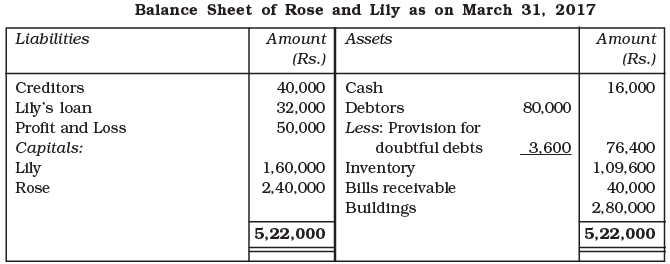
Rose and Lily decided to dissolve the firm on the above date. Assets (except bills receivables) realised Rs. 4,84,000. Creditors agreed to take Rs. 38,000. Cost of realisation was Rs. 2,400. There was a Motor Cycle in the firm which was bought out of the firm's money, was not shown in the books of the firm. It was now sold for Rs. 10,000. There was a contingent liability in respect of outstanding electric bill of Rs. 5,000 which was paid Bill Receivable taken over by Rose at Rs. 33,000.
Show Realisation Account, Partners Capital Acount, Loan Account and Cash Account.
Ans:
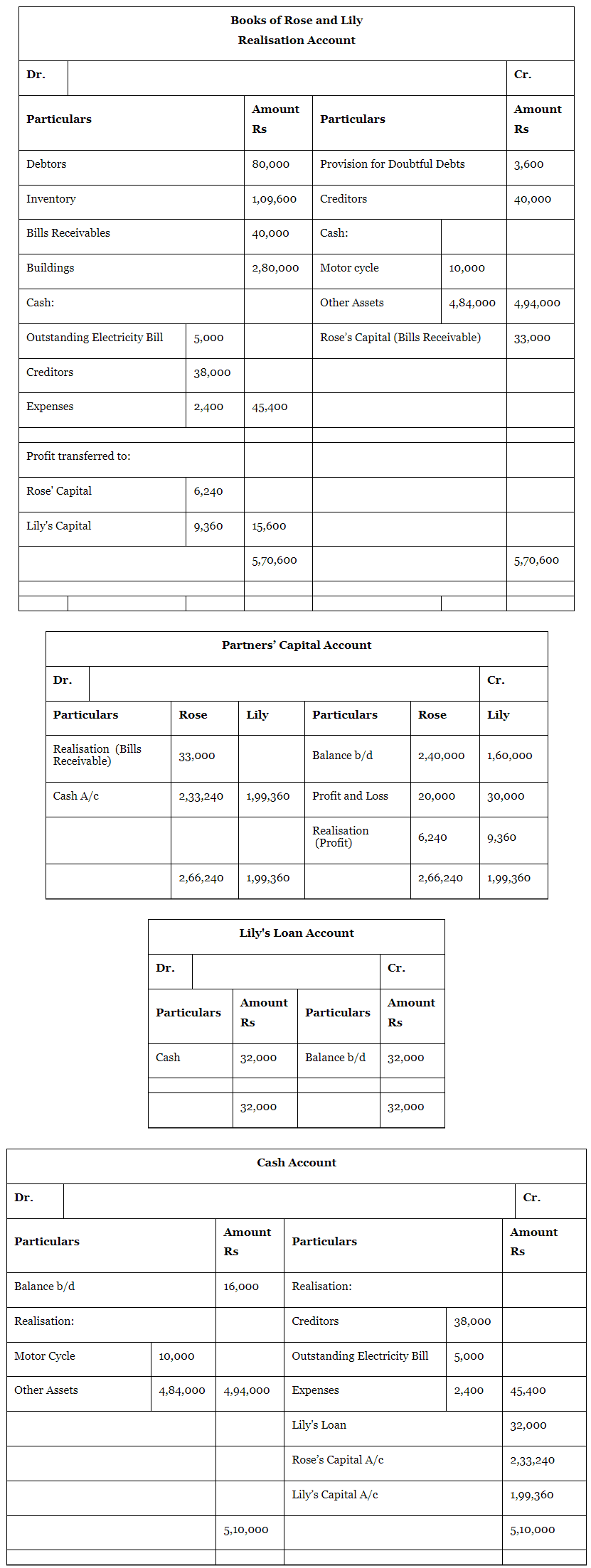
Note: In the solution Contingent Liability of Electricity Bill has been treated as Electricity Bill Payable. Further, it is also been assumed that Rosy has taken over Bills Receivable at Rs 33,000.
Solution - Explanation of key steps and entries:
- Transfer all assets (except cash/bank) to Realisation Account at book values.
- Record cash realised from assets (except bills receivable) Rs. 4,84,000: Bank A/c Dr Rs. 4,84,000; To Realisation A/c Rs. 4,84,000.
- Motor cycle (previously unrecorded) sold for Rs. 10,000: Bank A/c Dr Rs. 10,000; To Realisation A/c Rs. 10,000.
- Bills receivable taken over by Rose at Rs. 33,000: Rose's Capital A/c Dr Rs. 33,000; To Realisation A/c Rs. 33,000.
- Creditors accepted Rs. 38,000 in settlement: Creditors A/c Dr (full book amount); To Bank A/c Rs. 38,000; To Realisation A/c (discount/gain, if any).
- Cost of realisation Rs. 2,400 paid: Realisation A/c Dr Rs. 2,400; To Bank A/c Rs. 2,400.
- Contingent liability of electricity bill Rs. 5,000 materialised and paid: Realisation A/c Dr Rs. 5,000 (or Electricity Expense); To Bank A/c Rs. 5,000.
After passing these entries, close Realisation Account and transfer net gain or loss to partners' capital accounts in their profit-sharing ratio (2:3). Then settle the partner's loan (if any) and adjust capitals through Cash/Bank account. The detailed ledger workings are shown in the provided solution image.
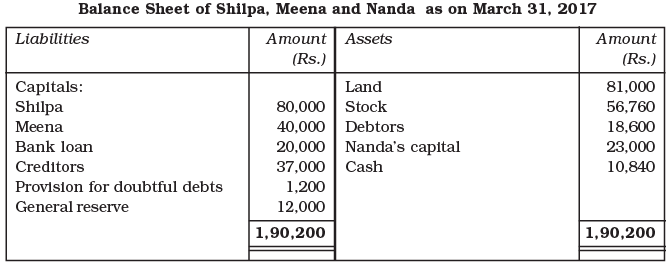
Q12: Shilpa, Meena and Nanda decided to dissolve their partnership on March 31, 2017. Their profit sharing ratio was 3:2:1 and their Balance Sheet was as under:
Ans:
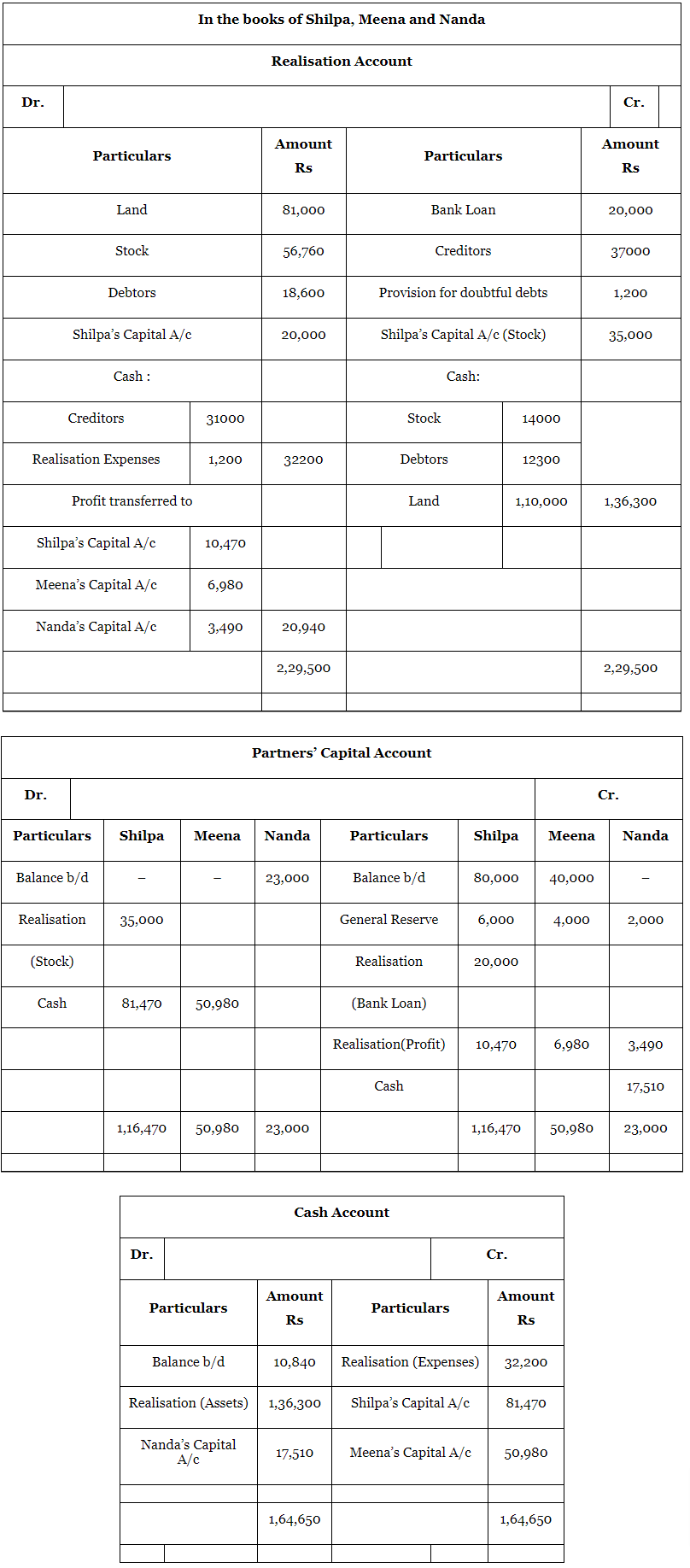
Solution - Key journal treatment for Realisation Account:
- Stock taken over by Shilpa: Shilpa's Capital A/c Dr Rs. 35,000; To Realisation A/c Rs. 35,000; (Shilpa also discharges the bank loan - treat as settlement of liability: Bank Loan A/c Dr Rs. 35,000; To Shilpa's Capital A/c Rs. 35,000 - or combined entries as per solution image).
- Remaining stock sold for Rs. 14,000: Bank A/c Dr Rs. 14,000; To Realisation A/c Rs. 14,000.
- Debtors: Rs. 10,000 realised Rs. 8,000 (Bank Dr Rs. 8,000; To Realisation A/c Rs. 8,000). Remaining debtors realised 50% at book value: appropriate Bank Dr and Realisation Cr entries are passed (see image for figures).
- Land sold for Rs. 1,10,000: Bank A/c Dr Rs. 1,10,000; To Realisation A/c Rs. 1,10,000.
- Typewriter (unrecorded) taken over by creditor at Rs. 6,000: Creditor's A/c Dr Rs. 6,000; To Realisation A/c Rs. 6,000.
- Cost of realisation Rs. 1,200 paid: Realisation A/c Dr Rs. 1,200; To Bank A/c Rs. 1,200.
Final step: Close Realisation A/c by transferring resultant profit or loss to partners' capital accounts in the ratio 3:2:1. The full ledger entries and totals are presented in the image.
Q13: Surjit and Rahi were sharing profits (losses) in the ratio of 3:2, their Balance Sheet as on March 31, 2017 is as follows:
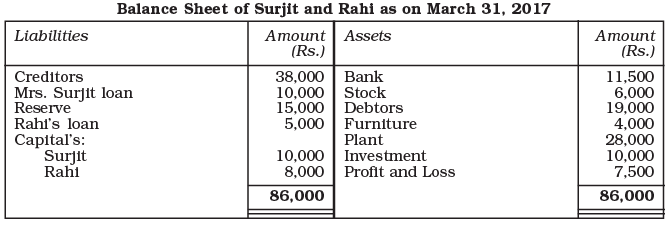
The firm was dissolved on March 31, 2017 on the following terms:
1. Surjit agreed to take the investments at Rs. 8,000 and to pay Mrs. Surojit's loan.
2. Other assets were realised as follows:
Stock Rs. 5,000
Debtors Rs. 18,500
Furniture Rs. 4,500
Plant Rs. 25,000
3. Expenses on realisation amounted to Rs. 1,600. 4. Creditors agreed to accept Rs. 37,000 as a final settlement.
You are required to prepare a Realisation account, Partner's Capital account and Bank account.
Ans:
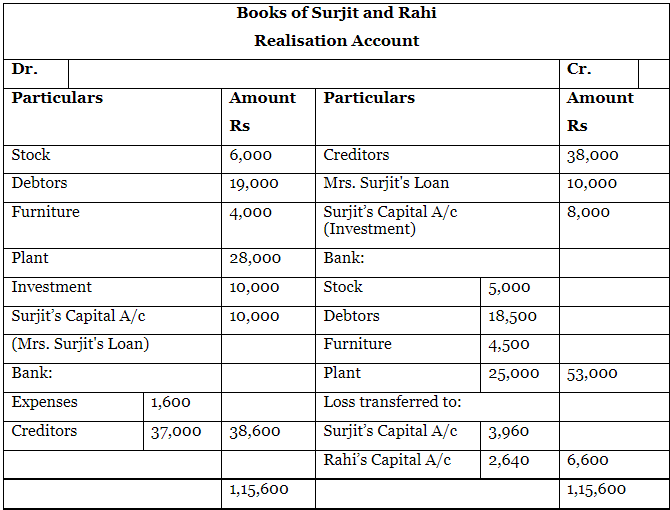
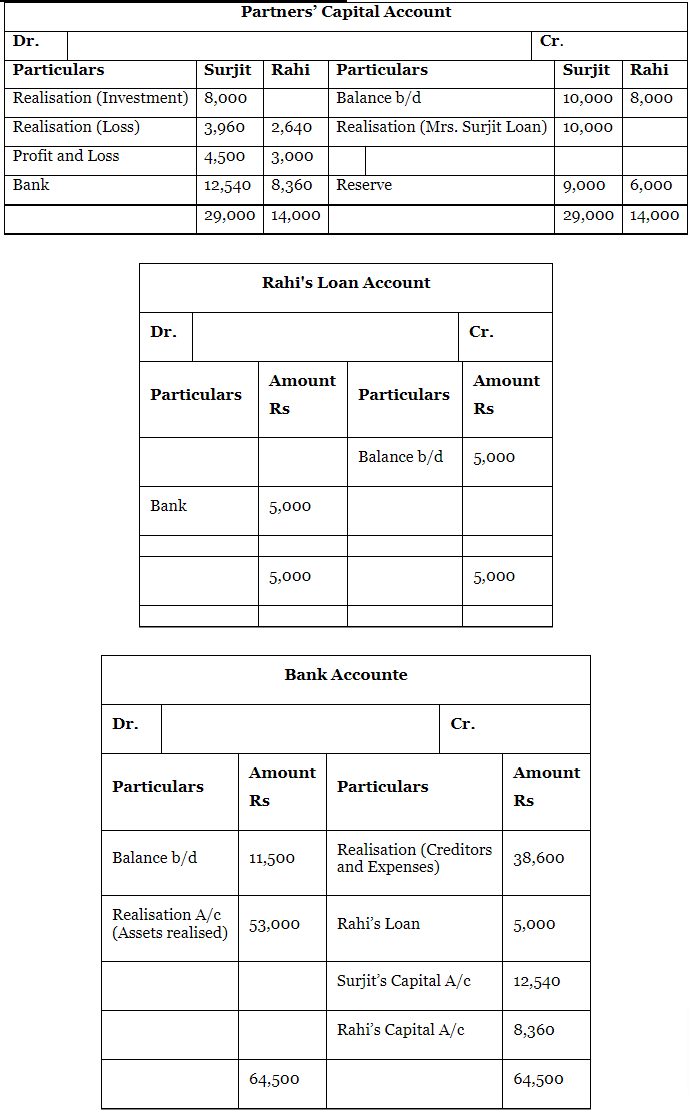
Solution - Outline of important entries:
- Investments taken over by Surjit at Rs. 8,000 and Surjit pays Mrs. Surojit's loan: Surjit's Capital A/c Dr Rs. 8,000; To Realisation A/c Rs. 8,000. Then Surjit's Capital A/c is debited/credited appropriately for discharge of the loan as per book figures (shown in detail in the image).
- Assets realised: Bank A/c Dr with realised amounts (Stock Rs. 5,000; Debtors Rs. 18,500; Furniture Rs. 4,500; Plant Rs. 25,000); To Realisation A/c corresponding credits.
- Realisation expenses Rs. 1,600: Realisation A/c Dr Rs. 1,600; To Bank A/c Rs. 1,600.
- Creditors settled at Rs. 37,000: Creditors A/c Dr (full book), To Bank A/c Rs. 37,000; any discount or adjustment shown in Realisation A/c.
After posting these, close Realisation A/c and transfer net gain/loss to partners in 3:2 ratio and show final bank receipts and payments in Bank Account. Full ledger workings appear in the provided images.
Q14: Rita, Geeta and Ashish were partners in a firm sharing profits/losses in the ratio of 3:2:1. On March 31, 2017 their balance sheet was as follows:
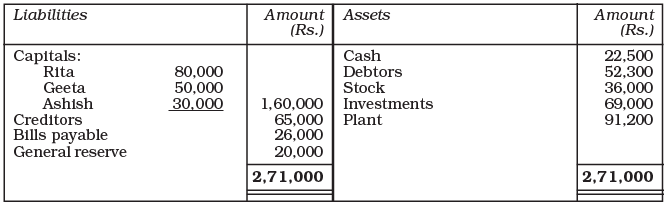
On the date of above mentioned date the firm was dissolved:
1. Rita was appointed to realise the assets. Rita was to receive 5% commission on the sale of assets (except cash) and was to bear all expenses of realisation,
2. Assets were realised as follows:
Debtors Rs.30,000
Stock Rs.26,000
Plant Rs.42,750
3. Investments were realised at 85% of the book value,
4. Expenses of realisation amounted to Rs. 4,100,
5. Firm had to pay Rs. 7,200 for outstanding salary not provided for earlier,
6. Contingent liability in respect of bills discounted with the bank was also materialised and paid off Rs. 9,800,
Prepare Realisation account, Capital Accounts of Partner's and Cash Account.
Ans:
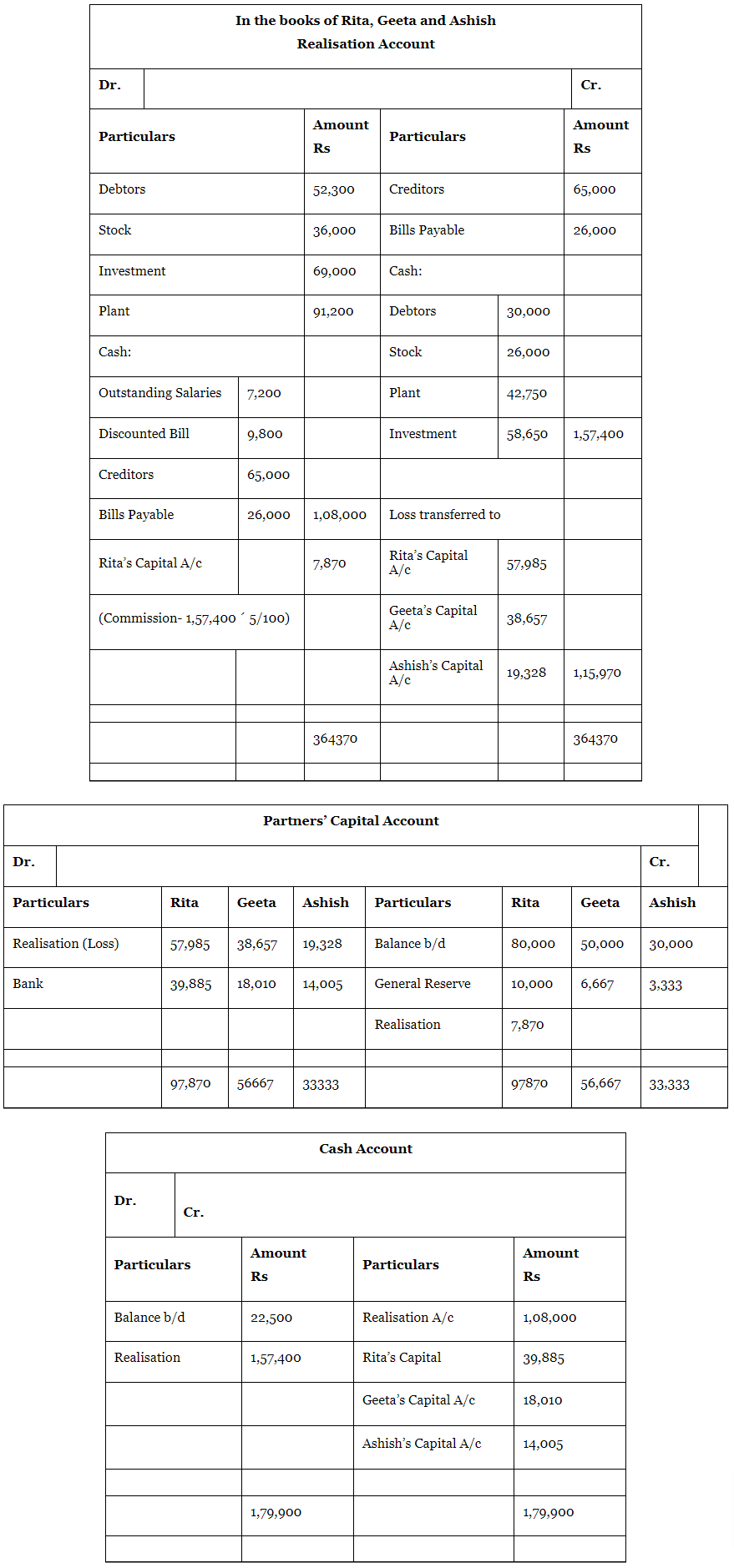
Note: As per the solution, the Loss on Realisation should be Rs 1,15,970 and the total of Cash Account should be Rs 1,79,900; however, the answer given in the book shows Rs 1,29,455 and Rs 1,65,705 respectively.
Solution - Key entries and treatment:
- Rita is realising assets and entitled to 5% commission on sale of assets (except cash). Since Rita bears all expenses of realisation, the firm will not record the realisation expenses; Rita will bear them personally unless otherwise agreed. However Rita's commission is an expense of realisation and will be recorded in the books.
- Realisation entries for amounts realised from Debtors, Stock and Plant: Bank A/c Dr with the respective realised amounts; To Realisation A/c.
- Investments realised at 85% of book value: Bank A/c Dr (85% of investments); To Realisation A/c.
- Outstanding salary Rs. 7,200 and contingent liability (bills discounted) Rs. 9,800 - both are paid: Realisation A/c Dr (or Expense A/c) and To Bank A/c Rs. 17,000 in total as shown by separate entries.
- Rita's commission: Realisation A/c Dr (5% of sale proceeds of assets other than cash); To Rita's Capital A/c (or Rita's Loan A/c if not paid immediately).
After these entries, close Realisation A/c and transfer resulting loss (or profit) to partners' capital accounts in the ratio 3:2:1. The Cash account will show receipts from realisations and payments (creditors, expenses, salaries, contingent liabilities). The complete numeric workings and final balances are presented in the provided solution image. Note the book's numerical discrepancy is pointed out in the note; follow the detailed ledger shown for the correct figures.
Note: Click here for Part III.
FAQs on NCERT Solution: Dissolution of Partnership Firm - 2
| 1. What are the key steps involved in the dissolution of a partnership? |  |
| 2. How are assets distributed among partners during dissolution? | |
| 3. What is the difference between dissolution of partnership and dissolution of partnership firm? | |
| 4. What are the rights of partners upon dissolution of a partnership? | |
| 5. How is goodwill treated during the dissolution of a partnership? | |