Differentiability of a Function and Rate of Change

D. Differentiability
Definition of Tangent
If f is defined on an open interval containing c, and if the limit

The slope of the tangent line to the graph of f at the point (c, f(c)) is also called the slope of the graph of f at x = c.
The above definition of a tangent line to a curve does not cover the possibility of a vertical tangent line. For vertical tangent lines, use the following definition. If f is continuous at c and
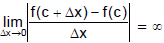
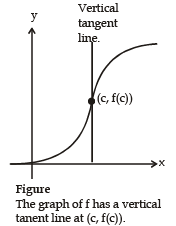
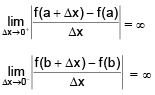
then the vertical line x = c, passing through (c, f(c)), is a vertical tangent line to the graph of f. For example, the function shown in the figure has a vertical tangent line at (c, f(c)). If the domain of f is the closed interval [a, b], extend the definition of a vertical tangent to include endpoints by considering one-sided limits (from the right at x = a and from the left at x = b).
The Derivative as a Function
In the preceding section we considered the derivative of a function f at a fixed number a:
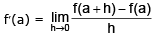
Note that alternatively, we can define
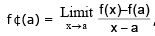
Now change the point of view: let the number a vary. If we replace a in Equation (1) by a variable x, we obtain
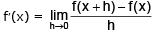
Given any number x for which this limit exists, we assign to x the number f'(x). So we can regard f' as a new function, called the derivative of f and defined by Equation (2). Geometrically, f'(x) is the slope of the tangent line to the graph of f at (x, f(x)).
The function f' is called the derivative of f because it is obtained from f by this limiting process. The domain of f' is the set {x | f'(x) exists} and may be smaller than the domain of f.
Average and Instantaneous Rate of Change
Suppose y is a function of x, say y = f(x). For a change from x to x + Δx, y changes from f(x) to f(x + Δx). The change in y is Δy = f(x + Δx) - f(x), and the average rate of change of y with respect to x over this interval is
Average rate of change =

As the interval over which we are averaging becomes shorter (that is, as


Thus,
Instantaneous Rate of Change =

Summary
Instantaneous Rate of Change
Suppose f(x) is differentiable at x = x0. Then the instantaneous rate of change of y = f(x) with respect to x at x0 is the value of the derivative of f at x0. That is
Instantaneous Rate of Change = f'(x0) =

Ex.13 Find the rate at which the function y = x2 sin x is changing with respect to x when x = .
.
For any x, the instantaneous rate of change in the derivative,
Sol.
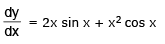
The derivative of y = x2 sin x is
f'(x) = 2x sin x + x2 cos x
Evaluate at x = π:
f'(π) = 2π sin π + π2 cos π
Since sin π = 0 and cos π = -1,
f'(π) = 0 + π2(-1) = -π2
The negative sign indicates that when x = π, the function is decreasing at the rate of


Example comparing average and instantaneous rates
Ex.14 Let f(x) = x2 - 4x + 7.
(a) Find the instantaneous rate of change of f at x = 3.
(b) Find the average rate of change of f with respect to
x between x = 3 and 5.
Sol.
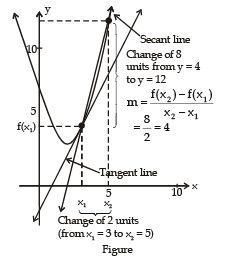
(a) The derivative of the function is
f'(x) = 2x - 4
Thus, the instantaneous rate of change of f at x = 3 is
f'(3) = 2(3) - 4 = 2
The tangent line at x = 3 has slope 2.
(b) The change in f from x = 3 to x = 5 is
f(5) - f(3) = [52 - 4(5) + 7] - [32 - 4(3) + 7] = 8
Thus, the average rate of change is
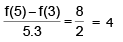
The slope of the secant line joining the points (3, f(3)) and (5, f(5)) is 4.
Derivability Over an Interval
Definition : A function f is differentiable at a if f'(a) exists. It is differentiable on an open interval (a, b) if it is differentiable at every number in the interval.
Derivability Over an Interval : f(x) is said to be derivable over an interval if it is derivable at each and every point of the interval. f(x) is said to be derivable over the closed interval [a, b] if :
- for the endpoints a and b, the one-sided derivatives f'(a+) and f'(b-) exist, and
- for any point c with a < c < b, the left-hand and right-hand derivatives f'(c-) and f'(c+) exist and are equal.
How Can a Function Fail to Be Differentiable?
There are three common ways a function may fail to be differentiable at a point:
- If the graph has a corner or cusp at the point (for example, y = |x| at x = 0); then the left and right derivatives are different and no tangent exists there.
- If the function is discontinuous at the point (for example, a jump discontinuity), then it cannot be differentiable there.
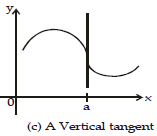
- If the tangent becomes vertical at the point (a vertical tangent), so that the derivative tends to ±∞.
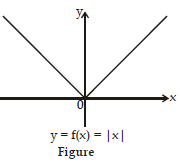
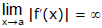
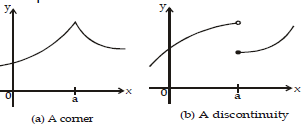
Right-hand and Left-hand Derivatives
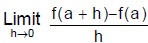
By definition:
f'(a) =
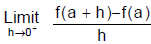
(i) The right-hand derivative of f at x = a, denoted by f'+(a), is defined by:
f'+(a) =
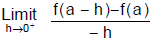
(ii) The left-hand derivative of f at x = a, denoted by f'-(a), is defined by:
f'-(a) =
We also write f'+(a) = f'(a+) and f'-(a) = f'(a-). The derivative f'(a) exists if and only if these one-sided derivatives exist and are equal.
Ex.20 If a function f is defined by f(x) =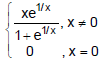 show that f is continuous but not derivable at x = 0
Sol.
Compute the right-hand and left-hand limits at 0:
f(0 + 0) =

f(0 - 0) =

Also f(0) = 0. Therefore
f(0 + 0) = f(0 - 0) = f(0) ⇒ f is continuous at x = 0.
Now compute the one-sided derivatives:
f'(0 + 0) =

f'(0 - 0) =

Since f'(0 + 0) ≠ f'(0 - 0), the derivative f'(0) does not exist; thus f is not differentiable at x = 0.


Ex.21 A function f(x) is such that , if it exists.
Sol.
Given that =
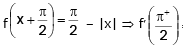
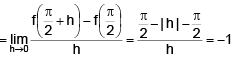

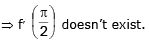
Ex.22 Let f be differentiable at x = a and let f(a) ≠ 0. Evaluate
Sol.
l =
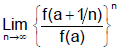
l =

Ex.23 Let f : R → R satisfying then show f(x) is differentiable at x = 0.
Sol.
Since,


Now,

From (ii) and (iii), we get f'(0) = 0. Therefore f(x) is differentiable at x = 0.

F. Operations on Differentiable Functions
1. If f(x) and g(x) are differentiable at x = a then the functions f(x) + g(x), f(x) - g(x), and f(x)·g(x) are differentiable at x = a. If g(a) ≠ 0 then f(x)/g(x) is differentiable at x = a.
If f and g are differentiable functions, then their product fg is differentiable. Proof:
Let a be a number in the domain of fg. By the definition of the product of two functions we have
(fg)(a) = f(a) g(a)
(fg)(a + t) = f(a + t) g(a + t)
Hence
(fg)'(a) =

The following algebraic manipulation will enable us to put the above fraction into a form in which we can see its limit:
f(a + t) g(a + t) - f(a) g(a) = f(a + t) g(a + t) - f(a) g(a + t) + f(a) g(a + t) - f(a) g(a)
= [f(a + t) - f(a)] g(a + t) + [g(a + t) - g(a)] f(a)
Thus
(fg)'(a) =

The limit of a sum is the sum of the limits. Moreover, f'(a) and g'(a) exist by hypothesis. Because g is differentiable at a, it is continuous there, so

(fg)'(a) =

= f'(a) g(a) + g'(a) f(a) = (f' g + g' f)(a).
2. If f(x) is differentiable at x = a and g(x) is not differentiable at x = a, then the product F(x) = f(x)·g(x) can still be differentiable at x = a. Example: f(x) = x and g(x) =

3. If f(x) and g(x) are both not differentiable at x = a, the product F(x) = f(x)·g(x) can still be differentiable at x = a. Example: f(x) =


4. If f(x) and g(x) are both non-differentiable at x = a then the sum F(x) = f(x) + g(x) may be differentiable. Example: f(x) =


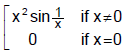
5. If f(x) is differentiable at x = a, then f'(x) is not necessarily continuous at x = a. Example: f(x) =
G. Functional Equations Involving Differentiability
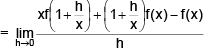
Ex.24 Let f(xy) = x f(y) + y f(x) for all x, and f(x) be differentiable in (0, ∞) then determine f(x).
Given f(xy)= x f(y) + y f(x)
Sol. Replacing x by 1 and y by x then we get x f(1) = 0

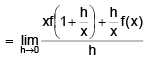
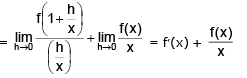

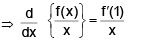
On integrating with respect to x and taking limits from 1 to x, we obtain
f(x)/x - f(1)/1 = f'(1) (ln x - ln 1)
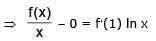
Since f(1) = 0, we get f(x) = f'(1) (x ln x).
Alternative Method :
Differentiate both sides of f(xy) = x f(y) + y f(x) with respect to x, treating y as constant. Then f'(xy)·y = f(y) + y f'(x).
Putting y = 1 gives a relation that leads, on integrating and using f(1) = 0, to
f(x) = f'(1) (x ln x).
Ex.25 If and f'(1) = e, determine f(x).
Sol.
Given e-xy f(xy) = e-x f(x) + e-y f(y) ....(1)
Putting x = y = 1 in (1), we get f(1) = 0 ...(2)
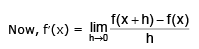
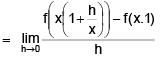

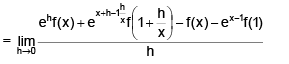
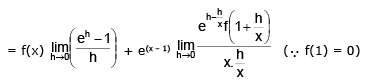


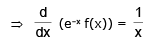
On integrating we obtain e-x f(x) = ln x + C. Using x = 1 and f(1) = 0, we find C = 0.
Therefore f(x) = ex ln x.
Ex.26 Let f be a function such that f(x + f(y)) = f(f(x)) + f(y) x, y where ε > 0, then determine f''(x) and f(x).
Sol.
Given f(x + f(y)) = f(f(x)) + f(y) .....(1)
Put x = y = 0 in (1): f(0 + f(0)) = f(f(0)) + f(0) ⇒ f(f(0)) = f(f(0)) + f(0)
Thus f(0) = 0 ...(2)
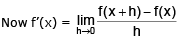
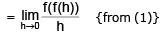

Integrating both sides with limits 0 to x yields f(x) = x. Therefore f'(x) = 1 and f''(x) = 0.
Optional brief summary
Differentiability is the existence of a finite tangent slope (derivative) at a point. The derivative represents the instantaneous rate of change. Functions fail to be differentiable at corners, discontinuities, or vertical tangents. One-sided derivatives decide differentiability at a point. Differentiable functions enjoy standard algebraic rules (sum, product, quotient) and these rules are useful in solving functional equations that involve differentiable functions.
FAQs on Differentiability of a Function and Rate of Change
| 1. What is the difference between derivability and differentiability? |  |
| 2. How are derivability and differentiability related to the rate of change of a function? | |
| 3. Can a function be differentiable but not derivable? | |
| 4. What does it mean for a function to be differentiable over an interval? | |
| 5. Can a function be differentiable over an interval but not continuous? | |




