JEE Exam > JEE Notes > Mathematics (Maths) Class 12 > Euler's Substitutions
Euler's Substitutions

Definition
Integrals of the form 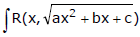 dx are calculated with the aid of the three Euler substitutions.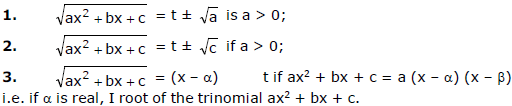
Ex.1 Evaluate I = 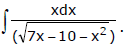
Sol. In this case a < 0 and c < 0 therefore neither the first, nor the second, Euler substitution is applicable.
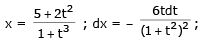
But the quadratic trinomial 7x - 10 - x2 has real roots α = 2, β = 5, therefore we use the third Euler substituion :


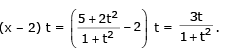


Ex.2 Evaluate 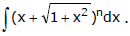
Sol.
 ...(1)
 ...(2)
We know

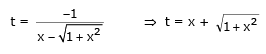





Can We Integrate All Continuous Function?
The question arises: Will our strategy for integration enables us to find the integral of every continuous function? For example, can we use it to evaluate ? The answer is no, at least not in terms of the functions that we are familiar with.
The functions that we have been dealing with in this book are called elementary functions. These are the polynomials, rational functions, power functions (x3), exponential function (ax), logarithmic functions trigonometric and inverse trigonometric functions, hyperbolic and inverse hyperbolic functions, and all functions that can be obtained from these by the five operations of addition, subtraction multiplication, division, and composition for instance, the function f(x) =
 is an elementary function
If f is an elementary function, then f' is an elementary function but
 f(x) dx need not be an elementary function. Consider f(x) =
  Since f is continuous, its integral exists, and if we define the function F by
 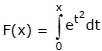 then we know from part 1 of the fundamental theorem of calculus that F'(x) =
  Thus, f(x) =
  has an antiderivative F, but it has been proved that F is not an elementary function.
?This means that no matter how hard we try, we will never succeed in evaluating

 dx in term of the function we know. The same can be said of the following integrals.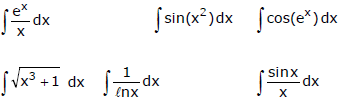
The document Euler's Substitutions is a part of the JEE Course Mathematics (Maths) Class 12.
All you need of JEE at this link: JEE
FAQs on Euler's Substitutions
| 1. What are Euler's substitutions? |  |
Euler's substitutions are a set of mathematical techniques used to simplify and solve differential equations. These substitutions involve replacing variables or functions in a given differential equation with new variables or functions, which can make the equation easier to solve.
| 2. How do Euler's substitutions work? | |
Euler's substitutions work by transforming a given differential equation into a new form that is easier to solve. This is done by introducing new variables or functions and substituting them into the original equation. The new variables or functions are chosen in such a way that they simplify the equation or eliminate certain terms, making it more manageable to solve.
| 3. What are some common examples of Euler's substitutions? | |
Some common examples of Euler's substitutions include substituting the variable x with the new variable x = e^t, or substituting the function y with the new function y = vx, where v is a new variable. These substitutions can transform a given differential equation into a simpler form that can be easily solved using standard techniques.
| 4. Can Euler's substitutions be used for all types of differential equations? | |
No, Euler's substitutions may not be applicable to all types of differential equations. These substitutions are most commonly used for solving linear and homogeneous differential equations. They may not be effective for non-linear or non-homogeneous equations, where other techniques like variation of parameters or power series solutions may be more suitable.
| 5. Are there any limitations or drawbacks to using Euler's substitutions? | |
Yes, there are limitations to using Euler's substitutions. These substitutions may not always lead to a simplified equation or a solution that can be easily determined. In some cases, the substitutions may introduce additional complexities or make the equation more difficult to solve. It is important to carefully analyze the given differential equation and assess whether Euler's substitutions are the most appropriate technique for solving it.
About this Document

4.93/5 Rating

Apr 29, 2026 Last updated
Related Exams
Document Description: Euler's Substitutions for JEE 2026 is part of Mathematics (Maths) Class 12 preparation. The notes and questions for Euler's Substitutions have been prepared according to the JEE exam syllabus. Information about Euler's Substitutions covers topics like and Euler's Substitutions Example, for JEE 2026 Exam. Find important definitions, questions, notes, meanings, examples, exercises and tests below for Euler's Substitutions.
Introduction of Euler's Substitutions in English is available as part of our Mathematics (Maths) Class 12 for JEE & Euler's Substitutions in Hindi for Mathematics (Maths) Class 12 course. Download more important topics related with notes, lectures and mock test series for JEE Exam by signing up for free. JEE: Euler's Substitutions
Description
Euler's Substitutions of Maths Class 12 covers all the important topics, helping you prepare for the JEE exam on EduRev. Start for free!
Information about Euler's Substitutions
In this doc you can find the meaning of Euler's Substitutions defined & explained in the simplest way possible. Besides explaining types of Euler's Substitutions theory, EduRev gives you an ample number of questions to practice Euler's Substitutions tests, examples and also practice JEE tests



Related Searches
study material, Viva Questions, Euler's Substitutions, Euler's Substitutions, Euler's Substitutions, Semester Notes, Free, Important questions, practice quizzes, video lectures, shortcuts and tricks, Objective type Questions, Previous Year Questions with Solutions, MCQs, Exam, Sample Paper, Extra Questions, mock tests for examination, ppt, past year papers, Summary, pdf ;