UPSC Exam > UPSC Notes > History for UPSC CSE > Society, Art & Architecture: The Cholas
Society, Art & Architecture: The Cholas | History for UPSC CSE PDF Download

Society, Art and Architecture
Society
- The Society was based on varna-Ashramdharma but the different varnas or castes lived peacefully with each other.
- Inter-caste marriages were permitted.
Points To Be Remembered
|
- There were no purdah system and women freely participated in all social and religious functions.
- Sati was not widely practised. The women inherited and owned property in their own right.
- The Devadasi system was also in vogue and there were prostitutes also in cities.
Caste System
- The caste system was the basis of the social organisation under the Cholas. Each caste was a hereditary occupational group.
- There was considerable proliferation of castes on account of inter-caste marriages.
- The Brahmanas being the learned part of society dominated the society. In appreciation of their service to society villages were given to them free of tax. Such villages were called brahmadeyas or chaturvedi magalams.
- Among the non-Brahmanas, the Vellalas were a powerful caste. They enjoyed certain privileges such as exemption from the payment of local dues.
- The Kamalas were another privileged group. But they were not permitted to perform Vedic rituals.
- The shepherds formed another important section of the community. Merchant group was the another important limb of the society.
- The Paraiyars lived in cheris and had their own separate cremation ground. They occupied a low position in society.
- A new class called the ‘Rathakaras’ emerged in this period. They were born of a high class husband and a low class wife.
- Another important social development during the period was the emergence of the Valangai and the Idangai factions. The Valangai was much
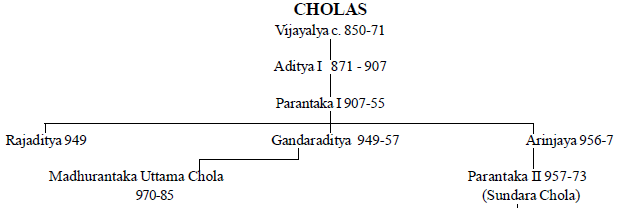 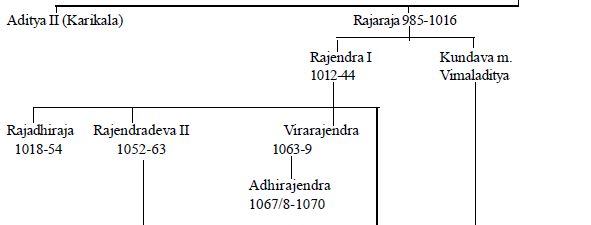 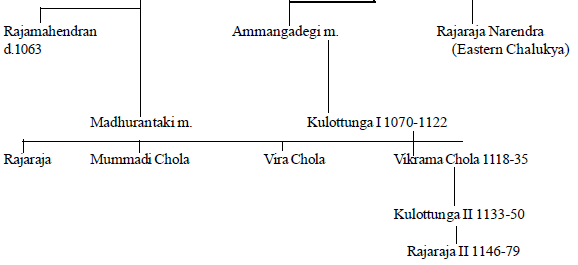 |
more privilged than the Idangai.
Position of Women
- Women in general were well treated in Chola times. They enjoyed then right to property.
- Sati was not practised generally though some royal women performed it.
- Monogamy was then rule among ordinary people. Polygamy was prevalent among the royal and aristocratic families. Dowry system was unknown. Girls were normally married at the age of twelve.
- Marriages were performed mostly according to Vedic rites.
- Women engaged themselves in music, dancing and drama.
- Some of them who were proficient in these dedicated themselves to the service of the temple. Their main duty was to participate in the daily activities of the temple and in the festivals. They were, therefore, called devaradiyar or talichderi pendir.
Scholars
- Among noted scholars of this period were Trutakadevara who wrote Jiwanachintamani, Kambana wrote Ramavatrama. His Kamba Ramayana has been regarded as a master-piece of Tamil literature.
- Among other noted Tamil works, Sulamani of Tolamokti, Kalingatuppani of Jayagodar, are important.
- The Buddhist scholar, Buddhamitra, wrote the text named Rasoliyan.
- During the reign of Prantaka I, Venkatamadhava wrote his commentary on Rigveda while Keshavaswamina wrote his scholarly work titled Nanartharanov (Sanskrit).
Art and Architecture
- The Cholas continued and developed the art tradition of the Pallavas and Pandyas.
- The replacement of brick of stone structures went on steadily under the Cholas.
- The chief featurers of Chola temples are their massive vimanas or towers—and spacious courtyards.
- In later Dravidian structures, however, the central towers are dwarfed by richly carved gopurams.
- The best specimens of the Chola art of early period are the temple of Vijayalaya-Choleswara, the Nagesvara temple, the Koranganatha temple and the Muvarakovintha temple.
- The Korangantha temple at Srinivasanllur which was probably, constructed during the reign of Parantak I has been regarded as the best example of the initial phase of the Chola development of the Dravida temple art.
- Rajaraja I constructed the Rajarajasvara temple at Tanjore and the temple of Viruvalisvarama in the Timnaveli district.
- Rajendra Chola also constructed a huge temple of Shiva at his capital of Gangaikon-dacholapuram.
- Rajendra II constructed the temple Airavat-esvara at Dasasuram while Koluttunga III constructed the temple of Kampaharesvara at Tribhuvanam.
The document Society, Art & Architecture: The Cholas | History for UPSC CSE is a part of the UPSC Course History for UPSC CSE.
All you need of UPSC at this link: UPSC
|
110 videos|653 docs|168 tests
|
FAQs on Society, Art & Architecture: The Cholas - History for UPSC CSE
| 1. What was the significance of the Cholas in society, art, and architecture? |  |
Ans. The Cholas were an ancient dynasty in South India known for their significant contributions to society, art, and architecture. They established a strong centralized government and implemented various administrative reforms. They also patronized the arts, including literature, music, dance, and sculpture, which flourished during their reign. The Chola kings were great builders and constructed magnificent temples and architectural marvels that are still revered for their intricate carvings and grandeur.
| 2. What were the major artistic achievements of the Cholas? | |
Ans. The Cholas were known for their exceptional artistic achievements. They commissioned beautiful bronze sculptures and exquisite stone carvings, often depicting gods, goddesses, and mythological scenes. Their temple architecture was characterized by intricate carvings, towering gopurams (gateways), and massive stone structures. The Chola painters also excelled in mural paintings, which adorned the walls of temples and palaces. These artistic endeavors showcased the Cholas' devotion to religion and their commitment to promoting cultural heritage.
| 3. How did the Cholas contribute to the development of architecture in South India? | |
Ans. The Cholas made significant contributions to the development of architecture in South India. They introduced several architectural innovations, such as the construction of large stone temples with elaborate sculptures and intricate carvings. They also pioneered the use of granite instead of brick and wood, which enhanced the durability and grandeur of their structures. The Chola temples, such as the Brihadeeswara Temple in Thanjavur, stand as a testament to their architectural prowess and continue to be admired for their beauty and engineering marvels.
| 4. What impact did the Cholas have on society during their rule? | |
Ans. The Cholas had a profound impact on society during their rule. They established a well-organized administrative system that ensured efficient governance and social stability. The Chola kings implemented various welfare measures, such as the distribution of food and provisions during times of famine, construction of irrigation tanks, and promotion of trade and commerce. They also prioritized education and patronized scholars, leading to a flourishing of literature, poetry, and music. The Cholas' contributions to society laid the foundation for a prosperous and culturally rich civilization.
| 5. How were the Cholas able to create such a lasting cultural legacy? | |
Ans. The Cholas were able to create a lasting cultural legacy through their patronage of the arts, their architectural marvels, and their administrative reforms. Their support for literature, music, dance, and sculpture fostered a vibrant cultural scene that thrived even after their decline. The grandeur and intricacy of Chola temples and sculptures continue to inspire awe and admiration, ensuring their legacy in the field of art and architecture. Additionally, the Cholas' efficient governance and welfare measures left a lasting impact on society, contributing to the overall development and prosperity of the region.
About this Document

1.5K Views

4.87/5
Rating

Oct 11, 2025
Last updated
Related Exams
Document Description: Society, Art & Architecture: The Cholas for UPSC 2025 is part of History for UPSC CSE preparation.
The notes and questions for Society, Art & Architecture: The Cholas have been prepared according to the UPSC exam syllabus. Information about Society, Art & Architecture: The Cholas covers topics
like and Society, Art & Architecture: The Cholas Example, for UPSC 2025 Exam. Find important definitions, questions, notes, meanings, examples, exercises and tests below for Society, Art & Architecture: The Cholas.
Introduction of Society, Art & Architecture: The Cholas in English is available as part of our History for UPSC CSE
for UPSC & Society, Art & Architecture: The Cholas in Hindi for History for UPSC CSE course.
Download more important topics related with notes, lectures and mock test series for UPSC
Exam by signing up for free. UPSC: Society, Art & Architecture: The Cholas | History for UPSC CSE
Description
Full syllabus notes, lecture & questions for Society, Art & Architecture: The Cholas | History for UPSC CSE - UPSC | Plus excerises question with solution to help you revise complete syllabus for History for UPSC CSE | Best notes, free PDF download
Information about Society, Art & Architecture: The Cholas
In this doc you can find the meaning of Society, Art & Architecture: The Cholas defined & explained in the simplest way possible. Besides explaining types of
Society, Art & Architecture: The Cholas theory, EduRev gives you an ample number of questions to practice Society, Art & Architecture: The Cholas tests, examples and also practice UPSC
tests

Related Searches
Previous Year Questions with Solutions
,Objective type Questions
,Exam
,ppt
,Free
,mock tests for examination
,Viva Questions
,Art & Architecture: The Cholas | History for UPSC CSE
,Summary
,Art & Architecture: The Cholas | History for UPSC CSE
,Important questions
,study material
,past year papers
,Semester Notes
,practice quizzes
,Extra Questions
,MCQs
,Society
,video lectures
,Sample Paper
,Society
,shortcuts and tricks
,Art & Architecture: The Cholas | History for UPSC CSE
,Society
;




Additional Information about Society, Art & Architecture: The Cholas for UPSC Preparation
Society, Art & Architecture: The Cholas Free PDF Download
The Society, Art & Architecture: The Cholas is an invaluable resource that delves deep into the core of the UPSC exam.
These study notes are curated by experts and cover all the essential topics and concepts, making your preparation more efficient and effective.
With the help of these notes, you can grasp complex subjects quickly, revise important points easily,
and reinforce your understanding of key concepts. The study notes are presented in a concise and easy-to-understand manner,
allowing you to optimize your learning process. Whether you're looking for best-recommended books, sample papers, study material,
or toppers' notes, this PDF has got you covered. Download the Society, Art & Architecture: The Cholas now and kickstart your journey towards success in the UPSC exam.
Importance of Society, Art & Architecture: The Cholas
The importance of Society, Art & Architecture: The Cholas cannot be overstated, especially for UPSC aspirants.
This document holds the key to success in the UPSC exam.
It offers a detailed understanding of the concept, providing invaluable insights into the topic.
By knowing the concepts well in advance, students can plan their preparation effectively.
Utilize this indispensable guide for a well-rounded preparation and achieve your desired results.
Society, Art & Architecture: The Cholas Notes
Society, Art & Architecture: The Cholas Notes offer in-depth insights into the specific topic to help you master it with ease.
This comprehensive document covers all aspects related to Society, Art & Architecture: The Cholas.
It includes detailed information about the exam syllabus, recommended books, and study materials for a well-rounded preparation.
Practice papers and question papers enable you to assess your progress effectively.
Additionally, the paper analysis provides valuable tips for tackling the exam strategically.
Access to Toppers' notes gives you an edge in understanding complex concepts.
Whether you're a beginner or aiming for advanced proficiency, Society, Art & Architecture: The Cholas Notes on EduRev are your ultimate resource for success.
Society, Art & Architecture: The Cholas UPSC Questions
The "Society, Art & Architecture: The Cholas UPSC Questions" guide is a valuable resource for all aspiring students preparing for the
UPSC exam. It focuses on providing a wide range of practice questions to help students gauge
their understanding of the exam topics. These questions cover the entire syllabus, ensuring comprehensive preparation.
The guide includes previous years' question papers for students to familiarize themselves with the exam's format and difficulty level.
Additionally, it offers subject-specific question banks, allowing students to focus on weak areas and improve their performance.
Study Society, Art & Architecture: The Cholas on the App
Students of UPSC can study Society, Art & Architecture: The Cholas alongwith tests & analysis from the EduRev app,
which will help them while preparing for their exam. Apart from the Society, Art & Architecture: The Cholas,
students can also utilize the EduRev App for other study materials such as previous year question papers, syllabus, important questions, etc.
The EduRev App will make your learning easier as you can access it from anywhere you want.
The content of Society, Art & Architecture: The Cholas is prepared as per the latest UPSC syllabus.
|
© EduRev
|
Education Revolution
|


|




Signup to see your scores
go up within 7 days!
Access 1000+ FREE Docs, Videos and Tests
Takes less than 10 seconds to signup