UPSC Exam > UPSC Notes > History for UPSC CSE > Factors leading to the Rise of the Marathas & Shivaji: The Maratha Kingdom & Confederacy
Factors leading to the Rise of the Marathas & Shivaji: The Maratha Kingdom & Confederacy | History for UPSC CSE PDF Download

Factors Leading to the Rise of the Marathas
- The mountaneous country provided security to the Marathas, on the one hand, and made them hardy soldiers with a spirit of self-reliance and capacity for hard work, on the other.
- The nature developed in the Marathas self reliance, courage, perseverance, a stern simplicity, a rough straightforwardness, a social equality and consequently pride in the dignity of man as man.
- The civil institutions as also the religious systems maintained an equilibrium in the composite society, free from the shackles of rigidity.
- The literature and language of the Marathas also acted as a unifying force.
- The spread of the Bhakti movement in Maharashtra inculcated the spirit of oneness among the Marathas.
- Ramdas Samarth, the author of the book Dasbodh, taught the philosophy of action or karma and exhorted Shivaji's son Sambhaji to unite all Marathas and to propagate the `Maharastra dharma'.
- The fall of Khandesh, the gradual disappearance of Ahmadnagar and the creation of the Mughal vice-royalty in the Deccan affected every aspect of Maratha life, which induced an awakening among the Marathas as a nation under the leadership of Shivaji and others that followed him.
Question for Factors leading to the Rise of the Marathas & Shivaji: The Maratha Kingdom & ConfederacyTry yourself: What factors contributed to the development of self-reliance and courage among the Marathas?View Solution
Shivaji (1647-80 A.D.)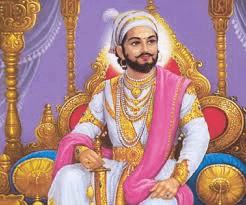
Shivaji
- He born in 1627 A.D. to Shahji Bhonsle and Jija Bai, in fort of Shivner, belonged to the Bhonsle clan.
- Probably in 1637 or 1638 A.D. Dadaji became the guardian of Shivaji and the administration of the jagir remained under Dadaji's defacto control till his death in 1647 when Shivaji assumed full charge.
- The jagir entrusted by Shahji to the care of Dadaji extended over the regions known as the Mavals.
- But before that at the age of 18, he conquered Raigarh, Kondana and Torna from Bijapur (1645-47).
- His real career of conquest began with his conquest of Javli (1656) from a Maratha chief (Chanda Rao More), which made him the master of the Mavala area or highlands (Mavali foot soldiers became a strong part of his army.)
- His attack of Adil Shahi territories between 1657 & 58 A.D., and deputation of Afzal Khan by Adil Shahi ruler to punish Shivaji; Shivaji's murder of Afzal (1659).
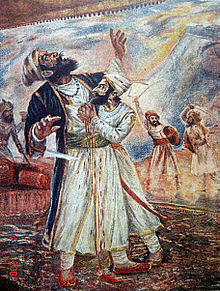 Shivaji killed afzal khan
 - Deputation of Shaista Khan (Governor of Deccan) by Aurangzeb to put down the rising power of Shivaji (1660); attack on Shivaji by Mughal forces from the North and Bijapuri forces from the South.
- Loss of Poona and several defeats for Shivaji between 1660 and 1663 A.D.; Shivaji's bold attack on Shaista's military camp and plunder of Surat (1664) and later Ahmednagar.
- Appointment of Raja Jai Singh of Amber by Aurangazeb to put down Shivaji (1665) and Jai Singh's success in besieging Shivaji in the fort of Purandar and the signing of the Treaty of Purandar (1665).
- Surrender of 23 forts (and also the territories around them) out of his 35 forts by Shivaji to Mughals.
- Recognition of Shivaji's right to certain parts of Bijapur kingdown (some were already under Shivaji's control and others were to be conquerred) by the Mughals.
- Grant of mansab of 5000 to Shivaji's son.
- Shivaji's visit to Agra, his imprisonment and escape (1666); his silence for 3 years (1666-69) and renewal of conflict with Mughals by his second plunder of Surat (1670).
- Four years of military conquests recoverning all his former forts and territories.
- His coronation at Raigarh in 1674 A.D. and assumption of the title of "Haindava Dharmodharak" (Protector of Hinduism).
- His alliance with the Qutb Shahis of Golconda and his campaign into Bijapur, Karnataka (1676-79) and conquest of Gingee (Jinji), Vellore, etc.
- His refusal to share the newly conqueered territories with Qutb Shahis and his death in 1680.
The document Factors leading to the Rise of the Marathas & Shivaji: The Maratha Kingdom & Confederacy | History for UPSC CSE is a part of the UPSC Course History for UPSC CSE.
All you need of UPSC at this link: UPSC
|
210 videos|855 docs|219 tests
|
FAQs on Factors leading to the Rise of the Marathas & Shivaji: The Maratha Kingdom & Confederacy - History for UPSC CSE
| 1. What were the key factors that led to the rise of the Marathas and Shivaji? |  |
Ans. The key factors that led to the rise of the Marathas and Shivaji include Shivaji's military and administrative strategies, the weakening of the Mughal Empire, the decline of the Bijapur Sultanate, the support of local communities, and the formation of the Maratha Confederacy.
| 2. How did Shivaji establish the Maratha Kingdom? | |
Ans. Shivaji established the Maratha Kingdom by implementing effective military tactics, such as guerrilla warfare and naval expeditions, to expand his control over strategic forts and territories. He also implemented administrative reforms, encouraged trade and agriculture, and fostered a sense of patriotism and loyalty among his subjects.
| 3. What was the significance of the Maratha Confederacy in the rise of the Marathas? | |
Ans. The Maratha Confederacy played a crucial role in the rise of the Marathas by uniting various Maratha chiefs and families under a common goal of challenging Mughal and regional powers. This confederacy provided a platform for coordinated military campaigns, sharing of resources, and collective decision-making, which greatly enhanced the Marathas' strength and influence.
| 4. How did the decline of the Mughal Empire contribute to the rise of the Marathas? | |
Ans. The decline of the Mughal Empire created a power vacuum in many regions of India, which allowed the Marathas to assert their control and expand their territories. The weakening of Mughal authority and the rise of regional powers provided favorable conditions for the Marathas to establish their own independent kingdom and challenge Mughal dominance.
| 5. How did the Marathas utilize banking systems in their rise to power? | |
Ans. The Marathas actively utilized banking systems to finance their military campaigns, trade ventures, and administrative expenses. They established networks of moneylenders and bankers who provided loans, facilitated trade transactions, and managed the financial affairs of the Maratha Kingdom. This enabled the Marathas to maintain a strong economy and financial stability, contributing to their rise to power.
About this Document

5.4K Views

4.89/5
Rating

Sep 20, 2025
Last updated
Related Exams
Document Description: Factors leading to the Rise of the Marathas & Shivaji: The Maratha Kingdom & Confederacy for UPSC 2025 is part of History for UPSC CSE preparation.
The notes and questions for Factors leading to the Rise of the Marathas & Shivaji: The Maratha Kingdom & Confederacy have been prepared according to the UPSC exam syllabus. Information about Factors leading to the Rise of the Marathas & Shivaji: The Maratha Kingdom & Confederacy covers topics
like and Factors leading to the Rise of the Marathas & Shivaji: The Maratha Kingdom & Confederacy Example, for UPSC 2025 Exam. Find important definitions, questions, notes, meanings, examples, exercises and tests below for Factors leading to the Rise of the Marathas & Shivaji: The Maratha Kingdom & Confederacy.
Introduction of Factors leading to the Rise of the Marathas & Shivaji: The Maratha Kingdom & Confederacy in English is available as part of our History for UPSC CSE
for UPSC & Factors leading to the Rise of the Marathas & Shivaji: The Maratha Kingdom & Confederacy in Hindi for History for UPSC CSE course.
Download more important topics related with notes, lectures and mock test series for UPSC
Exam by signing up for free. UPSC: Factors leading to the Rise of the Marathas & Shivaji: The Maratha Kingdom & Confederacy | History for UPSC CSE
Description
Full syllabus notes, lecture & questions for Factors leading to the Rise of the Marathas & Shivaji: The Maratha Kingdom & Confederacy | History for UPSC CSE - UPSC | Plus excerises question with solution to help you revise complete syllabus for History for UPSC CSE | Best notes, free PDF download
Information about Factors leading to the Rise of the Marathas & Shivaji: The Maratha Kingdom & Confederacy
In this doc you can find the meaning of Factors leading to the Rise of the Marathas & Shivaji: The Maratha Kingdom & Confederacy defined & explained in the simplest way possible. Besides explaining types of
Factors leading to the Rise of the Marathas & Shivaji: The Maratha Kingdom & Confederacy theory, EduRev gives you an ample number of questions to practice Factors leading to the Rise of the Marathas & Shivaji: The Maratha Kingdom & Confederacy tests, examples and also practice UPSC
tests


Related Searches
Factors leading to the Rise of the Marathas & Shivaji: The Maratha Kingdom & Confederacy | History for UPSC CSE
,shortcuts and tricks
,Factors leading to the Rise of the Marathas & Shivaji: The Maratha Kingdom & Confederacy | History for UPSC CSE
,MCQs
,Viva Questions
,mock tests for examination
,Previous Year Questions with Solutions
,video lectures
,Exam
,past year papers
,Important questions
,ppt
,Extra Questions
,Factors leading to the Rise of the Marathas & Shivaji: The Maratha Kingdom & Confederacy | History for UPSC CSE
,Objective type Questions
,Semester Notes
,study material
,Sample Paper
,Summary
,Free
,practice quizzes
;



Additional Information about Factors leading to the Rise of the Marathas & Shivaji: The Maratha Kingdom & Confederacy for UPSC Preparation
Factors leading to the Rise of the Marathas & Shivaji: The Maratha Kingdom & Confederacy Free PDF Download
The Factors leading to the Rise of the Marathas & Shivaji: The Maratha Kingdom & Confederacy is an invaluable resource that delves deep into the core of the UPSC exam.
These study notes are curated by experts and cover all the essential topics and concepts, making your preparation more efficient and effective.
With the help of these notes, you can grasp complex subjects quickly, revise important points easily,
and reinforce your understanding of key concepts. The study notes are presented in a concise and easy-to-understand manner,
allowing you to optimize your learning process. Whether you're looking for best-recommended books, sample papers, study material,
or toppers' notes, this PDF has got you covered. Download the Factors leading to the Rise of the Marathas & Shivaji: The Maratha Kingdom & Confederacy now and kickstart your journey towards success in the UPSC exam.
Importance of Factors leading to the Rise of the Marathas & Shivaji: The Maratha Kingdom & Confederacy
The importance of Factors leading to the Rise of the Marathas & Shivaji: The Maratha Kingdom & Confederacy cannot be overstated, especially for UPSC aspirants.
This document holds the key to success in the UPSC exam.
It offers a detailed understanding of the concept, providing invaluable insights into the topic.
By knowing the concepts well in advance, students can plan their preparation effectively.
Utilize this indispensable guide for a well-rounded preparation and achieve your desired results.
Factors leading to the Rise of the Marathas & Shivaji: The Maratha Kingdom & Confederacy Notes
Factors leading to the Rise of the Marathas & Shivaji: The Maratha Kingdom & Confederacy Notes offer in-depth insights into the specific topic to help you master it with ease.
This comprehensive document covers all aspects related to Factors leading to the Rise of the Marathas & Shivaji: The Maratha Kingdom & Confederacy.
It includes detailed information about the exam syllabus, recommended books, and study materials for a well-rounded preparation.
Practice papers and question papers enable you to assess your progress effectively.
Additionally, the paper analysis provides valuable tips for tackling the exam strategically.
Access to Toppers' notes gives you an edge in understanding complex concepts.
Whether you're a beginner or aiming for advanced proficiency, Factors leading to the Rise of the Marathas & Shivaji: The Maratha Kingdom & Confederacy Notes on EduRev are your ultimate resource for success.
Factors leading to the Rise of the Marathas & Shivaji: The Maratha Kingdom & Confederacy UPSC Questions
The "Factors leading to the Rise of the Marathas & Shivaji: The Maratha Kingdom & Confederacy UPSC Questions" guide is a valuable resource for all aspiring students preparing for the
UPSC exam. It focuses on providing a wide range of practice questions to help students gauge
their understanding of the exam topics. These questions cover the entire syllabus, ensuring comprehensive preparation.
The guide includes previous years' question papers for students to familiarize themselves with the exam's format and difficulty level.
Additionally, it offers subject-specific question banks, allowing students to focus on weak areas and improve their performance.
Study Factors leading to the Rise of the Marathas & Shivaji: The Maratha Kingdom & Confederacy on the App
Students of UPSC can study Factors leading to the Rise of the Marathas & Shivaji: The Maratha Kingdom & Confederacy alongwith tests & analysis from the EduRev app,
which will help them while preparing for their exam. Apart from the Factors leading to the Rise of the Marathas & Shivaji: The Maratha Kingdom & Confederacy,
students can also utilize the EduRev App for other study materials such as previous year question papers, syllabus, important questions, etc.
The EduRev App will make your learning easier as you can access it from anywhere you want.
The content of Factors leading to the Rise of the Marathas & Shivaji: The Maratha Kingdom & Confederacy is prepared as per the latest UPSC syllabus.
|
© EduRev
|
Education Revolution
|


|




Signup to see your scores
go up
within 7 days!
within 7 days!
Takes less than 10 seconds to signup