UPSC Exam > UPSC Notes > History for UPSC CSE > Foundation of Autonomous States
Foundation of Autonomous States | History for UPSC CSE PDF Download

Foundation of Autonomous States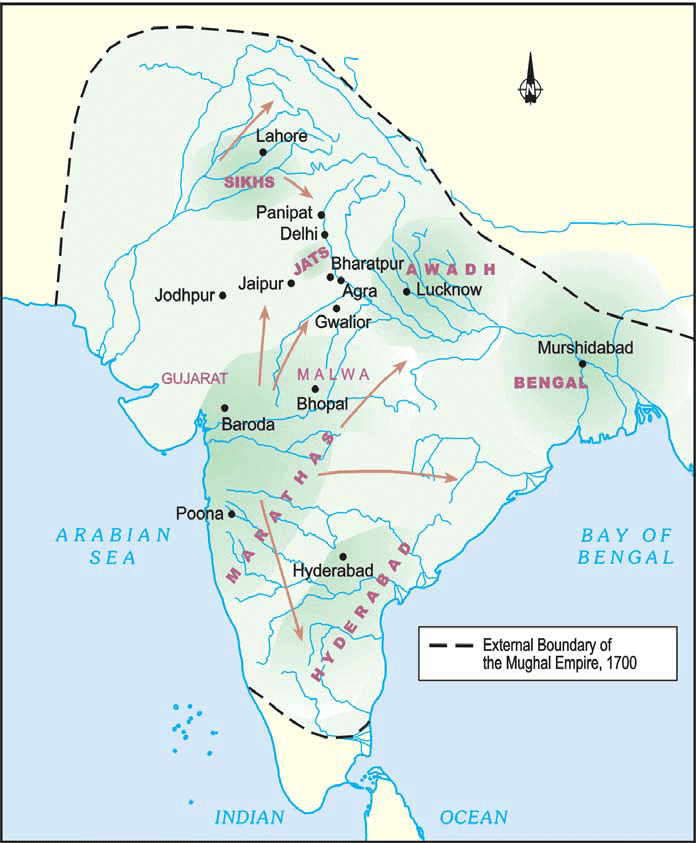
Hyderabad and the Carnatic
- The state of Hyderabad was founded by Nizam-ul-Mulk Asaf Jah (Chin Kilich Khan) in 1724.
- He was the Wazir of emperor Muhammad Shah. He was much disgusted by the indolence of the emperor. Finding no possibility of bringing the government into order he retired to Deccan where he became independent and founded the state of Hyderabad.
- The Carnatic was one of the Subahs of the Mughal Deccan and as such came under the Nizam of Hyderabad’s authority.
- But the Deputy Governor of Carnatic, known as the Nawab of Carnatic, had freed himself of the control of the Viceroy of Deccan and made his office hereditary. Thus Nawab Saadatullah Khan of Carnatic had made his nephew Dost Ali his successor without the approval of his superior, the Nizam.
Independence of Oudh
- Saadat Khan, who came of a Persian family from Khorasan, was the founder of the line of Nawab-Wazir.
Important Statements
|
- He had been originally appointed Faujdar of Biana but he happened to quarrel with some of the favourite nobles of Muhammad Shah’s court.
- He was sent away as Governor of Oudh in 1722 A.D. Before his death in 1739 A.D. he had become virtually independent and had made the province a hereditary possession.
- He was succeeded by his nephew Safdar Jang, who was simultaneously appointed the Wazir of the empire in 1748 A.D. and granted in addition the province of Allahabad.
- Safdar Jang gave a long period of peace to the people of Oudh and Allahabad before his death in 1754 A.D. Safdar Jang wrote: “The Avadh chiefs were capable of creating a disturbance in the twinkling of an eye and were more dangerous than the Marathas of the Deccan.”
Bengal
- After the death of Aurangzeb, Murshid Quli Khan and Alivardi Khan, made Bengal virtually independent.
- Even though Murshid Quli Khan was made Governor of Bengal as late as 1717 A.D., he had been its effective ruler since 1700 A.D., when he was appointed its Dewan.
- He established peace by freeing Bengal of internal and external danger. Bengal was now also relatively free of uprisings by zamindars.
Facts To Be Remembered
|
- The only three major uprisings during his period were; first by Sitaram Ray, Udai Narayan, and Ghulam Muhammad, and then by Shujat Khan and finally by Najat Khan.
- After defeating them, Murshid Quli Khan gave their zamindaris to his favourite, Ramjivan. Murshid Quli Khan died in 1727 A.D.
- Shuja-ud-din, son-in-law of Murshid Quli, usurped the throne in 1727 and ruled Bengal till 1739 A.D. With the incorporation of Bihar in Bengal Subah by the emperor Muhammad Shah in 1733 A.D., Shuja-ud-din became the Subahdar of an extensive administrative unit embracing the provinces of Bihar, Bengal and Orissa.
- After the death of Shuja-ud-din in 1739 A.D., his son Sarfaraz peacefully ascended the Masnad of Bengal. In that year, Alivardi Khan deposed and killed Shuja-ud-din’s son, Sarfaraz Khan and made himself the Nawab.
- From 1742 to 1751 A.D., the Marathas made repeated incursions and ravaged the territories of Alivardi Khan. Alivardi Khan agreed to pay to the Marathas an annual chauth of 12 lakhs of rupees, on condition that they would never cross the river Suvarnarekha.
- Alivardi Khan did not permit the English and the French to fortify their factories in Calcutta and Chandernagar.
- The Bengal Nawabs proved, however, to be short-sighted and negligent in one respect. They did not firmly put down the increasing tendency of the English East India company after 1707 A.D., to use military force, to threaten its use, to get its demands accepted.
- On the demise of Alivardi Khan in April 1756 his grandson Mirza Muhammad, better known by his title Siraj-ud-daula succeeded to the throne.
Mysore
- The kingdom of Mysore had preserved its precarious independence ever since the end of the Vijayanagar empire.
- Early in 18th century two ministers Nanjaraj and Devraj had seized power in Mysore.
- Haidar Ali started his career as a petty officer in the Mysore army. Cleverly using the opportunities that came his way, he gradually rose in the Mysore army. He soon recognised the advantages of western military training and applied it to the troops under his own command.
Facts To Be Remembered
|
- He established a modern arsenal in Dindigal in 1755. In 1761 he overthrew Nanjaraj and established his authority over the Mysore State.
- Almost from the beginning of the establishment of his power, he was engaged in wars with the Maratha Sardars, the Nizam, and the British.
- In 1769, he repeatedly defeated the British forces and captured the adjacent areas to Madras. He died in 1782 A.D. in course of second Anglo-Mysore War.
- He was succeeded by Tipu Sultan, who ruled Mysore till his death in 1799 A.D. He was an able administrator and a military genius.
- His infantry was armed with muskets and bayonets in the European fashion. He also made an effort to built a navy after 1796.
- For this purpose he established two dockyards, the models of the ships being supplied by the Sultan himself.
- His desire to change with the times was symbolised in the introduction of a new calendar, a new system of coinage, and new scales of weights and measures.
- He showed a keen interest in the French Revolution.
- He planted a Tree of Liberty at Sringapatnam and became a member of a Jacobian club.
- He tried to do away with the custom of giving Jagirs. He also made an attempt to reduce the hereditary possessions of the Poligars. His land revenue raised upto 1/3rd of the gross produce.
Punjab
- Sikhism had its birth at the same time when the Mughal rule was established in India. It was organised with a view to purging the society of its ills, promoting the Bhakti cult and securing unity between Hindu and Muslims.
- In its earlier phase, Sikhism remained a peaceful faith of devotion and service. It underwent transformation under the guidance of Guru Arjan Dev who gave his followers the idea of setting up self-government within the Mughal empire.
- The stream of persecutions that engulfed the Sikhs after the martyrdom of Guru Arjan Dev changed the entire out-look of the Sikhs.
- They continued to resist actively the tyranny of Mughal officials under the guidance of Guru
Facts To Be Remembered
|
Gobind Singh and Banda Bahadur.
- After Banda Bahadur they split themselves into several depradatory bands and took to guerilla warfare.
- They organised themselves in 65 roving bands in 1745. Later in 1748, at the instance of Nawab Kapur Singh, the bands were amalgamated into Dal Khalsa.
- The Dal Khalsa was placed under the command of Jassa Singh Ahluwalia. The Dal Khalsa was split up into 12 divisions, democratic in nature. After some time they came to be known as misls. ‘Misl’is an Arabic word. It means ‘equal’ or ‘alike’.
The twelve misls are as follows:
Name of the Mis Name of the Founder leader
- Singhpuria Misl: Nawab Kapur Singh
- Ahluwalia Misl: Jassa Singh Alhuwalia
- The Ramgarhia Jassa Singh
Misl: Ramgarhia - The Phulkian Phul Singh
Misl: - Kanhiya Misl: Jai Singh
- Bhagi Misl : Hari Singh
- Sukarchakya Misl: Charat Singh
- Nishanwalia Misl: Sardar Sangat Singh
- Karor Singhia Bhagel Singh
Misl: - Dallewalia Gulab Singh
Misl: - Nakai Misl : Hira Singh
- Shahidi Misl : Baba Dip Singh
- Every misl had its own chief who was quite independent in goveming his territory. When the misldars acted jointly, they divided the booty among themselves.
- The retainers had the perfect freedom in serving the chief of their misl or another chief whenever they so desired.
- The retainers did not receive any pay. They held land on the condition of rendering military service.
Panchayat System
- The village formed the administrative unit. It had its own panchayat which managed its affairs, decided disputes and arranged for defence in emergency.
- The village functionaries were the headman, accountant and watchman.
Revenue
The sources of income were:
- Land Revenue.
- Booty.
- Taxes on Trade.
- Heavy Fines.
Land Revenue
- For the puposes of land revenue, the villages were classified into two divisions viz.,
(i) Villages in the territory of the chief.
(ii) Villages under Rakhi system.
- Land revenue was collected at the rate of 1/5 of the produce of the artificially irrigated soil and 1/4 of the produce of rainy soil.
- It was collected in two six-monthly instalments in kind and cash.
- The villages under Rakhi system paid 1/5 to 1/2 of the rental or Government share. This cess was like Chauth of the Marathas.
Charity
- A cess called ‘Aya Gaya’ was levied to defray the expenses incurred in connection with the entertainment of guests and officials.
Justice
- There was no elaborate judicial system to dispense justice.
- Civil suits were decided by the local panchayats though they could be taken to the chief of the misl.
- Criminal cases were decided by the chief and his officials. Punishments were harsh and they varied with the nature of crime.
- Mutilation of limbs and capital punishments were awarded in rare cases ‘Shukrana’ and ‘Jurmana’ were also realised.
Land Tenure
- The following four system of land tenure were in vogue:
(i) Pattidari, (ii) Misldari, (iii) Tabedari, and (iv) Jagirdari.
Pattidari
- All constituents of a misl below the rank of a ‘Sardar’ held land as ‘Pattidar’. They were free in the management of their land.
Misldari
- Some petty chiefs who helped the misl got land under misldari system. If a misldar was not satisfied with the treatment meted out to him by the chief of the misl, he could shift to another chief’s territory with the same privileges.
Tabedari
- Under this system, retainers held the land which could be taken back if the chief was not satisfied with their work or conduct.
Jagirdari
- It gave hereditary possession to the jagirdars. Jagirdars were usually the near relatives and dependents of Sardars. They had to render military service to the chief.
The document Foundation of Autonomous States | History for UPSC CSE is a part of the UPSC Course History for UPSC CSE.
All you need of UPSC at this link: UPSC
|
110 videos|652 docs|168 tests
|
FAQs on Foundation of Autonomous States - History for UPSC CSE
| 1. What is an autonomous state? |  |
An autonomous state is a region or territory that has been granted a certain level of self-governance and decision-making power by a central government. It has the authority to make its own laws and policies within certain predetermined boundaries, while still being a part of a larger country or nation.
| 2. How are autonomous states established? | |
The establishment of autonomous states can vary depending on the country and its political system. In some cases, autonomous states are created through constitutional reforms or agreements between the central government and the regions seeking autonomy. This may involve negotiations, referendums, or legislative processes to determine the extent of autonomy and the specific powers granted to the autonomous state.
| 3. What are the advantages of having autonomous states? | |
Having autonomous states can bring several advantages. Firstly, it allows for the representation and preservation of diverse cultural, linguistic, or ethnic identities within a country. Autonomous states can also promote regional development and address specific local needs and concerns more effectively. Additionally, it can contribute to a more decentralized governance system, leading to better decision-making and more efficient administration.
| 4. Are there any limitations to the autonomy of autonomous states? | |
Yes, the autonomy of autonomous states can be limited in certain ways. The central government often retains control over areas such as defense, foreign policy, and macroeconomic management. There may also be limitations on the ability of the autonomous state to secede or become fully independent. The specific powers and limitations of an autonomous state are typically defined in a constitution or legal framework.
| 5. Can an autonomous state be abolished or changed? | |
Yes, the status of an autonomous state can be subject to change. Constitutional amendments, political shifts, or changes in the relationship between the central government and the autonomous region can lead to the abolition, alteration, or reorganization of autonomous states. However, such changes usually require a significant political process and often involve negotiations and consensus-building among the concerned parties.
About this Document

2.1K Views

4.83/5
Rating

Oct 11, 2025
Last updated
Related Exams
Document Description: Foundation of Autonomous States for UPSC 2025 is part of History for UPSC CSE preparation.
The notes and questions for Foundation of Autonomous States have been prepared according to the UPSC exam syllabus. Information about Foundation of Autonomous States covers topics
like and Foundation of Autonomous States Example, for UPSC 2025 Exam. Find important definitions, questions, notes, meanings, examples, exercises and tests below for Foundation of Autonomous States.
Introduction of Foundation of Autonomous States in English is available as part of our History for UPSC CSE
for UPSC & Foundation of Autonomous States in Hindi for History for UPSC CSE course.
Download more important topics related with notes, lectures and mock test series for UPSC
Exam by signing up for free. UPSC: Foundation of Autonomous States | History for UPSC CSE
Description
Full syllabus notes, lecture & questions for Foundation of Autonomous States | History for UPSC CSE - UPSC | Plus excerises question with solution to help you revise complete syllabus for History for UPSC CSE | Best notes, free PDF download
Information about Foundation of Autonomous States
In this doc you can find the meaning of Foundation of Autonomous States defined & explained in the simplest way possible. Besides explaining types of
Foundation of Autonomous States theory, EduRev gives you an ample number of questions to practice Foundation of Autonomous States tests, examples and also practice UPSC
tests


Related Searches
past year papers
,Summary
,MCQs
,study material
,Semester Notes
,shortcuts and tricks
,Viva Questions
,video lectures
,Exam
,Extra Questions
,Free
,Foundation of Autonomous States | History for UPSC CSE
,Objective type Questions
,Sample Paper
,Foundation of Autonomous States | History for UPSC CSE
,Foundation of Autonomous States | History for UPSC CSE
,Important questions
,practice quizzes
,Previous Year Questions with Solutions
,ppt
,mock tests for examination
;




Additional Information about Foundation of Autonomous States for UPSC Preparation
Foundation of Autonomous States Free PDF Download
The Foundation of Autonomous States is an invaluable resource that delves deep into the core of the UPSC exam.
These study notes are curated by experts and cover all the essential topics and concepts, making your preparation more efficient and effective.
With the help of these notes, you can grasp complex subjects quickly, revise important points easily,
and reinforce your understanding of key concepts. The study notes are presented in a concise and easy-to-understand manner,
allowing you to optimize your learning process. Whether you're looking for best-recommended books, sample papers, study material,
or toppers' notes, this PDF has got you covered. Download the Foundation of Autonomous States now and kickstart your journey towards success in the UPSC exam.
Importance of Foundation of Autonomous States
The importance of Foundation of Autonomous States cannot be overstated, especially for UPSC aspirants.
This document holds the key to success in the UPSC exam.
It offers a detailed understanding of the concept, providing invaluable insights into the topic.
By knowing the concepts well in advance, students can plan their preparation effectively.
Utilize this indispensable guide for a well-rounded preparation and achieve your desired results.
Foundation of Autonomous States Notes
Foundation of Autonomous States Notes offer in-depth insights into the specific topic to help you master it with ease.
This comprehensive document covers all aspects related to Foundation of Autonomous States.
It includes detailed information about the exam syllabus, recommended books, and study materials for a well-rounded preparation.
Practice papers and question papers enable you to assess your progress effectively.
Additionally, the paper analysis provides valuable tips for tackling the exam strategically.
Access to Toppers' notes gives you an edge in understanding complex concepts.
Whether you're a beginner or aiming for advanced proficiency, Foundation of Autonomous States Notes on EduRev are your ultimate resource for success.
Foundation of Autonomous States UPSC Questions
The "Foundation of Autonomous States UPSC Questions" guide is a valuable resource for all aspiring students preparing for the
UPSC exam. It focuses on providing a wide range of practice questions to help students gauge
their understanding of the exam topics. These questions cover the entire syllabus, ensuring comprehensive preparation.
The guide includes previous years' question papers for students to familiarize themselves with the exam's format and difficulty level.
Additionally, it offers subject-specific question banks, allowing students to focus on weak areas and improve their performance.
Study Foundation of Autonomous States on the App
Students of UPSC can study Foundation of Autonomous States alongwith tests & analysis from the EduRev app,
which will help them while preparing for their exam. Apart from the Foundation of Autonomous States,
students can also utilize the EduRev App for other study materials such as previous year question papers, syllabus, important questions, etc.
The EduRev App will make your learning easier as you can access it from anywhere you want.
The content of Foundation of Autonomous States is prepared as per the latest UPSC syllabus.
|
© EduRev
|
Education Revolution
|


|




Signup to see your scores
go up within 7 days!
Access 1000+ FREE Docs, Videos and Tests
Takes less than 10 seconds to signup