UPSC Exam  >  UPSC Test  >  Indian Polity CSE  >  Laxmikanth Test: Amendment of the Constitution - UPSC MCQ

Laxmikanth Test: Amendment of the Constitution for UPSC Indian Polity


MCQ Practice Test & Solutions: Laxmikanth Test: Amendment of the Constitution (15 Questions)

You can prepare effectively for UPSC Indian Polity for UPSC CSE with this dedicated MCQ Practice Test (available with solutions) on the important topic of "Laxmikanth Test: Amendment of the Constitution". These 15 questions have been designed by the experts with the latest curriculum of UPSC 2026, to help you master the concept.

Test Highlights:

  • - Format: Multiple Choice Questions (MCQ)
  • - Duration: 18 minutes
  • - Number of Questions: 15

Sign up on EduRev for free to attempt this test and track your preparation progress.

Laxmikanth Test: Amendment of the Constitution - Question 1

Among the following measures, which one does not require Parliament to pass a constitutional amendment bill?

  • 1. Amendment to the Fifth Schedule of the Indian Constitution
  • 2. Altering the boundary of a state
  • 3. Introduction of new Fundamental Duties

Detailed Solution: Question 1

1. Amendment to the Fifth Schedule
The Constitution of India allows the Fifth Schedule to be amended by Parliament through a simple majority, not via a constitutional amendment under Article 368.
✔️ So, it does NOT require a constitutional amendment bill.

2. Altering the boundary of a state
Under Articles 3 and 4 of the Constitution, Parliament can change state boundaries by a simple majority law, not a constitutional amendment.
✔️ So, this also does NOT require a constitutional amendment bill.

3. Introduction of new Fundamental Duties
Fundamental Duties are part of the Constitution (Article 51A). Adding new ones requires a constitutional amendment under Article 368.
✔️ So, this DOES require a constitutional amendment bill.

Laxmikanth Test: Amendment of the Constitution - Question 2

Consider the following statements:

  1. The Constitution of India does not set a time limit for the Governor to grant assent to a bill passed by the State Legislative Assembly.
  2. Article 368 of the Indian Constitution states that a Constitutional amendment bill cannot be introduced in the state legislature.

Which of the statements given above is/are correct?

Detailed Solution: Question 2

Both 1 and 2

Article 200 empowers the Governor to give assent to a bill, withhold assent, return it for reconsideration (except in the case of money bills), or reserve it for the President. The Constitution does not prescribe any fixed time limit within which the Governor must take one of these actions; any excessive or mala fide delay may be subject to judicial scrutiny, but no specific period is laid down in the text of the Constitution. This makes the first statement correct.

Article 368 lays down the procedure for amendment of the Constitution and requires that amendment bills be introduced and passed by the Parliament with a special majority (a majority of the total membership of each House and a two-thirds majority of members present and voting). It does not provide for introduction of constitutional amendment bills in State Legislatures; in certain cases, however, amendments must be ratified by the legislatures of not less than one-half of the states after passage by Parliament. This makes the second statement correct.

Therefore, both statements are correct.

Laxmikanth Test: Amendment of the Constitution - Question 3

Evaluate the following statements about tribunals:

  1. Provision with respect to the creation of tribunals was added through the 44th Constitutional Amendment Act, 1978.
  2. The Parliament has the power to establish tribunals for the adjudication of disputes related to the public services of local bodies.

Which of the statements given above is/are correct?

Detailed Solution: Question 3

2 only

Statement 1 is incorrect. The tribunal-related provisions were inserted by the 42nd Amendment (1976), which added Part XIV-A containing Article 323A and Article 323B. The 44th Amendment (1978) did not introduce those Articles.

Statement 2 is correct. Article 323A empowers Parliament to enact laws creating administrative tribunals to adjudicate disputes and complaints concerning recruitment and conditions of service of persons appointed to public services and posts in connection with the affairs of the Union, a State or any local authority. Article 323B permits Parliament and state legislatures to establish tribunals for specified matters such as taxation, foreign exchange, import/export controls, industrial and labour disputes, land reforms, ceiling on urban property, elections, foodstuffs and rent/tenancy issues.

Laxmikanth Test: Amendment of the Constitution - Question 4

Evaluate the statements that follow: "If the Government of India intends to amend the distribution of powers between the Union and the States," then:

  1. Any amendment to distribute powers between the Union and the States must be effected by the Parliament under article 368 of the Constitution of India with a special majority.
  2. Ratification by one-half of the states is necessary after Parliament has passed the amendment.

Which of the above statements is/are correct?
Detailed Solution: Question 4

Both 1 and 2

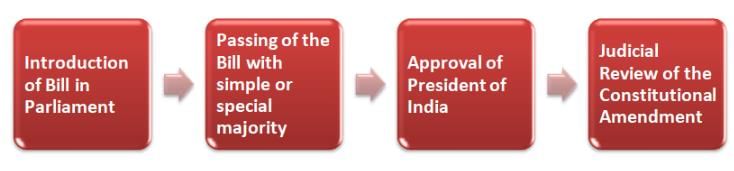
Both statements are correct. The power to amend the Constitution is vested in Parliament by Article 368, and most constitutional amendments must be passed by each House of Parliament by a special majority-that is, a majority of the total membership of the House and not less than two-thirds of the members present and voting.

Where an amendment affects specified matters (which include the distribution of powers between the Union and the States and provisions in the Seventh Schedule, among others), Article 368(2) requires that, after Parliament has passed the amendment, it must be ratified by the Legislatures of not less than one-half of the States before the amendment can be presented to the President for assent.

In short: Parliament must pass such amendments by a special majority, and when the amendment relates to distribution of powers between Centre and States it additionally requires ratification by at least one-half of the State Legislatures.

Laxmikanth Test: Amendment of the Constitution - Question 5

With regard to the process of amending the Constitution, evaluate the following statements:

  1. The introduction of a Constitution amendment bill does not require prior permission of the President.
  2. The Constitutional amendment bill can not be discussed in a joint sitting of two Houses of Parliament for discussion.

Which of the statements given above is/are correct?

Detailed Solution: Question 5

C: Both 1 and 2

Statement 1 is correct. Under Article 368, a Constitution amendment bill may be introduced in either House of Parliament by any member (minister or private member) and does not require the President's prior recommendation for introduction. However, after the bill is duly passed by Parliament, the President's assent is necessary for it to become law. Where the amendment seeks to alter provisions specified in Article 368(2), it must also obtain ratification by not less than one-half of the state legislatures.

Statement 2 is correct. A constitutional amendment bill must be passed separately by each House of Parliament by a special majority - that is, by a majority of the total membership of the House together with a two-thirds majority of members present and voting. Because this separate, special-majority requirement is prescribed by Article 368, the mechanism of a joint sitting (the procedure under Article 108 for ordinary bills) cannot be used to resolve disagreements between the two Houses on a Constitution amendment bill. Parliament may, however, refer such bills to a select or joint committee for examination, but not decide them in a joint sitting.

Therefore, both statements are correct.

Laxmikanth Test: Amendment of the Constitution - Question 6

Referring to the Constitution (Eighty-sixth Amendment) Act, 2002, evaluate the following statements:

  1. It provides for early childhood care and education to children below the age of six years.
  2. According to this Act, it is the fundamental duty of every citizen to provide opportunities for education to his/her child between the ages of three and fourteen years.

Which of the statements given above is/are correct?

Detailed Solution: Question 6

1 only

The Eighty-sixth Amendment Act, 2002 inserted Article 21A in the Constitution, making the right to free and compulsory education a fundamental right for children in the age group of 6-14 years.

The same Amendment also amended Article 45 (a Directive Principle) to require the State to endeavour to provide early childhood care and education to all children until they complete the age of six years. This makes the first statement correct.

The second statement is incorrect: the Amendment did not create a fundamental duty on citizens to provide educational opportunities to their children, nor did it set the age range as 3-14 years. The fundamental duties under Article 51A were not altered by this Act to include such an obligation.

Hence, only the first statement is correct.

Laxmikanth Test: Amendment of the Constitution - Question 7

Evaluate the following statements:

  1. The 100th Constitutional Amendment was enacted to facilitate the exchange of territories between India and Myanmar.
  2. A foreign state's cession of Indian territory is possible only through a constitutional amendment under Article 368.

Which of the statements above is/are correct?

Detailed Solution: Question 7

2 only

The first statement is incorrect. The 100th Constitutional Amendment Act, 2015 gave constitutional effect to the Land Boundary Agreement with Bangladesh (implementing the exchange of enclaves and boundary adjustments between India and Bangladesh), not with Myanmar.

The second statement is correct. In the Berubari Union jurisprudence, the Supreme Court held that the cession of Indian territory to a foreign state cannot be effected by ordinary legislation under Article 3 alone; such cession alters the territory provided for in the Constitution (First Schedule) and therefore requires a constitutional amendment under Article 368.

Accordingly, only the second statement is correct.

Laxmikanth Test: Amendment of the Constitution - Question 8

Consider the following statements about provisions related to cooperative societies: 1) The 97th Constitution (Amendment) Act, 2011 provided constitutional status to multi-state cooperative societies. 2) The subject 'cooperative societies' falls under the concurrent list of the Indian Constitution. Which of the statements above is/are correct?

  1. The 97th Constitution (Amendment) Act, 2011 provided constitutional status to multi-state cooperative societies.
  2. The subject 'cooperative societies' falls under the concurrent list of the Indian Constitution.

Detailed Solution: Question 8

1 only

Statement 1 is correct. The 97th Constitutional Amendment Act, 2011 inserted Part IX-B (Articles 243ZH-243ZT) titled "The Co-operative Societies", added a protection for the right to form cooperatives in Article 19(1)(c), and introduced the Directive Principle in Article 43B to promote cooperative societies. Those changes gave constitutional recognition to cooperative societies.

The Supreme Court in Rajendra N. Shah v. Union of India (2013) held that Part IX-B could not be sustained to the extent it sought to legislate on matters falling exclusively within the State List, but the provisions remain valid insofar as they apply to multi-state cooperative societies. This judicial outcome means the Amendment's constitutional recognition effectively applies to multi-state cooperatives.

Statement 2 is incorrect. The subject of cooperative societies traditionally fell under the State List (Entry 32) rather than the Concurrent List. The 97th Amendment provided constitutional recognition and framework for cooperatives but did not place the subject in the Concurrent List.

Therefore, only the first statement is correct.

Laxmikanth Test: Amendment of the Constitution - Question 9

The statements below express certain aims:

  1. To promote opportunities that support the healthy development of children.
  2. To lessen disparities in income, status, facilities, and opportunities.
  3. To protect and improve the environment, and to safeguard forests and wildlife.

How many of the directives above were adopted by the 44th Amendment to the Constitution?

Detailed Solution: Question 9

Only one - Article 38(2), inserted by the 44th Amendment (1978), introduced the obligation to minimize inequalities in income, status, facilities and opportunities.

The provision concerning the healthy development of children is found in Article 39(f) of the Directive Principles of State Policy and was part of the original Constitution; it was not introduced by the 44th Amendment.

The directive to protect and improve the environment and to safeguard forests and wildlife was added as Article 48A by the 42nd Amendment (1976). The 42nd Amendment also inserted Article 39A (equal justice and free legal aid) and Article 43A (worker participation in management).

Hence, only the directive relating to reducing inequalities (the one reflected in Article 38(2)) was adopted by the 44th Amendment (1978).

Laxmikanth Test: Amendment of the Constitution - Question 10

Which constitutional amendment introduced the provision that the President shall be bound by the aid and advice of the Council of Ministers?

Detailed Solution: Question 10

42nd Amendment - The 42nd Amendment (1976) amended Article 74(1) by adding that the President "shall, in the exercise of his functions, act in accordance with such advice" of the Council of Ministers, thereby making the President bound by that advice.

Before this amendment, Article 74 did not explicitly state that the President was bound to follow the Council's advice. The 44th Amendment (1978) subsequently added a proviso allowing the President to return advice to the Council for reconsideration once, after which the President must act in accordance with the advice.

Therefore, the explicit provision making the President bound by the Council of Ministers' advice was introduced by the 42nd Amendment.

Laxmikanth Test: Amendment of the Constitution - Question 11

By which Constitutional Amendment Act was the Sindhi language included in the Eighth Schedule of the Indian Constitution?

Detailed Solution: Question 11

21st Amendment Act of 1967

The language Sindhi was added to the Eighth Schedule by the 21st Amendment Act, 1967. At the time of the Constitution's adoption the Eighth Schedule listed 14 languages: Assamese, Bengali, Gujarati, Hindi, Kannada, Kashmiri, Malayalam, Marathi, Oriya (Odia), Punjabi, Sanskrit, Tamil, Telugu, Urdu.

Later additions include Konkani, Manipuri (Meitei), Nepali by the 71st Amendment Act, 1992, and Bodo, Dogri, Maithili, Santali by the 92nd Amendment Act, 2003, bringing the Eighth Schedule total to 22 languages.

Laxmikanth Test: Amendment of the Constitution - Question 12

On a particular day, 300 members are present in the Lok Sabha during the voting process. In this scenario, a constitutional amendment bill under Article 368 of the constitution:

Detailed Solution: Question 12

D is correct: the amendment cannot be passed without the support of at least 272 members.

Article 368 requires two conditions to be satisfied simultaneously for a constitutional amendment to be passed:

  • a majority of the total membership of the House (i.e., more than half of the total seats);
  • at least two-thirds of the members present and voting.

The total membership of the House is 543; more than half is

543 ÷ 2 = 271.5, so a majority of total membership requires at least 272 votes.

Two-thirds of the members present and voting (with 300 present) is

300 × 2/3 = 200 votes.

Both conditions must be met simultaneously, so the required number of supporting votes is the larger of the two figures. Therefore the minimum required is 272 votes, and option D (stating 272) is correct.

Laxmikanth Test: Amendment of the Constitution - Question 13

By which instrument could India cede its territory to another neighbouring country?

Detailed Solution: Question 13

A constitutional amendment by a bill passed by two third majority in both houses of Parliament.

Territorial cession affects the constitutional definition of the Territory of India (contained in Article 1), so it cannot be achieved by ordinary legislation or mere executive action alone.

The procedure for changing the Constitution is laid down in Article 368. An amendment bill must be passed in each House by a majority of the total membership of that House and by a majority of not less than two-thirds of the members present and voting (the precise two-stage majority requirement under Article 368).

This principle was applied by the Supreme Court in the Berubari Union litigation (State of West Bengal v. Union of India), after which Parliament enacted the Ninth Amendment to give effect to the transfer agreed with the neighbouring country. That decision establishes that ceding Indian territory requires a constitutional amendment.

By contrast, the executive may enter into treaties or settle boundary questions of interpretation and demarcation, but it cannot unilaterally transfer Indian territory to another state without the constitutional amendment process described above.

Laxmikanth Test: Amendment of the Constitution - Question 14

  1. A single individual serves as Governor for two or more States.
  2. The Council of Ministers must not exceed 15 percent of the total membership of the Legislative Assembly in the States.
  3. The Governor shall address the state legislature at the start of the first session after every general election.

How many provisions were added by constitutional amendments?

Detailed Solution: Question 14

Only two - Statements 1 and 2 are provisions introduced by constitutional amendments; Statement 3 is part of the original Constitution.

Statement 1: Originally Article 153 required a Governor for each State. The Seventh Amendment Act, 1956 amended the provision to permit the same person to hold the office of Governor for two or more States.

Statement 2: The ceiling on the strength of the Council of Ministers to not exceed 15% of the membership of the Legislative Assembly (with a minimum of 12 ministers including the Chief Minister) was introduced by the Ninety-first Amendment Act, 2003.

Statement 3: The requirement that the Governor address the State Legislature at the commencement of the first session after a general election is contained in Article 176(1) of the original Constitution and was not a later amendment.

Laxmikanth Test: Amendment of the Constitution - Question 15

  1. The privy purse was abolished by the 26th Constitutional Amendment Act (1971), citing a reduction in the government's revenue deficit as the rationale.
  2. The privy purse referred to the annual tax-free payment made to rulers of the princely state and their successors, drawn from the Consolidated Fund of India.

Which of the statements above is/are correct?

Detailed Solution: Question 15

B: 2 only

Statement 2 is correct and statement 1 is incorrect.

The privy purse was an annual, tax-free payment made to former rulers and their successors, charged on the Consolidated Fund of India under Article 291 of the Constitution; these payments were intended to meet the personal, household and ceremonial expenses of the former rulers as specified in accession and merger arrangements.

The abolition of these payments and the formal recognition of rulers was carried out by the 26th Constitutional Amendment (1971), which repealed the constitutional provisions relating to privy purses (including Article 291) and removed special privileges. The government's stated rationale emphasized the incompatibility of hereditary privileges with an egalitarian democratic republic rather than a motive of reducing a specific "revenue deficit," so the part of statement 1 giving that rationale is incorrect.

For context, about 565 princely states existed at the time of Indian independence; most rulers signed the Instrument of Accession ceding defence, external affairs and communications, and many later acceded to India through merger/standstill arrangements negotiated by Sardar Vallabhbhai Patel and V. P. Menon. The privy purse formed part of the terms offered to secure accession and integration.

Hence, only statement 2 is correct.

186 videos|843 docs|245 tests
Information about Laxmikanth Test: Amendment of the Constitution Page
In this test you can find the Exam questions for Laxmikanth Test: Amendment of the Constitution solved & explained in the simplest way possible. Besides giving Questions and answers for Laxmikanth Test: Amendment of the Constitution, EduRev gives you an ample number of Online tests for practice
186 videos|843 docs|245 tests
Download as PDF