
Force and Laws of Motion- Case Based Type Questions - Free with solutions
MCQ Practice Test & Solutions: Test: Force and Laws of Motion- Case Based Type Questions (15 Questions)
You can prepare effectively for Class 9 Class 9: Additional Practice with this dedicated MCQ Practice Test (available with solutions) on the important topic of "Test: Force and Laws of Motion- Case Based Type Questions". These 15 questions have been designed by the experts with the latest curriculum of Class 9 2026, to help you master the concept.
Test Highlights:
- - Format: Multiple Choice Questions (MCQ)
- - Duration: 30 minutes
- - Number of Questions: 15
Sign up on EduRev for free to attempt this test and track your preparation progress.

Direction: Read the following paragraph and choose the correct options to answer any four questions given below :
A large bus and a van, both moving with a velocity of magnitude v, have a head-on-collision and both the vehicles stop after the collision. The time of the collision is 1 sec.
Q. Which vehicle according to you will suffer the less damage?
Detailed Solution: Question 1
Direction: Read the following paragraph and choose the correct options to answer any four questions given below :
A large bus and a van, both moving with a velocity of magnitude v, have a head-on-collision and both the vehicles stop after the collision. The time of the collision is 1 sec.
Q. The vehicle, which experiences the smaller momentum change is ...................
Detailed Solution: Question 2

Direction: Read the following paragraph and choose the correct options to answer any four questions given below :
A large bus and a van, both moving with a velocity of magnitude v, have a head-on-collision and both the vehicles stop after the collision. The time of the collision is 1 sec.
Q. The vehicle, which experiences smaller force of impact is ....................
Detailed Solution: Question 3
Direction: Read the following paragraph and choose the correct options to answer any four questions given below :
A large bus and a van, both moving with a velocity of magnitude v, have a head-on-collision and both the vehicles stop after the collision. The time of the collision is 1 sec.
Q. The vehicle, which experiences the greater acceleration is .....................
Detailed Solution: Question 4
Direction: Read the following paragraph and choose the correct options to answer any four questions given below :
A large bus and a van, both moving with a velocity of magnitude v, have a head-on-collision and both the vehicles stop after the collision. The time of the collision is 1 sec.
Q. Under the same conditions, if there was a heavy truck heavier than the bus, in place of van, which one will be more affected?
Detailed Solution: Question 5
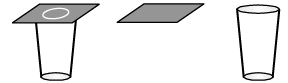
Direction: Study the following diagram and choose the correct options to answer any four questions given below:
In the figure below the card is flicked with a push. It was observed that the card moves ahead while coin falls in glass.
Q. Name the law which provides the definition of force.
Detailed Solution: Question 6
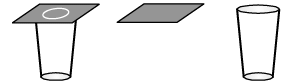
Direction: Study the following diagram and choose the correct options to answer any four questions given below:
In the figure below the card is flicked with a push. It was observed that the card moves ahead while coin falls in glass.
Q. Name the law involved in this case.
Detailed Solution: Question 7
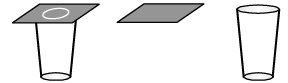
Direction: Study the following diagram and choose the correct options to answer any four questions given below:
In the figure below the card is flicked with a push. It was observed that the card moves ahead while coin falls in glass.
Q. Give reason for the above observation.
Detailed Solution: Question 8
Direction: Study the following diagram and choose the correct options to answer any four questions given below:
In the figure below the card is flicked with a push. It was observed that the card moves ahead while coin falls in glass.

Q. If the above coin is replaced by a heavy five rupee coin, what will be your observation. Give reason.
Detailed Solution: Question 9
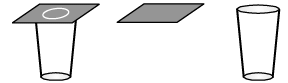
Direction: Study the following diagram and choose the correct options to answer any four questions given below:
In the figure below the card is flicked with a push. It was observed that the card moves ahead while coin falls in glass.
Q. State Newton’s first law of motion.
Detailed Solution: Question 10
Direction: Observe the diagram and answer any four questions below:
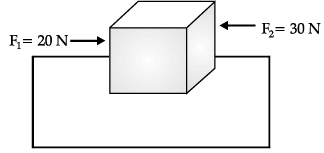
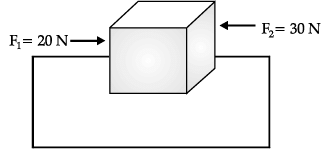
Two forces F1 = 20 N and F2 = 30 N are acting on an object as shown in figure :
Q. Identify the name of this extra force and its direction.
Detailed Solution: Question 11
Direction: Observe the diagram and answer any four questions below:
Two forces F1 = 20 N and F2 = 30 N are acting on an object as shown in figure :

Q. State the direction of the net force acting on the object ?
Detailed Solution: Question 12
Direction: Observe the diagram and answer any four questions below:
Two forces F1 = 20 N and F2 = 30 N are acting on an object as shown in figure :

Q. Find the net force acting on the object.
Detailed Solution: Question 13
Direction: Observe the diagram and answer any four questions below:
Two forces F1 = 20 N and F2 = 30 N are acting on an object as shown in figure :
Q. If the body still does not move under the application of these forces, what can be the possible reason for this.
Detailed Solution: Question 14
Direction: Observe the diagram and answer any four questions below:
Two forces F1 = 20 N and F2 = 30 N are acting on an object as shown in figure :

Q. What is the unit of force?
Detailed Solution: Question 15
|
4 docs|108 tests
|
