UPSC Exam  >  UPSC Test  >  CSAT Preparation  >  Test: Geometry- 1 - UPSC MCQ

Geometry- 1 - UPSC Free MCQ Test with solutions


MCQ Practice Test & Solutions: Test: Geometry- 1 (15 Questions)

You can prepare effectively for UPSC CSAT Preparation with this dedicated MCQ Practice Test (available with solutions) on the important topic of "Test: Geometry- 1". These 15 questions have been designed by the experts with the latest curriculum of UPSC 2026, to help you master the concept.

Test Highlights:

  • - Format: Multiple Choice Questions (MCQ)
  • - Duration: 30 minutes
  • - Number of Questions: 15

Sign up on EduRev for free to attempt this test and track your preparation progress.

Test: Geometry- 1 - Question 1

A vertical stick 20 m long casts a shadow 10 m long on the ground. At the same time, a tower casts a shadow 50 m long on the ground. Find the height of the tower.

Detailed Solution: Question 1

  • When the length of stick = 20 m, then length of shadow = 10 m i.e. in this case length = 2 * shadow
  • With the same angle of inclination of the sun, the length of the tower that casts a shadow of 50 m is: 2 * 50m = 100m
    ⇒ Height of tower = 100 m

Test: Geometry- 1 - Question 2

The area of similar triangles, ABC and DEF are 144cm2 and 81 cm2 respectively. If the longest side of the larger △ABC be 36 cm, then the longest side of the smaller △DEF is:

Detailed Solution: Question 2

  1. Identify the given areas and their ratio
    – Area of ΔABC (larger) = 144 cm²
    – Area of ΔDEF (smaller) = 81 cm²
    – Area ratio = 144 : 81 = 16 : 9

  2. Relate area ratio to linear scale factor
    For similar figures,
    (linear scale)² = (area ratio).
    So if the linear scale from DEF to ABC is k, then
    k² = 16 / 9
    ⇒ k = √(16/9) = 4 / 3

    This means each side of ABC is (4/3) times the corresponding side of DEF.

  3. Use the longest side of ABC to find the common multiplier
    Let the corresponding longest sides be:
    – ABC’s longest = 4 × m
    – DEF’s longest = 3 × m
    We know 4 m = 36 cm
    ⇒ m = 36 / 4 = 9 cm

  4. Compute DEF’s longest side
    DEF’s longest = 3 m = 3 × 9 = 27 cm

Answer: 27 cm (option a).

Test: Geometry- 1 - Question 3

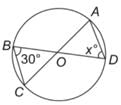
Find the value of x in the figure, if it is given that AC and BD are diameters of the circle.
Detailed Solution: Question 3

  • The triangle BOC is an isosceles triangle with sides OB and OC both being equal as they are the radii of the circle. Hence, the angle OBC = angle OCB = 30°.
  • Hence, the third angle of the triangle BOC i.e. Angle BOC would be equal to 120°.
    ⇒ BOC = AOD = 120° 
  • Also, in the isosceles triangle DOA: 
    Angle ODA = Angle DAO = x = 30°

Test: Geometry- 1 - Question 4

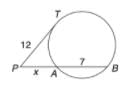
Find the value of x in the given figure.

Detailed Solution: Question 4

By the rule of tangents, we get:

⇒ 122 = (x + 7)x
⇒ 144 = x2 + 7x
⇒ x2 + 7x – 144 = 0
⇒ x2 +16x – 9x –144 = 0
⇒ x(x + 16) – 9(x + 16) = 0
⇒ x = 9 or –16

–16 can’t be the length, hence this value is discarded. Thus, x = 9

Test: Geometry- 1 - Question 5

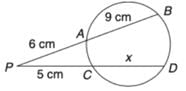
Find the value of x in the given figure.

Detailed Solution: Question 5

By the rule of chords, cutting externally, we get:

(9 + 6) * 6 = (5 + x) * 5
90 = 25 + 5x
5x = 65
x = 13 cm

Test: Geometry- 1 - Question 6

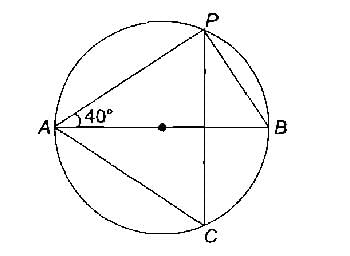
AB is the diameter of the circle and ∠PAB=40∘
what is the value of ∠PCA?
376998

Detailed Solution: Question 6

  • In △PAB

    ⇒  ∠PAB=40o         [ Given ]

    ⇒  ∠BPA=90o      [ angle inscribed in a semi-circle ]

    ⇒  ∠PAB+∠PBA+∠BPA=180o

    ∴   40o+∠PBA+90o=180o

    ∴   ∠PBA=180o−130o

    ∴   ∠PBA=50o

    ⇒  ∠PBA=∠PCA=50o     [ angles inscribed in a same arc PA ] 

    ∴   ∠PCA=50o

Test: Geometry- 1 - Question 7

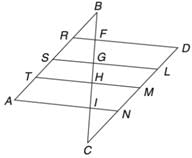
In the figure, AB is parallel to CD and RD || SL || TM || AN, and BR : RS : ST : TA = 3 : 5 : 2 : 7. If it is known that CN = 1.333 BR. Find the ratio of BF : FG : GH : HI : IC
Detailed Solution: Question 7

  • Since the lines, AB and CD are parallel to each other, and the lines RD and AN are parallel, it means that the triangles RBF and NCI are similar to each other. Since the ratio of CN : BR = 1.333, if we take BR as 3, we will get CN as 4.
  • This means that the ratio of BF : CI would also be 3 : 4.
    Also, the ratio of BR : RS : ST : TA = BF : FG : GH : HI = 3 : 5 : 2 : 7 (given).

Hence, the correct answer is 3 : 5 : 2 : 7 : 4 

Test: Geometry- 1 - Question 8

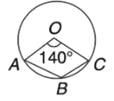
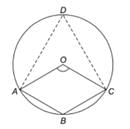
In the following figure, it is given that O is the centre of the circle and ㄥAOC = 140°. Find ㄥABC.
Detailed Solution: Question 8


∠AOC of minor sector = 140°
∠AOC of major sector=360° - 140° = 220°
Theorem: The angle subtended at the centre is twice the angle formed at the circumference of the circle.
Hence,


∴ The measure of ∠x = 110°

Test: Geometry- 1 - Question 9

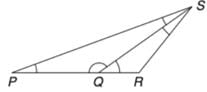
 In the figure below, PQ = QS, QR = RS and angle SRQ = 100°. How many degrees is angle QPS?
Detailed Solution: Question 9

In ΔQRS, QR = RS
⇒ ㄥRQS = ㄥRSQ (because angles opposite to equal sides are equal).
Thus:

ㄥRQS + ㄥRSQ = 180° - 100° = 80°
ㄥRQS = ㄥRSQ = 40°
ㄥPQS = 180° – 40° = 140°  (sum of angles on a line = 180°)

Then again, ㄥQPS = ㄥQSP (since angles opposite to equal sides are equal)

ㄥQPS + ㄥQSP = 180° – 140° = 40°
ㄥQPS = ㄥQSP = 20° 

Test: Geometry- 1 - Question 10

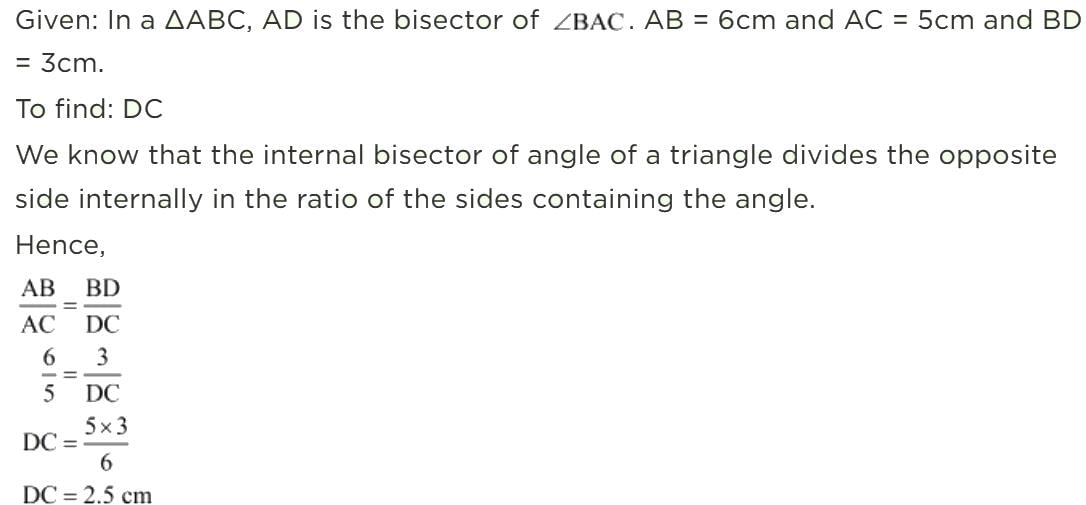
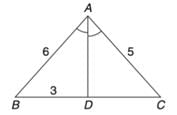
In the given figure, AD is the bisector of ∠BAC, AB = 6 cm, AC = 5 cm and BD = 3 cm. Find DC. 
Detailed Solution: Question 10

Test: Geometry- 1 - Question 11

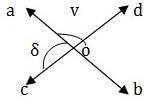
In the given figure, straight line AB and CD intersect at O. IF ∠δ =3∠v, then ∠v = ?
Detailed Solution: Question 11

COD is a  straight line 
∴ ∠δ + ∠v =180⁰ ⇒ 3v +v =180 ⇒ 4v = 180 ⇒ v =45⁰.

Test: Geometry- 1 - Question 12

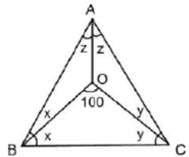
In a triangle ABC, the incentre is at 0. If ㄥBOC = 100°, find ㄥBAC. 
Detailed Solution: Question 12

In ∠BOC

⇒ x + y = 80°

⇒ 2x + 2y. = 160°

Also, 2x + 2y + 2z = 180°

⇒ 160° + 2z = 180°

⇒ ∠BAC = 2z = 20°

Test: Geometry- 1 - Question 13

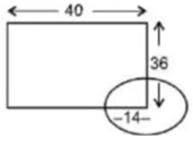
A rectangular enclosure 40 m x 36 m has a horse tethered to a corner with a rope of 14 m in length. What is the ratio of the respective areas it can graze if it is outside the enclosure and if it is inside the enclosure? 
Detailed Solution: Question 13

  • Imagine a circle on the corner of the rectangle
  • 3 quarters of the circle lie outside the rectangle and 1 quarter lies inside. 
  • Hence, Required ratio = 3 : 1

Test: Geometry- 1 - Question 14

Read the passage below and solve the questions based on it.
The area of a square is equal to the area of a rectangle. Moreover, the perimeter of the square is also equal to the perimeter of the rectangle. 

Q. The length of the rectangle is equal to the: 

Detailed Solution: Question 14

This is possible only when both the length and breadth of the rectangle are equal to the side of the square.

Test: Geometry- 1 - Question 15

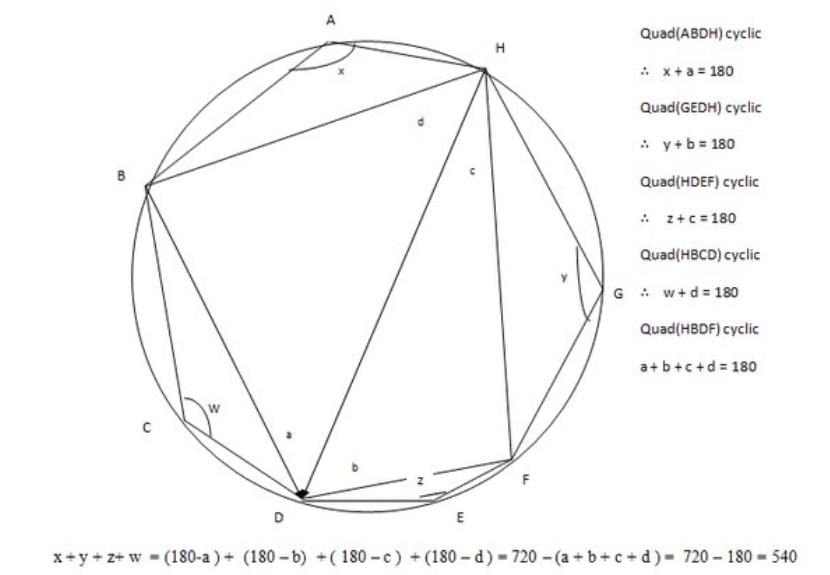
A quadrilateral is inscribed in a circle. If an angle is inscribed in each of the four segments outside the quadrilateral, then what is the sum of these four angles?

Detailed Solution: Question 15

148 videos|300 docs|126 tests
Information about Test: Geometry- 1 Page
In this test you can find the Exam questions for Test: Geometry- 1 solved & explained in the simplest way possible. Besides giving Questions and answers for Test: Geometry- 1, EduRev gives you an ample number of Online tests for practice
148 videos|300 docs|126 tests
Download as PDF