


All Exams >
NEET >
15 Weeks Preparation - Biology Class 12 >
All Questions
All questions of Sexual Reproduction in Flowering Plants for NEET Exam
Which of the following statements regarding the structure of microsporangium are correct?
(i) Microsporangium is generally surrounded by four wall layers-epidermis, endothecium, middle layers, and tapetum.
(ii) Outer three layers perform functions of protection and dehiscence of anthers.
(iii) Cells of tapetum undergo meiosis and produce microspore tetrads.- a)(i) and (ii)
- b)(ii) and (iii)
- c)(i) and (iii)
- d)(i), (ii) and (iii)
Correct answer is option 'A'. Can you explain this answer?
Which of the following statements regarding the structure of microsporangium are correct?
(i) Microsporangium is generally surrounded by four wall layers-epidermis, endothecium, middle layers, and tapetum.
(ii) Outer three layers perform functions of protection and dehiscence of anthers.
(iii) Cells of tapetum undergo meiosis and produce microspore tetrads.
(i) Microsporangium is generally surrounded by four wall layers-epidermis, endothecium, middle layers, and tapetum.
(ii) Outer three layers perform functions of protection and dehiscence of anthers.
(iii) Cells of tapetum undergo meiosis and produce microspore tetrads.
a)
(i) and (ii)
b)
(ii) and (iii)
c)
(i) and (iii)
d)
(i), (ii) and (iii)

|
Mira Joshi answered |
A microsporangium or future pollen sac is a cylindrical sac that appears circular in the transverse section. It consists of two parts, the outer wall, and central homogeneous sporogenous tissue.
Microsporangial wall has four types of layers - epidermis, endothecium, 1−3 middle layers, and tapetum.
The outer three layers perform the function of protection in the young anther and mechanism of dehiscence in the ripe anther.
Microsporangial wall has four types of layers - epidermis, endothecium, 1−3 middle layers, and tapetum.
The outer three layers perform the function of protection in the young anther and mechanism of dehiscence in the ripe anther.

The cells of endosperm have 24 chromosomes. What will be the number of chromosomes in the gametes? - a)8
- b)16
- c)23
- d)32
Correct answer is option 'A'. Can you explain this answer?
The cells of endosperm have 24 chromosomes. What will be the number of chromosomes in the gametes?
a)
8
b)
16
c)
23
d)
32
|
|
Mira Joshi answered |
In angiosperms, endosperm is a triploid structure.
∴ 3n = 24 (given), then n = 8
As gametes are haploid structures, therefore number of chromosomes in gametes is 8
∴ 3n = 24 (given), then n = 8
As gametes are haploid structures, therefore number of chromosomes in gametes is 8
Which of the following options is correct?- a)Transfer of pollen grains from the anther to the stigma of the same flower - Autogamy.
- b)Transfer of pollen grains from the anther of one flower to the stigma of another flower of same plant - Geitonogamy.
- c)Transfer of pollen grains from the anther to the stigma of a genetically different plant - Xenogamy.
- d)All of these.
Correct answer is option 'D'. Can you explain this answer?
Which of the following options is correct?
a)
Transfer of pollen grains from the anther to the stigma of the same flower - Autogamy.
b)
Transfer of pollen grains from the anther of one flower to the stigma of another flower of same plant - Geitonogamy.
c)
Transfer of pollen grains from the anther to the stigma of a genetically different plant - Xenogamy.
d)
All of these.
|
|
Mira Joshi answered |
Autogamy (Gk. autos-self, gamos-marriage) is a type of self-pollination in which an intersexual or perfect flower is pollinated by its own pollen.
Geitonogamy is a type of pollination in which pollen grains of one flower are transferred to the stigma of another flower belonging to either the same plant or a genetically similar plant. In geitonogamy, the flowers often show modifications similar to ones found in xenogamy or cross-pollination.
Xenogamy or cross-pollination is the transfer of pollen grains from the anther of one flower to the stigma of a genetically different flower.
Refer to the given characteristics of some flowers.
(i) LIght and non-sticky pollen grains
(ii) Exserted stigmas and anthers
(iii) Large, often feathert stigmas
(iv) Flowers colourless, odourless and nectarless
(v) Common in grassesAbove features are the characteristics of - a)anemophily
- b)hydrophily
- c)entomophily
- d)zoophily.
Correct answer is option 'A'. Can you explain this answer?
Refer to the given characteristics of some flowers.
(i) LIght and non-sticky pollen grains
(ii) Exserted stigmas and anthers
(iii) Large, often feathert stigmas
(iv) Flowers colourless, odourless and nectarless
(v) Common in grasses
(i) LIght and non-sticky pollen grains
(ii) Exserted stigmas and anthers
(iii) Large, often feathert stigmas
(iv) Flowers colourless, odourless and nectarless
(v) Common in grasses
Above features are the characteristics of
a)
anemophily
b)
hydrophily
c)
entomophily
d)
zoophily.
|
|
Mira Joshi answered |
Anemophily is a mode of cross pollination or transfer of pollen grains from a mature anther to the stigma of a pistil which is accomplished through the agency of wind, e.g., coconut palm, data palm, maize, many grasses, Cannabis, etc.
Coleorhiza and coleoptile are the protective sheaths coverging_______and__________respectively.
- a)plumule, epicotyl
- b)plumule, radicle
- c)radicle, plumule
- d)radicle, hypocotyl
Correct answer is option 'C'. Can you explain this answer?
Coleorhiza and coleoptile are the protective sheaths coverging_______and__________respectively.
a)
plumule, epicotyl
b)
plumule, radicle
c)
radicle, plumule
d)
radicle, hypocotyl

|
Vijay Bansal answered |
- The epicotyl bearing shoot apex and leaf primordia are enclosed in a foliar structure called coleoptile. It protects the plumule during emergence from the soil.
- The radicle is protected in a sheath called coleorhiza. It protects the radicle during its passage into the soil.
- So, the correct answer is " radicle, plumule ".
In the most common type of endosperm development:- a)cell wall formation occurs simultaneously with each nuclear division of PEN from the beginning.
- b) the PEN undergoes successive nuclear divisions to give rise to free nuclei and subsequently cell wall formation occurs.
- c)the PEN undergoes one division without cell wall formation and then all subsequent divisions are associated with cell wall formation.
- d)cell wall formation does not take place at all.
Correct answer is option 'B'. Can you explain this answer?
In the most common type of endosperm development:
a)
cell wall formation occurs simultaneously with each nuclear division of PEN from the beginning.
b)
the PEN undergoes successive nuclear divisions to give rise to free nuclei and subsequently cell wall formation occurs.
c)
the PEN undergoes one division without cell wall formation and then all subsequent divisions are associated with cell wall formation.
d)
cell wall formation does not take place at all.

|
Ciel Knowledge answered |
In the most common type of endosperm development:
- The PEN undergoes successive nuclear divisions to give rise to free nuclei.
- Subsequently, cell wall formation occurs.
This process implies that the initial divisions of the PEN do not involve cell wall formation; instead, the formation of free nuclei precedes cell wall development. This sequence is a fundamental aspect of endosperm development, ensuring the creation of a structured cellular framework during this critical stage of plant growth.
- The PEN undergoes successive nuclear divisions to give rise to free nuclei.
- Subsequently, cell wall formation occurs.
This process implies that the initial divisions of the PEN do not involve cell wall formation; instead, the formation of free nuclei precedes cell wall development. This sequence is a fundamental aspect of endosperm development, ensuring the creation of a structured cellular framework during this critical stage of plant growth.
One of the major contributors to pollen allergy is ____- a)carrot grass
- b)lawn grass
- c)wheat grass
- d)paddy
Correct answer is option 'A'. Can you explain this answer?
One of the major contributors to pollen allergy is ____
a)
carrot grass
b)
lawn grass
c)
wheat grass
d)
paddy

|
EduRev NEET answered |
- Pollen allergies are usually caused by plants that produce pollens in a large number.
- Because of this they might float in air as well causing them to enter respiratory tracts.
- Carrot grass, Parthenium are a major contributor to pollen allergies.
Persistent nucellus is called as______________and is found in __________.- a)perisperm, black pepper
- b)perisperm, groundnut
- c)endosperm, black pepper
- d)endosperm,groundnut
Correct answer is option 'A'. Can you explain this answer?
Persistent nucellus is called as______________and is found in __________.
a)
perisperm, black pepper
b)
perisperm, groundnut
c)
endosperm, black pepper
d)
endosperm,groundnut
|
|
Mira Joshi answered |
In some seeds, remains of nucellus persist. This residual nucellus which persists in the seed is called perisperm, e.g., black pepper, coffee, castor, cardamum, Nymphaea.
The inner most wall layer of anther is tapetum, the main function of tapetum is- a)Dehiscence
- b)Mechanical
- c)Nutrition
- d)Protection
Correct answer is option 'C'. Can you explain this answer?
The inner most wall layer of anther is tapetum, the main function of tapetum is
a)
Dehiscence
b)
Mechanical
c)
Nutrition
d)
Protection

|
Anisha Dey answered |
Understanding the Tapetum in Anther
The tapetum is a critical layer of cells found in the anther, which is a part of the stamen in flowering plants. Its primary function revolves around providing nutrition to developing pollen grains.
Key Functions of the Tapetum:
Why Nutrition is the Correct Answer:
The question specifically asks about the main function of the tapetum, and among the options provided, "Nutrition" (option 'C') is the most accurate. While the tapetum does play roles in mechanical support and possibly protection, its primary and most significant function is to ensure that pollen grains receive the necessary nutrients for their development.
In conclusion, understanding the role of the tapetum in the anther highlights its importance in the reproductive success of flowering plants, making it a key area of study in botany and plant biology.
The tapetum is a critical layer of cells found in the anther, which is a part of the stamen in flowering plants. Its primary function revolves around providing nutrition to developing pollen grains.
Key Functions of the Tapetum:
- Nutrition: The tapetum is responsible for supplying essential nutrients and proteins to the developing pollen grains. This nourishment is crucial for pollen maturation and viability.
- Formation of Pollen Coat: It aids in the formation of the pollen wall, which is vital for protecting pollen grains from environmental stressors during development and dispersal.
- Production of Ubisch Bodies: The tapetum produces ubisch bodies, which are involved in the synthesis of sporopollenin. This compound is essential for the structural integrity of the pollen grain's outer layer.
- Influence on Pollen Grain Size: The nutritional contributions from the tapetum can affect the size and quality of pollen grains, impacting fertilization success.
Why Nutrition is the Correct Answer:
The question specifically asks about the main function of the tapetum, and among the options provided, "Nutrition" (option 'C') is the most accurate. While the tapetum does play roles in mechanical support and possibly protection, its primary and most significant function is to ensure that pollen grains receive the necessary nutrients for their development.
In conclusion, understanding the role of the tapetum in the anther highlights its importance in the reproductive success of flowering plants, making it a key area of study in botany and plant biology.
What is the function of filiform apparatus in an angiosperm embryo sac?- a)Guides pollen tube from synergid to egg
- b)Helps in the entry of more than one pollen tube into a synergid
- c)Prevents entry of more than one pollen tube into a synergid
- d)Brings about opening of the pollen tube
Correct answer is option 'A'. Can you explain this answer?
What is the function of filiform apparatus in an angiosperm embryo sac?
a)
Guides pollen tube from synergid to egg
b)
Helps in the entry of more than one pollen tube into a synergid
c)
Prevents entry of more than one pollen tube into a synergid
d)
Brings about opening of the pollen tube
|
|
Mira Joshi answered |
In the ovule, the pollen tube is attracted by secretions of synergids. Jensen (1965) suggested that the filiform apparatus may be aiding the synergid in the absorption and transportation of materials into the embryo sac from the nucellus. He held the opinion that the filiform apparatus
The part of gynoecium that determines the compatible nature of pollen is?- a)stigma
- b)style
- c)ovary
- d)synergids
Correct answer is option 'A'. Can you explain this answer?
The part of gynoecium that determines the compatible nature of pollen is?
a)
stigma
b)
style
c)
ovary
d)
synergids

|
Niti Das answered |
Answer:
Stigma determines the compatible nature of pollen.
Explanation:
The gynoecium is the female reproductive part of the flower consisting of the stigma, style, and ovary. The stigma is the uppermost part of the gynoecium, which is sticky and receptive to pollen. The style is a long slender tube-like structure that connects the stigma to the ovary. The ovary is the swollen part of the gynoecium that contains the ovules, which develop into seeds after fertilization. The synergids are the two small cells present in the embryo sac, which help in the entry of pollen tube into the ovule.
The stigma plays a crucial role in determining the compatible nature of pollen. When pollen lands on the stigma, it germinates and grows a long tube-like structure called the pollen tube, which travels down the style and enters the ovary to fertilize the ovule. However, not all pollen can germinate on every stigma. The stigma has specific molecular characteristics that determine which pollen can successfully germinate on it. This is known as stigma specificity.
The molecular basis of stigma specificity is still being studied, but it is known that there is a mutual recognition process between the stigma and the pollen. The stigma produces chemicals that attract compatible pollen, which in turn releases chemicals that help it recognize the stigma. This recognition process is necessary to ensure successful fertilization and seed production.
Therefore, the stigma plays a crucial role in determining the compatible nature of pollen, and it is the part of the gynoecium that is responsible for ensuring successful fertilization and seed production.
Stigma determines the compatible nature of pollen.
Explanation:
The gynoecium is the female reproductive part of the flower consisting of the stigma, style, and ovary. The stigma is the uppermost part of the gynoecium, which is sticky and receptive to pollen. The style is a long slender tube-like structure that connects the stigma to the ovary. The ovary is the swollen part of the gynoecium that contains the ovules, which develop into seeds after fertilization. The synergids are the two small cells present in the embryo sac, which help in the entry of pollen tube into the ovule.
The stigma plays a crucial role in determining the compatible nature of pollen. When pollen lands on the stigma, it germinates and grows a long tube-like structure called the pollen tube, which travels down the style and enters the ovary to fertilize the ovule. However, not all pollen can germinate on every stigma. The stigma has specific molecular characteristics that determine which pollen can successfully germinate on it. This is known as stigma specificity.
The molecular basis of stigma specificity is still being studied, but it is known that there is a mutual recognition process between the stigma and the pollen. The stigma produces chemicals that attract compatible pollen, which in turn releases chemicals that help it recognize the stigma. This recognition process is necessary to ensure successful fertilization and seed production.
Therefore, the stigma plays a crucial role in determining the compatible nature of pollen, and it is the part of the gynoecium that is responsible for ensuring successful fertilization and seed production.
Read the given statements.
(i) Outer exine is made up of sporopollenin.
(ii) Inner intine is pecto-cellulosic in nature.
(iii) Generative cell is bigger and contains abundant food reserve.
(iv) Vegetative cell is small and floats in the cytoplasm of the generative cell.
Which of the given statements are not true regarding structure of pollen grain?- a)(i) and (ii)
- b)(ii) and (iii)
- c)(iii) and (iv)
- d)(i) and (iv)
Correct answer is option 'C'. Can you explain this answer?
Read the given statements.
(i) Outer exine is made up of sporopollenin.
(ii) Inner intine is pecto-cellulosic in nature.
(iii) Generative cell is bigger and contains abundant food reserve.
(iv) Vegetative cell is small and floats in the cytoplasm of the generative cell.
Which of the given statements are not true regarding structure of pollen grain?
(i) Outer exine is made up of sporopollenin.
(ii) Inner intine is pecto-cellulosic in nature.
(iii) Generative cell is bigger and contains abundant food reserve.
(iv) Vegetative cell is small and floats in the cytoplasm of the generative cell.
Which of the given statements are not true regarding structure of pollen grain?
a)
(i) and (ii)
b)
(ii) and (iii)
c)
(iii) and (iv)
d)
(i) and (iv)
|
|
Mira Joshi answered |
In a mature pollen grain, the generative cell is smaller and the tube (or vegetative) cell is larger. In the later stages of development of pollen grain, callose dissolves and the naked generative cell comes to lie freely in the cytoplasm of the tube cell. The tube cell has a cytoplasm which is rich in the food reserve (starch, protein, fat with mostly unsaturated fatty acids).
During the process of fertilization the pollen tube of the pollen grain usually enters the embryo sac through- a)integument
- b)nucellus
- c)chalaza
- d)micropyle.
Correct answer is option 'D'. Can you explain this answer?
During the process of fertilization the pollen tube of the pollen grain usually enters the embryo sac through
a)
integument
b)
nucellus
c)
chalaza
d)
micropyle.
|
|
Anisha Dey answered |
Pollen Tube and Fertilization Process
During fertilization in flowering plants, the pollen tube plays a crucial role in delivering sperm cells to the ovule. This process occurs through specific structures within the ovule.
Key Points About Pollen Tube Entry
- Micropyle: The pollen tube typically enters the embryo sac through a small opening called the micropyle. This is a crucial point of entry for successful fertilization.
- Embryo Sac Location: The embryo sac is located within the ovule, where the egg cell and synergids reside. The micropyle serves as the gateway to reach these structures.
- Pollen Tube Growth: After pollination, the pollen grain germinates and forms a pollen tube that grows towards the micropyle, guided by chemical signals released by the embryo sac.
- Fertilization Process: Upon reaching the micropyle, the pollen tube penetrates the embryo sac, allowing the sperm cells to fertilize the egg cell and synergids, leading to the formation of the zygote and endosperm.
Importance of Micropyle
- Specificity: The micropyle ensures that the pollen tube enters at the correct point, which is vital for successful fertilization and subsequent seed development.
- Protection: The micropyle also helps protect the developing embryo sac from external environmental factors while providing a pathway for the pollen tube.
In summary, the pollen tube enters the embryo sac through the micropyle, making it an essential structure for the fertilization process in flowering plants. Understanding this mechanism is crucial for studies in plant reproduction and development, especially for NEET aspirants.
During fertilization in flowering plants, the pollen tube plays a crucial role in delivering sperm cells to the ovule. This process occurs through specific structures within the ovule.
Key Points About Pollen Tube Entry
- Micropyle: The pollen tube typically enters the embryo sac through a small opening called the micropyle. This is a crucial point of entry for successful fertilization.
- Embryo Sac Location: The embryo sac is located within the ovule, where the egg cell and synergids reside. The micropyle serves as the gateway to reach these structures.
- Pollen Tube Growth: After pollination, the pollen grain germinates and forms a pollen tube that grows towards the micropyle, guided by chemical signals released by the embryo sac.
- Fertilization Process: Upon reaching the micropyle, the pollen tube penetrates the embryo sac, allowing the sperm cells to fertilize the egg cell and synergids, leading to the formation of the zygote and endosperm.
Importance of Micropyle
- Specificity: The micropyle ensures that the pollen tube enters at the correct point, which is vital for successful fertilization and subsequent seed development.
- Protection: The micropyle also helps protect the developing embryo sac from external environmental factors while providing a pathway for the pollen tube.
In summary, the pollen tube enters the embryo sac through the micropyle, making it an essential structure for the fertilization process in flowering plants. Understanding this mechanism is crucial for studies in plant reproduction and development, especially for NEET aspirants.
In (i) condition, both male and female flowers are borne on the same plant; an example of such plants is (ii).- a)(i) monoecious, (ii) cucurbit
- b)(i) monoecious, (ii) papaya
- c)(i) dioecious, (ii) cucurbit
- d)(i) dioecious, (ii) papaya
Correct answer is option 'A'. Can you explain this answer?
In (i) condition, both male and female flowers are borne on the same plant; an example of such plants is (ii).
a)
(i) monoecious, (ii) cucurbit
b)
(i) monoecious, (ii) papaya
c)
(i) dioecious, (ii) cucurbit
d)
(i) dioecious, (ii) papaya
|
|
Mira Joshi answered |
Monoecious plant species have separate male and female flowers on the same plant. Examples or monoecious plants are maize, birch, coconut and cucurbit. The plants in which male and female flowers are borne on separate individual are referred to as dioecious plants. e.g., papaya, date palm.
What is the function of germ porę?- a)Emergence of radicle.
- b)Absorption of water for seed germination.
- c)Initiation of pollen tube.
- d)All of these
Correct answer is option 'C'. Can you explain this answer?
What is the function of germ porę?
a)
Emergence of radicle.
b)
Absorption of water for seed germination.
c)
Initiation of pollen tube.
d)
All of these
|
|
Mira Joshi answered |
One or more thin areas present in the exine of pollen grains are known as germ pores. The germ pores are apertures in the exine layer of the pollen grain where the sporopollenin is absent. The germ pore helps in the formation of the pollen tube and the release of the male gametes during fertilisation. There are usually three germ pores in dicots (tricolpate) and one in monocots (monocolpate).
How many meiotic divisions are necessary for formation of 100 functional megaspores- a)100
- b)50
- c)25
- d)26
Correct answer is option 'A'. Can you explain this answer?
How many meiotic divisions are necessary for formation of 100 functional megaspores
a)
100
b)
50
c)
25
d)
26
|
|
Mira Joshi answered |
Megaspore mother cell (MMC) is the sporogenous cell that divides to give 4 haploid megaspores. Out of these 4 megaspores, only one is functional and other three degenerate. Hence 100 meiotic divisions are required for the formation of 100 functional megaspores.
Which function of tapetum is correct ?- a)Helps in pollen wall formation
- b)Transportation of nutrients to inner side of anther
- c)Synthesis of callase enzyme for separation of microspore tetrads
- d)All of these
Correct answer is option 'D'. Can you explain this answer?
Which function of tapetum is correct ?
a)
Helps in pollen wall formation
b)
Transportation of nutrients to inner side of anther
c)
Synthesis of callase enzyme for separation of microspore tetrads
d)
All of these
|
|
Mira Joshi answered |
Tapetum secretes Ubisch bodies which get covered with sporopollenin and so increase thickness of exine of pollen grain wall. Tapetum provides nourishment to developing microspores. It also secretes callase enzyme which dissolves callose substances by which four pollens of a pollen tetrad are united, hence separating microspores or pollens of a tetrad.
How many pollen mother cells should undergo meiotic division to produce 64 pollen grains? - a)64
- b)32
- c)16
- d)8
Correct answer is option 'C'. Can you explain this answer?
How many pollen mother cells should undergo meiotic division to produce 64 pollen grains?
a)
64
b)
32
c)
16
d)
8
|
|
Rishika Kaur answered |
Explanation:
To understand this question, let's go through the process of pollen grain formation in plants.
Pollen Grain Formation:
1. In the anther of a flower, there are pollen sacs which contain pollen mother cells (PMC).
2. These pollen mother cells undergo meiotic division to produce four haploid cells called microspores.
3. Each microspore then develops into a pollen grain, which is the male gametophyte in plants.
Now, let's calculate the number of pollen mother cells required to produce 64 pollen grains.
Calculation:
1. Each pollen mother cell produces four microspores.
2. So, the number of pollen mother cells required to produce 64 pollen grains will be 64 divided by 4.
3. 64/4 = 16.
Therefore, 16 pollen mother cells should undergo meiotic division to produce 64 pollen grains.
Summary:
- Pollen mother cells undergo meiotic division to produce microspores.
- Each pollen mother cell produces four microspores.
- To produce 64 pollen grains, 16 pollen mother cells are required.
To understand this question, let's go through the process of pollen grain formation in plants.
Pollen Grain Formation:
1. In the anther of a flower, there are pollen sacs which contain pollen mother cells (PMC).
2. These pollen mother cells undergo meiotic division to produce four haploid cells called microspores.
3. Each microspore then develops into a pollen grain, which is the male gametophyte in plants.
Now, let's calculate the number of pollen mother cells required to produce 64 pollen grains.
Calculation:
1. Each pollen mother cell produces four microspores.
2. So, the number of pollen mother cells required to produce 64 pollen grains will be 64 divided by 4.
3. 64/4 = 16.
Therefore, 16 pollen mother cells should undergo meiotic division to produce 64 pollen grains.
Summary:
- Pollen mother cells undergo meiotic division to produce microspores.
- Each pollen mother cell produces four microspores.
- To produce 64 pollen grains, 16 pollen mother cells are required.
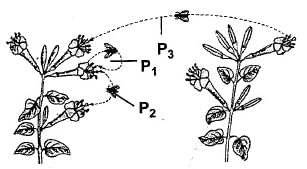
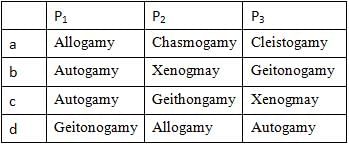
The given diagram shows two plants of the same species. Identify the types of pollination indicated at P1, P2 and P3
.
- a)a
- b)b
- c)c
- d)d
Correct answer is option 'C'. Can you explain this answer?
The given diagram shows two plants of the same species. Identify the types of pollination indicated at P1, P2 and P3
.
.
a)
a
b)
b
c)
c
d)
d
|
|
Mira Joshi answered |
Autogamy (Gk. autos-self, gamos-marriage) is a type of self-pollination in which an intersexual or perfect flower is pollinated by its own pollen.
Geitonogamy is a type of pollination in which pollen grains of one flower are transferred to the stigma of another flower belonging to either the same plant or a genetically similar plant. In geitonogamy, the flowers often show modifications similar to ones found in xenogamy or cross-pollination.
Xenogamy or cross-pollination is the transfer of pollen grains from the anther of one flower to the stigma of a genetically different flower.
The three cells found in a pollen grain when it is shed at 3-celled stage are- a)1 vegetative cell, 1 generative cell, 1 male gamete
- b)1 vegatative cell, 2 male gametes
- c)1 generative cell, 2 male gametes
- d)either (a) or (b)
Correct answer is option 'B'. Can you explain this answer?
The three cells found in a pollen grain when it is shed at 3-celled stage are
a)
1 vegetative cell, 1 generative cell, 1 male gamete
b)
1 vegatative cell, 2 male gametes
c)
1 generative cell, 2 male gametes
d)
either (a) or (b)
|
|
Mira Joshi answered |
A pollen grain with pollen tube carrying male gametes represents mature male gametophyte. It is 3-celled (one tube cell +2 male gametes) and 3-nucleated (one tube nucleus + two nuclei of each male gamete) structure.
Select the mismatched pair.- a)Storage of pollen grains -- -196∘C
- b)Pollen allergy -- Carrot grass
- c)Chasmogamous flowers -- Exposed anthers and stigmas
- d)Xenogamy -- Self pollination
Correct answer is option 'D'. Can you explain this answer?
Select the mismatched pair.
a)
Storage of pollen grains -- -196∘C
b)
Pollen allergy -- Carrot grass
c)
Chasmogamous flowers -- Exposed anthers and stigmas
d)
Xenogamy -- Self pollination

|
Prisha Khanna answered |
Mismatched Pair: Xenogamy -- Self pollination
Explanation:
Xenogamy and self-pollination are two different processes of pollination.
Xenogamy: It refers to the transfer of pollen grains from the anther of one flower to the stigma of another flower of the same or different plant. It involves cross-pollination that promotes genetic diversity and prevents inbreeding.
Self-pollination: It refers to the transfer of pollen grains from the anther to the stigma of the same flower or different flowers of the same plant. It involves self-fertilization that results in the production of genetically identical offspring.
Therefore, the mismatched pair is option D, Xenogamy -- Self pollination, as they are two different processes of pollination.
Explanation:
Xenogamy and self-pollination are two different processes of pollination.
Xenogamy: It refers to the transfer of pollen grains from the anther of one flower to the stigma of another flower of the same or different plant. It involves cross-pollination that promotes genetic diversity and prevents inbreeding.
Self-pollination: It refers to the transfer of pollen grains from the anther to the stigma of the same flower or different flowers of the same plant. It involves self-fertilization that results in the production of genetically identical offspring.
Therefore, the mismatched pair is option D, Xenogamy -- Self pollination, as they are two different processes of pollination.
______ of the pollen grain divides to form two male gametes.- a)Vegetative cell
- b)Generative cell
- c)Microspore mother cell
- d)None of these
Correct answer is option 'B'. Can you explain this answer?
______ of the pollen grain divides to form two male gametes.
a)
Vegetative cell
b)
Generative cell
c)
Microspore mother cell
d)
None of these
|
|
Anisha Dey answered |
Pollen Grain Structure and Function
Pollen grains are the male gametophytes in seed plants, crucial for sexual reproduction. They consist of two main types of cells: the vegetative cell and the generative cell.
Generative Cell Role
- The generative cell is responsible for the formation of male gametes (sperm cells).
- Upon pollen grain germination, the generative cell undergoes mitotic division to produce two male gametes.
Process of Male Gamete Formation
- After pollination, the pollen grain lands on the stigma of a compatible flower.
- The vegetative cell develops into the pollen tube, while the generative cell divides.
- This division results in two haploid male gametes that travel down the pollen tube toward the ovule for fertilization.
Other Cells in Pollen Grain
- Vegetative Cell: It develops into the pollen tube but does not divide to form gametes.
- Microspore Mother Cell: This cell undergoes meiosis to produce microspores, which develop into pollen grains, but it is not involved in the direct formation of gametes.
Conclusion
The correct answer to the question is option 'B', the generative cell, as it specifically divides to create the two male gametes necessary for fertilization in plants. Understanding this process is essential for grasping plant reproductive biology, especially for competitive exams like NEET.
Pollen grains are the male gametophytes in seed plants, crucial for sexual reproduction. They consist of two main types of cells: the vegetative cell and the generative cell.
Generative Cell Role
- The generative cell is responsible for the formation of male gametes (sperm cells).
- Upon pollen grain germination, the generative cell undergoes mitotic division to produce two male gametes.
Process of Male Gamete Formation
- After pollination, the pollen grain lands on the stigma of a compatible flower.
- The vegetative cell develops into the pollen tube, while the generative cell divides.
- This division results in two haploid male gametes that travel down the pollen tube toward the ovule for fertilization.
Other Cells in Pollen Grain
- Vegetative Cell: It develops into the pollen tube but does not divide to form gametes.
- Microspore Mother Cell: This cell undergoes meiosis to produce microspores, which develop into pollen grains, but it is not involved in the direct formation of gametes.
Conclusion
The correct answer to the question is option 'B', the generative cell, as it specifically divides to create the two male gametes necessary for fertilization in plants. Understanding this process is essential for grasping plant reproductive biology, especially for competitive exams like NEET.
Endosperm development precedes ____ development.- a)pollen tube
- b)embryo
- c)nuclei
- d)micropyle
Correct answer is option 'B'. Can you explain this answer?
Endosperm development precedes ____ development.
a)
pollen tube
b)
embryo
c)
nuclei
d)
micropyle

|
Lead Academy answered |
- Following double fertilization, post fertilization events begin.
- Events like endosperm formation and embryo development, formation of seeds from ovules and ovary into fruit are classified as post fertilization events.
Identify the wrong statement regarding post fertilization development.- a)The ovary wall develops into pericarp
- b)The outer integument of the ovule develops into tegmen
- c)The fusion nucleus (triple nucleus) develops into endosperm
- d)The ovule develops into seed
Correct answer is option 'B'. Can you explain this answer?
Identify the wrong statement regarding post fertilization development.
a)
The ovary wall develops into pericarp
b)
The outer integument of the ovule develops into tegmen
c)
The fusion nucleus (triple nucleus) develops into endosperm
d)
The ovule develops into seed
|
|
Mira Joshi answered |
After fertilisation, the integuments of the ovule form the protective coats (seed coats). Outer integument develops into testa and the inner one develops into tegmen.
How many meiotic divisions are required for the formation of 100 pollen grains?- a)100
- b)50
- c)25
- d)26
Correct answer is option 'C'. Can you explain this answer?
How many meiotic divisions are required for the formation of 100 pollen grains?
a)
100
b)
50
c)
25
d)
26
|
|
Mira Joshi answered |
Each microspore mother cell or pollen mother cell (PMC) or reduction division(meiosis) gives rise to 4 pollen grains. Hence, to form 100 pollen grains, 25 meiotic divisions are required.
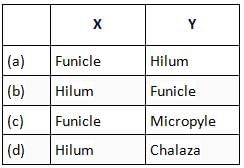
A typical angiospermous ovule is attached to the placenta by means of a stalk called X. Body of the ovule fuses with X in the region called Y. Identify X and Y.
- a)a
- b)b
- c)c
- d)d
Correct answer is option 'A'. Can you explain this answer?
A typical angiospermous ovule is attached to the placenta by means of a stalk called X. Body of the ovule fuses with X in the region called Y. Identify X and Y.
a)
a
b)
b
c)
c
d)
d
|
|
Mira Joshi answered |
A megasporangium is a minute structure attached to the placenta with the help of a stalk known as a funicle. A megasporangium is also usually known as the ovule. The ovule attaches with the funicle in a region called the hilum. Each ovule may be covered by a couple of envelopes known as integuments that surround the ovule from all around except at its tip. The opening at the tip of the ovule is called the micropyle. The end where micropyle is present is the micropylar end. Opposite to the micropylar end is a structure known as a chalaza. It represents the basal end of the ovule. The protective integuments enclose a mass of cells called nucellus. The cells of the nucellus have abundant nourishment materials. The nucellus covers the embryo sac or the female gametophyte. A meiotic division in the megaspore mother cell generally gives rise to four haploid megaspores, out of which a single functional megaspore matures into an embryo sac inside the ovule.
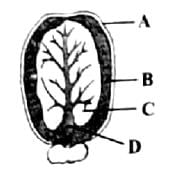
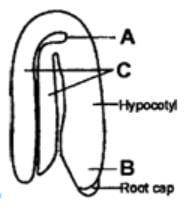
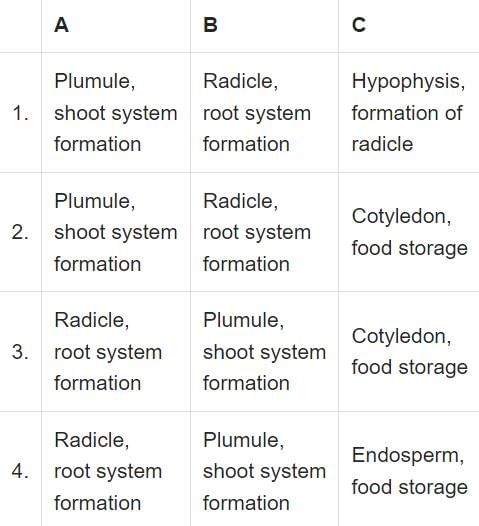
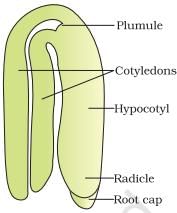
Identify the parts labelled as A, B, C and D in the given figure and select the correct option from the codes given below
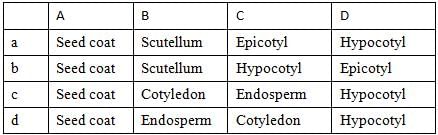
- a)a
- b)b
- c)c
- d)d
Correct answer is option 'D'. Can you explain this answer?
Identify the parts labelled as A, B, C and D in the given figure and select the correct option from the codes given below
a)
a
b)
b
c)
c
d)
d
|
|
Mira Joshi answered |
Correct option is D. A-Seed coat, B-Endosperm, C-Cotyledon, D-Hypocotyl
The diagram shows stages in embryo development in a dicot where A, B, and C respectively are: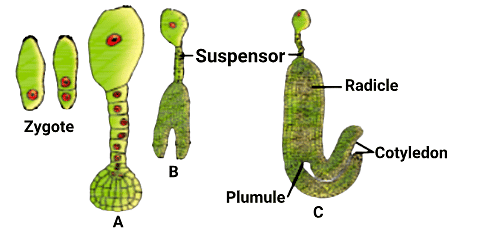
- a)Globular embryo, Heart shaped embryo, Immature Embryo
- b)Globular embryo, Heart shaped embryo, Mature Embryo
- c)Heart-shaped embryo, Globular embryo, Mature Embryo
- d)Heart-shaped embryo, Globular embryo, Immature Embryo
Correct answer is option 'B'. Can you explain this answer?
The diagram shows stages in embryo development in a dicot where A, B, and C respectively are:
a)
Globular embryo, Heart shaped embryo, Immature Embryo
b)
Globular embryo, Heart shaped embryo, Mature Embryo
c)
Heart-shaped embryo, Globular embryo, Mature Embryo
d)
Heart-shaped embryo, Globular embryo, Immature Embryo
|
|
Ciel Knowledge answered |
(B) The correct answer is B: Globular embryo, Heart-shaped embryo, Mature Embryo.
- Globular embryo: At this stage, the embryo is spherical in shape.
- Heart-shaped embryo: The embryo develops into a heart shape as it matures.
- Mature Embryo: This is the final stage where the embryo is fully developed and ready for seed formation.
Understanding these stages helps track the growth of a dicot embryo from its early spherical form to its mature, seed-forming stage.Globular embryo, Heart shaped embryo, Mature Embryo
- Globular embryo: At this stage, the embryo is spherical in shape.
- Heart-shaped embryo: The embryo develops into a heart shape as it matures.
- Mature Embryo: This is the final stage where the embryo is fully developed and ready for seed formation.
Understanding these stages helps track the growth of a dicot embryo from its early spherical form to its mature, seed-forming stage.Globular embryo, Heart shaped embryo, Mature Embryo
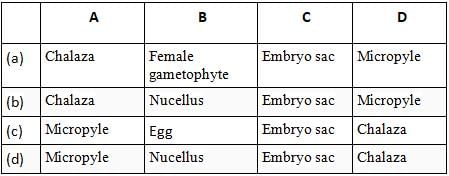
Identify the parts labelled A,B,C and D in the given figure and select the correct option.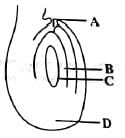
- a)a
- b)b
- c)c
- d)d
Correct answer is option 'D'. Can you explain this answer?
Identify the parts labelled A,B,C and D in the given figure and select the correct option.
a)
a
b)
b
c)
c
d)
d
|
|
Mira Joshi answered |
Given figure represents an anatropous ovule.
One of the most resistant biological material present in the exine of pollen grain is- a)pectocellulose
- b)sporopollenin
- c)suberin
- d)cellulose
Correct answer is option 'B'. Can you explain this answer?
One of the most resistant biological material present in the exine of pollen grain is
a)
pectocellulose
b)
sporopollenin
c)
suberin
d)
cellulose
|
|
Mira Joshi answered |
Outer layer (exine) of pollen grain is made of a highly resistant substance called sporopollenin. Sporopollenin is not degraded by any enzyme. It is not affected by high temperature, strong acid or strong alkali. Because of sporopollenin, pollen grains are well preserved as fossils.
A dithecous anther consists of ____(i)_______microsporangia, _____(ii)_______ in each lobe.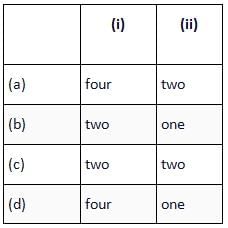
- a)a
- b)b
- c)c
- d)d
Correct answer is option 'A'. Can you explain this answer?
A dithecous anther consists of ____(i)_______microsporangia, _____(ii)_______ in each lobe.
a)
a
b)
b
c)
c
d)
d
|
|
Mira Joshi answered |
A stamen or male reproductive organ of a flower is made up of two parts- a stalk-like filament and a knob like terminal anther. Each anther has two lobes which are attached at the back by a sterile band called connective. When both the anther lobes are present, the stamen is called bithecous (or dithecous). A dithecous anther is tetrasporangiate having four microsporangia. Each lobe has two microsporangia separated by a strip of sterile tissue. When a single anther lobe is present, the stamen is termed as monothecous
In which condition should the ovaries be free?- a)Apoptosis
- b)Syncarpous
- c)Apocarpous
- d)Adephalous
Correct answer is option 'C'. Can you explain this answer?
In which condition should the ovaries be free?
a)
Apoptosis
b)
Syncarpous
c)
Apocarpous
d)
Adephalous

|
Stepway Academy answered |
- In apocarpous condition the ovaries must be free, though the other parts maybe fused.
- Example Oleandar. In simple words, separate carpels.
Select the correct option regarding the ploidy level of different structures of an angiospermous ovule.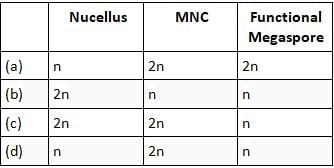
- a)a
- b)b
- c)c
- d)d
Correct answer is option 'C'. Can you explain this answer?
Select the correct option regarding the ploidy level of different structures of an angiospermous ovule.
a)
a
b)
b
c)
c
d)
d
|
|
Mira Joshi answered |
The body of the ovule consists of a mass of parenchymatous cells named nucellus. It is equivalent to megasporangium (2n). Megaspore mother cell or megasporocyte is a diploid (2n) cell which undergoes meiosis to form a linear tetrad of four haploid megaspores (n). Normally, the chalazal megaspore is the functional megaspore while the other three degenerate.
In the given diagram, X represents
- a)cellular endosperm
- b)nuclear endosperm
- c)helobial endosperm
- d)ruminate endosperm
Correct answer is option 'B'. Can you explain this answer?
In the given diagram, X represents
a)
cellular endosperm
b)
nuclear endosperm
c)
helobial endosperm
d)
ruminate endosperm
|
|
Mira Joshi answered |
Nuclear endosperm (X) is the most common type of endosperm. It is named so because it contains free nuclei in the beginning. The primary endosperm nucleus divides of free nuclei. Meanwhile central vacuole appears in the central cell and pushes the cytoplasm containing the nuclei to the periphery. The cytoplasm thickens so that the vacuole decreases in size. It ultimately disappears with the exception of a few cases. The multinucleate cytoplasm undergoes cleavage and gives rise to a multicellular tissue, e.g., maize, wheat, rice, sunflower, Capsella bursa-pastoris.
Identify the parts labelled A, B and C in the given figure and select the correct option.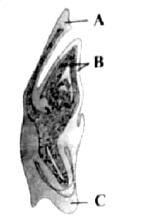
- a)A-Scutellum, B-Coleorhiza, C-Coleoptile
- b)A-Scutellum, B-Coleoptile, C-Coleorhiza
- c)A-Coleoptile, B-Scutellum, C-Coleorhiza
- d)A-Coleorhiza, B-Scutellum, C-Coleoptile
Correct answer is option 'B'. Can you explain this answer?
Identify the parts labelled A, B and C in the given figure and select the correct option.
a)
A-Scutellum, B-Coleorhiza, C-Coleoptile
b)
A-Scutellum, B-Coleoptile, C-Coleorhiza
c)
A-Coleoptile, B-Scutellum, C-Coleorhiza
d)
A-Coleorhiza, B-Scutellum, C-Coleoptile
|
|
Mira Joshi answered |
Given figure represents the monocotyledonous embryo of a grass.
Milk of tender coconut represents (i) and the surrounding white coconut meal represents (ii).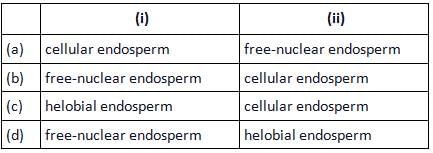
- a)a
- b)b
- c)c
- d)d
Correct answer is option 'B'. Can you explain this answer?
Milk of tender coconut represents (i) and the surrounding white coconut meal represents (ii).
a)
a
b)
b
c)
c
d)
d
|
|
Mira Joshi answered |
In coconut (Cocos nucifera), the surrounding white kernel called coconut meal is cellular endosperm and the coconut water (also called coconut milk) in the centre is free nuclear endosperm made up of thousands of nuclei.
Chapter doubts & questions for Sexual Reproduction in Flowering Plants - 15 Weeks Preparation - Biology Class 12 2025 is part of NEET exam preparation. The chapters have been prepared according to the NEET exam syllabus. The Chapter doubts & questions, notes, tests & MCQs are made for NEET 2025 Exam. Find important definitions, questions, notes, meanings, examples, exercises, MCQs and online tests here.
Chapter doubts & questions of Sexual Reproduction in Flowering Plants - 15 Weeks Preparation - Biology Class 12 in English & Hindi are available as part of NEET exam.
Download more important topics, notes, lectures and mock test series for NEET Exam by signing up for free.
15 Weeks Preparation - Biology Class 12
53 videos|246 docs|139 tests
|

|
© EduRev
|
Education Revolution
|


|







Signup on EduRev and stay on top of your study goals
10M+ students crushing their study goals daily