


Electronics and Communication Engineering (ECE) Exam > Electronics and Communication Engineering (ECE) Questions > A sinusoidal signal with peak to peak amplitu...
Start Learning for Free

A sinusoidal signal with peak to peak amplitude of 1.536 volt is quantized into 128 levels using a mid-rise uniform quantizer. The quantization noise power is
- a)0.768 V
- b)48 x 10-6 V
- c)12 x 10-6 V
- d)3.072 Volt
Correct answer is option 'C'. Can you explain this answer?
| FREE This question is part of | Download PDF Attempt this Test |
Verified Answer
A sinusoidal signal with peak to peak amplitude of 1.536 volt is quant...
 .
.Most Upvoted Answer
A sinusoidal signal with peak to peak amplitude of 1.536 volt is quant...
Quantization is the process of approximating a continuous signal with a finite number of discrete levels. In this case, a sinusoidal signal with a peak-to-peak amplitude of 1.536 volts is being quantized into 128 levels using a mid-rise uniform quantizer. We need to determine the quantization noise power.
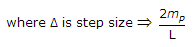
Mid-rise uniform quantization means that the quantization levels are equally spaced and the decision threshold for each level is located at the midpoint of the adjacent levels. In this case, there are 128 levels, so the quantization step size can be calculated as:
Quantization Step Size = (Peak-to-Peak Amplitude) / (Number of Levels)
= 1.536 volts / 128
= 0.012 volts
Now, we need to find the quantization error or quantization noise. The quantization error is the difference between the actual value of the analog signal and its quantized representation. For a sinusoidal signal, the quantization error can be calculated as:
Quantization Error = (Quantization Step Size) / sqrt(12)
= 0.012 volts / sqrt(12)
≈ 0.003461 volts
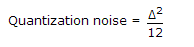
The quantization noise power can be calculated by squaring the quantization error and then taking the average value. Since the quantization error is a random variable, it is assumed to be uniformly distributed between -0.5 and +0.5 times the quantization step size. Therefore, the average power of the quantization noise can be calculated as:
Quantization Noise Power = (Quantization Error)^2 / 12
= (0.003461 volts)^2 / 12
≈ 12 x 10^-6 volts
Hence, the correct answer is option 'C', i.e., the quantization noise power is approximately 12 x 10^-6 volts.
Mid-rise uniform quantization means that the quantization levels are equally spaced and the decision threshold for each level is located at the midpoint of the adjacent levels. In this case, there are 128 levels, so the quantization step size can be calculated as:
Quantization Step Size = (Peak-to-Peak Amplitude) / (Number of Levels)
= 1.536 volts / 128
= 0.012 volts
Now, we need to find the quantization error or quantization noise. The quantization error is the difference between the actual value of the analog signal and its quantized representation. For a sinusoidal signal, the quantization error can be calculated as:
Quantization Error = (Quantization Step Size) / sqrt(12)
= 0.012 volts / sqrt(12)
≈ 0.003461 volts
The quantization noise power can be calculated by squaring the quantization error and then taking the average value. Since the quantization error is a random variable, it is assumed to be uniformly distributed between -0.5 and +0.5 times the quantization step size. Therefore, the average power of the quantization noise can be calculated as:
Quantization Noise Power = (Quantization Error)^2 / 12
= (0.003461 volts)^2 / 12
≈ 12 x 10^-6 volts
Hence, the correct answer is option 'C', i.e., the quantization noise power is approximately 12 x 10^-6 volts.
Attention Electronics and Communication Engineering (ECE) Students!
To make sure you are not studying endlessly, EduRev has designed Electronics and Communication Engineering (ECE) study material, with Structured Courses, Videos, & Test Series. Plus get personalized analysis, doubt solving and improvement plans to achieve a great score in Electronics and Communication Engineering (ECE).


|
Explore Courses for Electronics and Communication Engineering (ECE) exam
|

|
Similar Electronics and Communication Engineering (ECE) Doubts


Top Courses for Electronics and Communication Engineering (ECE)View all



A sinusoidal signal with peak to peak amplitude of 1.536 volt is quantized into 128 levels using a mid-rise uniform quantizer. The quantization noise power isa)0.768 Vb)48 x 10-6 Vc)12 x 10-6 Vd)3.072 VoltCorrect answer is option 'C'. Can you explain this answer?
Question Description
A sinusoidal signal with peak to peak amplitude of 1.536 volt is quantized into 128 levels using a mid-rise uniform quantizer. The quantization noise power isa)0.768 Vb)48 x 10-6 Vc)12 x 10-6 Vd)3.072 VoltCorrect answer is option 'C'. Can you explain this answer? for Electronics and Communication Engineering (ECE) 2024 is part of Electronics and Communication Engineering (ECE) preparation. The Question and answers have been prepared according to the Electronics and Communication Engineering (ECE) exam syllabus. Information about A sinusoidal signal with peak to peak amplitude of 1.536 volt is quantized into 128 levels using a mid-rise uniform quantizer. The quantization noise power isa)0.768 Vb)48 x 10-6 Vc)12 x 10-6 Vd)3.072 VoltCorrect answer is option 'C'. Can you explain this answer? covers all topics & solutions for Electronics and Communication Engineering (ECE) 2024 Exam. Find important definitions, questions, meanings, examples, exercises and tests below for A sinusoidal signal with peak to peak amplitude of 1.536 volt is quantized into 128 levels using a mid-rise uniform quantizer. The quantization noise power isa)0.768 Vb)48 x 10-6 Vc)12 x 10-6 Vd)3.072 VoltCorrect answer is option 'C'. Can you explain this answer?.
A sinusoidal signal with peak to peak amplitude of 1.536 volt is quantized into 128 levels using a mid-rise uniform quantizer. The quantization noise power isa)0.768 Vb)48 x 10-6 Vc)12 x 10-6 Vd)3.072 VoltCorrect answer is option 'C'. Can you explain this answer? for Electronics and Communication Engineering (ECE) 2024 is part of Electronics and Communication Engineering (ECE) preparation. The Question and answers have been prepared according to the Electronics and Communication Engineering (ECE) exam syllabus. Information about A sinusoidal signal with peak to peak amplitude of 1.536 volt is quantized into 128 levels using a mid-rise uniform quantizer. The quantization noise power isa)0.768 Vb)48 x 10-6 Vc)12 x 10-6 Vd)3.072 VoltCorrect answer is option 'C'. Can you explain this answer? covers all topics & solutions for Electronics and Communication Engineering (ECE) 2024 Exam. Find important definitions, questions, meanings, examples, exercises and tests below for A sinusoidal signal with peak to peak amplitude of 1.536 volt is quantized into 128 levels using a mid-rise uniform quantizer. The quantization noise power isa)0.768 Vb)48 x 10-6 Vc)12 x 10-6 Vd)3.072 VoltCorrect answer is option 'C'. Can you explain this answer?.
Solutions for A sinusoidal signal with peak to peak amplitude of 1.536 volt is quantized into 128 levels using a mid-rise uniform quantizer. The quantization noise power isa)0.768 Vb)48 x 10-6 Vc)12 x 10-6 Vd)3.072 VoltCorrect answer is option 'C'. Can you explain this answer? in English & in Hindi are available as part of our courses for Electronics and Communication Engineering (ECE).
Download more important topics, notes, lectures and mock test series for Electronics and Communication Engineering (ECE) Exam by signing up for free.
Here you can find the meaning of A sinusoidal signal with peak to peak amplitude of 1.536 volt is quantized into 128 levels using a mid-rise uniform quantizer. The quantization noise power isa)0.768 Vb)48 x 10-6 Vc)12 x 10-6 Vd)3.072 VoltCorrect answer is option 'C'. Can you explain this answer? defined & explained in the simplest way possible. Besides giving the explanation of
A sinusoidal signal with peak to peak amplitude of 1.536 volt is quantized into 128 levels using a mid-rise uniform quantizer. The quantization noise power isa)0.768 Vb)48 x 10-6 Vc)12 x 10-6 Vd)3.072 VoltCorrect answer is option 'C'. Can you explain this answer?, a detailed solution for A sinusoidal signal with peak to peak amplitude of 1.536 volt is quantized into 128 levels using a mid-rise uniform quantizer. The quantization noise power isa)0.768 Vb)48 x 10-6 Vc)12 x 10-6 Vd)3.072 VoltCorrect answer is option 'C'. Can you explain this answer? has been provided alongside types of A sinusoidal signal with peak to peak amplitude of 1.536 volt is quantized into 128 levels using a mid-rise uniform quantizer. The quantization noise power isa)0.768 Vb)48 x 10-6 Vc)12 x 10-6 Vd)3.072 VoltCorrect answer is option 'C'. Can you explain this answer? theory, EduRev gives you an
ample number of questions to practice A sinusoidal signal with peak to peak amplitude of 1.536 volt is quantized into 128 levels using a mid-rise uniform quantizer. The quantization noise power isa)0.768 Vb)48 x 10-6 Vc)12 x 10-6 Vd)3.072 VoltCorrect answer is option 'C'. Can you explain this answer? tests, examples and also practice Electronics and Communication Engineering (ECE) tests.
|
|
Explore Courses for Electronics and Communication Engineering (ECE) exam
|
|
Suggested Free Tests
Signup for Free!
Signup to see your scores go up within 7 days! Learn & Practice with 1000+ FREE Notes, Videos & Tests.


x
![]()

For Your Perfect Score in Electronics and Communication Engineering (ECE)
The Best you need at One Place

|
© EduRev
|
Education Revolution
|


Follow Us
|


Signup to see your scores
go up within 7 days!
Access 1000+ FREE Docs, Videos and Tests
Takes less than 10 seconds to signup