


Electrical Engineering (EE) Exam > Electrical Engineering (EE) Questions > What is the maximum output voltage of 3-phase... Start Learning for Free
What is the maximum output voltage of 3-phase full bridge rectifier supplied with a line voltage of 420 V?
- a)532 V
- b)567 V
- c)498 V
- d)526 V
Correct answer is option 'B'. Can you explain this answer?

Most Upvoted Answer
What is the maximum output voltage of 3-phase full bridge rectifier su...
To find the maximum output voltage of a 3-phase full bridge rectifier supplied with a line voltage of 420V, we need to consider the voltage drop across the diodes and the voltage phase shift caused by the rectification process.
The line voltage is given as 420V, which is the RMS (Root Mean Square) value of the voltage. To find the peak voltage, we can multiply the RMS value by √2.
Peak Voltage = RMS Voltage × √2
Peak Voltage = 420V × √2
Peak Voltage = 420V × 1.414
Peak Voltage ≈ 594.48V
However, this is the peak voltage before rectification. After rectification, there is a voltage drop across the diodes. In a full bridge rectifier, each diode will have a voltage drop of approximately 0.7V.
Voltage Drop across Diodes = 0.7V × 2
Voltage Drop across Diodes = 1.4V
To find the maximum output voltage, we subtract the voltage drop across the diodes from the peak voltage.
Maximum Output Voltage = Peak Voltage - Voltage Drop across Diodes
Maximum Output Voltage ≈ 594.48V - 1.4V
Maximum Output Voltage ≈ 593.08V
Therefore, the maximum output voltage of the 3-phase full bridge rectifier supplied with a line voltage of 420V is approximately 593.08V. None of the given options match this value.
The line voltage is given as 420V, which is the RMS (Root Mean Square) value of the voltage. To find the peak voltage, we can multiply the RMS value by √2.
Peak Voltage = RMS Voltage × √2
Peak Voltage = 420V × √2
Peak Voltage = 420V × 1.414
Peak Voltage ≈ 594.48V
However, this is the peak voltage before rectification. After rectification, there is a voltage drop across the diodes. In a full bridge rectifier, each diode will have a voltage drop of approximately 0.7V.
Voltage Drop across Diodes = 0.7V × 2
Voltage Drop across Diodes = 1.4V
To find the maximum output voltage, we subtract the voltage drop across the diodes from the peak voltage.
Maximum Output Voltage = Peak Voltage - Voltage Drop across Diodes
Maximum Output Voltage ≈ 594.48V - 1.4V
Maximum Output Voltage ≈ 593.08V
Therefore, the maximum output voltage of the 3-phase full bridge rectifier supplied with a line voltage of 420V is approximately 593.08V. None of the given options match this value.
Free Test
| FREE | Start Free Test |
Community Answer
What is the maximum output voltage of 3-phase full bridge rectifier su...
Concept:
The average output voltage of a three-phase bridge rectifier is given by
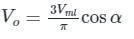
Maximum possible output voltage

Calculation:
Given that, line voltage (VL) = 420 V
Maximum line voltage = 420 × √2 V
Maximum possible output voltage
Maximum possible output voltage
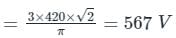
The average output voltage of a three-phase bridge rectifier is given by
Maximum possible output voltage
Calculation:
Given that, line voltage (VL) = 420 V
Maximum line voltage = 420 × √2 V
Maximum possible output voltage
Maximum possible output voltage
 | Explore Courses for Electrical Engineering (EE) exam |  |
Top Courses for Electrical Engineering (EE)View all



Top Courses for Electrical Engineering (EE)
Question Description
What is the maximum output voltage of 3-phase full bridge rectifier supplied with a line voltage of 420 V?a)532 Vb)567 Vc)498 Vd)526 VCorrect answer is option 'B'. Can you explain this answer? for Electrical Engineering (EE) 2026 is part of Electrical Engineering (EE) preparation. The Question and answers have been prepared according to the Electrical Engineering (EE) exam syllabus. Information about What is the maximum output voltage of 3-phase full bridge rectifier supplied with a line voltage of 420 V?a)532 Vb)567 Vc)498 Vd)526 VCorrect answer is option 'B'. Can you explain this answer? covers all topics & solutions for Electrical Engineering (EE) 2026 Exam. Find important definitions, questions, meanings, examples, exercises and tests below for What is the maximum output voltage of 3-phase full bridge rectifier supplied with a line voltage of 420 V?a)532 Vb)567 Vc)498 Vd)526 VCorrect answer is option 'B'. Can you explain this answer?.
What is the maximum output voltage of 3-phase full bridge rectifier supplied with a line voltage of 420 V?a)532 Vb)567 Vc)498 Vd)526 VCorrect answer is option 'B'. Can you explain this answer? for Electrical Engineering (EE) 2026 is part of Electrical Engineering (EE) preparation. The Question and answers have been prepared according to the Electrical Engineering (EE) exam syllabus. Information about What is the maximum output voltage of 3-phase full bridge rectifier supplied with a line voltage of 420 V?a)532 Vb)567 Vc)498 Vd)526 VCorrect answer is option 'B'. Can you explain this answer? covers all topics & solutions for Electrical Engineering (EE) 2026 Exam. Find important definitions, questions, meanings, examples, exercises and tests below for What is the maximum output voltage of 3-phase full bridge rectifier supplied with a line voltage of 420 V?a)532 Vb)567 Vc)498 Vd)526 VCorrect answer is option 'B'. Can you explain this answer?.
Solutions for What is the maximum output voltage of 3-phase full bridge rectifier supplied with a line voltage of 420 V?a)532 Vb)567 Vc)498 Vd)526 VCorrect answer is option 'B'. Can you explain this answer? in English & in Hindi are available as part of our courses for Electrical Engineering (EE). Download more important topics, notes, lectures and mock test series for Electrical Engineering (EE) Exam by signing up for free.
Here you can find the meaning of What is the maximum output voltage of 3-phase full bridge rectifier supplied with a line voltage of 420 V?a)532 Vb)567 Vc)498 Vd)526 VCorrect answer is option 'B'. Can you explain this answer? defined & explained in the simplest way possible. Besides giving the explanation of What is the maximum output voltage of 3-phase full bridge rectifier supplied with a line voltage of 420 V?a)532 Vb)567 Vc)498 Vd)526 VCorrect answer is option 'B'. Can you explain this answer?, a detailed solution for What is the maximum output voltage of 3-phase full bridge rectifier supplied with a line voltage of 420 V?a)532 Vb)567 Vc)498 Vd)526 VCorrect answer is option 'B'. Can you explain this answer? has been provided alongside types of What is the maximum output voltage of 3-phase full bridge rectifier supplied with a line voltage of 420 V?a)532 Vb)567 Vc)498 Vd)526 VCorrect answer is option 'B'. Can you explain this answer? theory, EduRev gives you an ample number of questions to practice What is the maximum output voltage of 3-phase full bridge rectifier supplied with a line voltage of 420 V?a)532 Vb)567 Vc)498 Vd)526 VCorrect answer is option 'B'. Can you explain this answer? tests, examples and also practice Electrical Engineering (EE) tests.
| Explore Courses for Electrical Engineering (EE) exam | |
Top Courses for Electrical Engineering (EE)
Explore Courses
Signup for Free!
Signup to see your scores go up within 7 days! Learn & Practice with 1000+ FREE Notes, Videos & Tests.


