


JEE Exam > JEE Questions > Let f (x) =(x2−4)1/3, then f has aa)loc...
Start Learning for Free
Let f (x) = (x2−4)1/3, then f has a
- a)local minima at x = 0
- b)local maxima at x = 0
- c)point of inflextion at x = 0
- d)none of these
Correct answer is option 'A'. Can you explain this answer?

Verified Answer
Let f (x) =(x2−4)1/3, then f has aa)local minima at x = 0b)local...
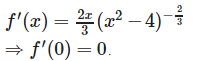
Also, for x < 0 (slightly) , f ‘(x) < 0 and for x > 0 (slightly) f ‘(x) >0. Hence f has a local minima at x = 0 .
Most Upvoted Answer
Let f (x) =(x2−4)1/3, then f has aa)local minima at x = 0b)local...
Solution:
To find the local minima or maxima, we need to find the first derivative of the given function and equate it to zero.
Let's find the first derivative of the given function f(x):
f(x) = (x^2/4)^(1/3)
f'(x) = (1/3)(x^2/4)^(-2/3)(2x/4)
f'(x) = (1/6)(x^2)^(1/3)(1/x)
f'(x) = (1/6)(x^2)^(1/3)/x
Now, equating f'(x) to zero:
(1/6)(x^2)^(1/3)/x = 0
(x^2)^(1/3) = 0
x = 0
Therefore, the only critical point of f(x) is x=0.
Now, let's check the nature of this critical point. For this, we need to find the second derivative of f(x) and evaluate it at x=0.
f''(x) = (1/6)(x^2)^(1/3)(-2x/(3x^2)) + (1/6)(1/x)(1/3)(x^2)^(1/3)(2x)
f''(x) = -(1/9)(x^2)^(-1/3) + (1/9)(x^2)^(1/3)
f''(x) = (1/9)(x^2)^(1/3)[1 - (1/x^2)]
f''(0) = (1/9)(0)^(1/3)[1 - (1/0^2)]
f''(0) is undefined.
Since the second derivative of f(x) is undefined at x=0, we cannot determine the nature of this critical point using the second derivative test.
However, we can observe the behavior of f(x) around x=0 to determine its nature.
For x>0, f(x) is an increasing function since its first derivative is positive.
For x<0, f(x)="" is="" a="" decreasing="" function="" since="" its="" first="" derivative="" is="">
Therefore, x=0 is a local minima of f(x).
Hence, the correct answer is option 'A'.
To find the local minima or maxima, we need to find the first derivative of the given function and equate it to zero.
Let's find the first derivative of the given function f(x):
f(x) = (x^2/4)^(1/3)
f'(x) = (1/3)(x^2/4)^(-2/3)(2x/4)
f'(x) = (1/6)(x^2)^(1/3)(1/x)
f'(x) = (1/6)(x^2)^(1/3)/x
Now, equating f'(x) to zero:
(1/6)(x^2)^(1/3)/x = 0
(x^2)^(1/3) = 0
x = 0
Therefore, the only critical point of f(x) is x=0.
Now, let's check the nature of this critical point. For this, we need to find the second derivative of f(x) and evaluate it at x=0.
f''(x) = (1/6)(x^2)^(1/3)(-2x/(3x^2)) + (1/6)(1/x)(1/3)(x^2)^(1/3)(2x)
f''(x) = -(1/9)(x^2)^(-1/3) + (1/9)(x^2)^(1/3)
f''(x) = (1/9)(x^2)^(1/3)[1 - (1/x^2)]
f''(0) = (1/9)(0)^(1/3)[1 - (1/0^2)]
f''(0) is undefined.
Since the second derivative of f(x) is undefined at x=0, we cannot determine the nature of this critical point using the second derivative test.
However, we can observe the behavior of f(x) around x=0 to determine its nature.
For x>0, f(x) is an increasing function since its first derivative is positive.
For x<0, f(x)="" is="" a="" decreasing="" function="" since="" its="" first="" derivative="" is="">
Therefore, x=0 is a local minima of f(x).
Hence, the correct answer is option 'A'.

|
Explore Courses for JEE exam
|

|
Top Courses for JEEView all





Question Description
Let f (x) =(x2−4)1/3, then f has aa)local minima at x = 0b)local maxima at x = 0c)point of inflextion at x = 0d)none of theseCorrect answer is option 'A'. Can you explain this answer? for JEE 2026 is part of JEE preparation. The Question and answers have been prepared according to the JEE exam syllabus. Information about Let f (x) =(x2−4)1/3, then f has aa)local minima at x = 0b)local maxima at x = 0c)point of inflextion at x = 0d)none of theseCorrect answer is option 'A'. Can you explain this answer? covers all topics & solutions for JEE 2026 Exam. Find important definitions, questions, meanings, examples, exercises and tests below for Let f (x) =(x2−4)1/3, then f has aa)local minima at x = 0b)local maxima at x = 0c)point of inflextion at x = 0d)none of theseCorrect answer is option 'A'. Can you explain this answer?.
Let f (x) =(x2−4)1/3, then f has aa)local minima at x = 0b)local maxima at x = 0c)point of inflextion at x = 0d)none of theseCorrect answer is option 'A'. Can you explain this answer? for JEE 2026 is part of JEE preparation. The Question and answers have been prepared according to the JEE exam syllabus. Information about Let f (x) =(x2−4)1/3, then f has aa)local minima at x = 0b)local maxima at x = 0c)point of inflextion at x = 0d)none of theseCorrect answer is option 'A'. Can you explain this answer? covers all topics & solutions for JEE 2026 Exam. Find important definitions, questions, meanings, examples, exercises and tests below for Let f (x) =(x2−4)1/3, then f has aa)local minima at x = 0b)local maxima at x = 0c)point of inflextion at x = 0d)none of theseCorrect answer is option 'A'. Can you explain this answer?.
Solutions for Let f (x) =(x2−4)1/3, then f has aa)local minima at x = 0b)local maxima at x = 0c)point of inflextion at x = 0d)none of theseCorrect answer is option 'A'. Can you explain this answer? in English & in Hindi are available as part of our courses for JEE.
Download more important topics, notes, lectures and mock test series for JEE Exam by signing up for free.
Here you can find the meaning of Let f (x) =(x2−4)1/3, then f has aa)local minima at x = 0b)local maxima at x = 0c)point of inflextion at x = 0d)none of theseCorrect answer is option 'A'. Can you explain this answer? defined & explained in the simplest way possible. Besides giving the explanation of
Let f (x) =(x2−4)1/3, then f has aa)local minima at x = 0b)local maxima at x = 0c)point of inflextion at x = 0d)none of theseCorrect answer is option 'A'. Can you explain this answer?, a detailed solution for Let f (x) =(x2−4)1/3, then f has aa)local minima at x = 0b)local maxima at x = 0c)point of inflextion at x = 0d)none of theseCorrect answer is option 'A'. Can you explain this answer? has been provided alongside types of Let f (x) =(x2−4)1/3, then f has aa)local minima at x = 0b)local maxima at x = 0c)point of inflextion at x = 0d)none of theseCorrect answer is option 'A'. Can you explain this answer? theory, EduRev gives you an
ample number of questions to practice Let f (x) =(x2−4)1/3, then f has aa)local minima at x = 0b)local maxima at x = 0c)point of inflextion at x = 0d)none of theseCorrect answer is option 'A'. Can you explain this answer? tests, examples and also practice JEE tests.
|
|
Explore Courses for JEE exam
|
|

Signup for Free!
Signup to see your scores go up within 7 days! Learn & Practice with 1000+ FREE Notes, Videos & Tests.


