Introduction to Trigonometry Class 10 Worksheet Maths Chapter 8

True and False
Q1: cosA = 4/3 for some angle A.
Ans: False
Q2: tanA = sinA/cosA
Ans: True
Q3: secA = 1cosA, for an acute angle
Ans: True
Q4: sin60º = 2sin30º
Ans: False
Q5: SinA + CosA = 1
Ans: False
Short Answer Questions
Q6: Write the values cos 0°, cos 45°, cos 60° and cos 90°. What happens to the values of cos as angle increases from 0° to 90°?
Ans: cos0∘ = 1
cos45∘ = 1/√2
cos 60∘ = 1/2
cos 90∘ = 0
We can see that values of cos decreases as angle increases from 0° to 90°
Q7: Write the values of tan 0°,tan 30°, tan 45°, tan 60° and tan 90°. What happens to the values of tan as angle increases from 0° to 90°?
Ans: tan 0∘ = 0
tan 30∘ = 1/√3
tan 60∘ = √3
cos 90∘ = undefined
We can see that values of cos decreases as angle increases from 0° to 90°
Q8: If cosec A = √10 . find other five trigonometric ratios.
Ans: Given cosec A = √10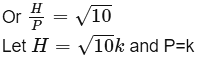
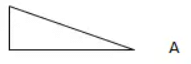
Now By Pythagoras theorem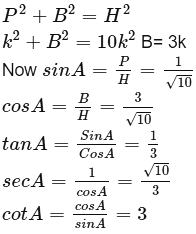
Q9: The value of (sin 30∘ + cos 30∘) − (sin 60∘ + cos 60∘) is
Ans: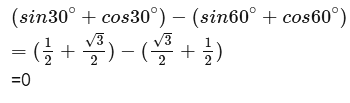
Q10: Evaluate the following: 2sin2 30∘ − 3cos245∘ + tan260∘
Ans: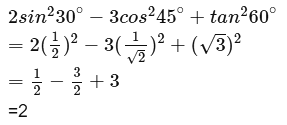
Q11: Evaluate:
cot230∘ − 2cos260∘ − 3/4sec245∘ − 4sec230∘
Ans: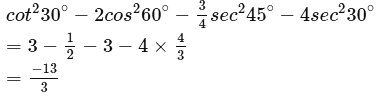
Q12: Write the values of sin 0°, sin 30°, sin 45°, sin 60° and sin 90°. What happens to the values of sin as angle increases from 0° to 90°?
Ans: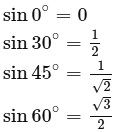
We can see that values of sin increases as angle increases from 0° to 90°
Q13: If sin A = 3/5 .find cos A and tan A.
Ans: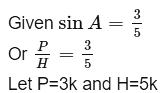
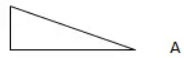
Now By Pythagoras theorem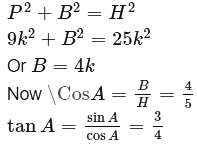
Q14: In a right triangle ABC right angled at B if sinA = 3/5. find all the six trigonometric ratios of C.
Ans: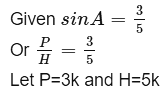
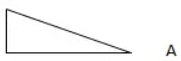
Now By Pythagoras theorem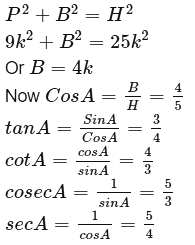
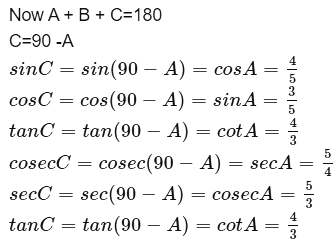
Q15: If sinB = 1/2 , show that 3 cosB − 4 cos3B = 0
Ans: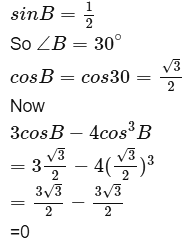
|
127 videos|584 docs|79 tests
|
FAQs on Introduction to Trigonometry Class 10 Worksheet Maths Chapter 8
| 1. What is the basic definition of trigonometry? |  |
| 2. What are the primary trigonometric functions and how are they defined? | |
| 3. How do you calculate the sine, cosine, and tangent of common angles like 0°, 30°, 45°, 60°, and 90°? | |
| 4. What is the Pythagorean theorem and how is it related to trigonometry? | |
| 5. How can trigonometry be applied in real life? | |




past year papers
,Introduction to Trigonometry Class 10 Worksheet Maths Chapter 8
,Exam
,MCQs
,Important questions
,video lectures
,Extra Questions
,ppt
,Previous Year Questions with Solutions
,practice quizzes
,Summary
,shortcuts and tricks
,Free
,Semester Notes
,mock tests for examination
,Introduction to Trigonometry Class 10 Worksheet Maths Chapter 8
,Viva Questions
,Introduction to Trigonometry Class 10 Worksheet Maths Chapter 8
,Objective type Questions
,Sample Paper
,study material
;



Worksheet Solution: Introduction to Trigonometry Free PDF Download
Importance of Worksheet Solution: Introduction to Trigonometry
Worksheet Solution: Introduction to Trigonometry Notes
Worksheet Solution: Introduction to Trigonometry Class 10 Questions
Study Worksheet Solution: Introduction to Trigonometry on the App
|
© EduRev
|
Education Revolution
|


|




within 7 days!