A tribunal is a specialised adjudicatory body set up to decide disputes in particular areas of law or administration. Tribunals provide an alternative forum to ordinary courts for resolving disputes quickly and with subject-matter expertise. The Constitution of India did not originally refer to tribunals by name. The 42nd Amendment Act, 1976 inserted Part XIV-A into the Constitution and added Articles 323A and 323B, thereby recognising the role of tribunals and enabling Parliament and state legislatures to provide for them by law.
Tribunals
Administrative Tribunals (Article 323A)
Introduction and Constitutional Basis
Article 323A empowers Parliament to provide by law for the adjudication or trial by tribunals of disputes and complaints with respect to the recruitment and conditions of service of persons appointed to public services and posts in connection with the affairs of the Union, a State or any local or other authority. The provision was intended to create a specialised forum for public service related matters.
Purpose and Scope
To provide specialised and expeditious adjudication of service matters - recruitment, posting, seniority, promotion, disciplinary actions and other conditions of service of public servants.
Scope includes employees of the Central government, state governments, local bodies, public corporations and other public authorities so far as the statute creating the tribunal provides jurisdiction.
The object is to reduce the burden on ordinary courts and to ensure decisions by bodies having administrative or technical expertise relevant to service matters.
Legislative and Statutory Framework
Parliament enacted the Administrative Tribunals Act, 1985 to give effect to Article 323A and to provide a statutory framework for the Central Administrative Tribunal (CAT) and State Administrative Tribunals (SATs).
The Act prescribes the constitution, jurisdiction, procedure and powers of these tribunals.
Effect on the Judicial System
Article 323A and the 1985 Act originally sought to exclude the jurisdiction of ordinary courts over service matters by directing adjudication to administrative tribunals.
This shift was meant to expedite resolution of service disputes, but it raised important questions about access to judicial review under Articles 226/227 of the Constitution - a matter later examined by the Supreme Court.
MULTIPLE CHOICE QUESTION
Try yourself: What is the purpose of Article 323A in the Constitution?
A
To create administrative tribunals for handling tax-related disputes.
B
To establish specialized courts for resolving administrative issues.
C
To centralize the resolution of disputes concerning public service employment and conditions.
D
To provide a legal framework for the establishment of tribunals.
Correct Answer: C
- Article 323A in the Constitution aims to centralize the resolution of disputes related to public service employment and conditions. - It covers a wide range of public services, including those at the Central government, state governments, local bodies, public corporations, and other public authorities. - By consolidating these disputes under administrative tribunals, the goal is to ensure prompt and efficient resolution by experts in the field. - This provision transfers the adjudication of service matters from civil courts and high courts to administrative tribunals, alleviating the burden on the regular judicial system. - The establishment of administrative tribunals enhances access to specialized justice for individuals employed in public services.
Report a problem
Central Administrative Tribunal (CAT)
Introduction
The Central Administrative Tribunal (CAT) was established in 1985 with its principal bench located in New Delhi and additional benches in various states.
It has 19 regular benches, with 17 operating at the principal seats of high courts and two at Jaipur and Lucknow, which also conduct circuit sittings at other high court seats.
CAT deals with recruitment and service matters of public servants falling under its jurisdiction.
Benches and Working
CAT has multiple benches to ensure regional accessibility; benches sit at principal seats of high courts and at other specified locations.
Benches may also hold circuit sittings as required for convenience and effective disposal of cases.
Jurisdiction
CAT has original jurisdiction over service matters relating to Central civil services, civilian employees of defence services and other statutory bodies and authorities specified by law.
It does not ordinarily cover members of the armed forces, officers or staff of the Supreme Court, or members of Parliament secretariat staff unless specifically included by statute.
Composition and Tenure
CAT is a multi-member body comprising a Chairman and Members. Appointments are drawn from judicial and administrative streams to ensure a mix of experience.
Sanctioned strength, terms of office, age limits and qualifications are governed by the statute and rules framed thereunder; appointments are for a fixed term subject to maximum age limits prescribed by law.
Appointment Procedure
Members and the Chairman of CAT are appointed by the Central Government in accordance with the Administrative Tribunals Act and rules made thereunder.
Appointments follow recommendations of a search-cum-selection committee constituted for the purpose to ensure suitability and competence of candidates.
Procedure and Legal Character
CAT is not strictly bound by the Civil Procedure Code (CPC) or by the Evidence Act in the same manner as ordinary courts; it functions on the principles of natural justice and statutory procedure.
Proceedings are intended to be less formal, more expeditious and cost-effective compared to ordinary courts; nominal filing fees and the right of parties to be represented are common features.
Judicial Review and Appeals
Originally, appeals against CAT orders were directed only to the Supreme Court; however, the constitutional validity of excluding High Court jurisdiction was challenged and adjudicated by the Supreme Court.
Following the Supreme Court's judgment in L. Chandra Kumar v. Union of India (1997), the ouster of jurisdiction of High Courts under Articles 226/227 was held unconstitutional, and tribunal orders became amenable to judicial review in High Courts and thereafter to the Supreme Court.
MULTIPLE CHOICE QUESTION
Try yourself: What is the jurisdiction of the Central Administrative Tribunal (CAT)?
A
CAT has jurisdiction over all legal matters in India.
B
CAT deals with recruitment and service matters of public servants within its scope.
C
CAT has jurisdiction over criminal cases involving public servants.
D
CAT is responsible for resolving disputes between private individuals.
Correct Answer: B
- CAT has jurisdiction over recruitment and service matters of public servants within its scope. - It deals with matters related to the All-India Services, Central civil services, civil posts under the Centre, and civilian employees of defense services. - However, it does not cover members of the defense forces, Supreme Court officers and staff, and Parliament secretarial staff. - CAT's jurisdiction is limited to the matters mentioned and does not extend to all legal matters in India.
Report a problem
State Administrative Tribunals (SATs) and Joint Administrative Tribunals (JATs)
Establishment and Jurisdiction
The Administrative Tribunals Act, 1985 empowers the Central Government to establish State Administrative Tribunals (SATs) on the request of the concerned State Government.
SATs exercise original jurisdiction over recruitment and service matters of employees of the respective state governments and authorities covered by the statute.
The Act also envisages Joint Administrative Tribunals (JATs) to serve two or more states where agreed upon.
Composition and Appointment
Chairman and Members of SATs are appointed by the Central Government, normally following recommendations of a search-cum-selection committee chaired by the Chief Justice of the High Court of the concerned State.
Composition mirrors CAT in that members are chosen for administrative and judicial experience to handle specialised service disputes.
Legal and Functional Features
SATs function under the Administrative Tribunals Act and follow the procedures prescribed therein.
They aim to provide an institutional, specialised forum close to state-level public servants and authorities for resolution of service grievances.
Tribunals for Other Matters (Article 323B)
Constitutional Provision and Subject-Matter
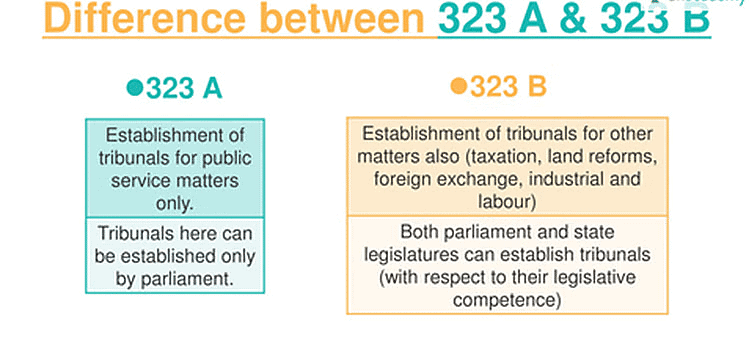
Article 323B authorises Parliament and State Legislatures to enact laws for the establishment of tribunals for adjudication of disputes in specified subject areas. The list of matters in Article 323B includes taxation, industrial and labour disputes, land reforms, elections, cooperatives, foodstuffs distribution and others; statutes may create tribunals covering these fields.
Matters Covered
Typical subject areas where tribunals have been constituted include taxation, company and corporate matters, environment, securities, customs, excise, service tax, industrial disputes and other specialised domains.
Article 323B is broader in scope than Article 323A and permits the creation of tribunals tailored to the needs of specific subject areas.
Authority to Establish
Tribunals under Article 323A can be provided for only by Parliament because they relate to public service matters across Union and States as specified in that Article.
Tribunals under Article 323B can be set up by both Parliament and State Legislatures, depending on the legislative competence for the particular subject matter.
Tribunal Structure and Hierarchy
Under Article 323A the statutory scheme provides for a Central tribunal and State tribunals for service matters without a specified hierarchical appellate structure among them.
Article 323B allows legislative schemes that may provide for a hierarchy of tribunals (for example, appellate tribunals and specialised appellate fora) depending on the statute under which they are constituted.
Examples of Statutory Tribunals
Income Tax Appellate Tribunal (ITAT) - tax disputes.
Customs, Excise and Service Tax Appellate Tribunal (CESTAT) - indirect tax disputes.
National Green Tribunal (NGT) - environmental disputes (constituted under the National Green Tribunal Act, 2010).
National Company Law Tribunal (NCLT) - company and insolvency related disputes (constituted under the Companies Act and Insolvency statutes).
Initially statutes and constitutional amendments attempted to oust judicial review of tribunal orders by high courts under Articles 226/227. The Supreme Court in L. Chandra Kumar v. Union of India (1997) held that such ouster was unconstitutional and reaffirmed the power of High Courts to exercise writ jurisdiction subject to reasonable restrictions.
As a result, orders of tribunals are amenable to judicial review by High Courts under Articles 226/227 and by the Supreme Court under Article 136, preserving the essential feature of judicial oversight and the rule of law.
Advantages of Tribunals
Provide specialised expertise in technical and administrative fields which ordinary courts may not possess.
Offer speedier disposal of cases through less formal procedures and focused jurisdiction.
Reduce burden on regular courts by diverting specialised matters to dedicated fora.
Often more accessible regionally due to multiple benches and circuit sittings.
Criticisms and Challenges
Proliferation of tribunals without uniform standards may lead to inconsistent procedures and delay in appointments.
Concerns about independence arise where administrative control over appointments, tenure and service conditions is significant.
Potential overlap of jurisdiction between tribunals and ordinary courts sometimes creates litigation over forum and causes delay.
Uneven quality of adjudication where adequate judicial or technical expertise is not ensured.
Current Position and Principles
Tribunals are an established part of the justice delivery framework in India and are created by statute for specialised adjudication.
Judicial review of tribunal decisions by High Courts and the Supreme Court remains a constitutional safeguard for rule of law and protection of fundamental rights.
Legislation, selection procedures, fixed tenures and safeguards of independence are important to ensure that tribunals perform their intended function effectively.
Conclusion
Tribunals are intended to provide specialised, efficient and cost-effective adjudication in technical and administrative matters. The constitutional recognition through Articles 323A and 323B and the statutory framework such as the Administrative Tribunals Act, 1985 have institutionalised tribunals in India. The Supreme Court's jurisprudence, notably in L. Chandra Kumar (1997), has preserved judicial review as an essential check, balancing the need for specialised tribunals with the constitutional guarantee of access to justice.
MULTIPLE CHOICE QUESTION
Try yourself: What is the purpose of the Administrative Tribunals Act of 1985?
A
To establish State Administrative Tribunals (SATs) for recruitment and service matters of state government employees.
B
To grant original jurisdiction to SATs over recruitment and service matters of state government employees.
C
To provide a legal framework for the establishment of SATs and Joint Administrative Tribunals (JATs).
D
To empower the Central government to appoint the Chairman and Members of SATs.
Correct Answer: C
- The purpose of the Administrative Tribunals Act of 1985 is to provide a legal framework for the establishment of State Administrative Tribunals (SATs) and Joint Administrative Tribunals (JATs). - SATs and JATs are bodies that handle recruitment and service matters of state government employees. - The act empowers the Central government to establish SATs and JATs upon request from state governments. - SATs exercise original jurisdiction over recruitment and service matters, similar to the Central Administrative Tribunal (CAT). - JATs are set up for two or more states and exercise all the jurisdiction and powers of administrative tribunals for the states involved.
1. What is the Central Administrative Tribunal (CAT)?
Ans. The Central Administrative Tribunal (CAT) is a specialized and exclusive tribunal in India that deals with service matters of government employees.
2. What is the function of State Administrative Tribunals?
Ans. State Administrative Tribunals are set up in each state of India to deal with service matters of state government employees and also other matters as specified by the state government.
3. How are administrative tribunals different from regular courts?
Ans. Administrative tribunals are specialized bodies that have expertise in specific areas of law, while regular courts have a broader jurisdiction and deal with a wide range of cases.
4. What types of matters do administrative tribunals handle?
Ans. Administrative tribunals handle matters related to service disputes, tax disputes, environmental issues, and other specific areas of law as designated by the government.
5. Can decisions of administrative tribunals be challenged in regular courts?
Ans. Yes, decisions of administrative tribunals can be challenged in regular courts through a process of judicial review.
Exam, past year papers, Laxmikanth Summary: Tribunals, study material, Previous Year Questions with Solutions, Viva Questions, Free, pdf , video lectures, MCQs, Laxmikanth Summary: Tribunals, shortcuts and tricks, mock tests for examination, Objective type Questions, Semester Notes, practice quizzes, Extra Questions, Important questions, Laxmikanth Summary: Tribunals, Sample Paper, Summary, ppt;


 Tribunals