Scientific Explanations of Common Phenomena | General Awareness - Bank Exams PDF Download

Introduction
Science is deeply intertwined with our everyday lives, often in ways we may not consciously recognize. Many natural and physical phenomena that we encounter daily—such as the cooling of water in an earthen pot, the blue color of the sky, or the floating of a bad egg in water—can be explained through scientific principles. This chapter explores the fundamental reasons behind such occurrences, helping us understand the laws of physics, chemistry, and biology that govern them.
From Newton’s laws of motion explaining why a person jumps forward when leaping off a moving train, to thermodynamics illustrating why a pressure cooker speeds up cooking, science provides logical and evidence-based answers to many everyday experiences. The chapter also delves into atmospheric pressure, capillary action, optics, electromagnetism, and other essential scientific principles that help explain common phenomena. By understanding these concepts, we not only develop curiosity about the world around us but also gain practical knowledge that can be applied in various fields of life.
Some Common Phenomena and their Scientific Explanation
- It is dangerous to sleep in an unventilated room with fire burning inside because the fire produces carbon monoxide and carbon dioxide gases. Carbon monoxide is poisonous and can cause death.
- The filament of an electric bulb is made of tungsten because it has a high melting point and can be heated to a high temperature to emit light.
- Water kept in an earthen pitcher becomes cold because the pitcher has minute pores on its surface which absorb water. Water in the pores evaporates when it comes in contact with air, and produces a cooling effect.
- The freezing compartment inside a refrigerator is at the top because the air in contact with it becomes cold and heavy and sinks downwards, cooling the rest of the compartment.
- A copper vessel left in the air for a long time turns green. This is due to the formation of copper carbonate when copper reacts with carbon dioxide and moisture present in the air.
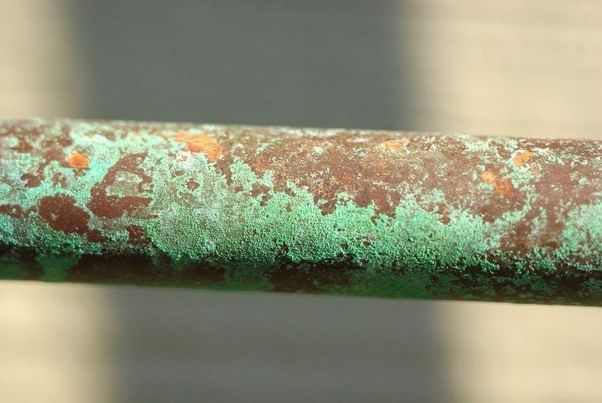 Formation of Copper Carbonate on pipe
 - A wick in a stove keeps burning continuously as kerosene rises in the wick due to capillary action.
- The Earth rotates on its axis from west to east. This rotation makes the Sun and the stars appear to be moving across the sky from east to west.
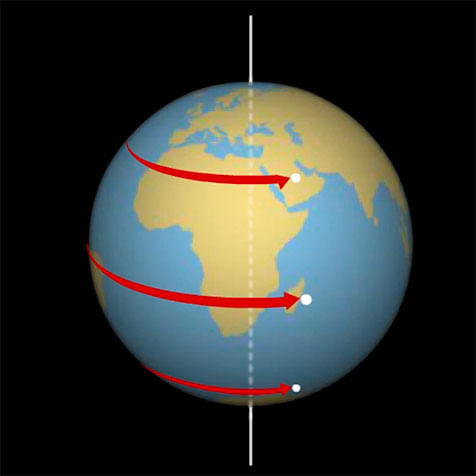 Earth rotation on its axis
 - The sky appears blue because the light of the Sun is spread or scattered by the dust particles in the air. In space the sky would appear black as there are no dust or air particles to scatter the light.
- Food is cooked quickly in a pressure cooker because of boiling point of water increases at high pressure. Food cooks faster at high temperature.
- In mountainous regions, the atmospheric pressure is less than it is at sea level. Water, therefore, boils at a lower temperature (less than 100 degree Celsius) and food takes more time to cook.
- When ice floating in a glass of water melts, the level of water remains unchanged because as a solid, ice displaces an equal volume of water.
- A man weighs more at the poles then at the equator because the polar radius of the Earth is less than the equatorial radius. Hence the gravitational pull is more at the poles than at the equator.
- Standing in double-decker buses, particularly on the upper floor, is not allowed because on tilting, the centre of gravity of the bus gets changed it is likely to overturn.
- A sliced apple, when exposed to air, turns brown after some time as it contains iron which gets oxidized and gives the fruit a brownish colour.

- The boiling point of seawater will be more than the boiling point of pure water because the former contains salt and other impurities.
- An ordinary clock loses time in summer because the length of its pendulum increases, and therefore, its time period also increases. The pendulum takes more time to complete each oscillation and thus loses time.
- Whenever there is water loss from the body, secretion of saliva is reduced resulting in dryness of the mouth and stimulating the sensation of thirst. Intake of fluid then helps in restoring the loss of the body.
- A swimmer just out of the river feels cold particularly if it is windy, because of the evaporation of water from his body surface. The evaporation is more on a windy day.
- Alcohol is sometimes rubbed on the body of a person suffering from fever. As soon as it is applied on the body, it evaporated taking away some heat from the body. Since evaporation has a cooling effect, the body temperature can be reduced by rubbing alcohol.
- Soft iron is used as an electromagnet because it remains a magnet only while the current passes through the coil around it and loses its magnetism when the current is switched off.
- The person jumping out of a moving train is carried forward in the direction of the train because the person himself is in motion sharing the velocity of the train and will continue in its state of uniform motion unless it exercises some force to prevent it (Newton’s first law of motion).
- A lightning conductor is fixed to all buildings to protect them from the destructive effects of the lightning.
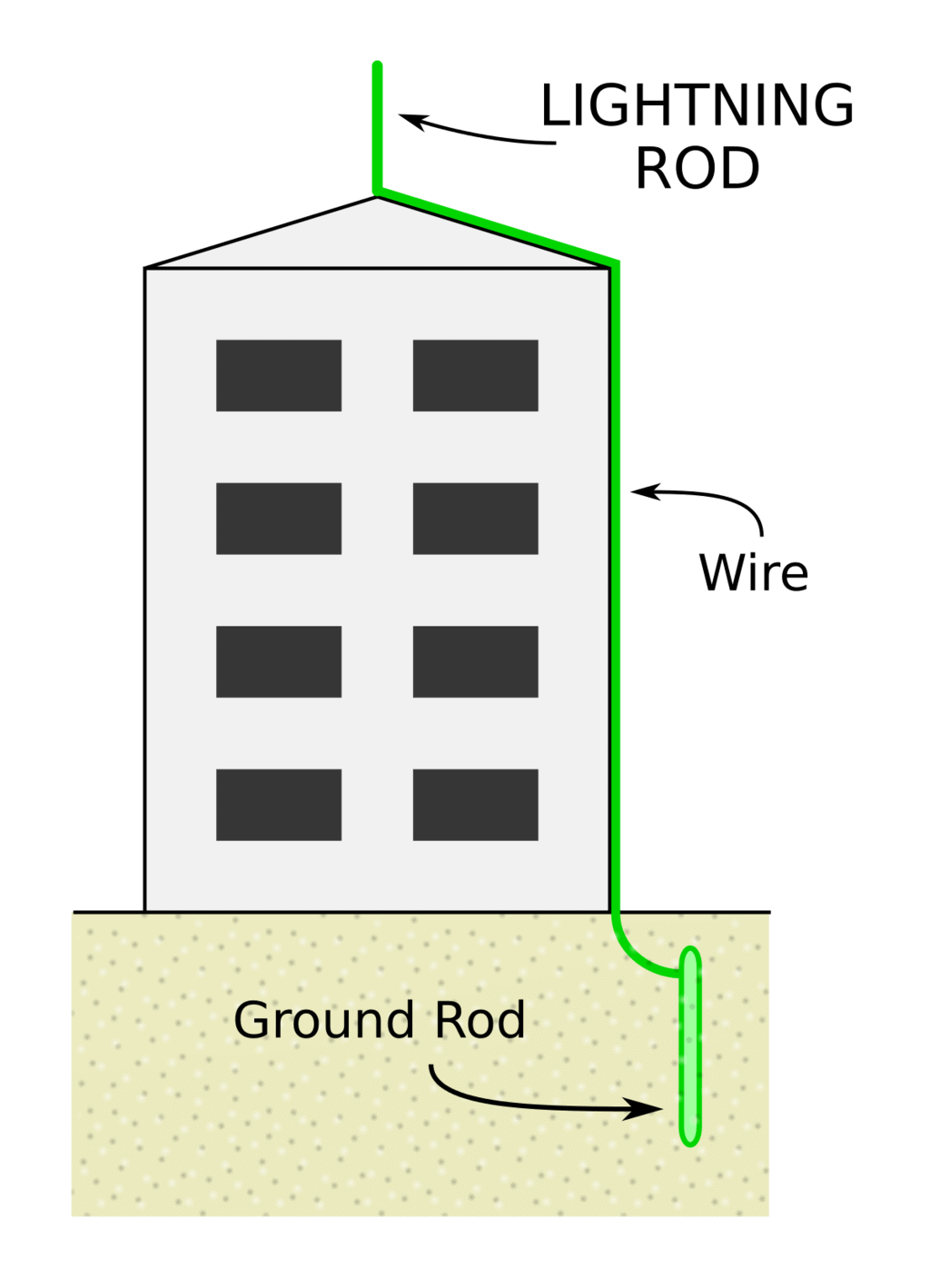 Working of lightning conductor
 - An electric bulb makes a bang when it is broken because there is a vacuum inside the electric bulb; when the bulb is broken air rushes in at great speed from all sides to fill the vacuum. The rushing of air produces a noise generally referred to as the “bang”.
- A small space is left between each set of two rails of railway line to allow for their expansion in summer.
- A bad egg floats in water because the up-thrust produced on account of displaced water by the immersed portion of the bad egg is greater than the weight of the egg.
- Moisture gathers on the outer surface of a glass tumbler containing cold water because the water vapours present in the air get cooled and appear as droplets of water on coming in contact with the cold surface of the glass tumbler.
- The launching of Earth satellites should be from a place near the equator to take the fullest advantage of the Earth’s movements. The regions of the Earth closer to the equator are moving faster through space as compared to regions elsewhere. Thus at the equator, rockets would start off with a speed of nearly 1600 km/hour. Father, rockets are usually fired in the direction of the Earth’s rotation.
- In deserts, day temperatures are very high and night temperature are extremely low because the specific heat of sand is very low. It; therefore, absorbs the heat readily and its temperature rises by a large degree during the day. At night sand radiates the heat equally readily, making the temperature low.
- If you are sweating; you will feel cooler on a hot day than on a cooler moist day because on a hot dry day the perspiration gets evaporated quickly producing more cooling effect.
- The air escaping from a punctured tyre feels cold because the air escaping from a punctured tyre enters a region of low pressure from high pressure and thus suffers a fall in temperature.
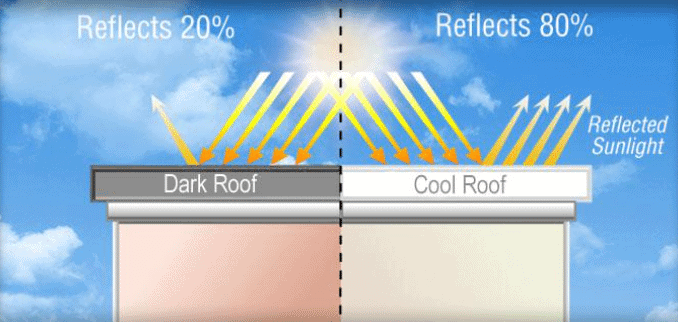
- White roof keeps the house cooler in summer than black roof because white roof reflects more and absorbs less heat whereas black roof absorbs more and reflects less heat rays.
- It is hotter on a cloudy night than on a clear night because clouds prevent the heat radiated by the Earth from escaping into the sky.
- Ice wrapped in a blanket does not melt away quickly because woollen blanket is a bad conductor of heat.
- A rose appears red when day light falls on it because it absorbs all the constituent colours of white light except red, which it reflects to us.
- Grass appears dark in blue light because it has the property of absorbing all other colours except its own colour. The blue rays falling on the grass are absorbed by it and hence it appears dark in colour
- A group of soldiers on a bridge are advised not to walk in steps because their movement causes the bridge to vibrate. It they walk in step the frequency of vibration may match the natural frequency of the bridge structure, thereby causing resonance. This resonance of frequency can cause the bridge to collapse.
- When the wind is blowing at high speed, the roofs of the hutments are sometime blown away. The pressure at the top falls much below the pressure below the roof. This difference in pressure across the roof causes it to be blown away.
- Human breath is visible in winter but not in summer because in winter air is cold and so water vapours present in the human breath condense, making it visible.

- Steam causes more severe burn than boiling water because steam at the same temperature has more latent heat which causes more severe burns than boiling water at the same temperature.
- It is not advisable to wash a clinical thermometer with boiling water because the boiling point of water is much is much above the maximum provided in the clinical thermometer. As a result, pressure from undue expansion of mercury may break it.
- The face turns red when one feels hot and turns blue when one feels cold. This is because in the first case the blood rushes towards the skin to get cooled, and in the second case it rushes away from the skin to keep itself warm.
- A petrol fire cannot be extinguished by pouring water over it because of the high temperature of burning petrol the water breaks up into hydrogen and oxygen which only helps in burning. Further, petrol being lighter than water, floats on water and continues to burn
- We experience difficulty in breathing on mountains because the pressure of the air outside is less as compared to the pressure of air inside the lungs.
- If a highly corked glass bottle full of water is left out of doors on a frosty night it will burst because the water contained in the bottle will freeze on a frosty night and convert into ice. There is no room available for the increased volume and this may result in bursting of the bottle.

- Water extinguishes fire because as it evaporates, the temperature of the burning body is lowered, thus retarding or stopping the burning action. Also the resulting vapour surrounds the burning substance cutting off the oxygen supply thus inhibiting the burning process. In fact, hot water will extinguish fire more quickly than cold water as hot water will vaporize faster.
- A perspiring man feels relief when air floats by his side because the flow of air increases the rate of evaporation of perspiration from the body.
- Water from a hand pump is warm in winter and cold in summer because in winter outside temperature is low and in summer outside temperature is higher as compared to the temperature of water obtained from underground which remains practically unchanged due to Earth being bad conductor of heat.
- A thick glass tumbler often cracks when very hot liquid is poured into it because the inner surface of the thick glass tumbler coming in contact with the hot liquid expand more in comparison with the outer surface which has relatively lower temperature. This unequal expansion of inner and outer surface causes the tumbler to crack.
- When a gun is fired at a visible distance, the sound is hears a little after the smokes is seen because the velocity of light is much higher than that of sound.
- A train stops when the chain pulled because of the following mechanism. When the chain is pulled, one small valve gets opened and air enters to the underside of the piston head of the brake cylinder through pipe connections.
- Initially there is vacuum on both top and bottom side of the piston head. When air enters the underside of the piston head, the piston raises up due to difference of pressure and pulls the brake thus stopping the train.
Conclusion
The world around us is filled with fascinating phenomena, each governed by scientific laws and principles. Understanding these everyday occurrences enhances our appreciation of science and its role in making sense of our surroundings. Whether it is the effect of evaporation in cooling our bodies through perspiration, the reason why clinical thermometers should not be washed in boiling water, or why bridges are at risk when soldiers march in step, scientific explanations provide clarity and insight.
Moreover, recognizing these principles helps us make informed decisions, such as why a petrol fire cannot be extinguished with water or why thick glass tumblers crack when exposed to sudden temperature changes. Science is not just a subject confined to textbooks—it is an essential tool that helps us navigate and interact with the world more effectively. As we continue to discover and apply these principles, we unlock new possibilities for innovation, safety, and efficiency in our daily lives.
|
365 videos|701 docs|149 tests
|
FAQs on Scientific Explanations of Common Phenomena - General Awareness - Bank Exams
| 1. What is the scientific explanation for why the sky appears blue during the day? |  |
| 2. Why do leaves change color in the fall? | |
| 3. How does a rainbow form? | |
| 4. What causes the tides in the ocean? | |
| 5. Why does lightning occur during thunderstorms? | |





shortcuts and tricks
,Scientific Explanations of Common Phenomena | General Awareness - Bank Exams
,Previous Year Questions with Solutions
,Scientific Explanations of Common Phenomena | General Awareness - Bank Exams
,Exam
,mock tests for examination
,video lectures
,Sample Paper
,Scientific Explanations of Common Phenomena | General Awareness - Bank Exams
,MCQs
,ppt
,Extra Questions
,Viva Questions
,Objective type Questions
,Free
,study material
,Summary
,Important questions
,past year papers
,practice quizzes
,Semester Notes
;




Scientific Explanations of Common Phenomena Free PDF Download
Importance of Scientific Explanations of Common Phenomena
Scientific Explanations of Common Phenomena Notes
Scientific Explanations of Common Phenomena Bank Exams Questions
Study Scientific Explanations of Common Phenomena on the App
|
© EduRev
|
Education Revolution
|


|




