CBSE Class 10  >  Class 10 Notes  >  Mathematics (Maths)   >  Value Based Questions: Statistics

Value Based Questions: Statistics

VALUE BASED QUESTIONS

Q1. The following table gives the percentage distribution of female students in various schools of rural areas of various states and UTs of India who are getting freeship.

Value Based Questions: Statistics


(i) Find the mean percentage of female students getting freeship.
(ii) Which mathematical concept is used in the above problem?
(iii) By giving freeship to girls/women students, which value is depicted by various states and UTs?

Sol. (i) We find xi (class marks) of each class and put them in the following table :
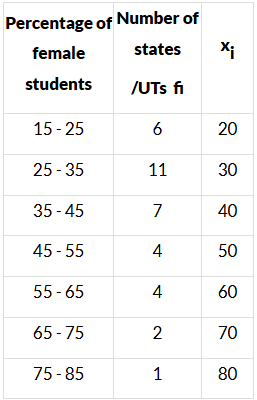
Value Based Questions: StatisticsHere, we take a = 50, h = 10 and di = xi - 50

ui = xi - 5010

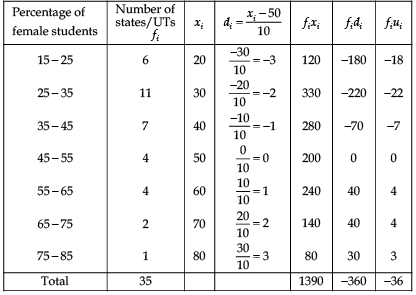
Putting di and ui in the following table :
Value Based Questions: Statistics

∵ From the table, we have :

Σfi = 35, Σfixi = 1390,

Σfidi = -360,  Σfiui = -36

= ΣfixiΣfi = 139035 = 39.71   [Using direct method]

OR

Using the step deviation method, we get:

= a + (Σfiui)Σfi × h = 50 + (-36)35 × 10 = 39.71

Thus, required percentage of women students = 39.71
(ii) Statistics.
(iii) Promoting women education.

The document Value Based Questions: Statistics is a part of the Class 10 Course Mathematics (Maths) Class 10.
All you need of Class 10 at this link: Class 10

FAQs on Value Based Questions: Statistics

1. What is the importance of statistics in decision-making processes?
Ans. Statistics play a crucial role in decision-making as they provide a systematic way to collect, analyze, and interpret data. By using statistical methods, decision-makers can identify trends, make predictions, and evaluate the effectiveness of different strategies, ultimately leading to informed and effective choices.
2. How can one determine the reliability of statistical data?
Ans. The reliability of statistical data can be determined by evaluating the source of the data, checking for consistency over time, assessing the sample size used in the study, and examining the methodology applied in data collection. Additionally, cross-referencing with other credible sources can enhance the reliability assessment.
3. What are the common types of statistical analyses used in research?
Ans. Common types of statistical analyses include descriptive statistics (mean, median, mode), inferential statistics (hypothesis testing, confidence intervals), regression analysis (linear and multiple regression), and non-parametric tests (Chi-square test, Mann-Whitney U test). Each type serves specific purposes in analyzing data.
4. How do you interpret the results of a statistical test?
Ans. Interpreting the results of a statistical test involves understanding the p-value, confidence intervals, and effect sizes. A p-value less than the chosen significance level (e.g., 0.05) indicates a statistically significant result. Confidence intervals provide a range within which the true parameter lies, while effect sizes assess the magnitude of the observed effect.
5. What are some common misconceptions about statistics?
Ans. Common misconceptions about statistics include the belief that correlation implies causation, that small sample sizes can yield reliable results, and that statistical significance guarantees practical significance. Understanding these misconceptions is important for correctly interpreting statistical findings and avoiding misleading conclusions.
Explore Courses for Class 10 exam
Get EduRev Notes directly in your Google search
Related Searches
Sample Paper, mock tests for examination, Extra Questions, Summary, ppt, shortcuts and tricks, video lectures, MCQs, Value Based Questions: Statistics, Value Based Questions: Statistics, Semester Notes, pdf , Important questions, Viva Questions, Free, study material, Exam, practice quizzes, past year papers, Previous Year Questions with Solutions, Value Based Questions: Statistics, Objective type Questions;