Chapter Notes: Globalisation & the Indian Economy


As consumers today, many of us have a diverse range of goods and services available. The latest models of digital cameras, mobile phones, and televisions from leading global manufacturers are easily accessible. Indian roads now feature a variety of car models each season, a departure from the past when Ambassador and Fiat were the dominant choices. This choice of brands extends to various products, from shirts to televisions to processed fruit juices.
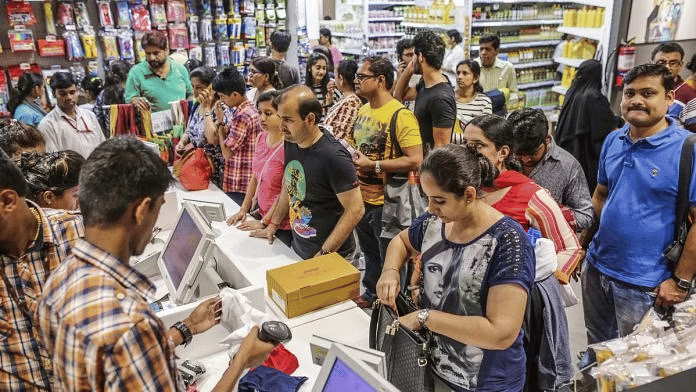 Consumer Choices
This abundance of choices is a relatively recent development in our markets, transforming rapidly within a matter of years.
The chapter explores the factors behind these changes and their impact on people's lives.
Production Across Countries
- Until the middle of the twentieth century, production was mainly organised within individual countries. Only raw materials, foodstuffs, and finished products moved across borders. This situation changed with the emergence of Multinational Corporations (MNCs).
- An MNC is a company that owns or controls production in more than one nation. These companies set up offices and factories in regions where they can obtain cheap labour and other resources. By doing so, they keep their production costs low and are able to earn greater profits.
- In many cases, an MNC may design its product in one country, manufacture various components in another, assemble the product in a third country, and finally sell it across the world.
- MNCs choose locations where they are close to markets, where both skilled and unskilled labour is available at low cost, and where other necessary factors of production can be easily found. They also prefer countries where government policies are favourable to their interests.
 Factors on which location Selection Depends
Interlinking Production Across Countries
Investment involves spending money on assets like land, buildings, machinery, and equipment. In the context of Multinational Corporations (MNCs), this investment is termed foreign investment, with the expectation of earning profits from these assets.
MNCs engage in global production through various methods of interaction with local producers:
Joint Production: MNCs often work together with local companies for joint production. This helps local businesses in two main ways:
- They receive financial investments to boost production.
- They gain access to advanced technology from the MNCs, which helps them produce more efficiently.
MNC Expansion and Influence through Acquisitions: Multinational companies (MNCs) often expand by buying local companies, using their vast wealth to do so.
For example, the American MNC Cargill Foods acquired the Indian company Parakh Foods, which had a strong reputation and marketing network in India. Cargill took over Parakh's four oil refineries and became the largest producer of edible oil in India, producing 5 million pouches daily. Many MNCs have more wealth than the budgets of developing countries, giving them significant power and influence.Controlled Production: Large MNCs in developed nations place orders with small producers. Examples include garments, footwear, and sports items from various countries. These small producers supply goods, which MNCs sell under their own brand names. The MNCs control pricing, quality, delivery, and labour conditions for these producers, exerting significant influence over the production process.
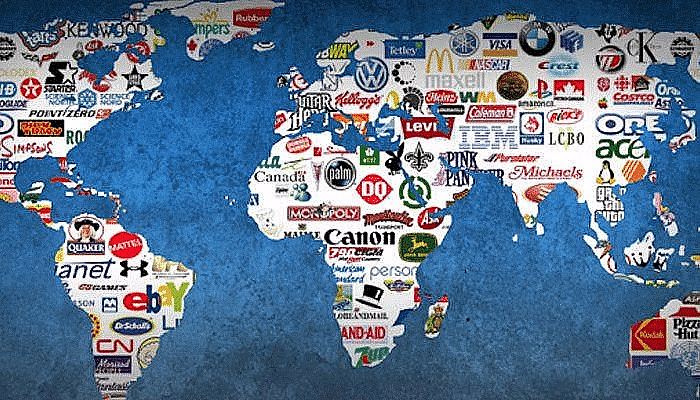 Interlinking Production Across Countries
The partnership between MNCs and local businesses in production helps local firms in several ways:
- MNCs can provide funds for additional investments, such as acquiring new machinery to improve production efficiency.
- Multinational corporations introduce advanced manufacturing technology, assisting local businesses in modernisation.
Generally, MNCs establish production where they can easily access markets; where skilled and unskilled labour is available at low costs; and where other production factors are assured. Additionally, MNCs seek government policies that protect their interests.
Foreign Trade and Integration of Markets
- Foreign trade has historically linked nations through trade routes, allowing for significant exchanges. Trading interests led companies like the East India Company to operate in India.
- This trade enables producers to widen their market reach beyond local borders, allowing them to sell not only in their home market but also in international ones.
- Generally, as trade increases, goods move between markets. This leads to a greater selection of products available. Prices for similar goods across different markets start to align, resulting in strong competition among producers from various countries, regardless of distance.
- Thus, foreign trade connects markets or integrates them across nations, enhancing global competition and increasing choices for consumers.
- The example of Chinese toys in Indian markets illustrates the effects of foreign trade. Chinese manufacturers recognised an opportunity to export toys to India, where prices were high. With lower prices and fresh designs, Chinese toys gained popularity, leading to 70-80% of Indian toy shops opting to sell them within a year. Indian consumers benefitted from a wider selection of toys at reduced prices. However, Indian toy makers faced challenges, as their sales dropped significantly due to this competition.
What is Globalisation?
- Globalisation is the process of rapid integration or interconnection between countries. This integration is happening because more and more goods, services, investments, and technology are moving between countries.
- Multinational Corporations (MNCs) play a major role in this process, as they spread production across different parts of the world and link economies together.
- Foreign trade has also increased the connection between markets across nations. When goods and services move freely from one country to another, producers and consumers in distant places become linked.
- As a result, production is now organised in complex ways across several countries, making them increasingly interdependent.
- Although people also move between countries for work, income, or education, the movement of goods, services and investments has been far more significant in driving globalisation in recent decades.
Factors that have Enabled Globalisation
Globalisation has been enabled mainly by three factors:
- Rapid improvements in technology
- Liberalisation of foreign trade and foreign investment policies
- Pressure from international organisations such as the WTO
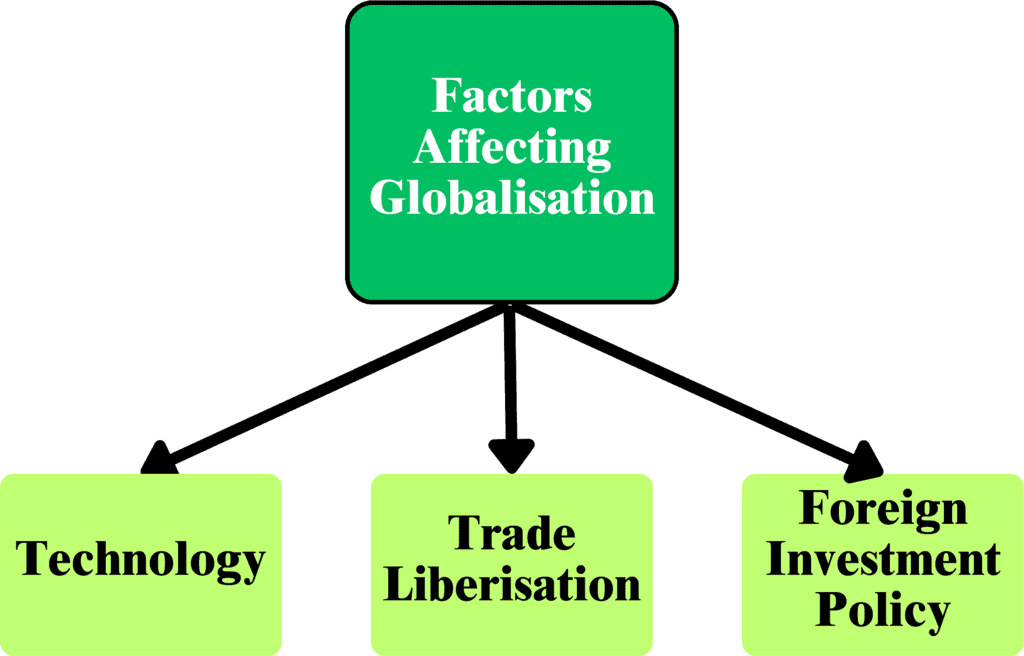 Factors Affecting Globalisation
1. Technology:
- Transportation Technology: In the last fifty years, advances in transportation have made it quicker and less expensive to send goods over long distances, boosting international trade. The use of shipping containers has been crucial, as they can be easily transferred onto ships, trains, planes, and trucks. This has greatly lowered handling costs at ports and sped up the delivery of exports.
- Information and Communication Technology: Major developments in telecommunications, computers, and the Internet have changed how we communicate globally. Tools like telegraphs, telephones (including mobile phones), and fax machines allow people around the world to connect and access information instantly. These technological advancements have also propelled globalisation forward.
- Satellite Communication: Satellite technology has improved global connections, allowing for effective communication even from remote locations.
- Computers and the Internet: Computers are now essential in nearly every industry, and the Internet provides immediate access to information and communication. This includes sending emails, making voice calls, and sharing data at low costs. Additionally, the cost of air transport has decreased, allowing for much larger volumes of goods to be shipped by air.
2. Liberalisation of Foreign Trade and Foreign Investment Policy
Governments use trade barriers (like taxes on imports or quotas) to regulate foreign trade and decide what kinds and how much of goods should come into the country.
- After Independence, India put barriers on foreign trade and foreign investment to protect domestic producers from foreign competition, as industries were just coming up.
- Only essential imports such as machinery, fertilisers and petroleum were allowed freely.
Starting around 1991, the Indian government made far-reaching changes:
- It decided that Indian producers should compete with producers around the world.
- It felt that competition would improve the performance of domestic producers.
- Barriers on foreign trade and foreign investment were removed to a large extent.
Removing barriers or restrictions set by the government is known as liberalisation.
With the liberalisation of trade:
- businesses are allowed to make decisions more freely about what to import or export,
- the government imposes much fewer restrictions than before.
This liberalisation of foreign trade and foreign investment policies has encouraged MNCs to invest in India and has increased India's integration with the world economy.
World Trade Organisation (WTO)
This organisation aims to liberalise international trade. This organisation says that all countries in the world should liberalise their policies.
- This organisation established the rules regarding international trade and sees that these rules are obeyed.
About 161 countries are members of the WTO.
 WTO Symbol
Support for Liberalization: International organizations, including the World Trade Organisation (WTO), support the removal of barriers to foreign trade and investment, advocating for free trade between countries.
WTO's Role: The WTO, initiated by developed countries, aims to establish and enforce international trade rules. It currently has about 161member countries.
Imbalance in Trade Barriers: Developing countries question why they must lower trade barriers while developed nations continue to subsidise their farmers. They argue this situation raises the question of whether trade is genuinely free and fair.
Example of Discrepancy: An example of this imbalance is the ongoing debate over trade in agricultural products, highlighting the unequal impact of WTO rules on different countries.
Impact of Globalisation in India
Globalisation has had a significant impact on India across various sectors, transforming its economy, society, and culture. Here are some of the key impacts of globalization in India:
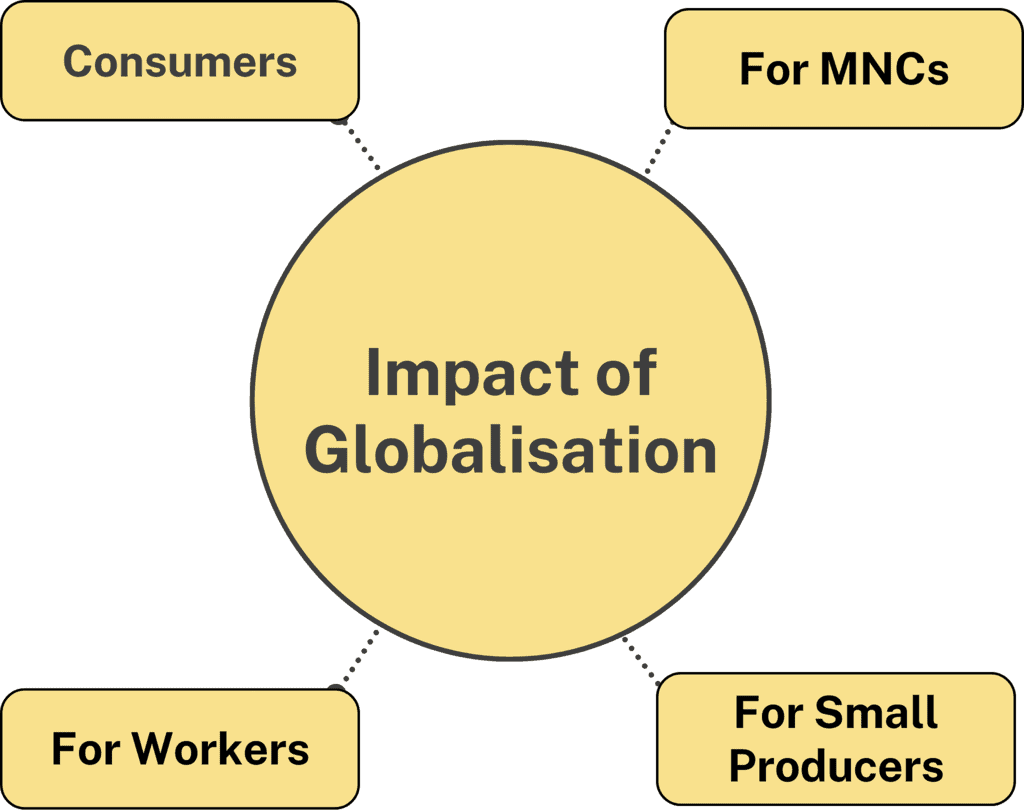 Impact of Globalisation
1. For Consumers
- Globalisation and greater competition among producers-both local and foreign-have been advantageous for consumers.
- Consumers now have greater choice in the market than before.
- They enjoy improved quality of many products.
- Many goods are available at lower prices.
- These benefits have been enjoyed particularly by the well-off sections in the urban areas.
- As a result, these consumers today enjoy a much higher standard of living than was possible earlier.
2. For MNCs
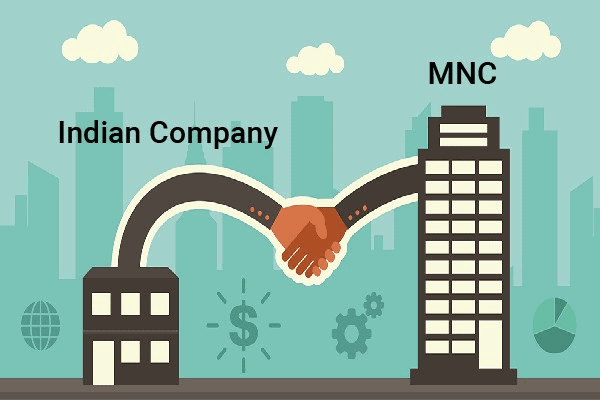 Large MNCs order their products from Indian exporters.
- With the rise of global trade, MNCs have greatly increased their reach and presence in different markets.
- Large MNCs procure their goods from Indian suppliers.
- Investments made by MNCs are referred to as foreign investment, which aims to generate profits from these assets.
- Seeing the potential in urban regions, MNCs are keen to establish factories and offices in sectors like mobile phones, cars, and electronics.
- MNCs have the ability to relocate their operations to other countries to reduce production expenses and maximise profits.
- This relocation can lead to negative impacts on workers, such as job uncertainty and lower pay.
- MNCs contribute funds for further investments and introduce advanced technology for manufacturing, boosting the abilities of local businesses.
3. For Workers
- No Job Security- Due to increasing competition in the market, many employers now prefer to hire workers on flexible terms. This means jobs are less secure, and workers can be let go at any moment.
- The issues regarding work conditions and the struggles faced by workers have become widespread across various industries and services in India. Workers often endure long hours and are required to take on night shifts regularly during busy periods to satisfy employer demands.
- Low Wages- There are limited job opportunities, and exporters are keen on reducing their costs. The number of workers exceeds the available positions, making it easy for employers to find cheap labour. Many workers feel compelled to work overtime just to make ends meet and are often willing to accept lower wages because of financial pressures.
- Large multinational corporations in the garment sector from Europe and America place orders with Indian exporters, which increases competition and puts more pressure on local workers.
- Additionally, workers in the organised sector, like Sushila, no longer receive the protections and benefits they once had.
4. For Small Producers
- Small producers are facing intense competition from well-established firms.
- Many small producers and workers have encountered serious challenges due to globalisation. While some can manage minor losses, numerous units have closed down, leaving many workers unemployed. This competitive strain has forced some small producers to sell their businesses to MNCs. Example: Industries like batteries, capacitors, plastics, toys, tyres, dairy products, and vegetable oil have seen small manufacturers significantly affected by competition.
- Certain large Indian companies, including Tata Motors, Infosys, Ranbaxy, Asian Paints, and Sundram Fasteners, have become multinationals themselves, taking advantage of globalisation by expanding their operations internationally.
- The effects of globalisation vary; skilled workers have found more opportunities, whereas unskilled workers continue to struggle.
- Small and medium industries in India provide the largest employment (11 crores) in the country, following agriculture.
Steps to Attract Foreign Investment
- In recent years, the central and state governments in India have taken special steps to attract foreign companies to invest in the country.
- One major initiative has been the setting up of Special Economic Zones (SEZs). These zones are designed to provide world-class facilities such as electricity, water, roads, transport, storage, and also recreational and educational facilities.
- Companies that set up production units in SEZs do not have to pay taxes for an initial period of five years.
- The government has also given greater flexibility in labour laws in order to attract more foreign investment. Instead of hiring workers on a regular, permanent basis, companies are allowed to hire workers flexibly, meaning for short periods whenever there is a high workload.
- This helps companies reduce the cost of labour, which they consider important for investment decisions.
Impact on Local Businesses
- SEZs are set up, what facilities they have, and that companies there get tax exemptions for 5 years.
- This has fostered a mutually beneficial relationship between local businesses and foreign investments.
Opposition and Concerns
- Some groups within India oppose the establishment of SEZs, citing concerns about:
- Displacement of local communities
- Prioritising corporate interests over public welfare
Broader Economic Policy
- The government's liberalisation strategy, backed by international organisations, plays a key role in making India more attractive for foreign investment.

The Struggle for a Fair Globalisation
Unequal Benefits of Globalisation
- The benefits of globalisation have not reached everyone equally.
- People with education, skills and wealth have gained the most from new opportunities.
- Many others have not shared these benefits.
What is Fair Globalisation?
- Globalisation is now a reality, so the challenge is to make it fair.
- Fair globalisation means:
- Creating opportunities for all, and
- Ensuring that the benefits are shared better among all sections of society.
Role of the Government
The government can play a major role in making globalisation fair by:
- Protecting the interests of all people, not just the rich and powerful.
- Ensuring that labour laws are properly implemented and workers receive their rights.
- Supporting small producers so they can improve and compete effectively.
- Using trade and investment barriers, if necessary.
- Negotiating at the WTO for fairer rules.
- Joining with other developing countries to resist domination of developed nations at the WTO.
Role of People's Organisations
- In recent years, public campaigns and people's organisations have influenced important decisions on trade and investment at the WTO.
- This shows that people can also play a major role in achieving fair globalisation.
FAQs on Chapter Notes: Globalisation & the Indian Economy
| 1. What exactly is globalisation and how does it affect the Indian economy? |  |
| 2. How did India's economic liberalisation in 1991 change things for businesses and consumers? | |
| 3. Why do some Indian farmers and small businesses struggle because of globalisation? | |
| 4. What are the main sectors in India that have benefited the most from globalisation? | |
| 5. How does foreign direct investment (FDI) impact India's development and employment opportunities? | |





