Class 6 Science Chapter 10 Question Answers - Fun with Magnets

Q1: What is a magnet?
Ans: The substance having the property of attracting magnetic materials is known as a magnet.
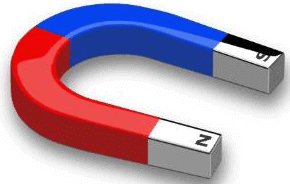 Horseshoe magnet
Q2: What is the use of a magnetic compass?
Ans: A magnetic compass is utilized for determining direction by aligning its needle with the Earth's magnetic field, allowing users to find the cardinal points of north, south, east, and west.
Q3: Artificial magnets are made in different shapes. Give some examples.
Ans: Bar magnet, horseshoe magnet, cylindrical magnet, etc.
Q4: Magnetite contains ______.
Ans: Iron
Magnetite is a type of iron ore and it does contain iron. Magnetite has the chemical formula Fe3O4, indicating that it is composed of three parts iron (Fe) and four parts oxygen (O). It is a magnetic mineral and one of the main sources of iron for the steel industry.
Q5: What are magnetic materials?
Ans: The materials that get attracted towards a magnet are called magnetic materials.
Q6: What are non-magnetic materials?
Ans: Materials that are not attracted to a magnet are called non-magnetic materials.
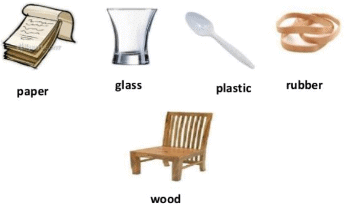 Non-magnetic materials
Q7: Give two examples each of magnetic and nonmagnetic material.
Ans:
(i) Examples of magnetic materials are iron and nickel.
(ii) Examples of nonmagnetic materials are plastic and rubber.
Q8: Cloth is a ______ material. (magnetic/non-magnetic)
Ans: Non-magnetic
Cloth is a non-magnetic material, meaning it does not have magnetic properties.
Q9: A magnet has ______ poles.
Ans: Two
A magnet has two poles, commonly known as the north pole and the south pole.
Q10: Magnet was first discovered in Greece. Is the statement true?
Ans: Yes
The phenomenon of magnetism was first discovered in ancient Greece, particularly in the region of Magnesia, where lodestone (a naturally magnetic iron ore, often magnetite) was found.
Q11: If we break a bar magnet into three parts, ______ poles will be formed.
Ans: Six
Q12: The materials that get attracted towards a magnet like iron are called ______.
Ans: Magnetic materials
The materials that get attracted towards a magnet, like iron, are called magnetic materials.
Q13: What are the two poles of a magnet?
Ans: North Pole and South Pole
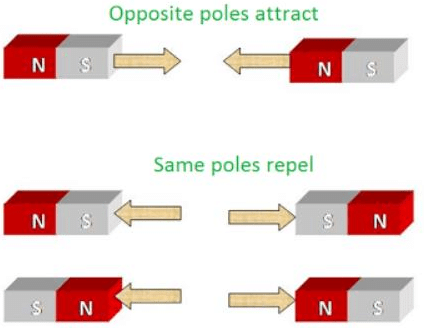 North and South Poles
Q14: What is the property of a magnet that allows it to attract certain materials?
Ans: The property of a magnet that allows it to attract certain materials is magnetism.
Q15: Cobalt is a ______ material. (Magnetic/non-magnetic)
Ans: Magnetic
Q16: A cylindrical magnet has only one pole. (True/False)
Ans: False
A cylindrical magnet, like any other magnet, has two poles – a north pole and a south pole.
Q17: Nickel is a ______ material. (magnetic/non-magnetic)
Ans: Magnetic
Q18: Can a magnet be used for finding directions?
Ans: Yes
Yes, a magnet can be used for finding directions. A magnetic compass, for example, utilizes the magnetic properties of a magnet to align itself with the Earth's magnetic field, providing a reliable method for determining directions.
Q19: Horseshoe magnet is a ______ magnet.
Ans: Artificial
A horseshoe magnet is an artificial magnet, meaning it is made by humans. It is a type of magnet with a U-shaped design, providing a strong magnetic field between its poles.
Q20: Same pole of magnet ______ each other.
Ans: Repel
Q21: All magnets have two poles, whatever their shape may be. Is the statement true?
Ans: Yes
All magnets, regardless of their shape, have two poles – a north pole and a south pole.
Q22: Bar magnet is an ______ magnet.
Ans: Artificial
 Bar MagnetQ23: Freely suspended magnet always comes to rest in a particular direction. Which is that direction?
Ans: North-south direction
Q24: What is the basic property of magnets?
Ans: Attraction and repulsion.
Q25: Magnetite is a natural magnet. (True/False)
Ans: True
Magnetite is a natural magnet; it is a type of iron ore that is naturally magnetic. It contains iron oxide and exhibits strong magnetic properties.
Q26: If we break a magnet, all its pieces have two poles each. (True/False)
Ans: True
Q27: Poles of a bar magnet are located near ______.
Ans: It's two ends.
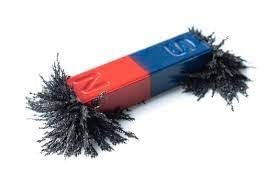
Q28: Where will the maximum iron filings stick on a bar magnet when it is brought near them?
Ans: At the ends of a bar magnet.
When a bar magnet is brought near iron filings, the maximum filings will stick to the ends (poles) of the bar magnet, where the magnetic field is strongest.
Q29: Write any one property of the magnet.
Ans: Like magnetic poles repel each other and unlike magnetic poles attract each other.
One property of magnets is that like magnetic poles repel each other, and unlike magnetic poles attract each other.
Q30: An electromagnet is used in the crane. (True/False)
Ans: True
Q31: Opposite poles of a magnet ______ each other.
Ans: Attract
FAQs on Class 6 Science Chapter 10 Question Answers - Fun with Magnets
| 1. What are magnets and how do they work? |  |
| 2. What are the different types of magnets? | |
| 3. Can magnets attract any material? | |
| 4. How can magnets be used in everyday life? | |
| 5. How can magnets be made stronger? | |





Summary
,Class 6 Science Chapter 10 Question Answers - Fun with Magnets
,Free
,shortcuts and tricks
,mock tests for examination
,practice quizzes
,ppt
,Class 6 Science Chapter 10 Question Answers - Fun with Magnets
,MCQs
,Viva Questions
,past year papers
,Exam
,Important questions
,Objective type Questions
,study material
,Class 6 Science Chapter 10 Question Answers - Fun with Magnets
,Extra Questions
,video lectures
,Semester Notes
,Sample Paper
,Previous Year Questions with Solutions
;



Very Short Question Answers: Fun with Magnets Free PDF Download
Importance of Very Short Question Answers: Fun with Magnets
Very Short Question Answers: Fun with Magnets Notes
Very Short Question Answers: Fun with Magnets Class 6 Questions
Study Very Short Question Answers: Fun with Magnets on the App
|
© EduRev
|
Education Revolution
|


|




