NEET Exam > NEET Notes > Biology Class 11 > Mind Map: Body Fluids & Circulation
Mind Map: Body Fluids & Circulation


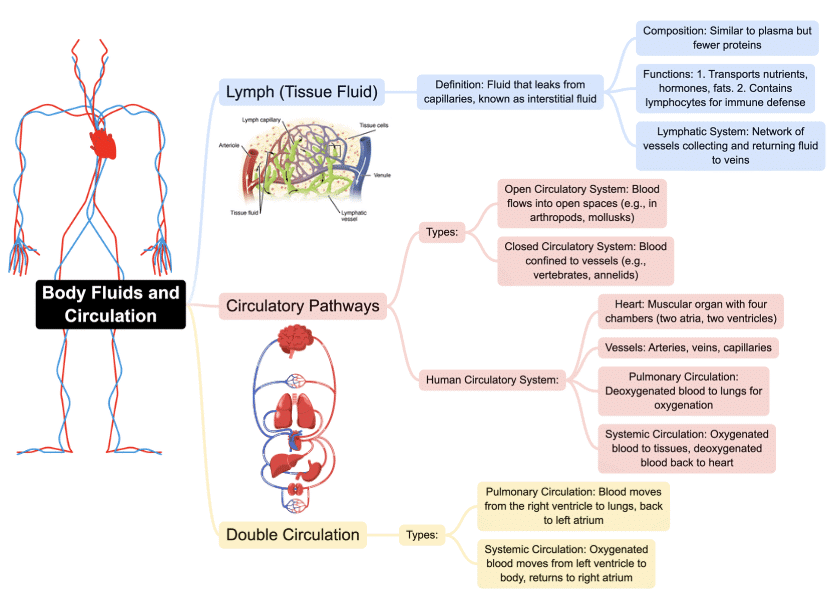
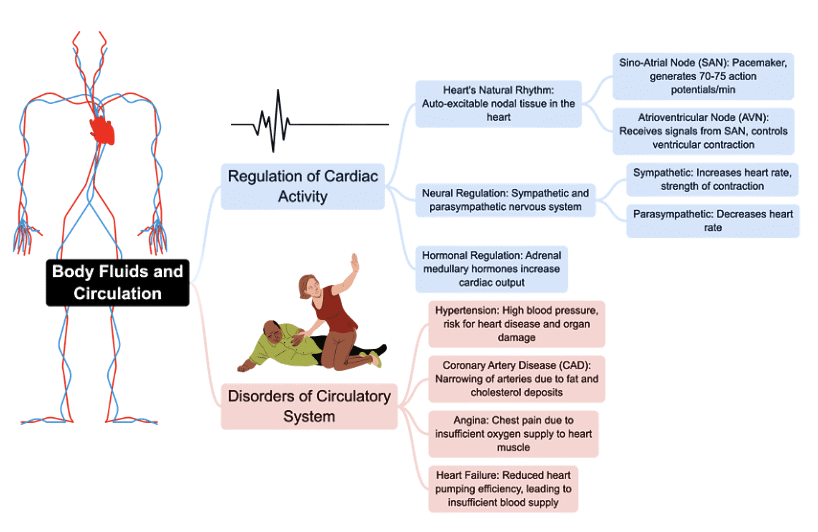
The document Mind Map: Body Fluids & Circulation is a part of the NEET Course Biology Class 11.
All you need of NEET at this link: NEET
FAQs on Mind Map: Body Fluids & Circulation
| 1. What is the difference between plasma and serum in body fluids? |  |
Ans. Plasma is the liquid component of blood containing fibrinogen and other clotting factors, while serum is plasma without fibrinogen after blood clotting occurs. Both are crucial transport mediums in circulatory physiology, carrying nutrients, hormones, and waste products throughout the body. Understanding this distinction is essential for NEET Biology Class 11 preparation.
| 2. How does lymph circulation work and why is it different from blood circulation? | |
Ans. Lymphatic circulation collects tissue fluid from body cells and returns it to the bloodstream via lymphatic vessels and nodes, unlike blood circulation which uses the heart as a pump. Lymph moves slowly through one-way valves without a dedicated pump, filtering harmful substances through lymph nodes. This secondary circulatory system maintains fluid balance and immune defence throughout the body.
| 3. What are the main components of blood and what does each one do? | |
Ans. Blood comprises plasma (55%), red blood cells for oxygen transport, white blood cells for immunity, and platelets for clotting. Red blood cells contain haemoglobin; white blood cells fight infections; platelets initiate coagulation. Each component plays a vital role in maintaining homeostasis and delivering nutrients and oxygen to tissues throughout circulation.
| 4. Why do capillaries exchange materials better than arteries and veins? | |
Ans. Capillaries have extremely thin walls (single endothelial layer) enabling rapid diffusion of oxygen, nutrients, and waste between blood and tissue fluid. Their narrow diameter slows blood flow, allowing sufficient time for exchange. Arteries and veins have thick muscular walls designed for transport rather than material exchange in the circulatory system.
| 5. What happens during systole and diastole, and how do these heart phases maintain circulation? | |
Ans. Systole is ventricular contraction pumping blood into arteries; diastole is relaxation allowing chambers to refill with blood. Together, these phases create the heartbeat cycle maintaining continuous circulation. Systolic pressure (contraction) and diastolic pressure (relaxation) measurements indicate cardiovascular efficiency and are critical concepts for understanding body fluids and circulatory physiology in NEET preparation.
About this Document

7.3K Views

4.95/5 Rating

Apr 18, 2026 Last updated
Document Description: Mind Map: Body Fluids & Circulation for NEET 2026 is part of Biology Class 11 preparation. The notes and questions for Mind Map: Body Fluids & Circulation have been prepared according to the NEET exam syllabus. Information about Mind Map: Body Fluids & Circulation covers topics like and Mind Map: Body Fluids & Circulation Example, for NEET 2026 Exam. Find important definitions, questions, notes, meanings, examples, exercises and tests below for Mind Map: Body Fluids & Circulation.
Introduction of Mind Map: Body Fluids & Circulation in English is available as part of our Biology Class 11 for NEET & Mind Map: Body Fluids & Circulation in Hindi for Biology Class 11 course. Download more important topics related with notes, lectures and mock test series for NEET Exam by signing up for free. NEET: Mind Map: Body Fluids & Circulation
Description
Mind Map: Body Fluids & Circulation of Biology Class 11 provides you one-page visual summary of the chapter covering all the important topics. Download the PDF from EduRev.
Information about Mind Map: Body Fluids & Circulation
In this doc you can find the meaning of Mind Map: Body Fluids & Circulation defined & explained in the simplest way possible. Besides explaining types of Mind Map: Body Fluids & Circulation theory, EduRev gives you an ample number of questions to practice Mind Map: Body Fluids & Circulation tests, examples and also practice NEET tests



Related Searches
Free, Semester Notes, video lectures, Important questions, Objective type Questions, Mind Map: Body Fluids & Circulation, past year papers, Mind Map: Body Fluids & Circulation, mock tests for examination, Extra Questions, pdf , Mind Map: Body Fluids & Circulation, practice quizzes, shortcuts and tricks, ppt, Exam, Summary, MCQs, Previous Year Questions with Solutions, Sample Paper, study material, Viva Questions;