CBSE Class 10 > Class 10 Notes > Science > Mind Map: Electricity
Mind Map: Electricity

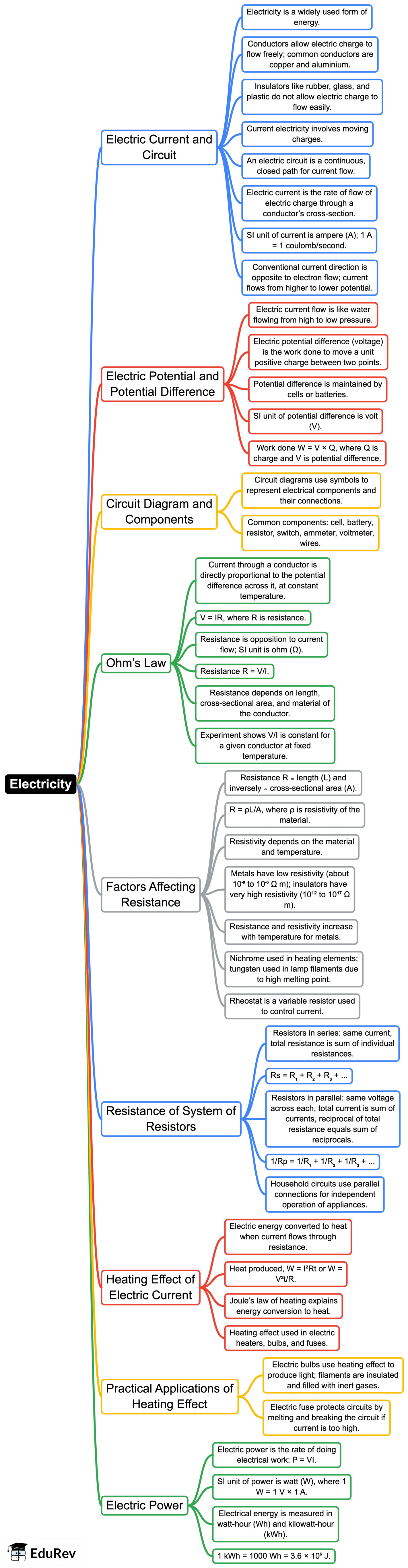
The document Mind Map: Electricity is a part of the Class 10 Course Science Class 10.
All you need of Class 10 at this link: Class 10
FAQs on Mind Map: Electricity
| 1. What's the difference between current and voltage in electricity, and why does it matter? |  |
Ans. Current is the flow of electric charge through a circuit, measured in amperes, while voltage is the electrical pressure that pushes the charge, measured in volts. Voltage drives the current-without sufficient voltage, current cannot flow. Understanding this distinction is essential for solving circuit problems in CBSE Class 10 Science exams and grasping how electrical devices function.
| 2. How do I calculate the resistance of a conductor using the resistivity formula? | |
Ans. Resistance equals resistivity multiplied by length, then divided by cross-sectional area: R = ρL/A. Resistivity (ρ) depends on the material's nature, length (L) is the conductor's physical dimension, and area (A) is its thickness. This relationship shows why thinner wires resist current flow more than thicker ones, a fundamental concept in circuit analysis and Class 10 electricity problems.
| 3. What are the main differences between series and parallel circuits in terms of current and voltage? | |
Ans. In series circuits, current remains constant throughout but voltage divides across resistances, while in parallel circuits, voltage stays constant but current divides among branches. Series circuits have higher total resistance; parallel circuits have lower total resistance. These configurations behave differently in practical applications-parallel circuits power household appliances because each device receives full voltage independently.
| 4. Why do some materials conduct electricity better than others, and what's the role of free electrons? | |
Ans. Conductivity depends on the number of free electrons available to move through a material's atomic structure. Metals like copper have abundant free electrons, enabling excellent electrical conduction; insulators like rubber have tightly bound electrons that resist movement. This electron mobility directly affects a material's resistivity and its suitability for specific electrical applications in circuits and devices.
| 5. How can I quickly identify whether a circuit problem involves Ohm's Law, and what's the correct formula to use? | |
Ans. Ohm's Law applies when finding relationships between voltage, current, and resistance in a conductor: V = IR. If a question provides any two of these quantities and asks for the third, use this formula directly. Understanding when to apply Ohm's Law versus other circuit concepts-like power calculations or Joule heating-is crucial for scoring well on Class 10 CBSE electricity questions and practical numericals.
About this Document

7.2K Views

4.71/5 Rating

Apr 19, 2026 Last updated
Document Description: Mind Map: Electricity for Class 10 2026 is part of Science Class 10 preparation. The notes and questions for Mind Map: Electricity have been prepared according to the Class 10 exam syllabus. Information about Mind Map: Electricity covers topics like and Mind Map: Electricity Example, for Class 10 2026 Exam. Find important definitions, questions, notes, meanings, examples, exercises and tests below for Mind Map: Electricity.
Introduction of Mind Map: Electricity in English is available as part of our Science Class 10 for Class 10 & Mind Map: Electricity in Hindi for Science Class 10 course. Download more important topics related with notes, lectures and mock test series for Class 10 Exam by signing up for free. Class 10: Mind Map: Electricity
Description
Mind Map: Electricity of Science Class 10 provides you one-page visual summary of the chapter covering all the important topics. Download the PDF from EduRev.
Information about Mind Map: Electricity
In this doc you can find the meaning of Mind Map: Electricity defined & explained in the simplest way possible. Besides explaining types of Mind Map: Electricity theory, EduRev gives you an ample number of questions to practice Mind Map: Electricity tests, examples and also practice Class 10 tests



Related Searches
Free, Previous Year Questions with Solutions, mock tests for examination, Important questions, Objective type Questions, study material, Sample Paper, Summary, pdf , Mind Map: Electricity, practice quizzes, Extra Questions, video lectures, past year papers, shortcuts and tricks, Exam, Viva Questions, Semester Notes, MCQs, Mind Map: Electricity, Mind Map: Electricity, ppt;