Class 9 Exam > Class 9 Notes > Subject-Wise Mind Maps for Class 9 > Mind Map: Climate
Mind Map: Climate | Subject-Wise Mind Maps for Class 9 PDF Download

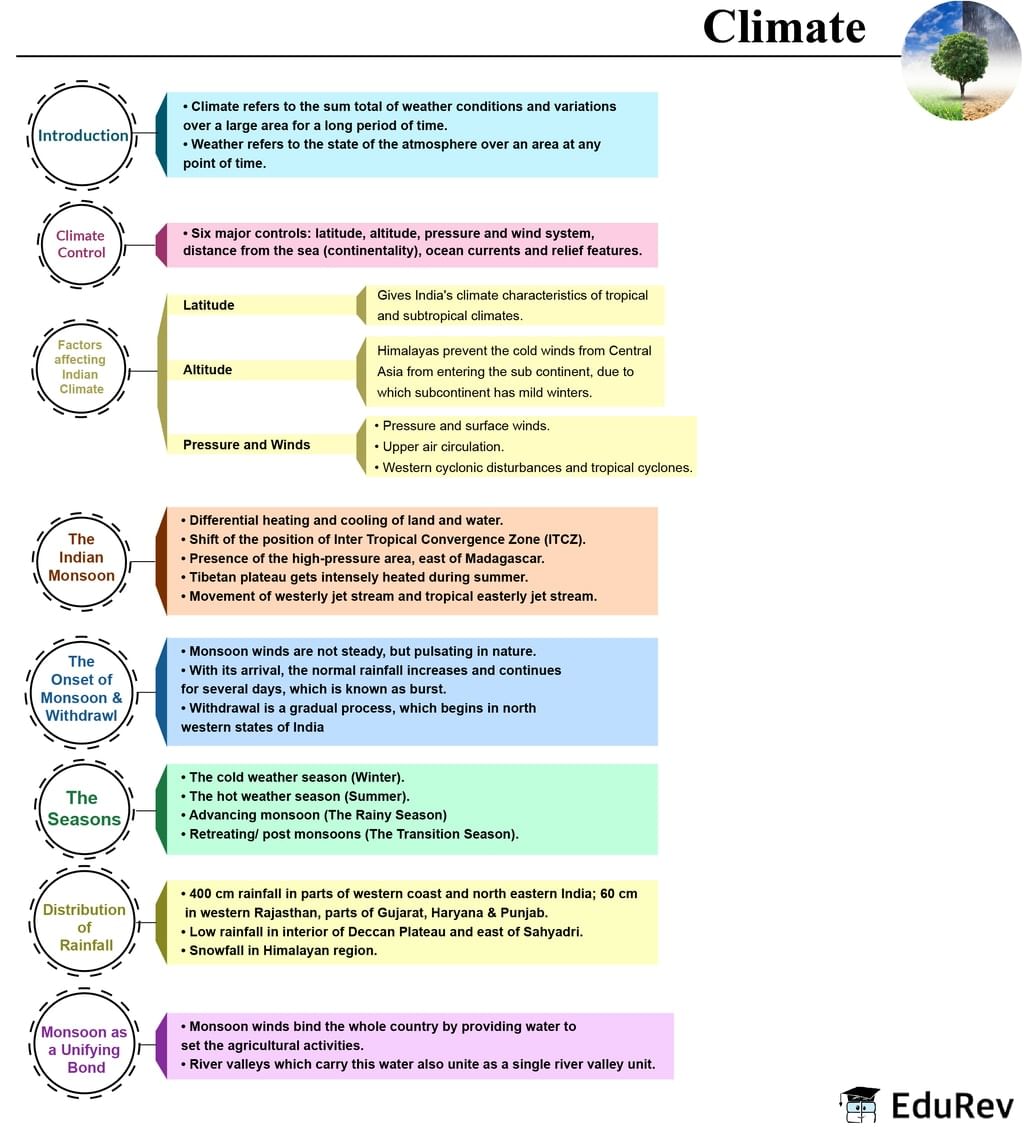
The document Mind Map: Climate | Subject-Wise Mind Maps for Class 9 is a part of the Class 9 Course Subject-Wise Mind Maps for Class 9.
All you need of Class 9 at this link: Class 9
FAQs on Mind Map: Climate - Subject-Wise Mind Maps for Class 9
| 1. What is climate change? |  |
Ans. Climate change refers to long-term shifts in temperature, precipitation, wind patterns, and other aspects of the Earth's climate system. It is primarily caused by human activities, such as the burning of fossil fuels, deforestation, and industrial processes, which release greenhouse gases into the atmosphere and trap heat.
| 2. How is climate change affecting the planet? | |
Ans. Climate change is impacting the planet in various ways. Rising temperatures are leading to the melting of glaciers and polar ice caps, causing sea levels to rise. This results in coastal flooding and the loss of valuable ecosystems. Climate change also leads to more frequent and severe weather events, such as hurricanes, droughts, and heatwaves, affecting agriculture, water resources, and human health.
| 3. What are the main greenhouse gases responsible for climate change? | |
Ans. The main greenhouse gases responsible for climate change include carbon dioxide (CO2), methane (CH4), nitrous oxide (N2O), and fluorinated gases. These gases trap heat in the atmosphere, creating a greenhouse effect that contributes to global warming. CO2 is primarily released from burning fossil fuels, while CH4 is emitted from livestock and agricultural practices. N2O is mainly produced by agricultural and industrial activities.
| 4. How can individuals contribute to mitigating climate change? | |
Ans. Individuals can make a difference in mitigating climate change by adopting sustainable practices. They can reduce their carbon footprint by conserving energy at home, using public transportation or carpooling, and choosing renewable energy sources. Other actions include recycling and reducing waste, eating a plant-based diet, and supporting organizations and policies that promote climate action.
| 5. What are the potential consequences of not addressing climate change? | |
Ans. Failing to address climate change could have severe consequences. These include more frequent and intense natural disasters, such as hurricanes and floods, leading to displacement of communities and loss of lives. Rising sea levels could submerge coastal cities and low-lying areas, causing mass migration and economic disruptions. Additionally, climate change can result in food and water shortages, ecosystem collapse, and threaten biodiversity and human health.
About this Document

1K Views

4.83/5
Rating

Oct 04, 2025
Last updated
Document Description: Mind Map: Climate for Class 9 2025 is part of Subject-Wise Mind Maps for Class 9 preparation.
The notes and questions for Mind Map: Climate have been prepared according to the Class 9 exam syllabus. Information about Mind Map: Climate covers topics
like and Mind Map: Climate Example, for Class 9 2025 Exam. Find important definitions, questions, notes, meanings, examples, exercises and tests below for Mind Map: Climate.
Introduction of Mind Map: Climate in English is available as part of our Subject-Wise Mind Maps for Class 9
for Class 9 & Mind Map: Climate in Hindi for Subject-Wise Mind Maps for Class 9 course.
Download more important topics related with notes, lectures and mock test series for Class 9
Exam by signing up for free. Class 9: Mind Map: Climate | Subject-Wise Mind Maps for Class 9
Description
Full syllabus notes, lecture & questions for Mind Map: Climate | Subject-Wise Mind Maps for Class 9 - Class 9 | Plus excerises question with solution to help you revise complete syllabus for Subject-Wise Mind Maps for Class 9 | Best notes, free PDF download
Information about Mind Map: Climate
In this doc you can find the meaning of Mind Map: Climate defined & explained in the simplest way possible. Besides explaining types of
Mind Map: Climate theory, EduRev gives you an ample number of questions to practice Mind Map: Climate tests, examples and also practice Class 9
tests


Related Searches
Mind Map: Climate | Subject-Wise Mind Maps for Class 9
,MCQs
,ppt
,study material
,mock tests for examination
,shortcuts and tricks
,Summary
,video lectures
,practice quizzes
,Important questions
,past year papers
,Exam
,Semester Notes
,Sample Paper
,Viva Questions
,Mind Map: Climate | Subject-Wise Mind Maps for Class 9
,Extra Questions
,Previous Year Questions with Solutions
,Objective type Questions
,Mind Map: Climate | Subject-Wise Mind Maps for Class 9
,Free
;



Additional Information about Mind Map: Climate for Class 9 Preparation
Mind Map: Climate Free PDF Download
The Mind Map: Climate is an invaluable resource that delves deep into the core of the Class 9 exam.
These study notes are curated by experts and cover all the essential topics and concepts, making your preparation more efficient and effective.
With the help of these notes, you can grasp complex subjects quickly, revise important points easily,
and reinforce your understanding of key concepts. The study notes are presented in a concise and easy-to-understand manner,
allowing you to optimize your learning process. Whether you're looking for best-recommended books, sample papers, study material,
or toppers' notes, this PDF has got you covered. Download the Mind Map: Climate now and kickstart your journey towards success in the Class 9 exam.
Importance of Mind Map: Climate
The importance of Mind Map: Climate cannot be overstated, especially for Class 9 aspirants.
This document holds the key to success in the Class 9 exam.
It offers a detailed understanding of the concept, providing invaluable insights into the topic.
By knowing the concepts well in advance, students can plan their preparation effectively.
Utilize this indispensable guide for a well-rounded preparation and achieve your desired results.
Mind Map: Climate Notes
Mind Map: Climate Notes offer in-depth insights into the specific topic to help you master it with ease.
This comprehensive document covers all aspects related to Mind Map: Climate.
It includes detailed information about the exam syllabus, recommended books, and study materials for a well-rounded preparation.
Practice papers and question papers enable you to assess your progress effectively.
Additionally, the paper analysis provides valuable tips for tackling the exam strategically.
Access to Toppers' notes gives you an edge in understanding complex concepts.
Whether you're a beginner or aiming for advanced proficiency, Mind Map: Climate Notes on EduRev are your ultimate resource for success.
Mind Map: Climate Class 9 Questions
The "Mind Map: Climate Class 9 Questions" guide is a valuable resource for all aspiring students preparing for the
Class 9 exam. It focuses on providing a wide range of practice questions to help students gauge
their understanding of the exam topics. These questions cover the entire syllabus, ensuring comprehensive preparation.
The guide includes previous years' question papers for students to familiarize themselves with the exam's format and difficulty level.
Additionally, it offers subject-specific question banks, allowing students to focus on weak areas and improve their performance.
Study Mind Map: Climate on the App
Students of Class 9 can study Mind Map: Climate alongwith tests & analysis from the EduRev app,
which will help them while preparing for their exam. Apart from the Mind Map: Climate,
students can also utilize the EduRev App for other study materials such as previous year question papers, syllabus, important questions, etc.
The EduRev App will make your learning easier as you can access it from anywhere you want.
The content of Mind Map: Climate is prepared as per the latest Class 9 syllabus.
|
© EduRev
|
Education Revolution
|


|




Signup on EduRev and stay on top of your study goals
10M+ students crushing their study goals daily