Overview: Fundamental Duties | Indian Polity for UPSC CSE PDF Download
| Table of contents |

|
| Fundamental Duties |
|
| Article 51A: Fundamental Duties |
|
| Available Legal Provisions |
|
| Relevance of Fundamental Duties |
|

Fundamental Duties
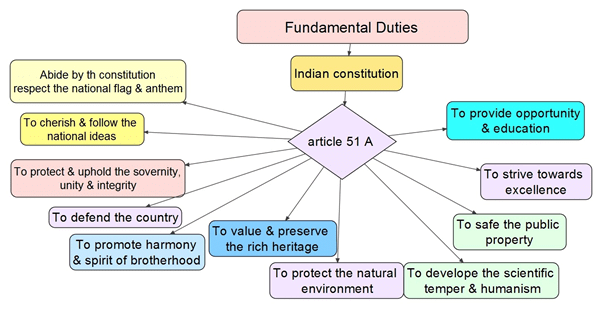
- Part IVA of the Indian Constitution deals with Fundamental Duties. As of now, there are 11 Fundamental duties.
- Originally, the Constitution of India did not contain these duties. Fundamental duties were added by 42nd and 86th Constitutional Amendment acts.
- Citizens are morally obligated by the Constitution to perform these duties. However, like the Directive Principles, these are non-justifiable, without any legal sanction in case of their violation or non-compliance.
Article 51A: Fundamental Duties
It shall be the duty of every citizen of India: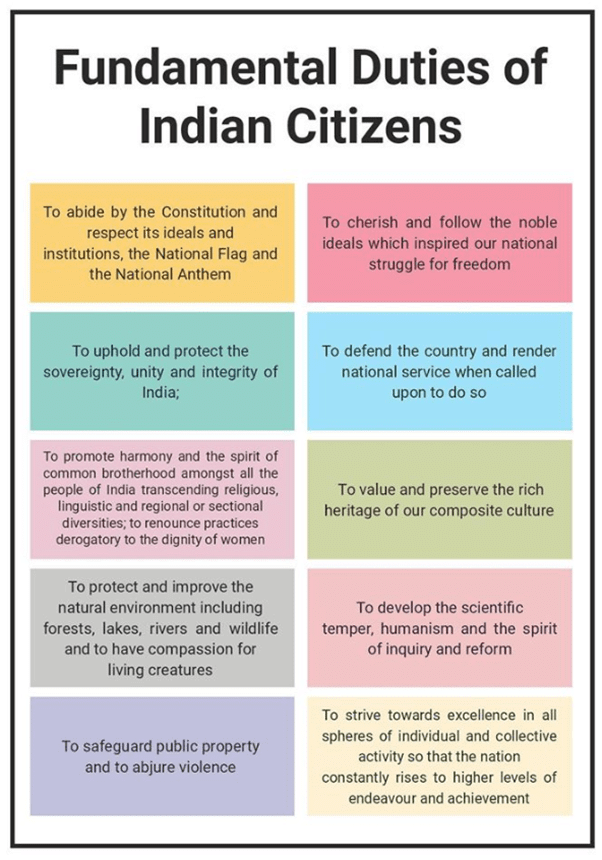
(a) to abide by the Constitution and respect its ideals and institutions, the National Flag and the National Anthem;
(b) to cherish and follow the noble ideals which inspired our national struggle for freedom;
(c) to uphold and protect the sovereignty, unity and integrity of India;
(d) to defend the country and render national service when called upon to do so;
(e) to promote harmony and the spirit of common brotherhood amongst all the people of India transcending religious, linguistic and regional or sectional diversities; to renounce practices derogatory to the dignity of women;
(f) to value and preserve the rich heritage of our composite culture;
(g) to protect and improve the natural environment including forests, lakes, rivers and wildlife, and to have compassion for living creatures;
(h) to develop the scientific temper, humanism and the spirit of inquiry and reform;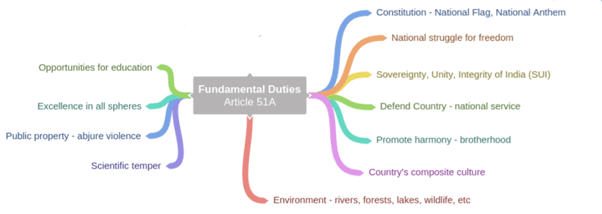 (i) to safeguard public property and to abjure violence;
(j) to strive towards excellence in all spheres of individual and collective activity so that the nation constantly rises to higher levels of endeavour and achievement.
(k) to provide opportunities for education by the parent the guardian, to his child, or a ward between the age of 6-14 years as the case may be.
➤ Info-bits related to Fundamental Duties
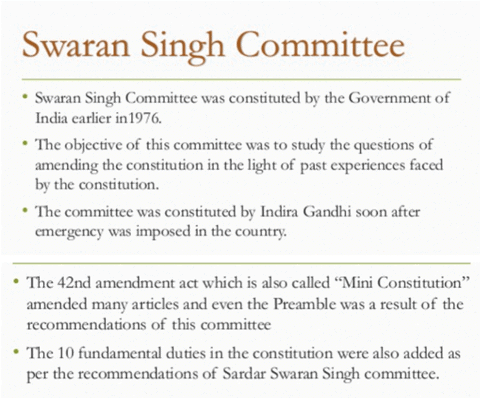
- The Fundamental Duties of citizens were added to the Constitution by the 42nd Amendment in 1976, upon the recommendations of the Swaran Singh Committee that was constituted by the government earlier that year.
- Fundamental duties are applicable only to citizens and not to aliens.
- India borrowed the concept of Fundamental Duties from the USSR.
- The inclusion of Fundamental Duties brought our Constitution in line with Article 29 (1) of the Universal Declaration of Human Rights and with provisions in several modern Constitutions of other countries.
- Out of the ten clauses in article 51A, six are positive duties and the other five are negative duties. Clauses (b), (d), (f), (h), (j) and (k) require the citizens to perform these Fundamental Duties actively.
- It is suggested that a few more Fundamental Duties, namely, duty to vote in an election, duty to pay taxes and duty to resist injustice may be added in due course to article 51A in Part IVA of the Constitution. (NATIONAL COMMISSION TO REVIEW THE WORKING OF THE CONSTITUTION: A Consultation Paper on EFFECTUATION OF FUNDAMENTAL DUTIES OF CITIZENS).
- It is no longer correct to say that Fundamental Duties enshrined in article 51A are not enforceable to ensure their implementation and are a mere reminder. Fundamental Duties have the element of compulsion regarding compliance.
- A number of judicial decisions are available towards the enforcement of certain clauses under Article 51A.
- Comprehensive legislation is needed for clauses (a), (c), (e), (g) and (i). The remaining 5 clauses, which are exhortation of basic human values, have to be developed amongst citizens through the education system by creating proper and graded curricular input from the primary level of education to the higher and professional levels.
Available Legal Provisions
- Justice Verma Committee was constituted in 1998 “to work out a strategy as well as the methodology of operationalizing a countrywide programme for teaching fundamental Duties in every educational institution as a measure of in-service training”.
- The Verma Committee was conscious of the fact that any non-operationalization of Fundamental Duties might not necessarily be the lack of concern or non-availability of legal and other enforceable provisions, but it was more a case of lacuna in the strategy of implementation.
- It, therefore, thought it appropriate to list in brief some of the legal provisions already available in regard to enforcement of Fundamental Duties.
A summary of such legal provisions is given below:
- In order to ensure that no disrespect is shown to the National Flag, Constitution of India and the National anthem, the Prevention of Insults to National Honour Act, 1971 was enacted.

- The Emblems and Names (Prevention of Improper Use) Act 1950 was enacted soon after independence, inter alia, to prevent improper use of the National Flag and the National Anthem.
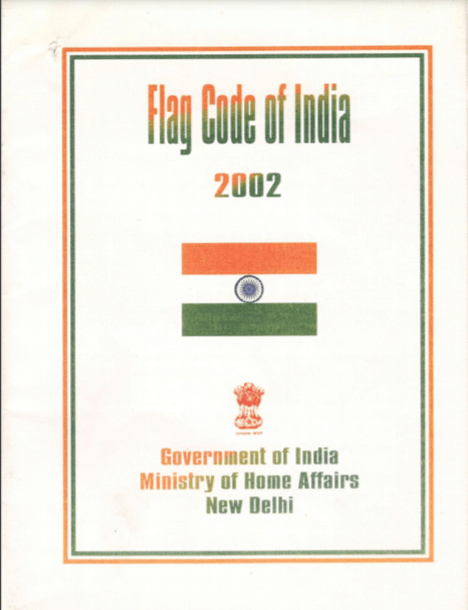
- In order to ensure that the correct usage regarding the display of the National Flag is well understood, the instructions issued from time to time on the subject have been embodied in the Flag Code of India, which has been made available to all the State Governments, and Union territory Administration (UTs).

- There are a number of provisions in the existing criminal laws to ensure that the activities which encourage enmity between different groups of people on grounds of religion, race, place of birth, residence, language, etc. are adequately punished. Writings, speeches, gestures, activities, exercise, drills, etc. aimed at creating a feeling of insecurity or ill-will among the members of other communities, etc. have been prohibited under Section 153A of the Indian Penal Code (IPC).
- Imputations and assertions prejudicial to the national integration constitute a punishable offence under Section 153 B of the IPC.
- A Communal organization can be declared unlawful association under the provisions of Unlawful Activities (Prevention) Act 1967.
- Offences related to religion are covered in Sections 295-298 of the IPC (Chapter XV).
- Provisions of the Protection of Civil Rights Act, 1955 (earlier the Untouchability (Offences) Act 1955).
- Sections 123(3) and 123(3A) of the Representation of People Act, 1951 declares that soliciting of vote on the ground of religion and the promotion or attempt to promote feelings of enmity or hatred between different classes of citizens of India on the grounds of religion, race, caste, community or language is a corrupt practice. A person indulging in a corrupt practice can be disqualified for being a Member of Parliament or a State Legislature under Section 8A of the Representation of People Act, 1951.
Relevance of Fundamental Duties
- Citizenship is the validation of the social contract between the people of the country and the government elected by them, which is legitimized by the Constitution of a country. The rights of the citizens are the basis of this contract.
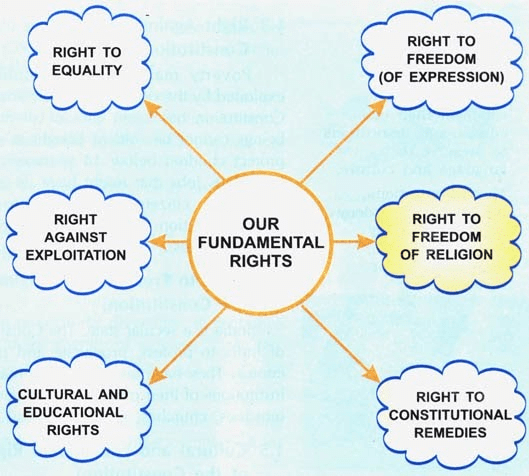
- While emphasizing on rights, it is very important that the citizens are also sincere about their duties towards the society at large and the country, especially its safety and security imperatives.
- Close scrutiny of the Fundamental duties indicates that a number of them refer to values, which have been part of Indian tradition, mythology, religion and practices.
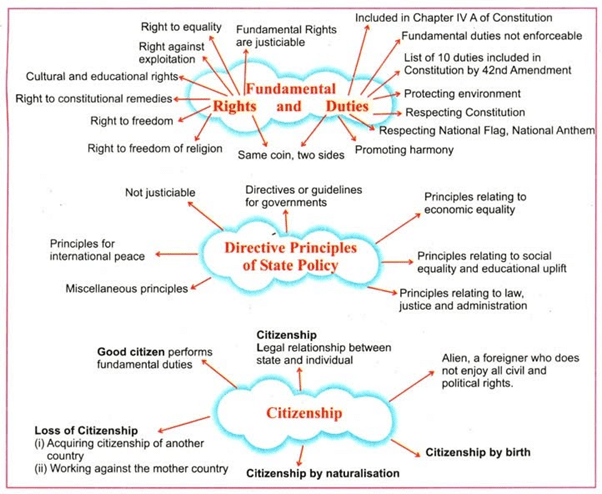
- The Indian Constitution provides different sections of Fundamental Rights, Fundamental Duties and Directive Principles of the State Policy to regulate the conduct of citizens among each other, and the state’s conduct with the citizens. These different segments of the Indian Constitution provide a rule book of rights, duties, and guidelines for citizens’ behaviour and conduct along with the parameters with which the government has to keep itself fully aligned while making laws.
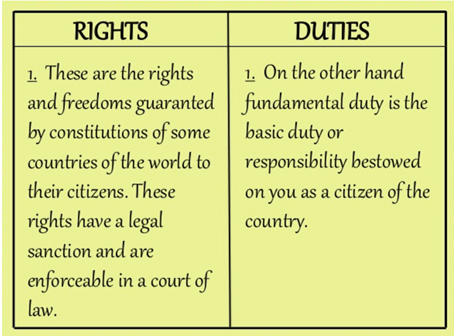
- Fundamental Rights are defined as the basic human rights of all citizens. Part III of the Indian Constitution contains all the fundamental rights applicable to all the individuals irrespective of race, religion, caste, creed or gender or place of birth. All these rights are enforceable by the courts, subject to specific restrictions. The basic idea behind formulating these Fundamental Rights is to protect the liberty of citizens and to maintain the social democracy of the country based on the factors of equality in society.
- The Directive Principles of State Policy serves as guidelines for the government to incorporate while framing the laws. These principles are enshrined in Part IV of the Indian Constitution set forth the fundamental guidelines for the State to apply in framing, enacting and passing laws establishing a social, economic democratic nation.
- The Fundamental Duties have been defined as the moral obligations of all the citizens to help promote the welfare of the country and to uphold the unity of the nation. These duties are set out in Part IVA of the Indian Constitution concerning the individuals and the nation. Just like the Directive Principles, these duties represent guidelines that the citizens should obey for the welfare of a democratic nation.
➤ Concept of Duties in India
- India is one of the few countries in the world with a glorious tradition of democracy since ancient times, where people have had a tradition of performing their duties.
- Since time immemorial, an individual’s “kartavya” — the performance of one’s duties towards society, his/her country and his/her parents, was emphasised.
- The Bhagwad Gita and Ramayana also ask people to perform their duties. In the Gita, Lord Krishna ordains, “One should do one’s duties without expectation of any fruits”.
- According to Mahatma Gandhi the very performance of a duty secures us our right. Rights cannot be divorced from duties.
- Mahatama Gandhi held that “Satyagraha was born, for I was always striving to decide what my duty was.”
- Also, Swami Vivekananda observed, “it is the duty of every person to contribute in the development and progress of India”.
- A very significant feature of the Indian Constitution is that it balances citizens’ rights and duties.
- Fundamental duties were added by the 42nd Amendment Act 1976 upon the recommendation of the Swaran Singh Committee.
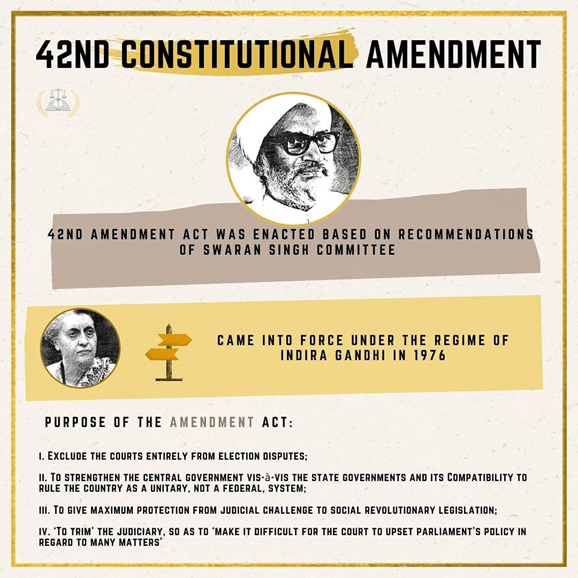
- According to Indira Gandhi, “the moral value of fundamental duties would not be to smother rights but to establish a democratic balance by making people conscious of their duties equally as they are conscious of their rights”.
➤ Importance of Duties
- Many nations across the world have transformed into developed economies by embodying the principles of “Responsible Citizenship”.
- Responsible Citizenship: All the responsibilities and duties that citizens of a nation should exercise and respect.
- The USA is a classic example in this respect. The Citizens’ Almanac, issued by the US Citizenship and Immigration Services, details the responsibilities of its citizens.
- Another example is Singapore, whose growth story has been fuelled by its emphasis on the relentless pursuit of duties by its citizens. As a result, Singapore has transformed from a less developed nation to a highly developed one in a short span of time.
Relevance of Fundamental Duties in Present Times
- Even three decades after the fundamental duties were incorporated, there’s no adequate awareness among citizens.
- In 1998, Atal Bihari Vajpayee’s government had appointed the Justice J.S. Verma Committee to operationalise the suggestions to teach fundamental duties to the citizens of the country.
- Today, it is important to emphasise the need to remember fundamental duties for the progress of India.
- Fundamental duty enshrined under Article 51A(e) seeks to promote harmony and the spirit of common brotherhood, transcending the barriers of religion, language, etc.
- However, India’s democratic setup, over six decades has not fully able to forge this common brotherhood.
- Similarly, there is a duty under Article 51A(g) to protect and improve the environment, but India has been severely affected by air & water pollution and the impact of climate change.
- Fundamental duty envisaged under Article 51A(h) developing a sense of oneness, a scientific temper and the spirit of inquiry, nor a healthy, secular attitude.
- On the contrary, the school environment and social milieu are such that children learn all the wrong things about each other and become victims of social prejudices.
- India has a composite culture (under Article 51A(f)), “Vasudhaiva Kutumbakam” sums up that perspective.
- However, presently there is growing intolerance in Indian society, reflected by cases of cow vigilantism, mob lynching, etc.
- Democracy cannot establish deep roots in society until the citizens don’t complement fundamental rights with their fundamental duties. For a polity to survive, citizens should have a high sense of duty.
- Universally, great emphasis has been laid on citizens’ duties. Article 29(1) of the Universal Declaration of Human Rights states:
- It states that “Everyone has duties to the community in which alone the free and full development of his personality is possible.”

Way Forward
- Recently, the Prime Minister of India has rightly said that our children should be taught the Constitution.
- Incorporating the essential aspects of fundamental duties in all oaths and pledges.
- The Supreme Court has said that since duties are obligatory for citizens, the state should strive to achieve the same goal.
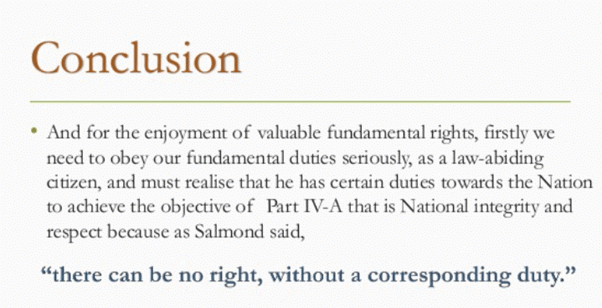
Rights and duties have to exist together. Rights without duties will lead to anarchy. In this context, the Fundamental Duties serve as a constant reminder of national goals as well as inculcate a profound sense of social responsibility.
Conclusion
- A constitutional expert, BR Ambedkar had studied the constitutions of about 60 countries.
- The text prepared by him provided constitutional guarantees and a wide range of civil liberties for citizens including freedom of religion, the abolition of untouchability, and the outlawing of all forms of discrimination.
- Recently, the Prime Minister of India has rightly said that our children should be taught the Constitution.
- Incorporating the essential aspects of fundamental duties in all oaths and pledges.
- The Supreme Court has said that since duties are obligatory for citizens, the state should strive to achieve the same goal.
- Rights and duties have to exist together. Rights without duties will lead to anarchy.
- In this context, the Fundamental Duties serve as a constant reminder of national goals as well as inculcate a profound sense of social responsibility.
|
162 videos|999 docs|260 tests
|
FAQs on Overview: Fundamental Duties - Indian Polity for UPSC CSE
| 1. What are fundamental duties in India? |  |
| 2. Are fundamental duties legally enforceable in India? | |
| 3. What are some examples of fundamental duties in India? | |
| 4. Do fundamental duties apply only to citizens or to everyone in India? | |
| 5. Can fundamental duties be amended or modified in the future? | |




Semester Notes
,MCQs
,shortcuts and tricks
,ppt
,Sample Paper
,video lectures
,Important questions
,Overview: Fundamental Duties | Indian Polity for UPSC CSE
,Overview: Fundamental Duties | Indian Polity for UPSC CSE
,Overview: Fundamental Duties | Indian Polity for UPSC CSE
,Previous Year Questions with Solutions
,past year papers
,Exam
,practice quizzes
,mock tests for examination
,Free
,Summary
,study material
,Objective type Questions
,Viva Questions
,Extra Questions
;



Overview: Fundamental Duties Free PDF Download
Importance of Overview: Fundamental Duties
Overview: Fundamental Duties Notes
Overview: Fundamental Duties UPSC Questions
Study Overview: Fundamental Duties on the App
|
© EduRev
|
Education Revolution
|


|




within 7 days!