Parliament of India - Structure, Functions, and Key Insights | Indian Polity for UPSC CSE PDF Download

Parliament of India
The Parliament of India (Sansad) is the legislative branch of the Union Government and serves as the country's supreme legislative body.
- It is established under the Constitution of India and plays a central role in the nation’s democratic governance.
- The Parliament holds the authority to enact laws, scrutinize government actions, and acts as a symbol of India’s democratic ethos.
- Through its constitutional powers, it contributes significantly to policy-making and ensuring accountability in governance.
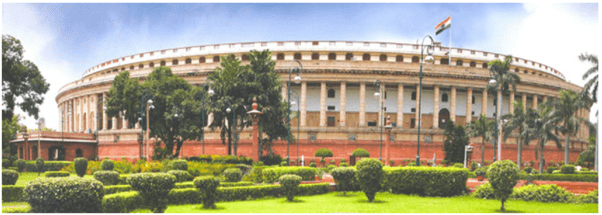 The Parliament
- It is a bicameral legislature composed of the President of India and the two houses: the Rajya Sabha (Council of States) and the Lok Sabha (House of the People).
- The President of India, as the head of the legislature, has the authority to summon, prorogue, or dissolve the Lok Sabha, but these powers are exercised on the advice of the Prime Minister and the Union Council of Ministers.
- Members of Parliament (MPs) in Lok Sabha are directly elected by the public through single-member constituencies, while those in Rajya Sabha are elected by State Legislative Assemblies using proportional representation.
- The Sansad Bhavan (Parliament House), designed by Edwin Lutyens and Herbert Baker, was inaugurated on 18 January 1927 by Lord Irwin, the then Viceroy of India.
- Recently, a new Parliament building was constructed as part of the Central Vista Redevelopment Project, aiming to modernize facilities while preserving the legacy of Indian democracy.
- The Constituent Assembly of India, tasked with drafting the Constitution of India, was established following independence from British rule in 1947.
- The Parliament not only enacts laws and ensures government accountability but also stands as a symbol of India's vibrant democracy and commitment to good governance.
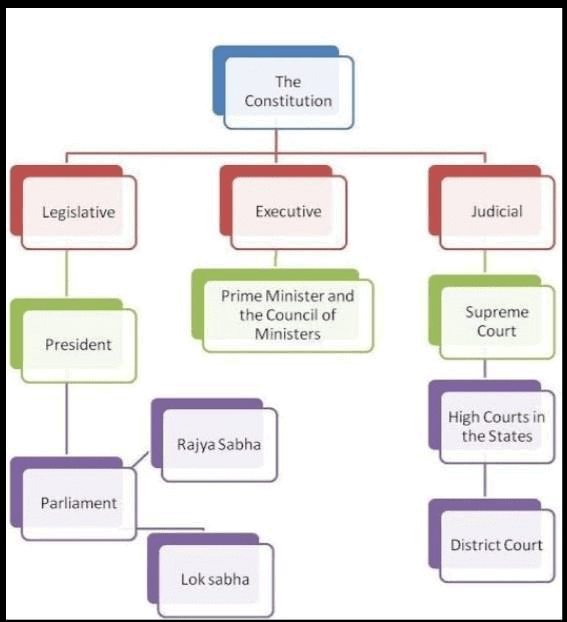 Constitution Flow Chart
Constitutional Provisions Related to Parliament of India
- Articles 79 to 122 in Part V of the Indian Constitution govern the structure and functioning of the Parliament of India.
- These provisions encompass the organization, composition, duration, officers, procedures, privileges, and powers of Parliament.
- They establish the constitutional framework for the legislative branch's effective operation and governance.
Structure of Parliament of India
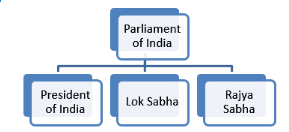 Components of Parliament
President of India
The President of India is the Head of the State and exercises powers as defined in the Constitution of India.
- The President of India, the head of state, is a component of Parliament. Under Article 60 and Article 111, the President’s responsibility is to ensure that laws passed by the Parliament are in accordance with the constitutional mandate and that the stipulated procedure is followed before according to his/her approval to the bills.
- The President of India is elected for a period of 5 years and is elected by the Members of Parliament and state legislatures.

Lok Sabha
The Lok Sabha, or House of the People, is the lower house of India's bicameral Parliament, with the upper house being the Rajya Sabha.
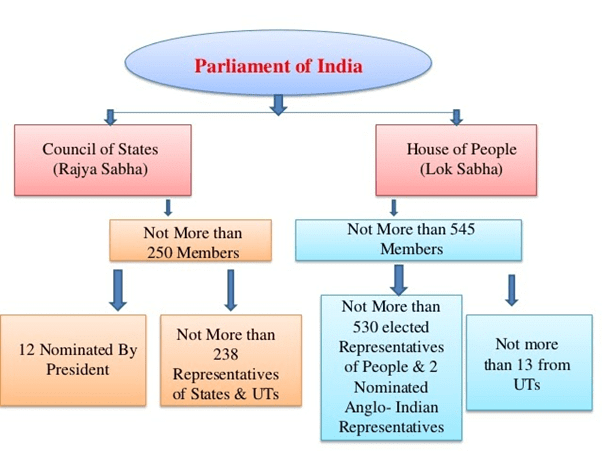
- Lok Sabha (House of the People) or the lower house has 543 members. 543 members are directly elected by citizens of India on the basis of their work and the region from which they are standing.
- Every citizen of India who is over 18 years of age, irrespective of gender, caste, religion, or race and is otherwise not disqualified, is eligible to vote for the Lok Sabha.
- The Constitution allows the Lok Sabha to have a maximum strength of 552 members. They have a term of five years.
- To be eligible for membership in the Lok Sabha, a person must be a citizen of India and must be 25 years of age or older, mentally sound, should not be bankrupt, and should not be criminally convicted.
Rajya Sabha
The Rajya Sabha or Council of States is the upper house of the bicameral Parliament of India.
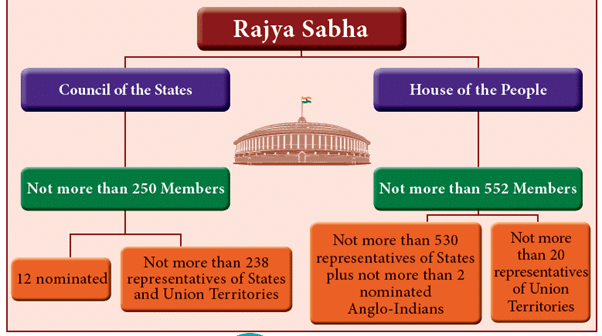 Details of Rajya Sabha
- Rajya Sabha (Council of States) or the upper house is a permanent body not subject to dissolution.
- One-third of the members retire every second year and are replaced by newly elected members. Each member is elected for a term of six years.
- Its members are indirectly elected by members of the legislative bodies of the states.
- The Rajya Sabha can have a maximum of 250 members. It has an allowed strength of 245 members, of which 233 are elected from States and Union Territories and 12 are nominated by the President of India.
- The number of members that can be elected from a state depends on the population of that very state.
- The minimum age for a person to become a member of Rajya Sabha is 30 years.
Functions of Parliament
The functions of the Parliament are mentioned in the Indian Constitution in Chapter II of Part V. The functions of the Parliament can be classified under several heads. They are discussed below:
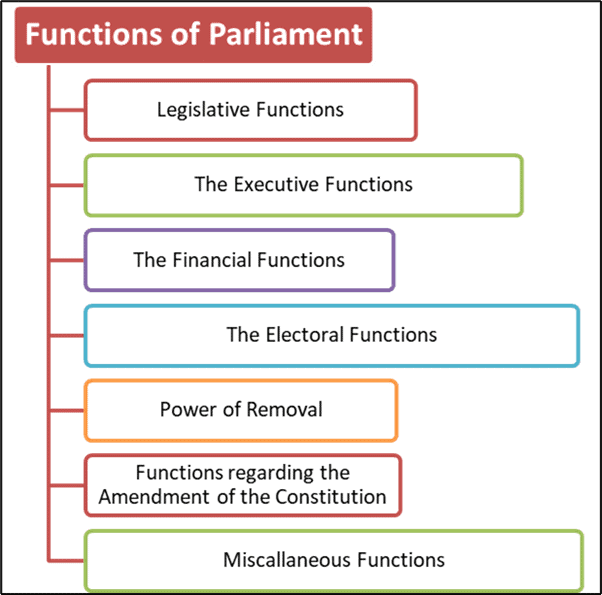
1. Legislative Functions
- The Parliament legislates on all matters mentioned in the Union List and the Concurrent List.
- In the case of the Concurrent List, where the state legislatures and the Parliament have joint jurisdiction, the union law will prevail over the states unless the state law had received the earlier presidential assent. However, the Parliament can any time, enact a law adding to, amending, varying or repealing a law made by a state legislature.
- The Parliament can also pass laws on items in the State List under the following circumstances:
(i) If an emergency is in operation, or any state is placed under President’s Rule (Article 356), the Parliament can enact laws on items in the State List as well.
(ii) As per Article 249, the Parliament can make laws on items in the State List if the Rajya Sabha passes a resolution by ⅔ majority of its members present and voting, that it is necessary for the Parliament to make laws on any item enumerated in the State List, in the national interest.
(iii) As per Article 253, it can pass laws on the State List items if it is required for the implementation of international agreements or treaties with foreign powers.
(iv) According to Article 252, if the legislatures of two or more states pass a resolution to the effect that it is desirable to have a parliamentary law on any item listed in the State List, the Parliament can make laws for those states.
2. Executive Functions (Control over the Executive)
In the parliamentary form of government, the executive is responsible to the legislature. Hence, the Parliament exercises control over the executive by several measures.
- By a vote of no-confidence, the Parliament can remove the Cabinet (executive) out of power. It can reject a budget proposal or any other bill brought by the Cabinet. A motion of no-confidence is passed to remove a government from office.
- The MPs (Members of Parliament) can ask questions to the ministers on their ommissions and commissions. Any lapses on the part of the government can be exposed in the Parliament.
- Adjournment Motion: Allowed only in the Lok Sabha, the chief objective of the adjournment motion is to draw the attention of the Parliament to any recent issue of urgent public interest. It is considered an extraordinary tool in Parliament as the normal business is affected.
- The Parliament appoints a Committee on Ministerial Assurances that sees whether the promises made by the ministers to the Parliament are fulfilled or not.
- Censure Motion: A censure motion is moved by the opposition party members in the House to strongly disapprove any policy of the government. It can be moved only in the Lok Sabha. Immediately after a censure motion is passed, the government has to seek the confidence of the House. Unlike in the case of the no-confidence motion, the Council of Ministers need not resign if the censure motion is passed.
- Cut Motion: A cut motion is used to oppose any demand in the financial bill brought by the government.Question for Parliament of India - Structure, Functions, and Key InsightsTry yourself:Which Article states that 'the Parliament can make laws on items in the State List if the Rajya Sabha passes a resolution by ⅔ majority of its members present and voting, that it is necessary for the Parliament to make laws on any item enumerated in the State List, in the national interest.View Solution
3. Financial Functions
Parliament is the ultimate authority when it comes to finances. The Executive cannot spend a single pie without parliamentary approval.
- The Union Budget prepared by the Cabinet is submitted for approval by the Parliament. All proposals to impose taxes should also be approved by the Parliament.
- There are two standing committees (Public Accounts Committee and Estimates Committee) of the Parliament to keep a check on how the executive spends the money granted to it by the legislature. You can also read on parliamentary committees.
4. Amending Powers
The Parliament has the power to amend the Constitution of India. Both Houses of Parliament have equal powers as far as amending the Constitution is concerned. Amendments will have to be passed in both the Lok Sabha and the Rajya Sabha for them to be effective.
 |
Download the notes
Parliament of India - Structure, Functions, and Key Insights
|
Download as PDF |
5. Electoral Functions
The Parliament takes part in the election of the President and the Vice President. The electoral college that elects the President comprises of, among others, the elected members of both Houses. The President can be removed by a resolution passed by the Rajya Sabha agreed to by the Lok Sabha.
6. Judicial Functions
In case of breach of privilege by members of the House, the Parliament has punitive powers to punish them. A breach of privilege is when there is an infringement of any of the privileges enjoyed by the MPs.
- A privilege motion is moved by a member when he feels that a minister or any member has committed a breach of privilege of the House or one or more of its members by withholding facts of a case or by giving wrong or distorted facts. Read more on privilege motion.
- In the parliamentary system, legislative privileges are immune to judicial control.
- The power of the Parliament to punish its members is also generally not subject to judicial review.
- Other judicial functions of the Parliament include the power to impeach the President, the Vice President, the judges of the Supreme Court, High Courts, Auditor-General, etc.
7. Other powers/functions of the Parliament
- Issues of national and international importance are discussed in the Parliament. The opposition plays an important role in this regard and ensures that the country is aware of alternate viewpoints.
- A Parliament is sometimes talked of as a ‘nation in miniature’.
- In a democracy, the Parliament plays the vital function of deliberating matters of importance before laws or resolutions are passed.
- The Parliament has the power to alter, decrease or increase the boundaries of states/UTs.
- The Parliament also functions as an organ of information. The ministers are bound to provide information in the Houses when demanded by the members.
 |
Take a Practice Test
Test yourself on topics from UPSC exam
|
Practice Now |
Sessions of Parliament of India
Session of Parliament of India is the period during which the parliament assembles to conduct its business.
- The President has the power to summon each house at certain intervals and there should not be a more than 6 months gap in between the assembly.
- Parliament should meet at least twice a year. Usually, parliament conducts 3 sessions in a year.
- Budget session: February to May
- Monsoon session: July to September
- Winter session: November to December
Challenges Faced by the Parliament of India
- Frequent Disruptions: Repeated interruptions and reduced parliamentary sittings limit the time available for meaningful debates on critical legislation.
- Corruption and Money Power: The influence of money in politics and allegations of corruption weaken the integrity of parliamentary proceedings.
- Criminalization of Politics: The presence of individuals with criminal records in politics poses a significant challenge to democratic values.
- Lack of Internal Party Democracy: Limited internal democracy within political parties affects transparency and accountability in decision-making.
- Inadequate Representation of Women: The underrepresentation of women in Parliament hinders diversity and inclusivity.
- Need for Procedural Reforms: Outdated parliamentary procedures require reforms to improve efficiency and effectiveness.
Few Interesting Facts on Parliament of India
- Dr. Neelam Sanjeeva Reddy holds a unique distinction, he was the Chief Minister of Andhra Pradesh, Lok Sabha speaker & President of India.
- Present Speaker of the Lok Sabha – Om Birla.
- G. V. Malvankar was the first speaker for Lok Sabha (15 May 1952 – 27 Feb 1956)
- No. Of MPs in seventeenth Lok Sabha (2019 -2024) – 543.
- The First session of the First Lok Sabha commenced on 13 May 1952.
- Santosh Kumar Gangwar & Maneka Sanjay Gandhi are the longest-serving members of the seventeenth Lok Sabha.
- The Zero Hour is an Indian parliamentary innovation, introduced in 1962, to raise pressing matters without prior notice.
|
144 videos|635 docs|203 tests
|
FAQs on Parliament of India - Structure, Functions, and Key Insights - Indian Polity for UPSC CSE
| 1. What are the constitutional provisions related to the Parliament of India? |  |
| 2. What is the structure of the Parliament of India? | |
| 3. What are the main functions of the Parliament of India? | |
| 4. How many sessions does the Parliament of India hold in a year? | |
| 5. What are some challenges faced by the Parliament of India? | |




and Key Insights | Indian Polity for UPSC CSE
,Previous Year Questions with Solutions
,Functions
,video lectures
,study material
,Extra Questions
,past year papers
,Objective type Questions
,Sample Paper
,and Key Insights | Indian Polity for UPSC CSE
,Functions
,mock tests for examination
,Viva Questions
,Free
,ppt
,shortcuts and tricks
,Parliament of India - Structure
,Important questions
,and Key Insights | Indian Polity for UPSC CSE
,practice quizzes
,Exam
,Semester Notes
,Functions
,MCQs
,Summary
,Parliament of India - Structure
,Parliament of India - Structure
;



Parliament of India - Structure, Functions, and Key Insights Free PDF Download
Importance of Parliament of India - Structure, Functions, and Key Insights
Parliament of India - Structure, Functions, and Key Insights Notes
Parliament of India - Structure, Functions, and Key Insights UPSC Questions
Study Parliament of India - Structure, Functions, and Key Insights on the App
|
© EduRev
|
Education Revolution
|


|




