

Best Study Material for UPSC Exam
UPSC Exam > UPSC Notes > UPSC Mains: International Relations > India and Bhutan Relations
India and Bhutan Relations | UPSC Mains: International Relations PDF Download
Indo-Bhutan relations
Prime Minister’s two day visit to Thimphu affirmed a long-standing tradition between India and Bhutan.
Issue
Context
Prime Minister’s two day visit to Thimphu affirmed a long-standing tradition between India and Bhutan.
Background
- Bhutan was a protectorate of British India and came under the British suzerainty in 1865. It signed the ‘Treaty of Punakha’ with the British in 1910, which set the stage for any future contact between the two countries after the British left the subcontinent.
- India’s relations with Bhutan were handled by a Political Officer based in Sikkim. This continued until 1948, when a Bhutanese delegation visited India and wished to revise the treaties previously signed with the British
- After India’s independence in 1947, standstill agreements with Sikkim, Nepal and Tibet were signed to continue existing relations until new agreements were made. For Bhutan, its status became clearer following Nehru's invitation for a Bhutanese delegation to participate in the Asian Regional Conference in 1947.
- Diplomatic relations between India and Bhutan were established in 1968 with the establishment of a special office of India in Thimphu.
- Sharing a 699 Kilometers border, India and Bhutan shares a deep religion-cultural links. Guru Padmasambhava, a Buddhist saint also played an influential role in spreading Buddhism and deepening traditional ties between people in both nations.
- The basic framework of India- Bhutan bilateral relations was the Treaty of Friendship and Cooperation signed in 1949 between the two countries.
- The Golden Jubilee of the establishment of formal diplomatic relations between India and Bhutan was been celebrated in the year 2018.
- India and Bhutan share traditionally warm and friendly relationship which is relatively trouble free when compared with other South Asian
- The two countries have always shared a unique and organic relationship which is often termed as a ‘sacred bond’, largely sustained by regular high level visits and dialogues between the neighbors.
- Bhutan has been central to India’s two major policies – the ‘Neighborhood First Policy’ and the ‘Act-East Policy’.
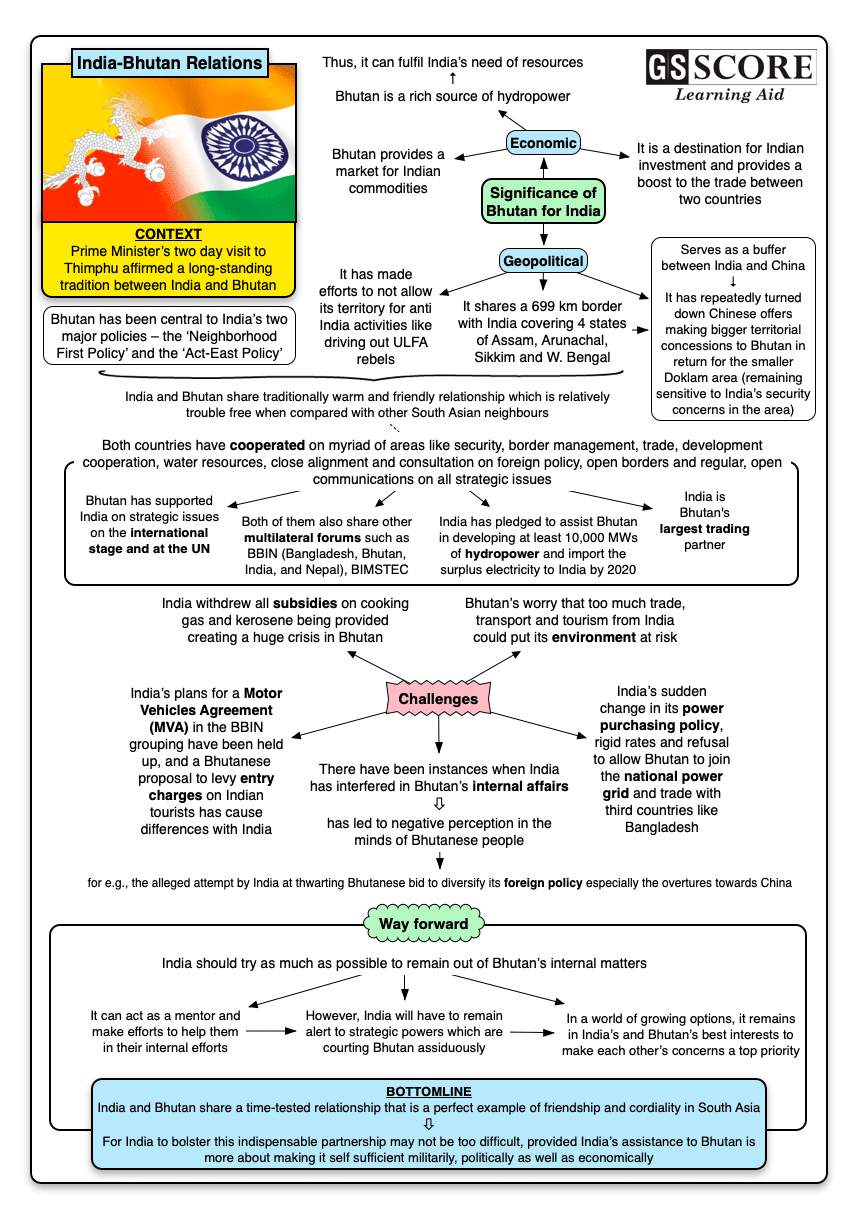
Bhutan’s Significance to India
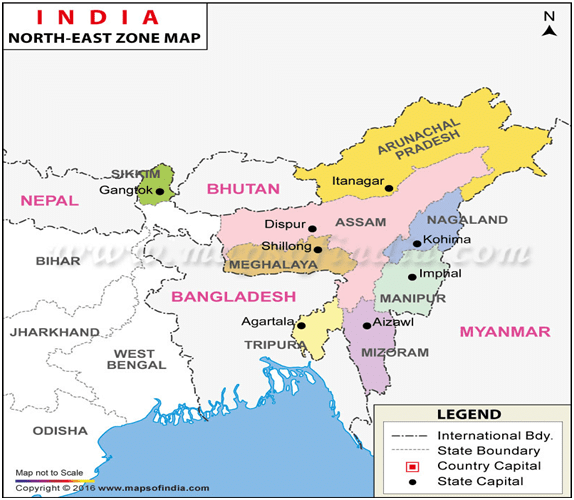
- Bhutan shares border with four Indian States: Assam, Arunachal Pradesh, West Bengal and Sikkim.
- Bhutan serves as a buffer between India and China.
- Bhutan provides a market for Indian commodities and is a destination for Indian investment along with providing boost to the trade between two countries.
- Bhutan is a rich source of hydropower. Thus, can fulfill India’s need of resources.
- Politically stable Bhutan is very important to India, as unstable situations in Bhutan can provide a safe haven to anti-India activities and anti-India militant groups.
- Bhutan has never played the China card against India unlike Nepal which always threatens for the same.
- Bhutan has repeatedly turned down Chinese ‘package deal’ offers making bigger territorial concessions to Bhutan in return for the smaller Doklam area (remaining sensitive to India’s security concerns in the area).
- Bhutan’s effort to drive out ULFA rebels was of a great significance.
- Bhutan’s Happiness index which is adopted by India (Madhya Pradesh) also is a great initiative learnt from Bhutanese.
Areas of Cooperation
- There are a number of institutional mechanisms between India and Bhutan in areas such as security, border management, trade, transit, economic, hydro-power, development cooperation, water resources.
- There have been regular exchanges at the Ministerial and officials’ level, exchanges of parliamentarian delegations to strengthen partnership in diverse areas of cooperation.
- India has pledged to assist Bhutan in developing at least 10,000 MWs of hydropower and import the surplus electricity to India by 2020.
- Inauguration of the 720 MW Mangdechhu hydropower plant which is of great significance for both the countries.
- Open borders, close alignment and consultation on foreign policy, and regular, open communications on all strategic issues are the hallmark of the relationship that has maintained its consistency for the past many decades.
- Bhutan’s unequivocal support to India on strategic issues has meant a lot to India on the international stage and at the United Nations.
- India is Bhutan's largest trading partner. Major exports from India to Bhutan are mineral products, machinery and mechanical appliances, electrical equipments etc. whereas major items of import from Bhutan are electricity, ferrosilicon, Portland cement etc.
- Both of them also share other multilateral forums such as BBIN (Bangladesh, Bhutan, India, and Nepal), BIMSTEC.
- There is a Joint Group of Experts (JGE) on flood management between India and Bhutan to discuss the probable causes and effects of the recurring floods and erosion in the southern foothills of Bhutan and adjoining plains in India.
- Prestigious Nehru-Wangchuk Scholarship is being awarded to deserving and talented Bhutanese nationals to undertake studies in selected and premier Indian educational Institutions.
 |
Download the notes
India and Bhutan Relations
|
Download as PDF |
Download as PDF
Challenges in the relation
- There have been instances when India has interfered in Bhutan’s internal affairs. This has led to negative perception of India in the minds of Bhutanese people.
- Ties came under a strain over India’s sudden change in its power purchasing policy, rigid rates and refusal to allow Bhutan to join the national power grid and trade with third countries like Bangladesh.
- Bhutan’s worry that too much trade, transport and tourism from India could put its environment at risk.
- India’s plans for a Motor Vehicles Agreement (MVA) in the Bangladesh-Bhutan-India-Nepal grouping have been held up, and a Bhutanese proposal to levy entry charges on Indian tourists has cause differences with India.
- Earlier generations of Bhutanese students never looked beyond India, but in recent years young Bhutanese have shown a preference for education destinations in Australia, Singapore and Thailand.
- India withdrew all subsidies on cooking gas and kerosene being provided to Bhutan creating a huge crisis in Bhutan that strained the bilateral ties.
- The crisis in Indo-Bhutan relations exploded apparently, over alleged attempt by India at thwarting Bhutanese bid to diversify its foreign policy especially the overtures towards
 |
Take a Practice Test
Test yourself on topics from UPSC exam
|
Practice Now |
Practice Now
Way forward
- India and Bhutan share a time-tested relationship that is a perfect example of friendship and cordiality in South Asia. For India to bolster this indispensable partnership may not be too difficult, provided India’s assistance to Bhutan is more about making it self sufficient militarily, politically as well as economically.
- With India’s help, Bhutan can become economically competitive, militarily advanced and self reliant in matters of national security.
- Furthermore, as world’s largest democracy, India can guide Bhutan in developing requisite democratic infrastructure and a political establishment that can sustain the demands of a democratic society.
- India should try as much as possible to remain out of Bhutan’s internal matters; it can act as a mentor and make efforts to help them in their internal efforts.
- Bhutan however, until recently as per the treaty obligation of 2007 followed the Indian direction, kept India’s interest in mind and evaded a settlement with China.
- Bhutan does not rely on powers outside the region for the maintenance of a strategic order in the South Asian region; India should always harness the potential.
- India will have to remain alert to strategic powers which are courting Bhutan assiduously, as is evident from the high-level visits from China and the U.S. In a world of growing options, it remains in India’s and Bhutan’s best interests to make each other’s concerns a top priority.
The document India and Bhutan Relations | UPSC Mains: International Relations is a part of the UPSC Course UPSC Mains: International Relations.
All you need of UPSC at this link: UPSC
|
88 videos|126 docs
|



FAQs on India and Bhutan Relations - UPSC Mains: International Relations
| 1. What is the current status of Indo-Bhutan relations? |  |
| 2. What are the key areas of cooperation between India and Bhutan? | |
Ans. India and Bhutan cooperate in various sectors such as hydropower, trade, education, health, and security. The two countries have a significant partnership in the development of hydropower projects, which is a major source of revenue and energy for Bhutan.
| 3. How does India support Bhutan's development? | |
Ans. India has been a key development partner for Bhutan, providing financial and technical assistance for various developmental projects. India has supported Bhutan in infrastructure development, capacity building, and social welfare programs.
| 4. What is the significance of the Indo-Bhutan friendship treaty? | |
Ans. The Indo-Bhutan friendship treaty, signed in 2007, further strengthened the bilateral relations between the two countries. It ensures close cooperation in matters of mutual interest, and the treaty also reflects India's commitment to Bhutan's security and sovereignty.
| 5. How do India and Bhutan collaborate on environmental conservation? | |
Ans. India and Bhutan have a strong collaboration in environmental conservation. They work together to protect and preserve the biodiversity of the Eastern Himalayas, including the conservation of endangered species and the management of protected areas.
Related Exams
About this Document

1.2K Views

4.79/5
Rating

Mar 29, 2025
Last updated
Document Description: India and Bhutan Relations for UPSC 2025 is part of UPSC Mains: International Relations preparation.
The notes and questions for India and Bhutan Relations have been prepared according to the UPSC exam syllabus. Information about India and Bhutan Relations covers topics
like Indo-Bhutan relations, Issue and India and Bhutan Relations Example, for UPSC 2025 Exam. Find important definitions, questions, notes, meanings, examples, exercises and tests below for India and Bhutan Relations.
Introduction of India and Bhutan Relations in English is available as part of our UPSC Mains: International Relations
for UPSC & India and Bhutan Relations in Hindi for UPSC Mains: International Relations course.
Download more important topics related with notes, lectures and mock test series for UPSC
Exam by signing up for free. UPSC: India and Bhutan Relations | UPSC Mains: International Relations
Description
Full syllabus notes, lecture & questions for India and Bhutan Relations | UPSC Mains: International Relations - UPSC | Plus excerises question with solution to help you revise complete syllabus for UPSC Mains: International Relations | Best notes, free PDF download
Information about India and Bhutan Relations
In this doc you can find the meaning of India and Bhutan Relations defined & explained in the simplest way possible. Besides explaining types of
India and Bhutan Relations theory, EduRev gives you an ample number of questions to practice India and Bhutan Relations tests, examples and also practice UPSC
tests
Related Searches
India and Bhutan Relations | UPSC Mains: International Relations
,Extra Questions
,Exam
,mock tests for examination
,ppt
,Summary
,Previous Year Questions with Solutions
,MCQs
,Objective type Questions
,India and Bhutan Relations | UPSC Mains: International Relations
,Sample Paper
,past year papers
,video lectures
,study material
,Semester Notes
,Important questions
,Free
,practice quizzes
,India and Bhutan Relations | UPSC Mains: International Relations
,shortcuts and tricks
,Viva Questions
,




Additional Information about India and Bhutan Relations for UPSC Preparation
India and Bhutan Relations Free PDF Download
The India and Bhutan Relations is an invaluable resource that delves deep into the core of the UPSC exam.
These study notes are curated by experts and cover all the essential topics and concepts, making your preparation more efficient and effective.
With the help of these notes, you can grasp complex subjects quickly, revise important points easily,
and reinforce your understanding of key concepts. The study notes are presented in a concise and easy-to-understand manner,
allowing you to optimize your learning process. Whether you're looking for best-recommended books, sample papers, study material,
or toppers' notes, this PDF has got you covered. Download the India and Bhutan Relations now and kickstart your journey towards success in the UPSC exam.
Importance of India and Bhutan Relations
The importance of India and Bhutan Relations cannot be overstated, especially for UPSC aspirants.
This document holds the key to success in the UPSC exam.
It offers a detailed understanding of the concept, providing invaluable insights into the topic.
By knowing the concepts well in advance, students can plan their preparation effectively.
Utilize this indispensable guide for a well-rounded preparation and achieve your desired results.
India and Bhutan Relations Notes
India and Bhutan Relations Notes offer in-depth insights into the specific topic to help you master it with ease.
This comprehensive document covers all aspects related to India and Bhutan Relations.
It includes detailed information about the exam syllabus, recommended books, and study materials for a well-rounded preparation.
Practice papers and question papers enable you to assess your progress effectively.
Additionally, the paper analysis provides valuable tips for tackling the exam strategically.
Access to Toppers' notes gives you an edge in understanding complex concepts.
Whether you're a beginner or aiming for advanced proficiency, India and Bhutan Relations Notes on EduRev are your ultimate resource for success.
India and Bhutan Relations UPSC Questions
The "India and Bhutan Relations UPSC Questions" guide is a valuable resource for all aspiring students preparing for the
UPSC exam. It focuses on providing a wide range of practice questions to help students gauge
their understanding of the exam topics. These questions cover the entire syllabus, ensuring comprehensive preparation.
The guide includes previous years' question papers for students to familiarize themselves with the exam's format and difficulty level.
Additionally, it offers subject-specific question banks, allowing students to focus on weak areas and improve their performance.
Study India and Bhutan Relations on the App
Students of UPSC can study India and Bhutan Relations alongwith tests & analysis from the EduRev app,
which will help them while preparing for their exam. Apart from the India and Bhutan Relations,
students can also utilize the EduRev App for other study materials such as previous year question papers, syllabus, important questions, etc.
The EduRev App will make your learning easier as you can access it from anywhere you want.
The content of India and Bhutan Relations is prepared as per the latest UPSC syllabus.
|
© EduRev
|
Education Revolution
|


|








Signup to see your scores
go up within 7 days!
Access 1000+ FREE Docs, Videos and Tests
Takes less than 10 seconds to signup